- Phân tích
- Tin tức và các công cụ
- Tin tức thị trường
- Australian Dollar holds gains despite softer Consumer Inflation Expectations
Australian Dollar holds gains despite softer Consumer Inflation Expectations
- The Australian Dollar strengthens as the US Dollar struggles amid persistent tariff uncertainty and recession fears.
- Australia’s Consumer Inflation Expectations dropped to 3.6% in March, down from 4.6% in February.
- The latest US Consumer Price Index report showed that headline and core inflation cooled faster than anticipated in February.
The Australian Dollar (AUD) continues to strengthen against the US Dollar (USD) for the third consecutive session, despite weaker Consumer Inflation Expectations data released on Thursday. Consumer expectations of future inflation during the next 12 months fell to 3.6% in March, down from 4.6% in February—the highest level since April 2024.
The AUD/USD pair rises as the US Dollar faces headwinds amid ongoing tariff uncertainty from US President Donald Trump and growing concerns over a potential US recession. However, the pair’s gains may be capped after Trump ruled out exempting Australia from his 25% tariffs on aluminum and steel, key exports valued at nearly $1 billion.
Prime Minister Anthony Albanese affirmed on Wednesday that “Australia will not impose reciprocal tariffs on the US,” emphasizing that retaliatory measures would only increase costs for Australian consumers and drive inflation higher.
Investors remain focused on the Reserve Bank of Australia’s (RBA) policy outlook, particularly after last week’s robust economic data lowered expectations of further rate cuts. Economic growth exceeded forecasts, marking its first acceleration in over a year.
Australian Dollar appreciates as US Dollar struggles amid recession concerns
- The US Dollar Index (DXY), which tracks the US Dollar against six major currencies, is remaining steady around 103.50 at the time of writing. However, the DXY strengthened as traders digested the latest US Consumer Price Index (CPI) data, which showed both headline and core inflation cooling faster than expected in February. The softer inflation report fueled speculation that the US Federal Reserve (Fed) could cut interest rates sooner than anticipated.
- US monthly headline inflation slowed to 0.2% in February, down from 0.5% in January, while core inflation eased to 0.2%, below the expected 0.3%. On an annual basis, headline inflation declined to 2.8% from 3.0%, while core inflation fell to 3.1% from 3.3%.
- President Trump reversed his decision to double tariffs on Canadian steel and aluminum to 50%, a move he announced late Tuesday. However, the White House confirmed to Reuters that new 25% tariffs on all imported steel and aluminum will still take effect on Wednesday, impacting allies and key US suppliers, including Canada and Mexico.
- Trump characterized the economy as being in a "transition period," hinting at a potential slowdown. Investors took his remarks as an early signal of possible economic turbulence in the near future.
- Last week, Fed Chair Jerome Powell reassured markets that the central bank sees no immediate need to adjust monetary policy despite rising uncertainties. San Francisco Fed President Mary Daly echoed this sentiment, noting that increasing business uncertainty could dampen demand but does not justify an interest rate change.
- RBA Deputy Governor Andrew Hauser highlighted that global trade uncertainty is at a 50-year high. Hauser warned that uncertainty stemming from US President Donald Trump's tariffs could prompt businesses and households to delay planning and investment, potentially weighing on economic growth.
- Bloomberg reported on Tuesday, citing sources familiar with the matter, that trade and other negotiations between the US and China remain at a deadlock. Chinese officials state that the US has not provided clear steps regarding fentanyl measures needed for tariff relief. Meanwhile, a source familiar with White House discussions indicated that no plans are currently underway for an in-person meeting between the two leaders.
- China announced on Saturday that it will impose a 100% tariff on Canadian rapeseed oil, oil cakes, and peas, along with a 25% levy on aquatic products and pork from Canada. The move comes in retaliation for tariffs introduced by Canada in October, escalating trade tensions. This marks a new front in a broader trade conflict driven by US President Donald Trump's tariff policies. The tariffs are set to take effect on March 20.
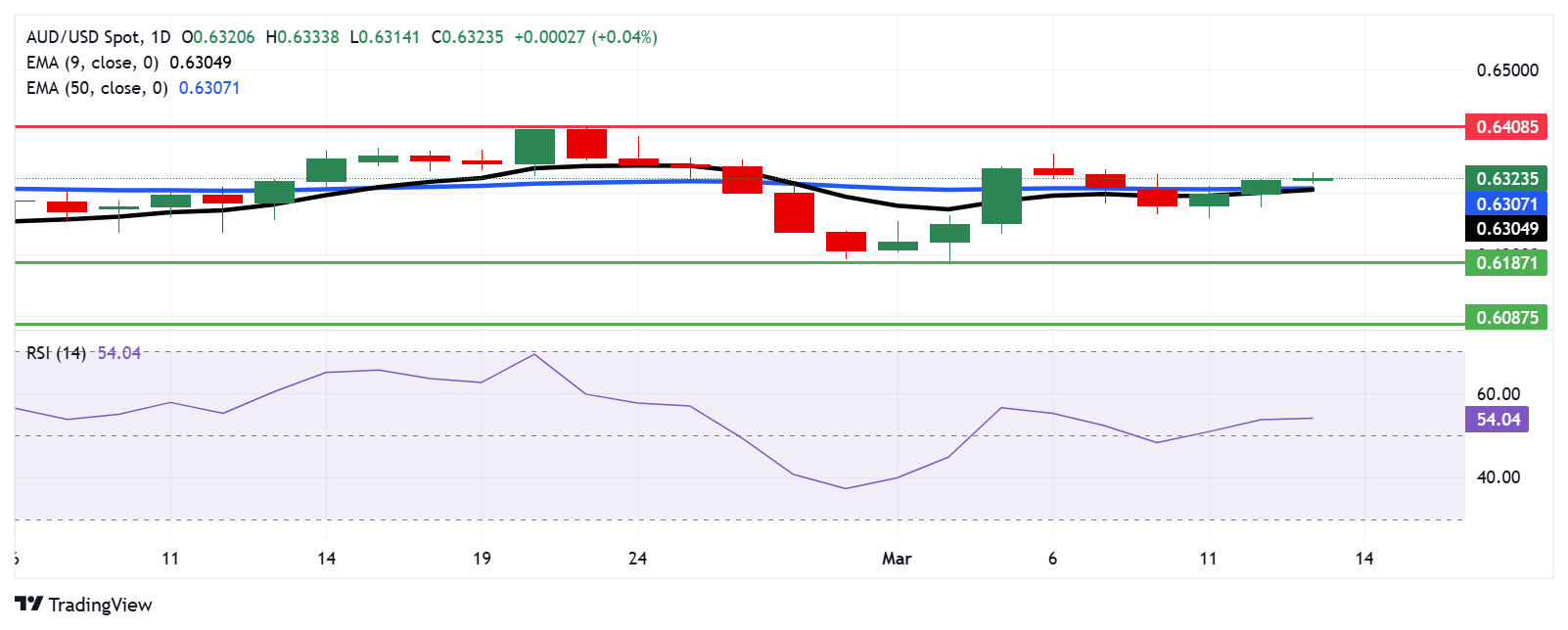
Australian Dollar maintains position above 50-day EMA near 0.6300
The AUD/USD pair is trading near 0.6320 on Thursday, with technical analysis of the daily chart showing the pair moving above the nine-day Exponential Moving Average (EMA), signaling strengthening short-term price momentum. Additionally, the 14-day Relative Strength Index (RSI) has moved slightly above 50, indicating a bullish bias.
On the upside, the AUD/USD pair could explore the area around the three-month high of 0.6408, last reached on February 21.
The AUD/USD pair could find immediate support at the 50-day EMA at 0.6307 level, aligned with the nine-day EMA at 0.6304 level. A break below this level could weaken the short-term price momentum and lead the pair to navigate the region around the five-week low of 0.6187, recorded on March 5.
AUD/USD: Daily Chart
Australian Dollar PRICE Today
The table below shows the percentage change of Australian Dollar (AUD) against listed major currencies today. Australian Dollar was the strongest against the Japanese Yen.
| USD | EUR | GBP | JPY | CAD | AUD | NZD | CHF | |
|---|---|---|---|---|---|---|---|---|
| USD | -0.01% | -0.02% | 0.01% | 0.03% | -0.02% | -0.10% | -0.09% | |
| EUR | 0.00% | -0.01% | 0.03% | 0.02% | -0.02% | -0.06% | -0.08% | |
| GBP | 0.02% | 0.00% | 0.02% | 0.03% | -0.01% | -0.06% | -0.04% | |
| JPY | -0.01% | -0.03% | -0.02% | 0.00% | -0.03% | -0.10% | -0.06% | |
| CAD | -0.03% | -0.02% | -0.03% | -0.00% | -0.03% | -0.10% | -0.08% | |
| AUD | 0.02% | 0.02% | 0.00% | 0.03% | 0.03% | -0.05% | -0.01% | |
| NZD | 0.10% | 0.06% | 0.06% | 0.10% | 0.10% | 0.05% | 0.05% | |
| CHF | 0.09% | 0.08% | 0.04% | 0.06% | 0.08% | 0.01% | -0.05% |
The heat map shows percentage changes of major currencies against each other. The base currency is picked from the left column, while the quote currency is picked from the top row. For example, if you pick the Australian Dollar from the left column and move along the horizontal line to the US Dollar, the percentage change displayed in the box will represent AUD (base)/USD (quote).
Economic Indicator
Consumer Inflation Expectations
The Consumer Inflation Expectation released by the Melbourne Institute presents the consumer expectations of future inflation during the next 12 months. The higher expectations, the stronger the effect they will have on a probability of a rate hike by the RBA. Therefore, a high reading should be taken as positive, or bullish, for the AUD, while a low expectations are seen as negative or bearish.
Read more.Last release: Thu Mar 13, 2025 00:00
Frequency: Monthly
Actual: 3.6%
Consensus: -
Previous: 4.6%
Source: University of Melbourne







© 2000-2026. Bản quyền Teletrade.
Trang web này được quản lý bởi Teletrade D.J. LLC 2351 LLC 2022 (Euro House, Richmond Hill Road, Kingstown, VC0100, St. Vincent and the Grenadines).
Thông tin trên trang web không phải là cơ sở để đưa ra quyết định đầu tư và chỉ được cung cấp cho mục đích làm quen.
Giao dịch trên thị trường tài chính (đặc biệt là giao dịch sử dụng các công cụ biên) mở ra những cơ hội lớn và tạo điều kiện cho các nhà đầu tư sẵn sàng mạo hiểm để thu lợi nhuận, tuy nhiên nó mang trong mình nguy cơ rủi ro khá cao. Chính vì vậy trước khi tiến hành giao dịch cần phải xem xét mọi mặt vấn đề chấp nhận tiến hành giao dịch cụ thể xét theo quan điểm của nguồn lực tài chính sẵn có và mức độ am hiểu thị trường tài chính.
Sử dụng thông tin: sử dụng toàn bộ hay riêng biệt các dữ liệu trên trang web của công ty TeleTrade như một nguồn cung cấp thông tin nhất định. Việc sử dụng tư liệu từ trang web cần kèm theo liên kết đến trang teletrade.vn. Việc tự động thu thập số liệu cũng như thông tin từ trang web TeleTrade đều không được phép.
Xin vui lòng liên hệ với pr@teletrade.global nếu có câu hỏi.


 Chuyển khoản
 ngân hàng


