- Phân tích
- Tin tức và các công cụ
- Tin tức thị trường
- Japanese Yen edges higher against USD, drags USD/JPY closer to 148.00 mark
Japanese Yen edges higher against USD, drags USD/JPY closer to 148.00 mark
- The Japanese Yen snaps a two-day losing streak against the USD and recovers further from the weekly low.
- Concerns about Trump’s trade tariffs and hawkish BoJ expectations continue to act as a tailwind for the JPY.
- Fed rate cut bets keep the USD close to a multi-month low and contribute to capping the upside for USD/JPY.
The Japanese Yen (JPY) edged higher against its American counterpart during the Asian session on Thursday and moves away from the weekly low touched the previous day. The chaotic implementation of US President Donald Trump's tariffs and their impact on the global economy might continue to drive demand for the safe-haven JPY. Moreover, rising bets that the Bank of Japan (BoJ) will continue raising interest rates amid broadening inflation in Japan lend support to the JPY.
Meanwhile, hawkish BoJ expectations remain supportive of the recent surge in the Japanese government bond (JGB) yields. The resultant narrowing of the rate differential between Japan and other countries further acts as a tailwind for the lower-yielding JPY. The US Dollar (USD), on the other hand, hangs near a multi-month low amid expectations that the Federal Reserve (Fed) will cut rates several times this year. This, in turn, contributes to capping the upside for the USD/JPY pair.
Japanese Yen draws support from rising trade tensions and BoJ rate hike bets
- US President Donald Trump's 25% tariff on all steel and aluminum imports took effect on Wednesday. Trump also threatened that he would respond to any countermeasures announced by the European Union and Canada.
- Trump repeated his warning to reveal "reciprocal" tariffs next month on countries around the world, fueling concerns about a further escalation of a trade war and lending support to the traditionally safe-haven Japanese Yen.
- Japanese firms agreed to significant wage hikes for the third straight year to help workers cope with inflation and address labour shortages. Higher wages are expected to boost consumer spending and contribute to rising inflation.
- This potential gives the Bank of Japan more room for additional interest rate hikes this year. This, in turn, keeps the yield on the 10-year Japanese government bond close to its highest levels since the 2008 Global Financial Crisis.
- Meanwhile, BOJ Governor Kazuo Ueda signaled that they have no immediate plans to intervene in the bond market, and said that it is natural for long-term rates to move in a way that reflects the market's outlook for the policy rate.
- Traders ramp up their bets that the Federal Reserve will have to lower interest rates this year by more than expected amid the rising possibility of an economic downturn on the back of the Trump administration’s aggressive policies.
- The expectations were reaffirmed by data released on Wednesday, which showed that the headline US Consumer Price Index (CPI) rose less than expected, by 2.8% on a yearly basis in February, down from 3% in the previous month.
- Additional details of the report revealed that the core CPI, which excludes volatile food and energy prices, eased from the 3.3% increase in January to the 3.1% YoY rate during the reported month. The reading was below the 3.2% anticipated.
- Traders now look forward to the release of the US Producer Price Index (PPI) for a fresh impetus later during the early North American session. The fundamental backdrop, however, seems tilted in favor of the USD/JPY bears.
USD/JPY could retest multi-month low once the 148.00 mark is broken decisively
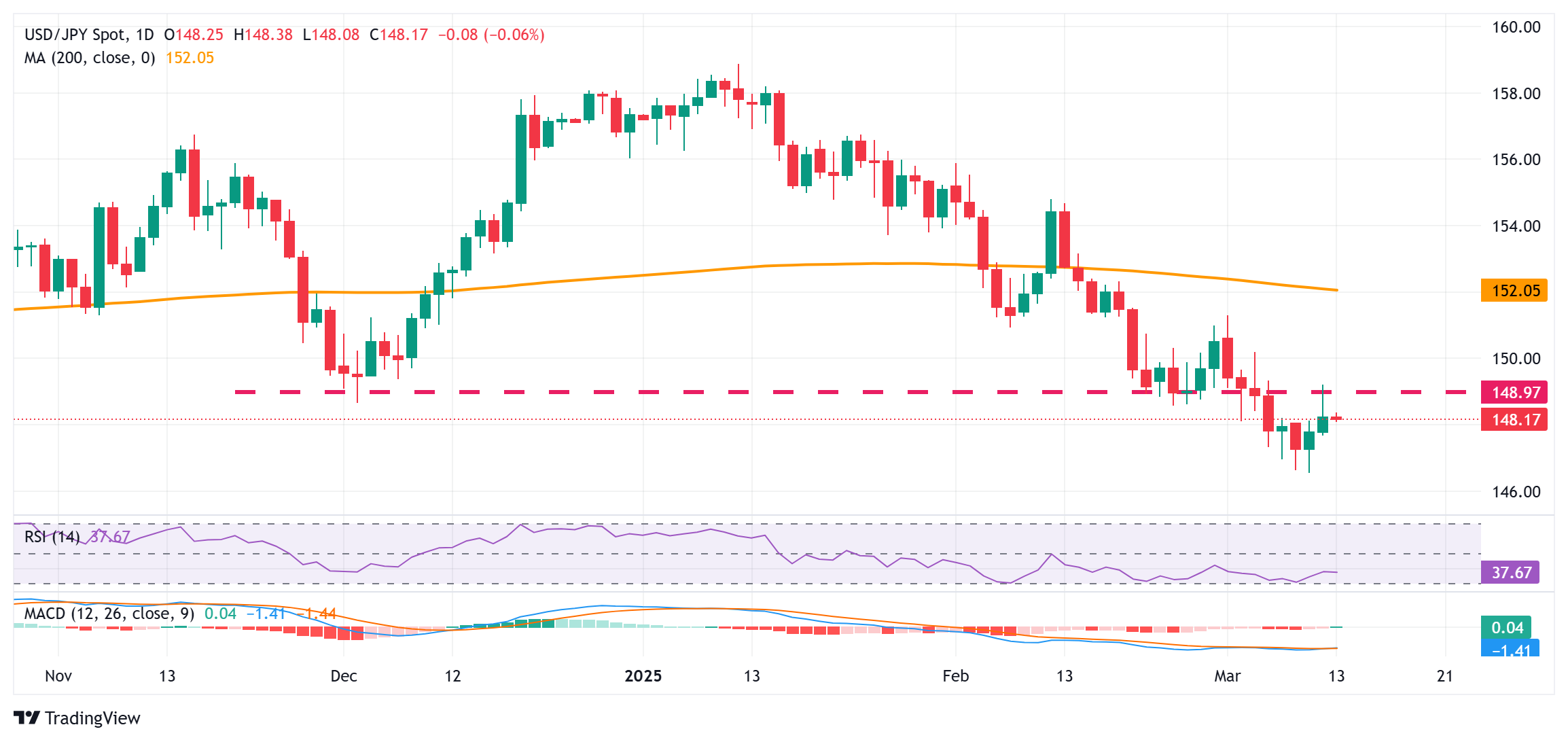
From a technical perspective, the overnight failure to find acceptance above the 149.00 round-figure mark and the subsequent pullback validate the negative outlook for the USD/JPY pair. Moreover, oscillators on the daily chart are holding deep in bearish territory and are still away from being in the oversold zone. This, in turn, suggests that the path of least resistance for spot prices remains to the downside. Hence, some follow-through selling below the 148.00 mark could expose the next relevant support near the 147.25-147.20 region before the pair slides further below the 147.00 mark, towards retesting the multi-month low, around the 146.55-146.50 area touched on Tuesday.
On the flip side, the 148.60-148.70 zone now seems to act as an immediate hurdle ahead of the 149.00 mark and the overnight swing high, around the 149.20 region. A sustained strength beyond the latter might prompt a short-covering rally and allow the USD/JPY pair to reclaim the 150.00 psychological mark. The momentum could extend further towards the 150.55-150.60 horizontal barrier en route to the 151.00 round figure and the monthly swing high, around the 151.30 area.
Japanese Yen FAQs
The Japanese Yen (JPY) is one of the world’s most traded currencies. Its value is broadly determined by the performance of the Japanese economy, but more specifically by the Bank of Japan’s policy, the differential between Japanese and US bond yields, or risk sentiment among traders, among other factors.
One of the Bank of Japan’s mandates is currency control, so its moves are key for the Yen. The BoJ has directly intervened in currency markets sometimes, generally to lower the value of the Yen, although it refrains from doing it often due to political concerns of its main trading partners. The BoJ ultra-loose monetary policy between 2013 and 2024 caused the Yen to depreciate against its main currency peers due to an increasing policy divergence between the Bank of Japan and other main central banks. More recently, the gradually unwinding of this ultra-loose policy has given some support to the Yen.
Over the last decade, the BoJ’s stance of sticking to ultra-loose monetary policy has led to a widening policy divergence with other central banks, particularly with the US Federal Reserve. This supported a widening of the differential between the 10-year US and Japanese bonds, which favored the US Dollar against the Japanese Yen. The BoJ decision in 2024 to gradually abandon the ultra-loose policy, coupled with interest-rate cuts in other major central banks, is narrowing this differential.
The Japanese Yen is often seen as a safe-haven investment. This means that in times of market stress, investors are more likely to put their money in the Japanese currency due to its supposed reliability and stability. Turbulent times are likely to strengthen the Yen’s value against other currencies seen as more risky to invest in.







© 2000-2026. Bản quyền Teletrade.
Trang web này được quản lý bởi Teletrade D.J. LLC 2351 LLC 2022 (Euro House, Richmond Hill Road, Kingstown, VC0100, St. Vincent and the Grenadines).
Thông tin trên trang web không phải là cơ sở để đưa ra quyết định đầu tư và chỉ được cung cấp cho mục đích làm quen.
Giao dịch trên thị trường tài chính (đặc biệt là giao dịch sử dụng các công cụ biên) mở ra những cơ hội lớn và tạo điều kiện cho các nhà đầu tư sẵn sàng mạo hiểm để thu lợi nhuận, tuy nhiên nó mang trong mình nguy cơ rủi ro khá cao. Chính vì vậy trước khi tiến hành giao dịch cần phải xem xét mọi mặt vấn đề chấp nhận tiến hành giao dịch cụ thể xét theo quan điểm của nguồn lực tài chính sẵn có và mức độ am hiểu thị trường tài chính.
Sử dụng thông tin: sử dụng toàn bộ hay riêng biệt các dữ liệu trên trang web của công ty TeleTrade như một nguồn cung cấp thông tin nhất định. Việc sử dụng tư liệu từ trang web cần kèm theo liên kết đến trang teletrade.vn. Việc tự động thu thập số liệu cũng như thông tin từ trang web TeleTrade đều không được phép.
Xin vui lòng liên hệ với pr@teletrade.global nếu có câu hỏi.


 Chuyển khoản
 ngân hàng


