- Phân tích
- Tin tức và các công cụ
- Tin tức thị trường
- US Dollar trades slightly lower ahead of final US data of the week
US Dollar trades slightly lower ahead of final US data of the week
- The US Dollar trades slightly lower on Friday after recovering initial weekly losses.
- The US Dollar has barely been affected by the geopolitical events this week.
- The US Dollar Index has been limited by the 104.00 hurdle and looks to be closing off the week in a negative tone.
The US Dollar Index (DXY), which tracks the performance of the US Dollar (USD) against six major currencies, sees volatility abate this week. The index, which has been limited below the 104.00 hurdle this week, hasn’t moved that much despite rumors of a possible ceasefire deal by Ukraine, the first steps in the German spending plan voting and retaliations from Canada and Europe on US tariffs.
On the economic data front, the final releases are expected later this Friday. The University of Michigan will publish its preliminary consumer sentiment reading for March and the 5-year inflation expectation.
Daily digest market movers: Calming down towards the weekend
- Gold as a safe haven asset has breached the $3,000 mark this Friday in a recession-feared-induced rally where traders are much concerned about economic growth and the tariffs outlook, with reciprocal levies coming into effect in April.
- A government shutdown looks to be avoided after Senate Minority Leader Chuck Schumer is said to back the House-passed funding measure.
- At 14:00 GMT, the University of Michigan will release its preliminary reading for March:
- The US Consumer Sentiment Index is expected to decline by 63.1, coming from 64.7.
- The US 5-year Consumer Inflation Expectation has no forecast and was at 3.5% in the final February reading.
- Equities are making another attempt to brush off the negative tone for this week. All indices are up over 0.50% across Europe and in the US.
- The CME Fedwatch Tool projects a 97.0% chance for no interest rate changes in the upcoming Fed meeting on March 19. The chances of a rate cut at the May 7 meeting stand at 32.8% and 78.5% at June’s meeting.
- The US 10-year yield trades around 4.329%, off its near five-month low of 4.10% printed on March 4 and after hitting a five-day high on Thursday.
US Dollar Index Technical Analysis: Does it make sense?
The US Dollar Index (DXY) shows bearish fatigue after its steep downward correction last week. Volatility in its price action completely eroded, and even the DXY stabilizes on Friday after recovering initial weekly losses. While tensions build-up ahead of reciprocal tariffs taking effect in April, it looks like the US Dollar Index might be on the verge of paring back some of the previous week’s losses when assessing the direction into next week.
Upside risk is a rejection at 104.00 that could result in more downturn. If bulls can avoid that, look for a large sprint higher towards the 105.00 round level, with the 200-day Simple Moving Average (SMA) at 105.02. Once broken through that zone, a string of pivotal levels, such as 105.53 and 105.89, will present as caps.
On the downside, the 103.00 round level could be considered a bearish target in case US yields roll off again, with even 101.90 not unthinkable if markets further capitulate on their long-term US Dollar holdings.
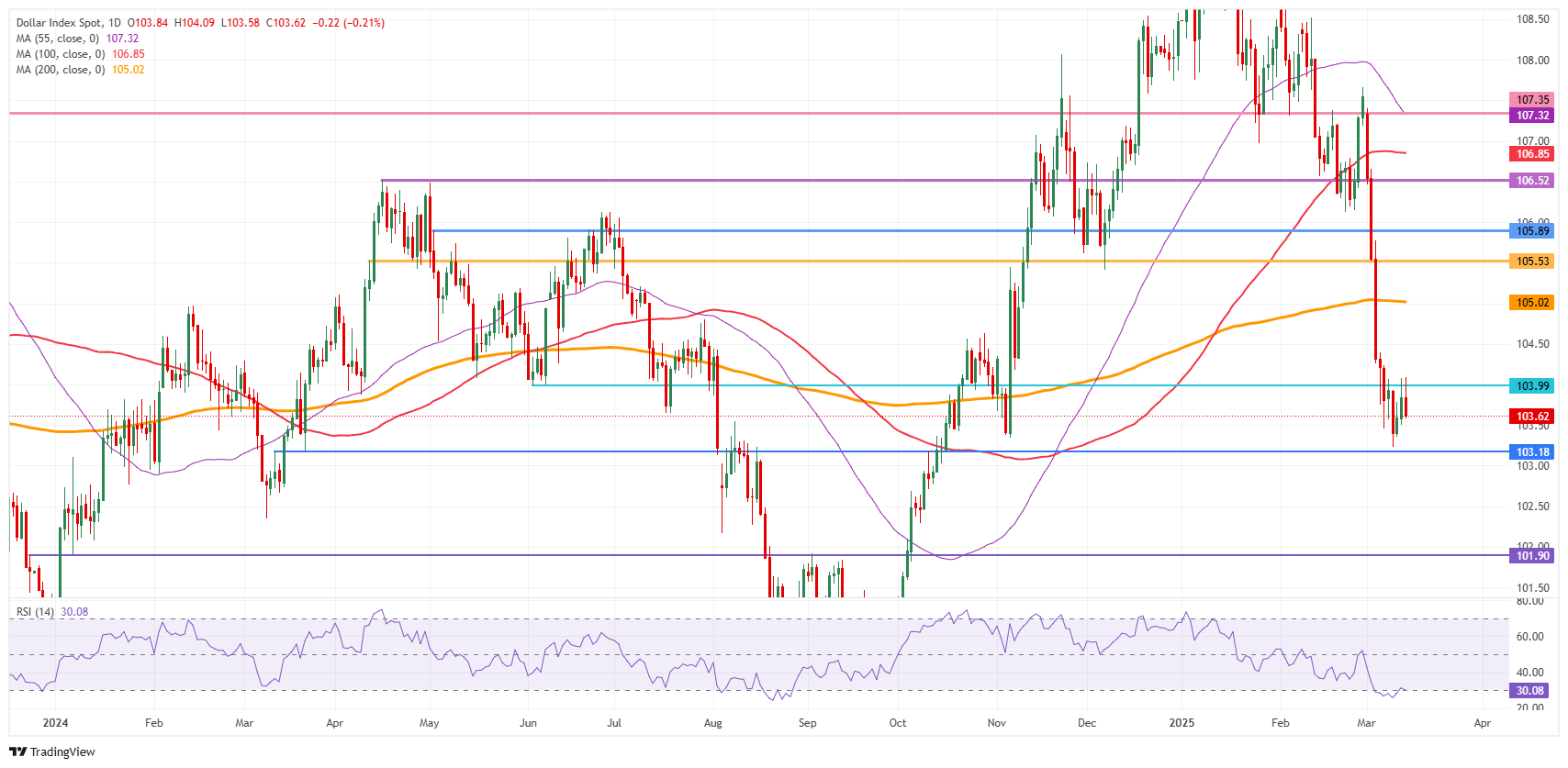
US Dollar Index: Daily Chart
US-China Trade War FAQs
Generally speaking, a trade war is an economic conflict between two or more countries due to extreme protectionism on one end. It implies the creation of trade barriers, such as tariffs, which result in counter-barriers, escalating import costs, and hence the cost of living.
An economic conflict between the United States (US) and China began early in 2018, when President Donald Trump set trade barriers on China, claiming unfair commercial practices and intellectual property theft from the Asian giant. China took retaliatory action, imposing tariffs on multiple US goods, such as automobiles and soybeans. Tensions escalated until the two countries signed the US-China Phase One trade deal in January 2020. The agreement required structural reforms and other changes to China’s economic and trade regime and pretended to restore stability and trust between the two nations. However, the Coronavirus pandemic took the focus out of the conflict. Yet, it is worth mentioning that President Joe Biden, who took office after Trump, kept tariffs in place and even added some additional levies.
The return of Donald Trump to the White House as the 47th US President has sparked a fresh wave of tensions between the two countries. During the 2024 election campaign, Trump pledged to impose 60% tariffs on China once he returned to office, which he did on January 20, 2025. With Trump back, the US-China trade war is meant to resume where it was left, with tit-for-tat policies affecting the global economic landscape amid disruptions in global supply chains, resulting in a reduction in spending, particularly investment, and directly feeding into the Consumer Price Index inflation.







© 2000-2026. Bản quyền Teletrade.
Trang web này được quản lý bởi Teletrade D.J. LLC 2351 LLC 2022 (Euro House, Richmond Hill Road, Kingstown, VC0100, St. Vincent and the Grenadines).
Thông tin trên trang web không phải là cơ sở để đưa ra quyết định đầu tư và chỉ được cung cấp cho mục đích làm quen.
Giao dịch trên thị trường tài chính (đặc biệt là giao dịch sử dụng các công cụ biên) mở ra những cơ hội lớn và tạo điều kiện cho các nhà đầu tư sẵn sàng mạo hiểm để thu lợi nhuận, tuy nhiên nó mang trong mình nguy cơ rủi ro khá cao. Chính vì vậy trước khi tiến hành giao dịch cần phải xem xét mọi mặt vấn đề chấp nhận tiến hành giao dịch cụ thể xét theo quan điểm của nguồn lực tài chính sẵn có và mức độ am hiểu thị trường tài chính.
Sử dụng thông tin: sử dụng toàn bộ hay riêng biệt các dữ liệu trên trang web của công ty TeleTrade như một nguồn cung cấp thông tin nhất định. Việc sử dụng tư liệu từ trang web cần kèm theo liên kết đến trang teletrade.vn. Việc tự động thu thập số liệu cũng như thông tin từ trang web TeleTrade đều không được phép.
Xin vui lòng liên hệ với pr@teletrade.global nếu có câu hỏi.


 Chuyển khoản
 ngân hàng


