- Phân tích
- Tin tức và các công cụ
- Tin tức thị trường
Tin tức thì trường

Major US stock indexes finished trading in the red on the back of a decline in bank shares, which presented their quarterly results.
A certain pressure on the indices also had disappointing data on the US. Preliminary results of the studies, submitted by Thomson-Reuters and the Michigan Institute, showed: the mood sensor among US consumers fell in April, more than the average expert predictions. According to the data, in April the consumer sentiment index fell to 97.8 points compared to the final reading for March at 101.4 points. According to average estimates, the index had to fall to the level of 100.5 points. In addition, the results of the research presented in the report showed that the current conditions index fell to 115.0 from 121.2, the expectations index fell to 86.8 from 88.8, the index of 12 months of inflation expectations was + 2.7% against +2 , 8%, while the index of 5-year inflation expectations worsened to + 2.4% against + 2.5% in March.
In addition, the Job Vacancy and Yield Survey (JOLTS) from the US Bureau of Labor Statistics showed that in February the number of vacancies fell to 6.052 million. Meanwhile, the figure for January was revised to 6.228 million from 6.312 million. Analysts had expected the number vacancies will decrease only to 6.173 million. The vacancy rate was 3.9 percent, decreasing by 0.1 percent compared to January. The number of vacancies declined in the private sector, and little has changed in the government segment. As for branches, the number of vacancies increased in the finance and insurance sector (+69,000) and in the state and municipal education segment (+31,000). The reduction was recorded in a number of industries, with the largest drop observed in the housing and food services sector (-91,000), the construction sector (-56,000) and the wholesale segment (-38,000). In addition, hiring amounted to 5.507 million against 5.574 million in January. The level of hiring fell by 0.1 percent, and amounted to 3.7 percent. The number of hired workers has changed little in the private sector, as well as in the government sphere.
The components of the DOW index finished the auction mixed (15 in positive territory, 15 in negative territory). The leader of growth was shares of General Electric Company (GE, + 2.43%). Outsider were the shares of JPMorgan Chase & Co. (JPM, -2.91%).
Most S & P sectors recorded a decline. The largest decrease was recorded in the financial sector (-0.9%). The utilities sector grew most (+ 0.5%)
At closing:
Dow -0.50% 24,360.86 -122.19
Nasdaq -0.47% 7.106.65 -33.60
S & P -0.29% 2,656.34 -7.65
The number of job openings was little changed at 6.1 million on the last business day of February, the U.S. Bureau of Labor Statistics reported today. Over the month, hires and separations were little changed at 5.5 million and 5.2 million, respectively. Within separations, the quits rate was unchanged at
2.2 percent and the layoffs and discharges rate was little changed at 1.1 percent. This release includes estimates of the number and rate of job openings, hires, and separations for the nonfarm sector by industry and by four geographic regions.
-
Companies name Russia, Middle East, North Africa, Turkey and China as regions where they experienced hindrances to their activities the most
-
Despite rising barriers to business, a quarter of 2,100 firms surveyed expect business to improve, 10 pct expect deterioration
-
First quarter job growth 'strong'; risk of boom-bust if unemployment drops too far
-
U.S. should increase policy buffers ahead of next downturn
-
Fiscal stimulus could leave economy vulnerable in next downturn
-
Trade tariffs risk disrupting U.S. economy in hard-to-predict ways
Tremendous pressure is building, like never before, for the Border Wall and an end to crime cradling Sanctuary Cities. Started the Wall in San Diego, where the people were pushing really hard to get it. They will soon be protected! @realDonaldTrump
-
Propose banning U.S. goods, such as tobacco and alcohol, and medicine
-
Propose banning some american citizens from entering Russia
The first estimate for euro area (EA19) exports of goods to the rest of the world in February 2018 was €177.5 billion, an increase of 3.0% compared with February 2017 (€172.3 bn). Imports from the rest of the world stood at €158.6 bn, a rise of 1.5% compared with February 2017 (€156.2 bn). As a result, the euro area recorded a €18.9 bn surplus in trade in goods with the rest of the world in February 2018, compared with +€16.1 bn in February 2017. Intra-euro area trade rose to €153.7 bn in February 2018, up by 3.9% compared with February 2017.
-
OECD stocks could reach 5-year average by may, product stocks already in deficit
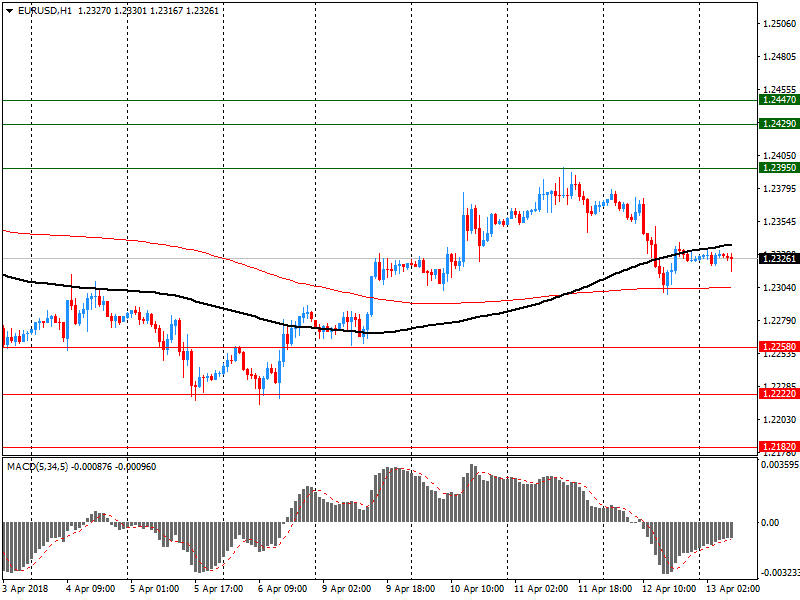
EUR/USD
Resistance levels (open interest**, contracts)
$1.2447 (2181)
$1.2429 (1394)
$1.2395 (215)
Price at time of writing this review: $1.2326
Support levels (open interest**, contracts):
$1.2258 (3773)
$1.2222 (4049)
$1.2182 (3636)
Comments:
- Overall open interest on the CALL options and PUT options with the expiration date May, 4 is 75998 contracts (according to data from April, 12) with the maximum number of contracts with strike price $1,2650 (4069);
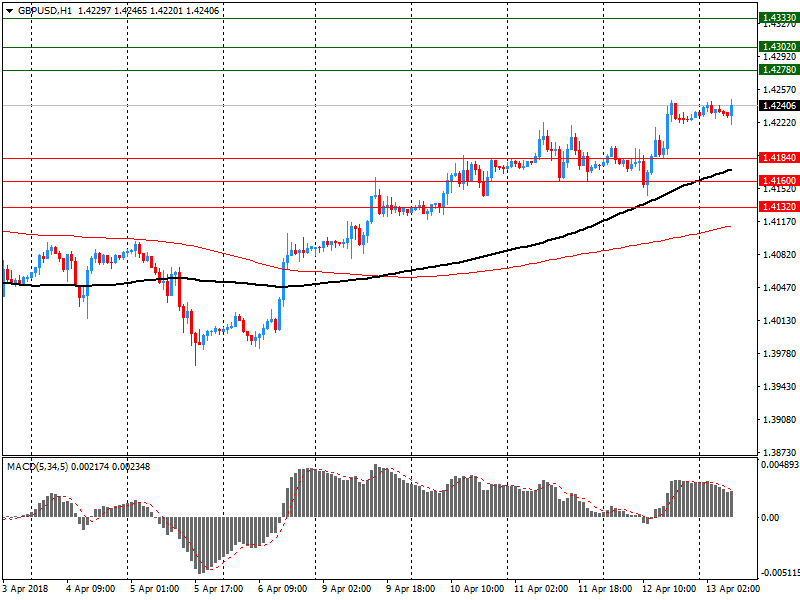
GBP/USD
Resistance levels (open interest**, contracts)
$1.4333 (2094)
$1.4302 (2028)
$1.4278 (883)
Price at time of writing this review: $1.4241
Support levels (open interest**, contracts):
$1.4184 (354)
$1.4160 (498)
$1.4132 (896)
Comments:
- Overall open interest on the CALL options with the expiration date May, 4 is 23118 contracts, with the maximum number of contracts with strike price $1,4400 (3203);
- Overall open interest on the PUT options with the expiration date May, 4 is 23781 contracts, with the maximum number of contracts with strike price $1,3850 (2488);
- The ratio of PUT/CALL was 1.03 versus 1.03 from the previous trading day according to data from April, 12
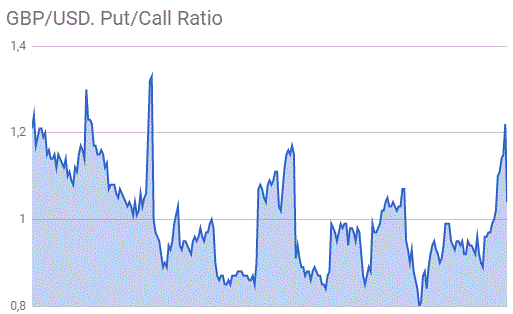
* - The Chicago Mercantile Exchange bulletin (CME) is used for the calculation.
** - Open interest takes into account the total number of option contracts that are open at the moment.
Consumer prices in Germany were 1.6% higher in March 2018 than in March 2017. The inflation rate - measured by the consumer price index - thus increased slightly. In the three preceding months the rate of inflation had declined gradually. Compared with February 2018, the consumer price index rose by 0.4% in March 2018. The Federal Statistical Office (Destatis) thus confirms its provisional overall results of 29 March 2018.
The prices of energy products were up 0.5% year on year in March 2018. The rise in energy prices was thus considerably smaller than the overall rise in prices. In February 2018, the rate of energy price increase had been even lower at +0.1%. From March 2017 to March 2018, price rises were recorded especially for heating oil (+5.4%). The price of electricity (+1.5%) and charges for central and district heating (+0.8%) were also up on a year earlier. In contrast, price decreases were recorded in the same period for solid fuels (-1.6%), gas (-1.4%) and motor fuels (-0.7%). Excluding energy prices, the inflation rate in March 2018 would have been +1.6% as well.
China's exports declined unexpectedly in March, while imports grew more-than-expected, according to rttnews.
In dollar terms, exports fell 2.7 percent year-over-year in March, confounding economists' forecast for a notable increase of 11.8 percent.
Meanwhile, imports surged 14.4 percent in March from a year ago, faster than the expected spike of 12.0 percent.
The trade deficit came in at $4.98 billion in March, in contrast to the expected surplus of $27.5 billion.
-
Bank capital ratios close to or above "unquestionably strong" targets
-
Risks to bank capital from past misconduct "appear limited" so far
-
Overall funding costs for banks has declined over the past year
-
Small minority of borrowers with interest only loans to face difficulty with refinancing







© 2000-2026. Bản quyền Teletrade.
Trang web này được quản lý bởi Teletrade D.J. LLC 2351 LLC 2022 (Euro House, Richmond Hill Road, Kingstown, VC0100, St. Vincent and the Grenadines).
Thông tin trên trang web không phải là cơ sở để đưa ra quyết định đầu tư và chỉ được cung cấp cho mục đích làm quen.
Giao dịch trên thị trường tài chính (đặc biệt là giao dịch sử dụng các công cụ biên) mở ra những cơ hội lớn và tạo điều kiện cho các nhà đầu tư sẵn sàng mạo hiểm để thu lợi nhuận, tuy nhiên nó mang trong mình nguy cơ rủi ro khá cao. Chính vì vậy trước khi tiến hành giao dịch cần phải xem xét mọi mặt vấn đề chấp nhận tiến hành giao dịch cụ thể xét theo quan điểm của nguồn lực tài chính sẵn có và mức độ am hiểu thị trường tài chính.
Sử dụng thông tin: sử dụng toàn bộ hay riêng biệt các dữ liệu trên trang web của công ty TeleTrade như một nguồn cung cấp thông tin nhất định. Việc sử dụng tư liệu từ trang web cần kèm theo liên kết đến trang teletrade.vn. Việc tự động thu thập số liệu cũng như thông tin từ trang web TeleTrade đều không được phép.
Xin vui lòng liên hệ với pr@teletrade.global nếu có câu hỏi.


 Chuyển khoản
 ngân hàng


