- Analytics
- News and Tools
- Market News
Analytics, News, and Forecasts for CFD Markets: currency news — 01-06-2022.
- NZD/USD fades bounce off weekly low after two-day downtrend.
- New Zealand Q1 Terms of Trade Index matches 0.5% figures.
- Firmer US data, recession fears join sour sentiment to weigh on prices.
- US ADP Employment Change, Factory Orders and Aussie trade numbers will be eyed for immediate directions, risk catalysts are crucial.
NZD/USD renews intraday low to 0.6480 as bears keep reins for the third consecutive day to Thursday’s Asian session. In doing so, the Kiwi pair justifies the market’s risk-off mood, as well as a firmer US dollar, while paying a little heed to the upbeat trade data at home.
New Zealand’s Terms of Trade Index for the first quarter (Q1) of 2022 rose 0.5%, matching forecasts, while reversing the previous -1.0% figures.
It’s worth noting that the growing fears of recession, as well as faster monetary tightening by the global central banks, keep weighing on the NZD/USD prices. On the same line could be the latest trade/geopolitical tussles surrounding China and Russia.
Strong US data and Fed Beige Book raised concerns over economic growth and inflation in the US while Fed speakers renewed chatters surrounding a faster rate hike trajectory. That said, the US ISM Manufacturing PMI for April rose to 56.1 versus the 54.5 expected and the 55.4 prior. Further, the US JOLTs Job Openings eased below 11.8 prior readings but matched 11.4 market forecasts. Furthermore, the monthly release of the Fed Beige Book showed that the majority of districts indicated slight or modest growth while most informed of continued price rises. Also, three districts, out of 12, expressed concerns about a US recession.
St. Louis Federal Reserve Bank President James Bullard also raised concerns about the US recession as he repeated that a pace of 50 bps hike per meeting is a “good plan” for now. On the same line, Federal Reserve Bank of Richmond President Thomas Barkin mentioned, “You can't find a recession in the data or actions of business execs,'' speaking on Fox Business.
Recently, Reuters came out with the news suggesting the US readiness to implement a ban on Xinjiang goods whereas comments from China's Ambassador to Australia, Xiao Qian, hint at no relief to Aussie business houses from Beijing’s ban despite the change in government.
Against this backdrop, S&P 500 Futures drop 0.20% whereas the US 10-year Treasury yields retreat from a two-week high, down 1.2 basis points (bps) to 2.91% of late.
Looking forward, Australia’s trade figures for April and risk catalysts may offer immediate directions but major attention will be given to the US ADP Employment Change for May, expected 300K versus 247K prior.
Also read: US ADP Employment Change May Preview: The labor market recedes from center stage
Technical analysis
A three-week-old support line and 21-day EMA restrict short-term NZD/USD downside near 0.6470. Recovery moves, however, remain elusive until the quote rises past May’s high near 0.6570.
- GBP/USD remains depressed around two-week low, sidelined of late.
- Clear downside break of short-term key support, 200-SMA keep sellers hopeful.
- RSI conditions, 100-SMA restrict immediate downside ahead of the multi-month low marked in May.
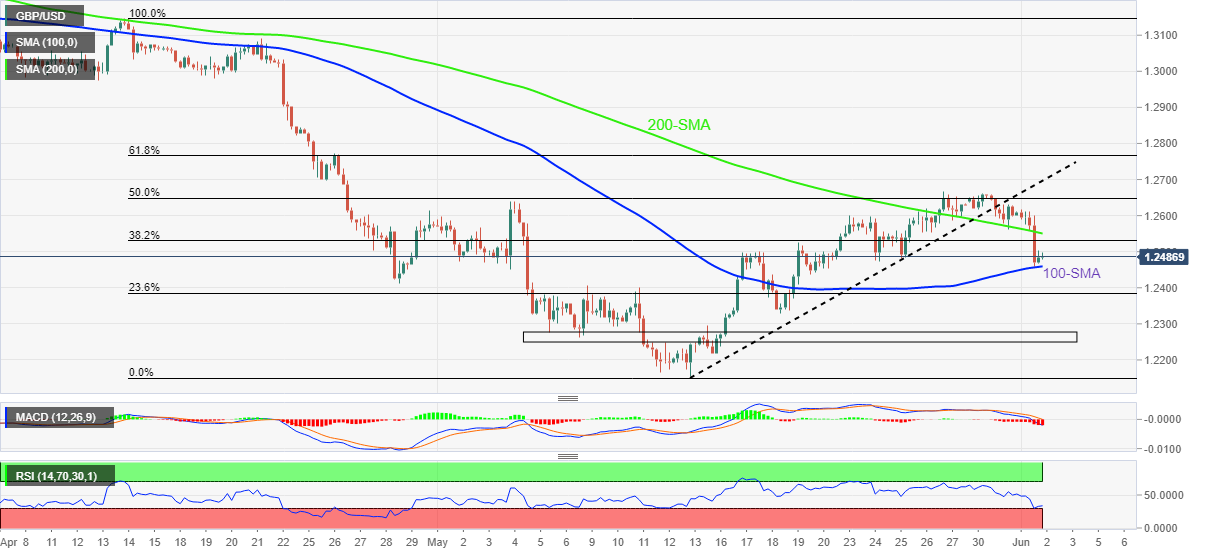
GBP/USD licks its wounds around a fortnight low, after dropping the most in two weeks, as the 100-SMA probes the downturn during Thursday’s Asian session. Even so, the cable pair stays pressured around 1.2480-80 levels by the press time.
Although nearly oversold RSI (14) joins the 100-SMA to challenge the pair sellers around 1.2460, bearish MACD signals and sustained trading below 200-SMA keep sellers hopeful.
Also favoring the bears is the pair’s downside break of an ascending support line from May 13, now resistance around 1.2700.
It’s worth noting, however, that multiple supports around the 23.6% Fibonacci retracement (Fibo.) of April-May fall could challenge the GBP/USD bears around 1.2385, even if the quote drops below the 100-SMA level of 1.2460.
Following that, a broad one-month-old horizontal area surrounding 1.2275-55 will be a tough nut to crack for the pair sellers.
On the contrary, recovery moves could initially aim for the 200-SMA and May’s peak, respectively around 1.2550 and 1.2670, before targeting the support-turned-resistance line near 1.2700.
Should the GBP/USD bulls manage to keep reins past 1.2700, the 61.8% Fibonacci retracement level of 1.2765 will be in focus.
GBP/USD: Four-hour chart
Trend: Further weakness expected
- The USD/JPY gains some 2.45% in the week.
- Asian equity futures reflect a dampened market mood, though
- Fed officials backed 50 bps in the next couple of meetings and are set to tighten as needed.
The USD/JPY rallies past the 130.00 mark, a level last seen on May 12, when the major pulled back towards the 125.00 area, before resuming the ongoing uptrend as traders brace for a move towards a re-test of the YTD high at 131.34. At 130.19, the USD/JPY portrays the constant greenback strength amidst a risk-aversion environment.
Dampen market mood and fears of a US recession lifts the USD/JPY
Investors remain nervous, courtesy of global central banks’ tightening monetary conditions. Also, renewed fears of escalating the Russia-Ukraine conflict surfaced as the Russian military captured an industrial city in the Donbas region, while the US prepares to send additional weaponry to Ukraine.
Meanwhile, Asian equities are poised to a “flat” open, as shown by stock futures, recording minimal losses. The US Dollar Index, a gauge of the buck’s value, rose 0.75% on Wednesday, sitting at 102.542, a tailwind for the USD/JPY.
The yield on 10-year Treasuries spiked higher as traders raised bets on the path for rate hikes, and the Fed began its Quantitatitative Tightening (QT) process.
Positive ISM PMI and Fed speakers, boost the greenback
The US docket reported positive data, with May’s ISM Manufacturing PMI rising unexpectedly, lifting the USD/JPY towards a fresh three-week high. That, alongside Fed speakers crossing newswires, gave enough strength to lift the pair above 130.00. San Francisco Fed President Mary Daly and her colleague James Bullard both backed raising rates by 50 bps this month, while Richmond’s President Thomas Barkin said it made “perfect sense” to tighten policy.
An absent Japanese economic docket would keep USD/JPY traders leaning on US data. The US economic docket would feature the ADP May Employment report alongside Initial Jobless Claims for the week ending on May 28 and Factory Orders.
“US authorities are ready to implement a ban on imports from China's Xinjiang region when a law requiring it becomes enforceable later in June, a US Customs official said on Wednesday,” per Reuters. The news adds that a "very high" level of evidence would be required for an exemption, said the source mentioned.
Key quotes
The law includes a "rebuttable presumption" that all goods from Xinjiang, where Chinese authorities established detention camps for Uyghurs and other Muslim groups, are made with forced labor, and bars their import unless it can be proven otherwise.
China denies abuses in Xinjiang, a major cotton producer that also supplies much of the world's materials for solar panels, and says the law "slanders" the country's human rights situation.
Elsewhere, China's Ambassador to Australia, Xiao Qian, says Beijing is ready to talk to Australia’s new government without preconditions. The diplomat, however, mentioned that China's punitive trade sanctions will not be dropped while also saying, “This will not happen until there is an improvement in the “political relationship” between Canberra and Beijing.”
FX reaction
Forex markets failed to offer any immediate reaction to the news but the AUD/USD remains pressured around the 0.7170 level after reversing from a one-month high the previous day.
Read: AUD/USD bulls could be about to throw in the towel, but the 38.2% Fibo is key
- EUR/JPY is oscillating above 138.50, upside remains favored on ECB-BJ policy divergence.
- To fix the inflation mess, the ECB is left with no other choice than to end its low rates cycle.
- Upbeat Japan’s employment data failed to strengthen the yen bulls.
The EUR/JPY pair is juggling in a narrow range of 138.45-138.70 in the early Tokyo session. The cross has remained in the grip of the shared currency bulls for the last two weeks on expected divergence in the ECB-BOJ monetary policy stance as early as possible.
The European Central Bank (ECB) is qualified to announce a hawkish interest rate decision in its June monetary policy. Soaring inflation in eurozone amid rising prices of oil, food products, and other commodities are impacting the wallets of the households, and fixing the inflation mess is highly required.
One thing is worth noting that the eurozone has failed to keep the improvement in the employment data. The Unemployment Rate remained constant at 6.8%, lower than the market consensus of 6.7%. Despite a flat performance on the employment front, ending of the lower rate culture is highly needed to maintain harmony in the economy.
Going forward, investors will keep an eye on the eurozone Retail Sales, which are due on Friday. A preliminary estimate for the annual and monthly Retail Sales is 5.4% and 0.3% respectively. The economic data is expected to display an outperformance as the prior prints were 0.8% on annual basis and -0.3% on monthly basis.
On the Japanese yen front, the upbeat employment data failed to strengthen the yen bulls. The Jobs/Applicants ratio was improved to 1.23% vs. the former figure of 1.22%. Also, the Unemployment Rate jumped to 2.5% against the estimates and the prior print of 2.6%. The Bank of Japan (BOJ) will continue with its ultra-loose monetary policy as the growth forecasts are still lower than the pre-pandemic records.
- WTI flirts with intraday low, prints three-day downtrend.
- Growing concerns over recession in the US and China weigh on energy demand outlook.
- Russia’s likely exit from OPEC+ could increase supply even as EU sanctions hurt the output.
- OPEC is likely to stick to current policy, risk flows, US data are also important to watch for fresh impulse.
WTI remains on the back foot for the third consecutive day, despite the latest bounce off intraday lows, as fears surrounding growth and Russia’s exit from OPEC+ weigh on the black gold. That said, the quote remains pressured at around $112.50 after dropping to $112.11 during the early hours of Thursday’s Asian session.
As bears cheer the gloomy outlook for demand and a boost to supplies of oil to extend pullback from a three-month high, they ignored the latest draw of API Weekly Crude Oil Stock for the week ended on May 27. That said, the industry stockpiles shrank by 1.181M versus the previous addition of 0.567M.
Strong US data and Fed Beige Book raised concerns over economic growth and inflation in the US. That said, the US ISM Manufacturing PMI for April rose to 56.1 versus the 54.5 expected and the 55.4 prior. Further, the US JOLTs Job Openings eased below 11.8 prior readings but matched 11.4 market forecasts. It’s worth noting that the monthly release of the Fed Beige Book showed that the majority of districts indicated slight or modest growth while most informed of continued price rises. Also, three districts, out of 12, expressed concerns about a US recession.
It’s worth noting that China’s successive contraction in manufacturing activities, as per the latest Caixin Manufacturing PMI, joins the hawkish path of the global central banks to also weigh on the black gold.
On Wednesday, the Bank of Canada (BOC) announced 50 basis points (bps) rate hike and the US is well on that path as St. Louis Federal Reserve Bank President James Bullard also raised concerns about the US recession as he repeated that a pace of 50 bps hike per meeting is a “good plan” for now. Further, Federal Reserve Bank of Richmond President Thomas Barkin mentioned, “You can't find a recession in the data or actions of business execs,'' speaking on Fox Business.
Elsewhere, speculations over Russia’s departure from OPEC+, comprising the Organization of the Petroleum Exporting Countries (OPEC) and Russia, triggered through a Wall Street Journal (WSJ) piece, also drowned the black gold. Further, chatters that the OPEC will keep its current policy of increasing output by 432,000 BPD, per Reuters, during today’s meeting exerts additional downside pressure on the WTI oil prices.
In addition to the aforementioned catalysts, today’s US ADP Employment Change for May, expected 300K versus 247K prior, will be eyed as well. Furthermore, the official weekly oil inventory data from the Energy Information Administration (EIA), expected -0.067M versus -1.1019M prior, will offer additional directions and should be watched carefully.
Technical analysis
Despite the latest pullback, WTI crude oil prices remain beyond three-week-old support and the 10-DMA level surrounding $112.00, which in turn keeps buyers hopeful. However, a clear upside break of March’s top surrounding $115.90 becomes necessary for the energy bulls to retake the control.
- AUD/USD is consolidating the recent volatility and has left a doji on the daily chart.
- The price could be in for some sideways action as markets take a rest bite ahead of more critical US events.
At 0.7150, AUD/USD is flat on the day and trading in the middle of the overnight ranges. It has been a period of finding equilibrium while the US dollar bounces back to life, spurred on by fears of global inflation.
The dollar index DXY, which measures the currency against six major peers, climbed to 102.71 and stalled near there, extending Tuesday's gains. Equities fell and bond yields rose as strong US manufacturing and job openings data reinforced the need for aggressive Fed funds rate hikes. The US 10-year yield lifted 9.3bps to 2.937%. As such, the high beta currency was pressured before rebounding in the midday session of New York.
In data, the US May ISM manufacturing index surprised by rising to 56.1 (55.4 previously) – the consensus expectation was for a small decline. New orders improved, rising to 55.1 (53.5 previously), while prices paid eased slightly to 82.2 (84.6 previously). Analysts said the latter is still far too high to be comfortable for the Fed.
As for the Reserve Bank of Australia, the analysts said that yesterday's growth data for the first quarter for Australia has prompted them to look for a 40bp hike in the cash rate to 0.75% in June (previously expected 25bps).
''Not only did the data show a healthy 0.8% q/q lift in GDP (as expected), but based on our calculations, non-farm average hourly earnings lifted 5.3% y/y in Q1 – an acceleration from 3.3% previously. While these earnings data can be volatile and thrown around by compositional issues, the print was still much higher than we were expecting to see,'' the analysts explained.
''Combine that with the strongest quarterly increase in the household consumption deflator since 1990 (ex-GST), and we think it should convince Governor Lowe that “there is a very strong argument” to move in larger increments than the usual 25bps.''
AUD/USD technical analysis
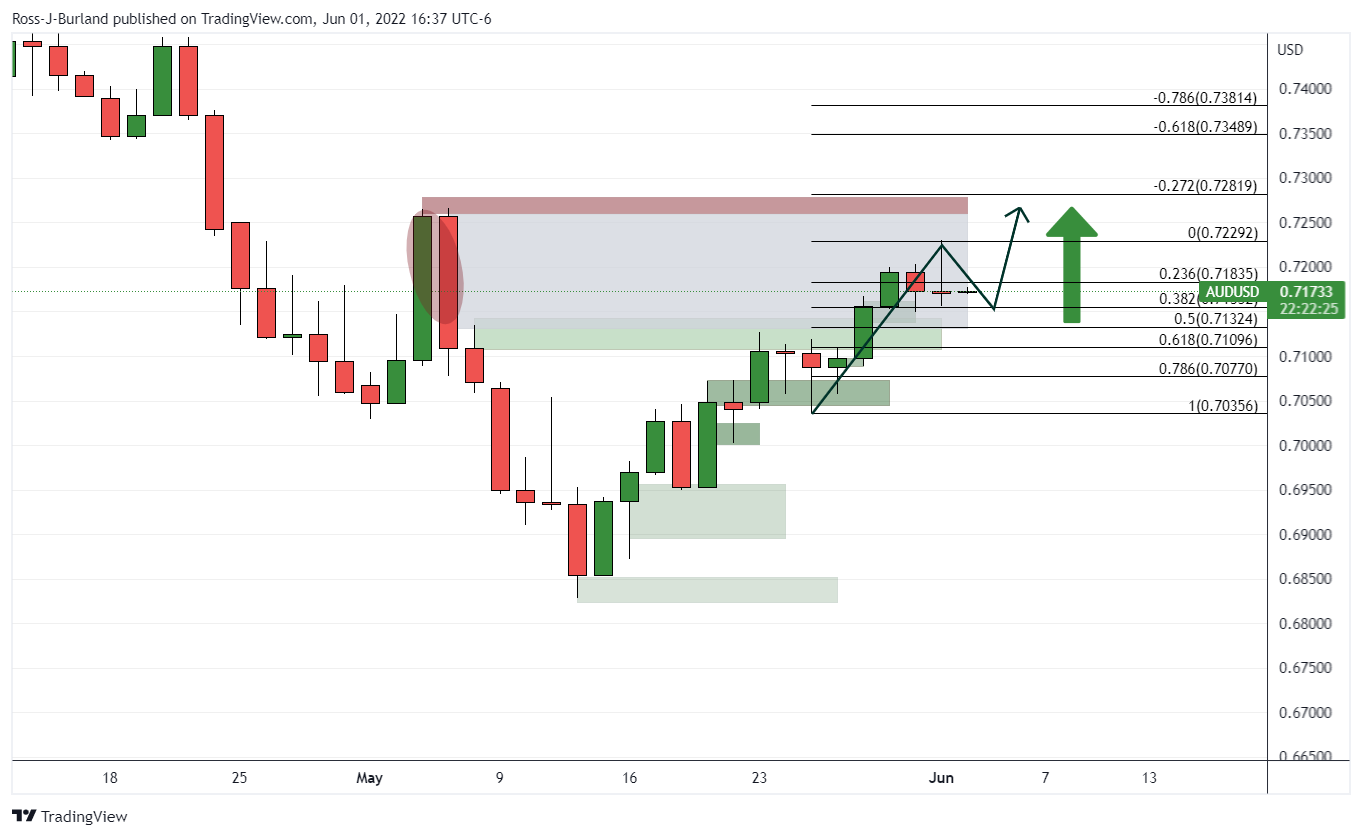
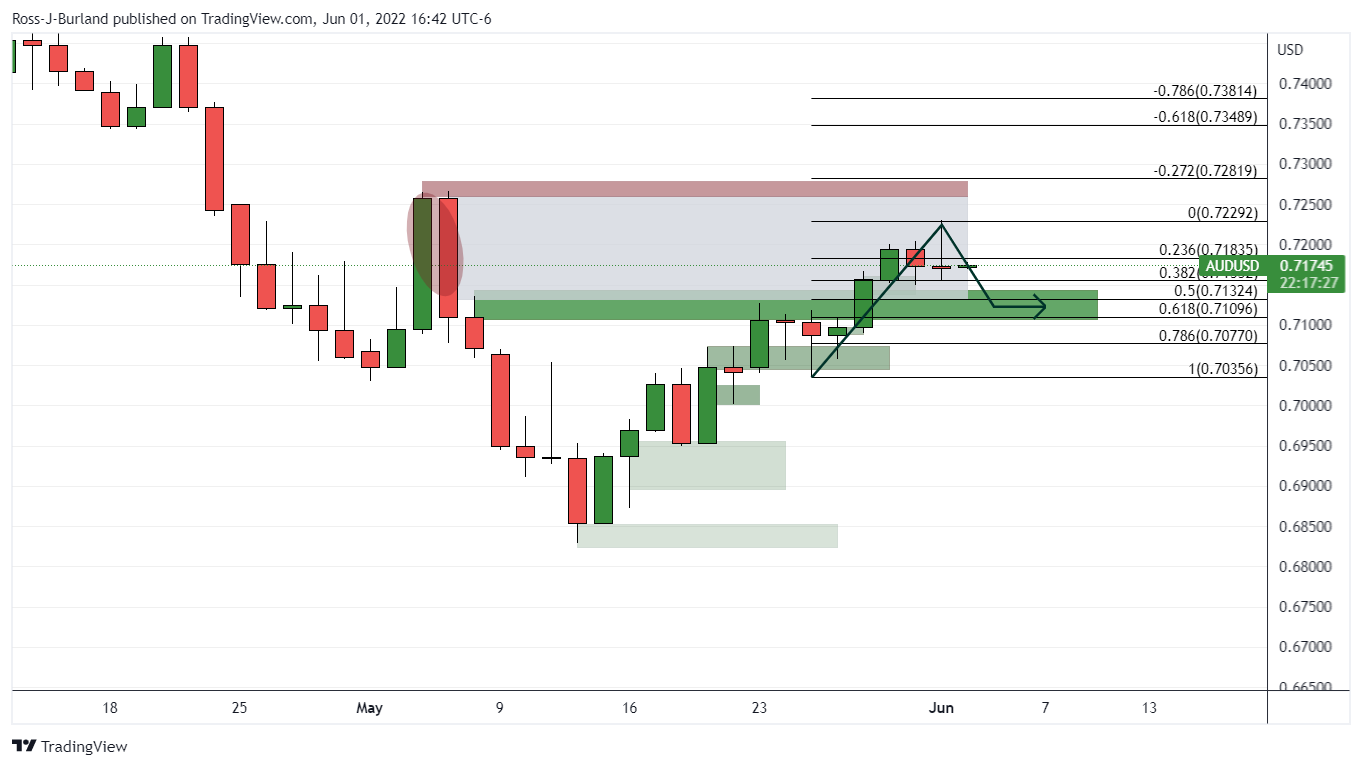
Wednesday's doji is not so bullish but the restest of the 38.2% could encourage buying as bulls move in at a discount and see to a full-on mitigation of the price imbalance between the highs of the doji to towards the My 5 highs of 0.7266. Failing that, if the bulls throw in the towel, a deeper correction to the support area below would be likely ahead of US Nonfarm Payrolls on Friday.
- The US Dollar index continues its weekly rally, up by 0.89%.
- Risk-aversion and positive US ISM Manufacturing PMI boost the greenback and rallies vs. most G7 currencies.
- US Dollar Index Price Forecast (DXY): The bias remains intact, though a break above 103.000 might pave the way for further gains.
The US Dollar Index, a measure of the greenback’s value vs. a basket of six foreign currencies, climbs 0.75% due to a risk-aversion Wednesday trading session as the New York session wanes and Asia takes over. At the time of writing, the DXY sits at 102.549.
The market mood remains negative, with US bourses closing lower while Asian equity futures register losses. Stronger than expected ISM Manufacturing PMI data pressured the buck against major currencies, lifting the index. Additionally, US Treasury yields led by the 10-year benchmark note rose six bps and finished around 2.911%.
Fed speakers remain hawkish, underpinning the USD
Fed speakers crossed wires on Wednesday. The first in line was the San Francisco Fed President Mary Daly, who said that she sees a couple of 50 bps increases and added that they need expeditiously to get rates to neutral.
Late in the day, Richmond’s Fed President, Thomas Barkin, said that a recession couldn’t be found in the data or actions of business executives. At the same time, he added that a reduction in the balance sheet does a little more on top of rate hikes to tighten policy. Barkin added that comfortable with the path of rate hikes for the next couple of meetings while supporting more rate hikes.
Closing the parade was the St. Louis Fed President James Bullard. He said that “The current US macroeconomic situation is straining the Fed’s credibility with respect to its inflation target.” Furthermore, he added that the US labor markets and the US economy remain robust, but Russia’s invasion of Ukraine and a sharp slowdown in China means risk remains “substantial.”
US Dollar Index Price Forecast (DXY): Technical outlook
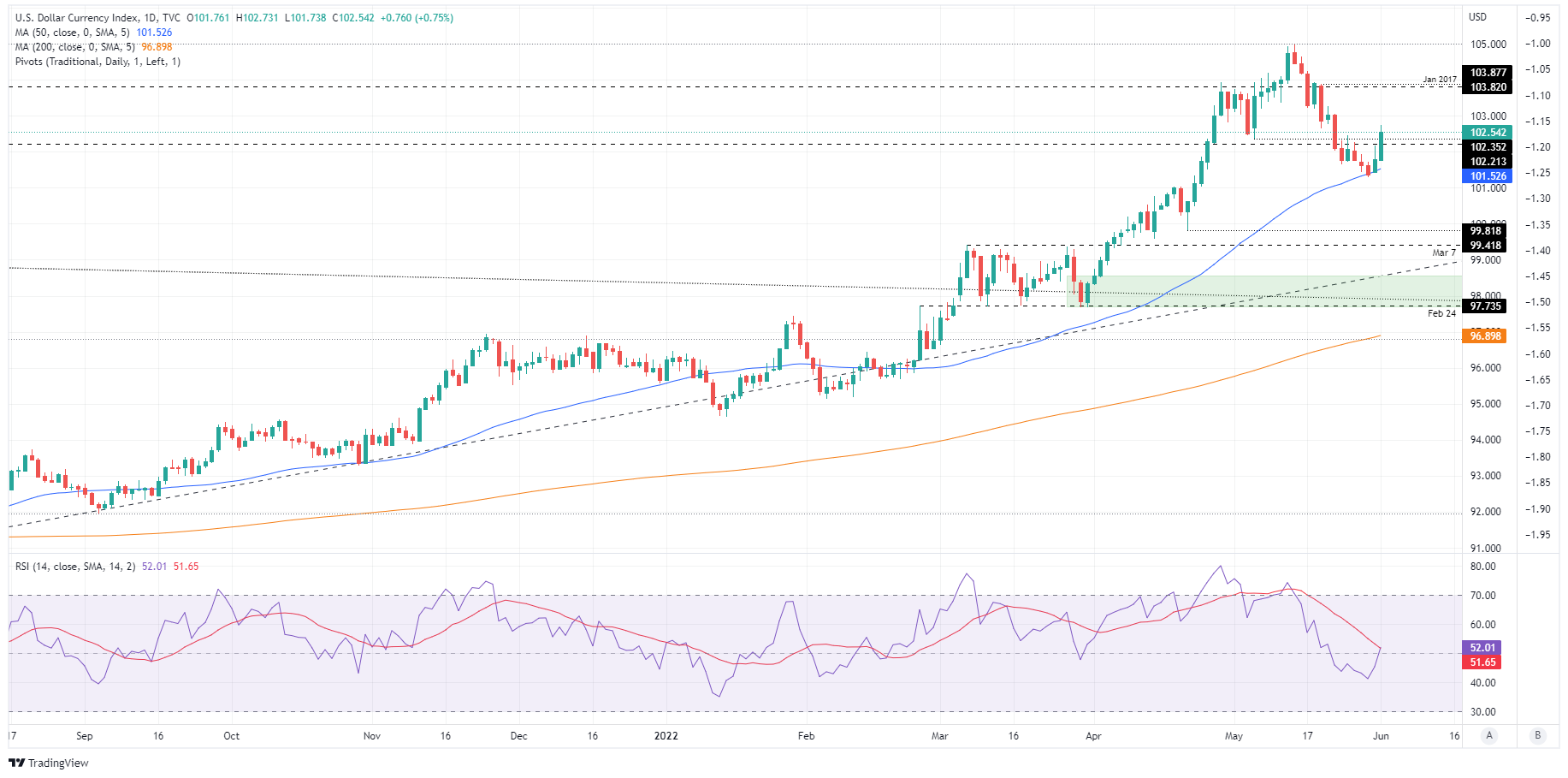
The DXY remains upward biased. On Tuesday, the index pierced the 50-day moving average (DMA) around 101.447 but bounced off and closed at 101.414, forming a “bullish-piercing” pattern.
Wednesday’s price action witnessed bulls entering the market, lifting the US Dollar Index above the 102.000 mark, achieving a daily close above the May 5 swing low at 102.352. Therefore, the DXY bias remains intact.
That said, the US Dollar Index’s first resistance would be 103.000. A breach of the latter would expose the May 19 high at 103.820, followed by the YTD high at 105.005.
- USD/CAD defends the bounce off six-week low, grinds higher of late.
- BOC announced 0.50% rate hike, showed readiness to "act more forcefully if needed".
- Upbeat US data, hawkish Fedspeak underpin DXY’s biggest daily gains in a month.
- US ADP Employment Change, Factory Orders and Fed/BOC speakers eyed ahead of the key US NFP.
USD/CAD stays defensive around a two-month low, following the first positive daily close in six, as softer oil prices and strong US dollar tease buyers. That said, the Loonie pair seesaws around 1.2655-60 during an inactive start to Thursday’s Asian session.
The quote dropped to the lowest levels since early April just after the Bank of Canada (BOC) announced 50 basis points (bps) of rate hikes, matching market consensus. However, the important was the policymakers’ preparedness for aggressive rate lifts if needed to achieve its 2.0% inflation target.
It’s worth noting, however, that fears of growth and inflation, not to forget hawkish comments from the Fed policymakers, bolstered the US Dollar Index (DXY) and poured cold water on the BOC’s strong rate hike. Also fueling the USD/CAD prices was a retreat in the WTI crude oil prices, Canada’s key export.
Strong US data and Fed Beige Book raised concerns over economic growth and inflation in the US while Fed speakers renewed chatters surrounding a faster rate hike trajectory. That said, the US ISM Manufacturing PMI for April rose to 56.1 versus the 54.5 expected and the 55.4 prior. Further, the US JOLTs Job Openings eased below 11.8 prior readings but matched 11.4 market forecasts. It’s worth noting that the monthly release of the Fed Beige Book showed that the majority of districts indicated slight or modest growth while most informed of continued price rises. Also, three districts, out of 12, expressed concerns about a US recession.
Elsewhere, St. Louis Federal Reserve Bank President James Bullard also raised concerns about the US recession as he repeated that a pace of 50 bps hike per meeting is a “good plan” for now. Further, Federal Reserve Bank of Richmond President Thomas Barkin mentioned, “You can't find a recession in the data or actions of business execs,'' speaking on Fox Business.
It’s worth noting that WTI crude oil prices dropped for the second consecutive day on Wednesday, extending pullback from a three-month high to near $113.50 at the latest, as firmer US dollar and recession fears. Also, downbeat PMI data from China and anxiety ahead of today’s Organization of the Petroleum Exporting Countries (OPEC) meeting weigh on the black gold prices.
Amid these plays, the Wall Street benchmarks closed for the second day in the red while the US 10-year Treasury yields printed a three-day uptrend while refreshing a fortnight high near 2.95%.
Moving on, US ADP Employment Change for May, expected 300K versus 247K prior, will be eyed closed due to being the early signal for Friday’s US Nonfarm Payrolls (NFP). Also important to watch is the US Factory Orders for May bearing forecasts of a 0.7% increase compared to 2.2% in previous readouts. At home, an anticipated recovery in Canada Building Permits, to 0.7% from -9.3% prior, may test the USD/CAD rebound.
Also read: US ADP Employment Change May Preview: The labor market recedes from center stage
Technical analysis
A daily closing below 200-DMA, around 1.2665 by the press time, keeps USD/CAD directed towards a two-month-old support line near 1.2600.
- EUR/USD is expected to decline towards 1.0627 as DXY rebounded on upbeat PMI data.
- Mounting inflationary pressures in eurozone are compelling for a rate hike announcement by the ECB.
- The annual eurozone Retail Sales may climb to 5.4%, higher than the former figure of 0.8%.
The EUR/USD pair is juggling around 1.0650 after a sheer downside move from 1.0730 on Thursday. A sluggish consolidation move is indicating the occurrence of an intensive selling action, which will expose the asset to more downside.
The pair has displayed a vulnerable performance in the last two trading sessions after a firmer rebound in the US dollar index (DXY). Rising odds of an extreme hawkish monetary policy dictation by the Federal Reserve (Fed) in its June monetary policy and the upbeat US ISM Manufacturing PMI were sufficient to bring bulls back into the counter. The US ISM PMI landed at 56.1, higher than the forecasts of 54.5 and the prior print of 55.4.
On the euro front, the chances of the first rate hike announcement by the European Central Bank (ECB) taking into account the inflationary pressures have been bolstered. The eurozone Harmonized Index of Consumer Prices (HICP) landed at 8.1% vs. the expectation of 7.7% and the prior print of 7.4%. A significant upside in the inflation numbers in Europe is compelling for an end of the lower rates cycle and the ECB will feature rate hikes in its upcoming monetary policy meetings.
Going forward, investors will focus on the release of the US Nonfarm Payrolls (NFP), which is seen at 325k against the prior print of 428k. Meanwhile, eurozone will report the Retail Sales on Friday. As per the market consensus, the annual Retail Sales are seen at 5.4% vs. 0.8% released last April.
- Gold price is facing resistance around $1,850.00 on upbeat US ISM Manufacturing PMI data.
- A parallel upside move in the DXY and the golf prices is indicating an improvement in the safe-haven appeal.
- The US NFP will be the major event this week, which is expected to land at 325k.
Gold price (XAU/USD) is displaying some signs of exhaustion after a pullback move to its crucial resistance at $1,850.00. The precious metal and the US dollar index (DXY) have displayed a rare parallel upside move as both assets were advancing north on Wednesday. An initiative selling action could be observed in the gold prices amid lack of positive triggers.
Outperformance from the economic data
On Wednesday, the Institute for Supply Management (ISM) reported the Manufacturing PMI at 56.1, higher than the forecasts of 54.5 and the prior print of 55.4. An outperformance from the US economy on Manufacturing PMI despite rising inflationary pressures spurted a rally in the DXY. The DXY moved sharply higher after an upside break of the consolidation formed in a range of 101.80-102.05. Currently, the asset is balancing around 102.60.
US NFP in focus
This week, the entire investing community will focus on the release of the US Nonfarm Payrolls (NFP), which is due on Friday. A preliminary estimate for the additional jobs created in April is 325k, against the prior print of 428k. Also, the average monthly NFP figure is 551.6k from the last 12-months. More than 100k fall in job openings from a month and 200k fall in relation to the 12-month average figure indicates that the Federal Reserve (Fed) is required to focus again on balancing the labor market.
Gold technical analysis
On an hourly scale, the gold price is facing barricades around the ascending trendline of the Symmetrical Triangle, which is placed from May 20 low at $1,832.41 while the descending trendline is plotted from May 24 high at $1,869.75. The Relative Strength Index (RSI) (14) has displayed a sheer upside move from the bearish range of 20.00-40.00 to the bullish range of 60.00-80.00, which indicates a firmer reversal in the counter.
Gold hourly chart
-637897171556838165.png)
- The AUD/JPY rallies, albeit in a risk-off mood, as global equities are trading with losses.
- The sentiment is downbeat on investors’ worries about the US entering a recession and the Ukraine-Russia conflict escalation.
- AUD/JPY Price Forecast: The cross-currency is upward biased and will face solid resistance around 94.00.
The Australian dollar rallies against the Japanese yen, despite a risk-off market sentiment, reflected by global equities falling on Wednesday, courtesy of fears that the US Federal Reserve might cause a recession in the US and Russia’s advancement in Ukraine. At the time of writing, the AUD/JPY is trading at 93.37, a level last seen on May 5.
Since the beginning of Wednesday’s Asian session, positive data boosted the Aussie. Australia’s Q1 GDP rose by 0.75% QoQ and 3.3% YoY, beating the market expectations of 0.6% and 2.9%, respectively. Also, the China Caixin PMI for May rose by 48.1, vs. 48.0 expected, showing the resilience of the second-largest economy.
The AUD/JPY Wednesday’s open was 92.28, and the cross-currency rallied sharply, almost non-stop, though it dipped briefly towards 92.40 but kept upswing until reaching a daily high at 93.61.
AUD/JPY Price Forecast: Technical outlook
From a daily chart perspective, the AUD/JPY is upward biased after reclaiming the 50-day moving average (DMA) around 91.89. Also, the Relative Strength Index (RSI) in bullish territory aims higher, with enough room before entering the overbought zone.
In the meantime, the AUD/JPY 4-hour chart shows the pair with the same bias as the daily chart, but it’s worth noting that the AUD/JPY will face a solid resistance area around May 4 high at 94.02. Why is that level so important? Because it’s the pivot high of the downtrend that began in early May, towards May 12 swing low at 87.30, for a 670 pip fall.
If AUD/JPY bulls break above the May 4 high, that will open the door for further gains. The AUD/JPY first resistance would be 94.50, followed by the 95.00 figure. A breach of the latter would expose the YTD high at 95.74.

Key Technical Levels
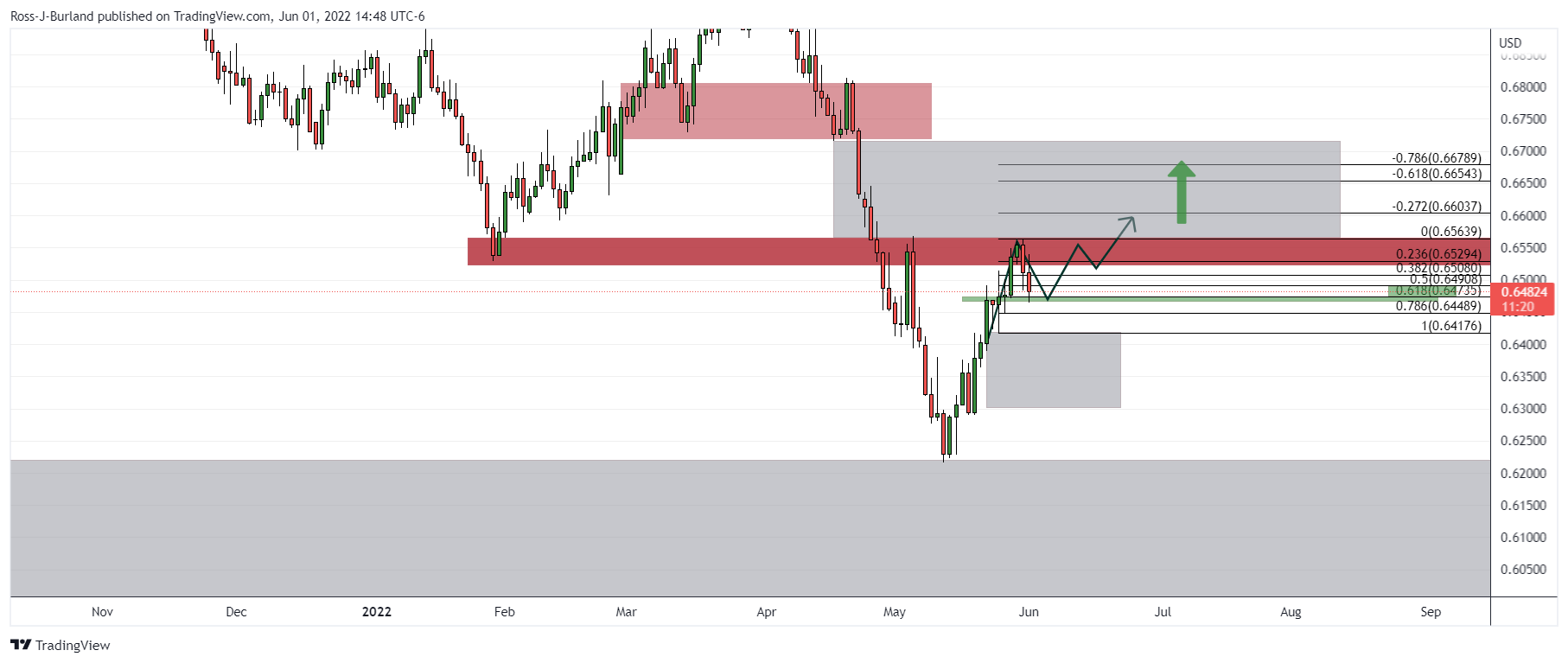
- The outlook will be bullish ahead if buyers can breach the resistance of 0.6564.
- The downside will be opened if the price breaks below 0.6417.
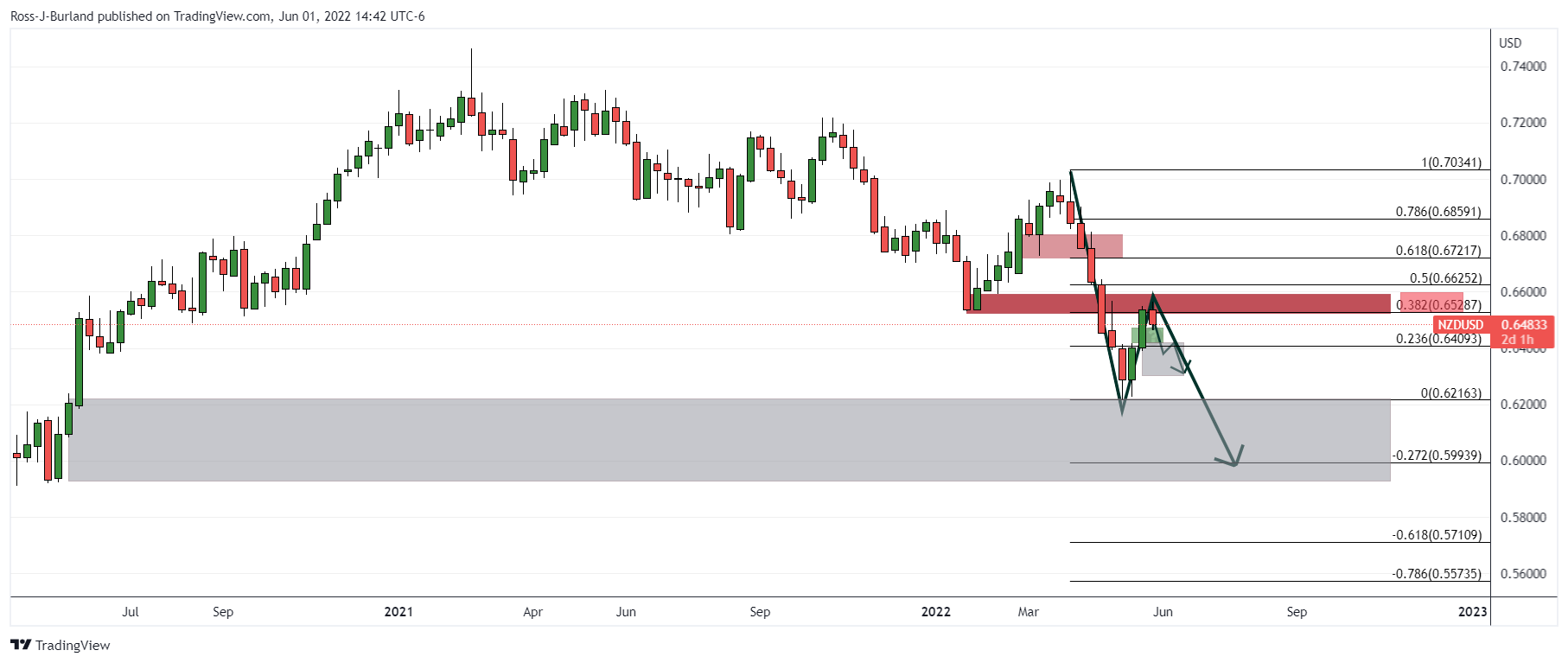
As per the prior analysis, NZD/USD Price Analysis: Bulls need to break a key weekly level at this juncture, it was stated that the bulls need a clean break of the resistance or they will risk facing a firm move by the bears. Indeed, the bears have played their hand since the analysis and the price is being forced lower to test a potential support structure. The following illustrates the state of play on a multi-timeframe basis:
NZD/USD prior analysis
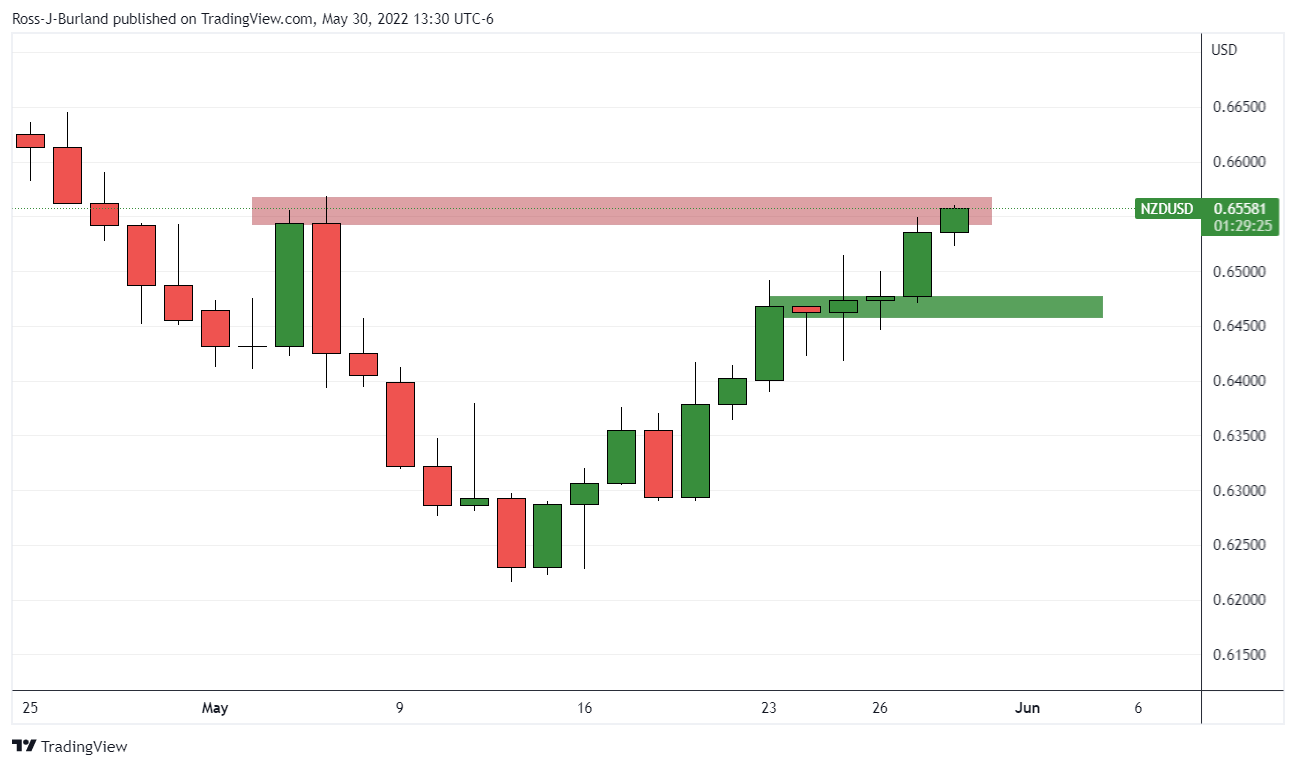
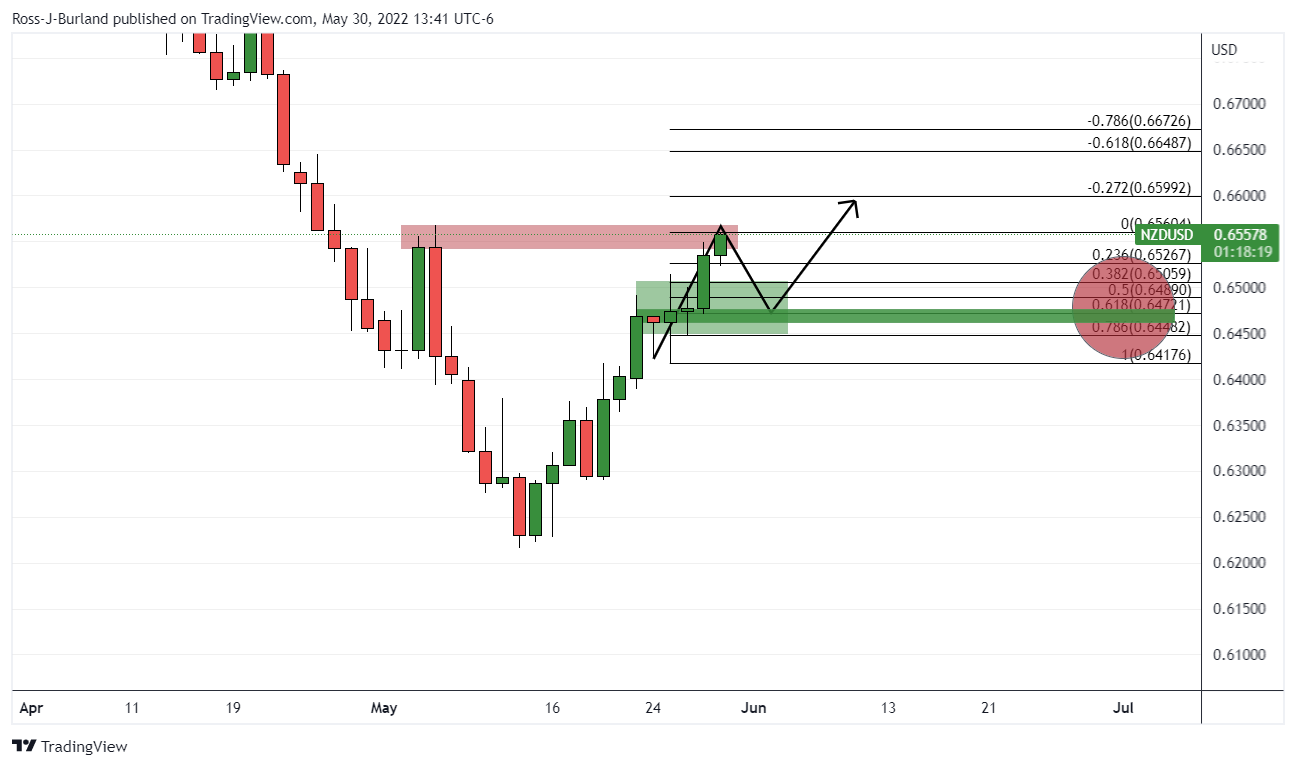
''The prior resistance on the daily and 4-hour charts that have a confluence with the daily Fibonacci scale would be expected to act as a support structure for the coming sessions.''
NZD/USD live market
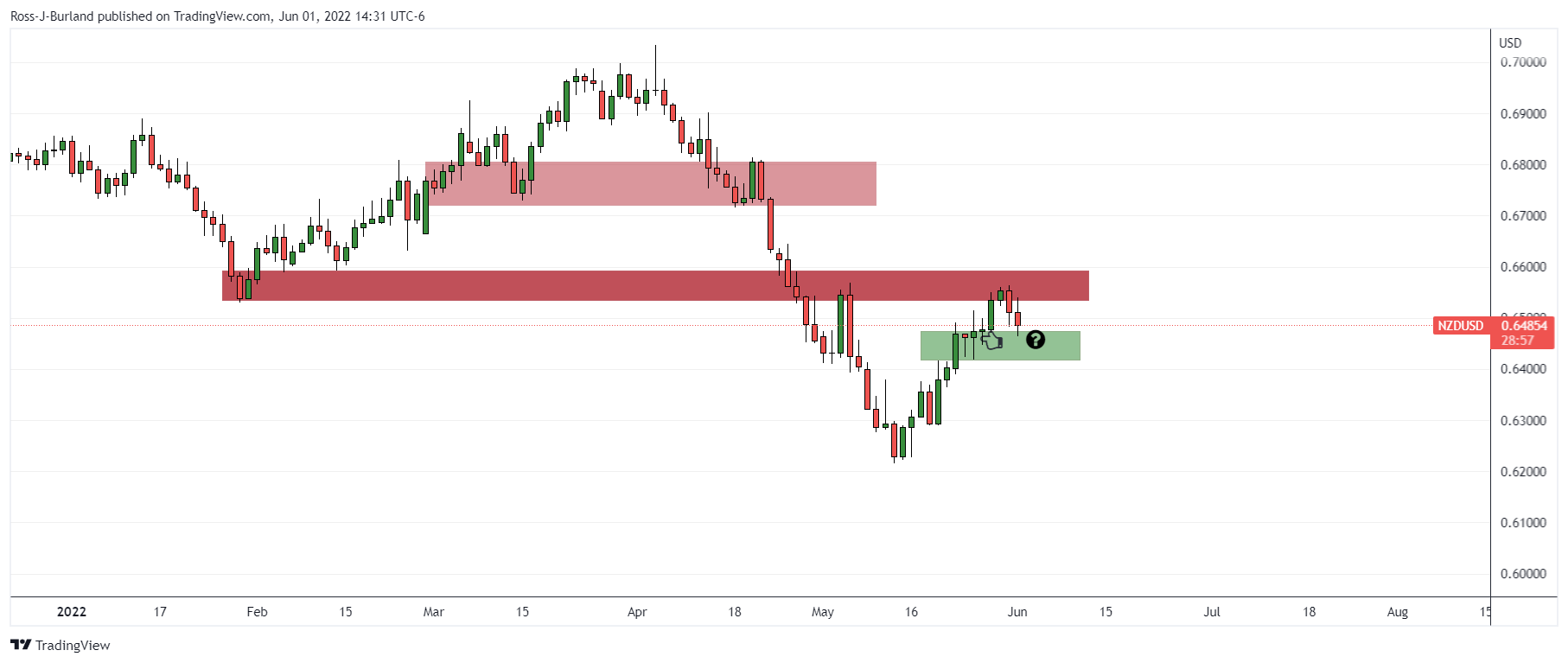
As illustrated, the price has indeed moved towards the support area, so the question is whether the bulls will commit here to throw in the towel, pressured by the bears.
If the bears over-power the bulls, following some initial resistance from the bulls, then the case of a bearish head and shoulders could be made:
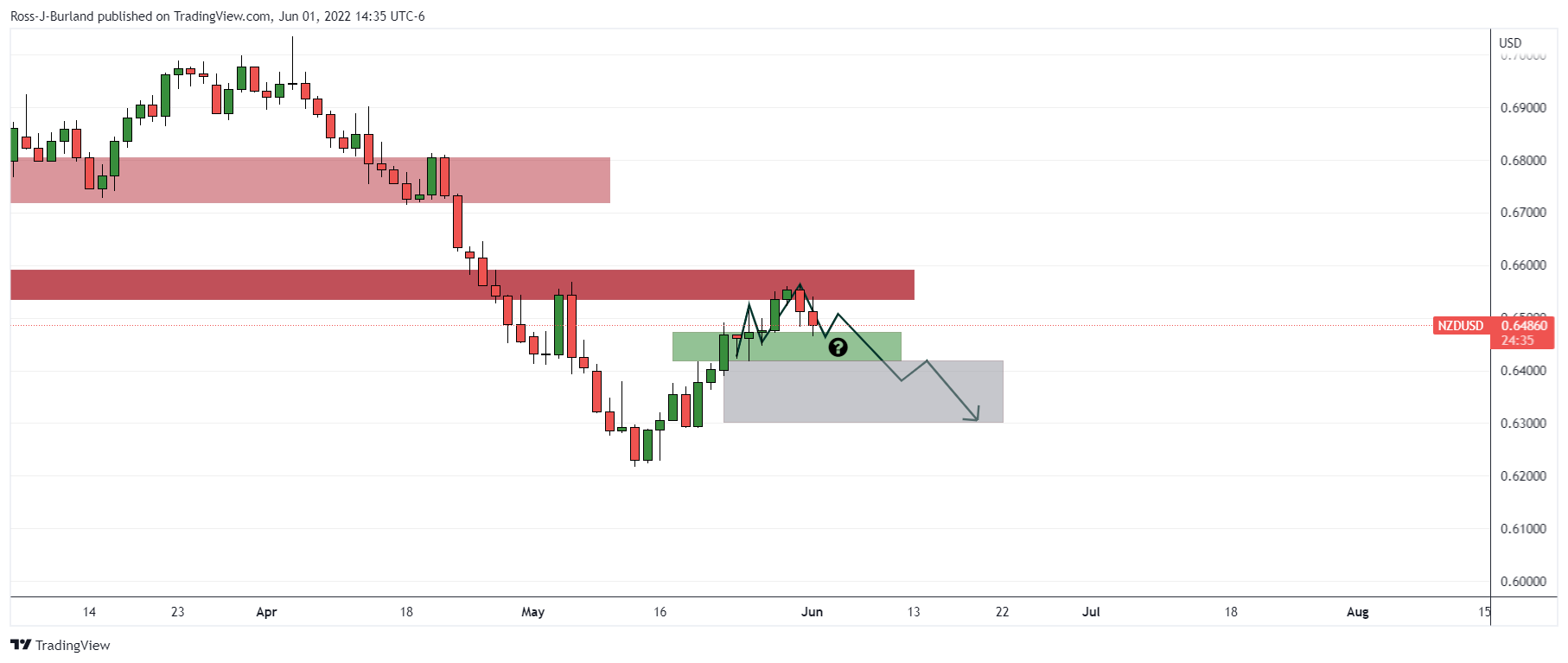
The price imbalance between the prior lows of 0.6417 to the 18 and 19 May support near 0.6290 will be vulnerable to mitigation.
This scenario would coincide with the weekly outlook as follows:
Or, if the bulls do maintain control, the outlook could be very bullish ahead if they can breach the resistance of 0.6564:
Joe Biden is laser-focused on knocking down sky-high gasoline prices, but he has a limited influence to do that and the US President said he cannot take immediate action to bring them down. Biden officials have been openly pleading with Big Oil to pump more despite his campaign efforts to address climate change. Yet, Biden has been draining oil from the SPR at a record pace, urging US oil and gas companies to pump more oil and trying to persuade OPEC to add supply.
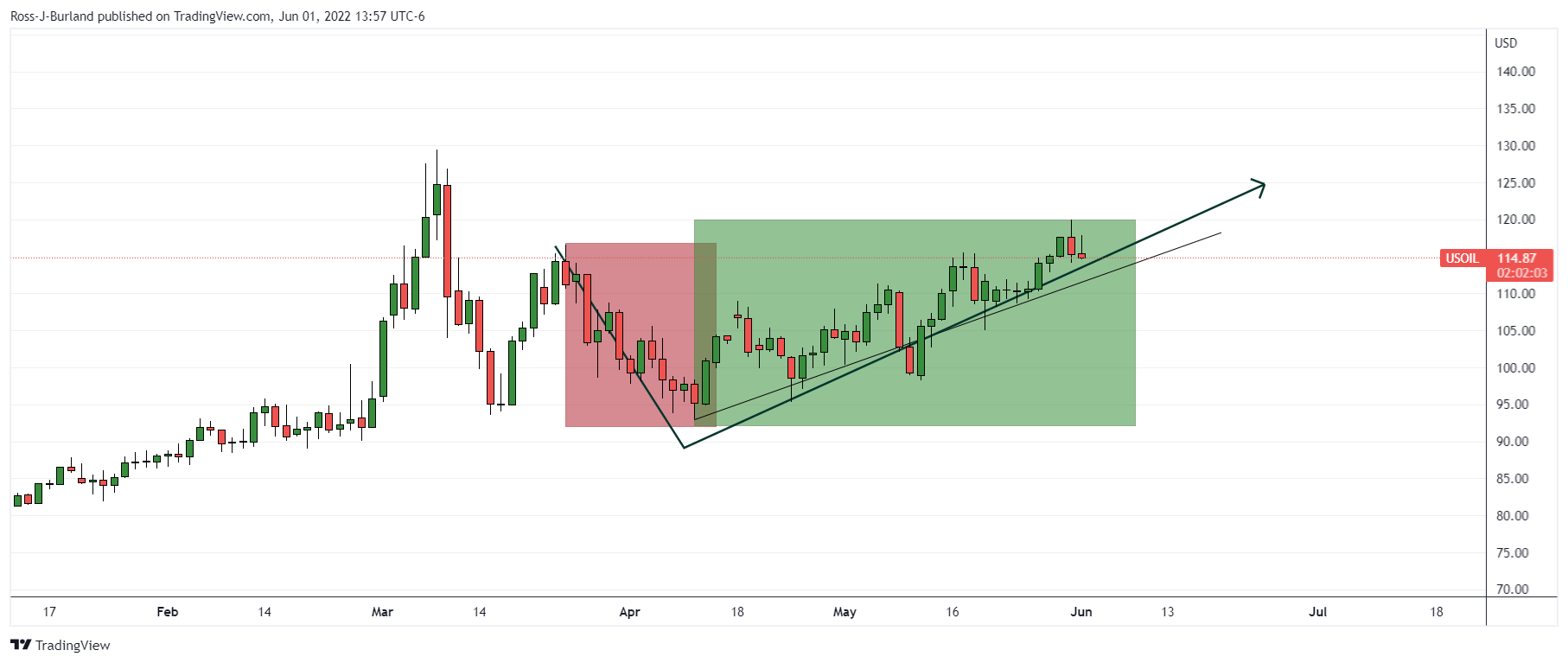
The oil markets were paying attention to Biden's plans in March when he announced a record-setting release of 180 million barrels of oil from the SPR following the disruptions caused by Russia's invasion of Ukraine. However, the relief proved to be temporary and the price of oil is back on the rise:
WTI daily chart
- GBP/USD bulls correcting the avalanche from early NY trade's business.
- US dollar firmer in risk-off tones in the financial markets.
- BoE eyed for later this month, rate hike expected.
At 1.2493, GBP/USD is down over 0.8% on the day and has fallen from a high of 1.2616 to a low of 1.2458. The US dollar has come back into vogue over the last few sessions amid a rise in US yields. The risk sentiment has been on tenterhooks and the pound typically trades as a high beat to the performance of global stocks, regarded as a risky currency due to the twin deficits.
Stocks fell broadly midday Wednesday on worries over aggressive tightening risks. Asian exchanges traded choppily overnight, while European bourses edged lower on the continent. In the US, the US 10-year yield rose more than 9 basis points to 2.939% after the Institute for Supply Management's manufacturing index unexpectedly rose in May, climbing to 56.1 last month from 55.4 in April. The Dow Jones Industrial Average fell by 1.3% to 32,584 and the S&P 500 declined to a low of 4,073.85. This all occurred at the same time that the pound collapsed at the start of the New York session, losing some 140 pips in morning trade.
In line with expectations, the Bank of England (BoE) hiked the Bank Rate by another 25bp to 1.00%. at the start of last month. As expected, attention was on forward guidance and not the rate hike itself which came in slightly dovish. Analysts at Danske Bank, consequently, changed their Bank of England call now expecting three additional 25bp rate hikes (June, August and November vs. 25bp in August and November previously) ''recognising that the Bank of England is probably not ready to slow the rate hike pace just yet.''
''We still see risks skewed towards more rate hikes, as risk is that inflation continues to surprise to the upside.''
On Wednesday, the Bank of England Deputy Governor Jon Cunliffe speaking on Wednesday who said that the central bank was seeing evidence of a slowdown in the housing market.
"We see evidence of a slowdown in the housing market. There are some straws in the wind that show the market is starting to turn," Cunliffe said in an interview with ITV News.
"The Bank expects the economy, that’s already slowing, and we expect it to slow further, to slow quite a lot over next year or so. And I think that will have an impact on the housing market."
GBP/USD technical analysis
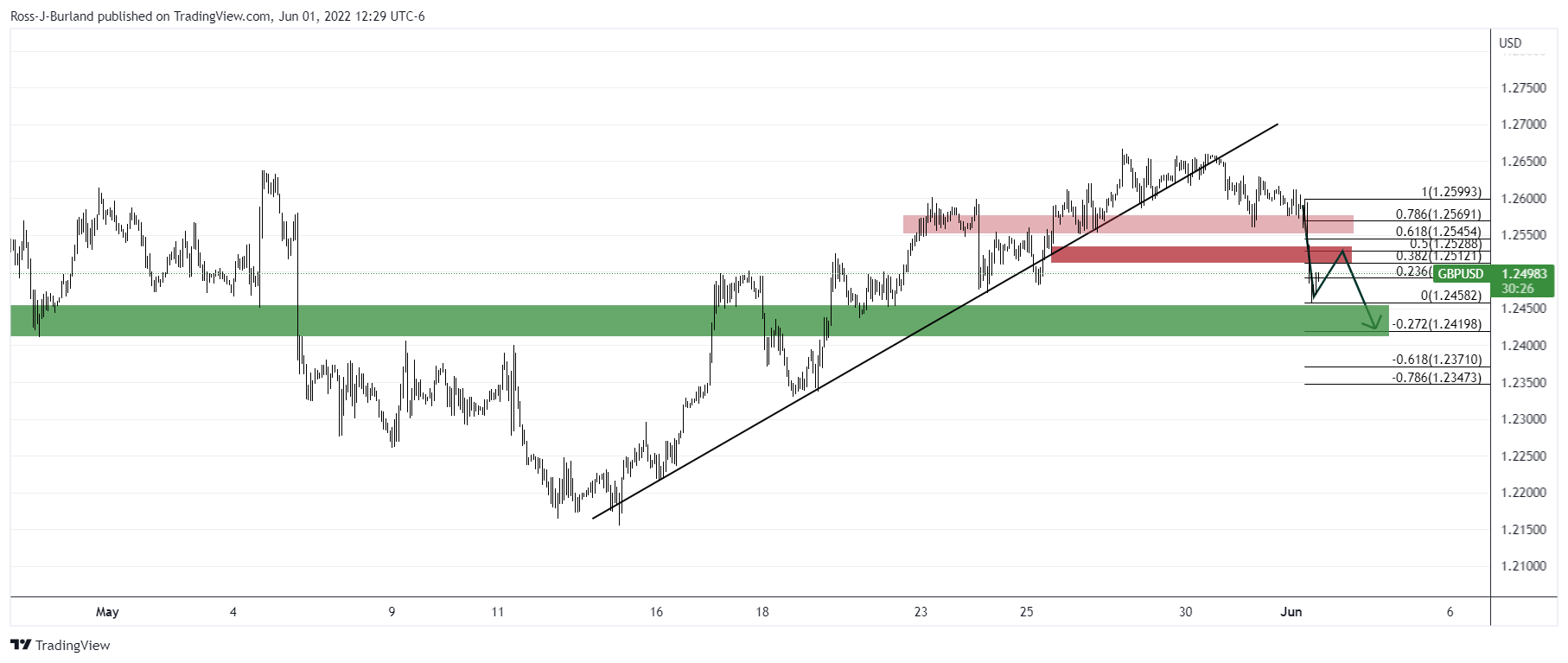
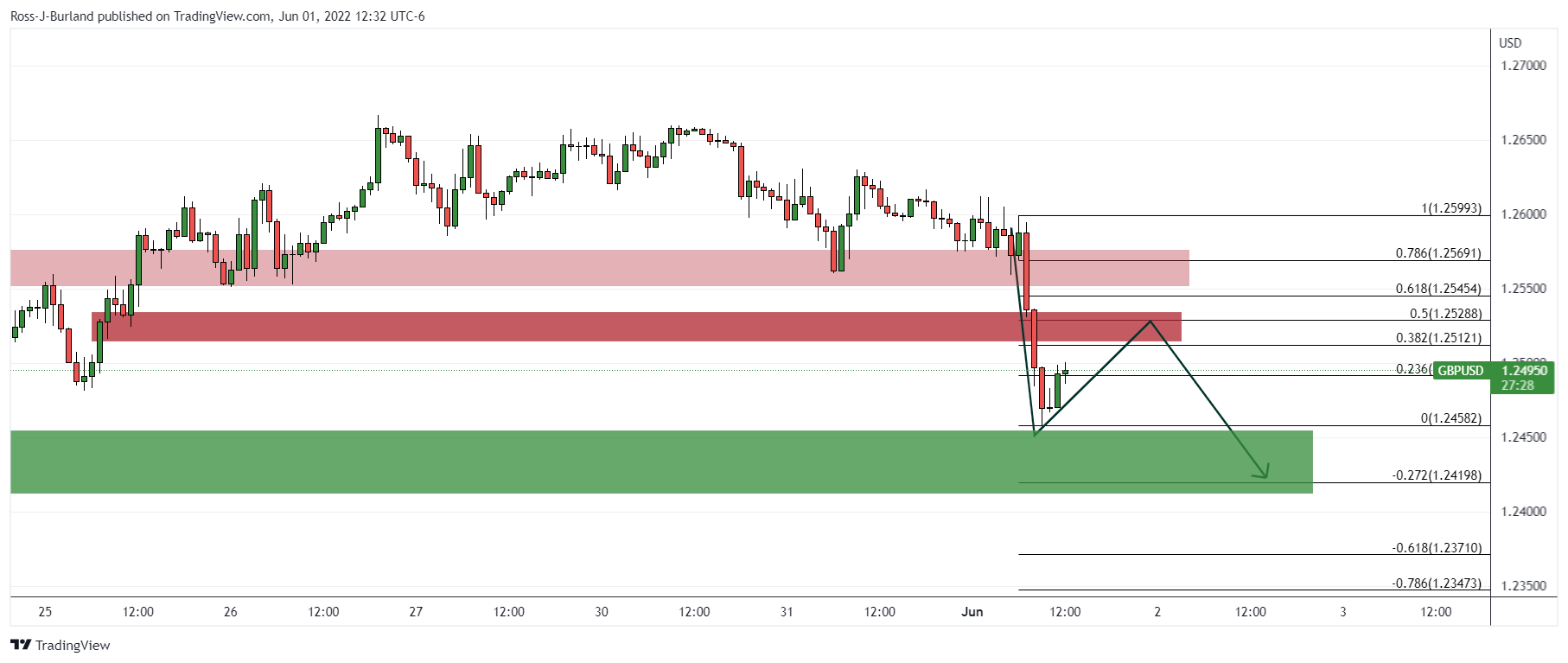
Cable has started to rebound and a 50% mean reversion to restest old support at 1.2524, from May 25 trade, could be on the cards. This would be mitigating some of the price imbalance left behind following the recent bearish impulse:
What you need to take care of on Thursday, June 2:
The American dollar surged during US trading hours as stocks fell and yields advanced. The catalyst was a mixture of upbeat US data boosting the greenback and concerns about a soon-to-come recession.
The focus remained on inflation and growth and whether policymakers would tighten monetary policies further. The latest taking action was the Bank of Canada, which lifted interest rates by 50 bps to 1.5% on Wednesday. Policymakers noted that they are prepared to “act more forcefully if needed” to achieve their 2% inflation target.
Late on Tuesday, Atlanta Fed President Raphael Bostic clarified a potential pause in rate hikes in September should not be understood as the central bank coming to the rescue of markets. On the contrary, he said that by September, some of the uncertainty over the economy could be resolved, and therefore, there could be a “significant reduction in inflation” this year. James Bullard, on the other hand, noted that it’s too early to say inflation has peaked, adding that a pace of 50 bps hike per meeting is a “good plan” for now.
The US ISM Manufacturing PMI rose to 56.1 in May from 55.4 in the previous month, surpassing the market’s expectations. The unexpected increase in activity boosted the dollar while affecting demand for Treasuries. But yields also rose on the back of lingering inflation concerns and rate hikes speculation, with that on the 10-year Treasury note reaching an intraday high of 2.95%.
The US Fed Beige Book brought up some interesting points. All the twelve districts reported continued economic growth, but the majority indicated slight or modest growth. Also, most districts informed of continued price rises, while three districts expressed concerns about a US recession.
Commodity-linked currencies were the best performers against the greenback, as the AUD/USD pair retained gains and settled at around 0.7190, while USD/CAD flirted with 1.2600 before bouncing to the current 1.2630 price zone.
The Japanese yen was the worst performer, as USD/JPY soared to 130.18, holding nearby early on Thursday.
The EUR/USD pair edged sharply lower, ending the day in the 1.0650 price zone, while the GBP/USD settled just below 1.2500.
The focus now shifts to US employment-related data ahead of the Nonfarm Payrolls report to be out on Friday.
Like this article? Help us with some feedback by answering this survey:
Federal Reserve's Tom Barkin has stated that ''you can't find a recession in the data or actions of business execs,'' speaking on Fox Business.
Key quotes
- It's time to normalize.
- Reduction in balance sheet does a little more on top of rate hikes to tighten policy.
- Perfectly comfortable with path of rate hikes for the next couple meetings.
- The stronger the economy, and inflation, the better the case is to do more on rates.
US dollar update
Today, the US dollar is lifted by higher Treasury yields as global inflation worries flared anew. The dollar index (DXY), which measures the currency against six major peers, is rising by 0.8% % to 102.59 at the time of print, extending Tuesday's gains.
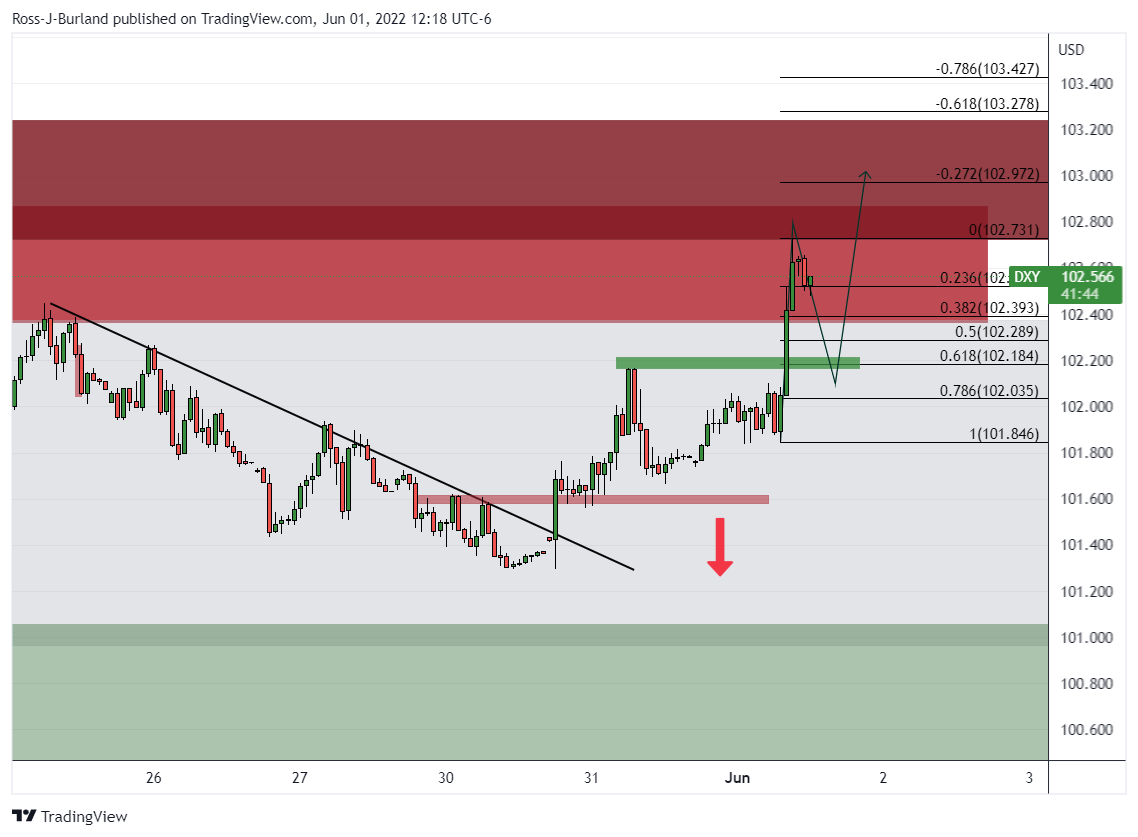
The price is falling towards prior areas of the structure that could be expected to act as a support area in the coming sessions if reached. These happen to align with the key Fibonacci's namely the 38.2% and 61.8% ratios.
- The USD/CHF extends its rally to two consecutive days, up by 0.57%.
- Risk-aversion bosts the appeal for the greenback, while safe-haven peers remain on the defensive.
- USD/CHF Price Forecast: Bulls keeping the major above 0.9600 would open the door for further gains.
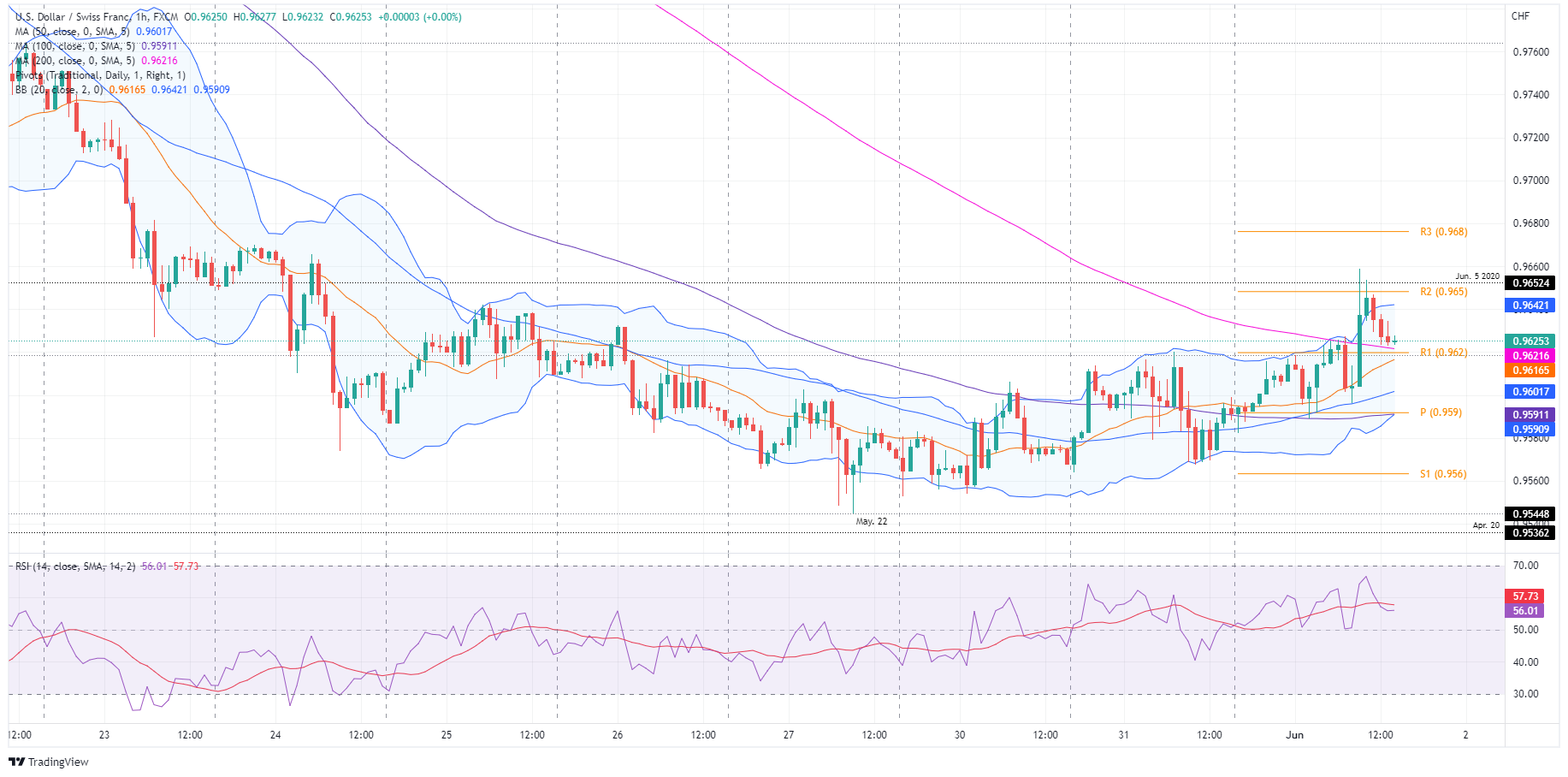
The USD/CHF advances for the second consecutive day though faltering of breaking above June 5, 2020, at 0.9652, but positive in the week, trimming some of last week’s losses by 0.57%. At the time of writing, the USD/CHF is trading at 0.9625, gaining 0.35%.
Sentiment remains negative. Hostilities in the Ukraine-Russia conflict escalated, with the Russian military advancing in an industrial city, via Reuters. Meanwhile, broad US Dollar strength and investors worry that the US Federal Reserve tightening monetary policy conditions could bring the economy into a recession, boosts the USD/CHF.
The US Dollar Index, a gauge of the buck’s value vs. a basket of peers, edges higher by 0.75%, and sits at 102.530. At the same time, US Treasury yields advanced, led by the 10-year benchmark note rate up by nine bps up at 2.937%.
The USD/CHF Wednesday’s price action shows that bulls get some momentum back, lifting the pair from below the 50-day moving average (DMA) at 0.9583, and reaching a daily high at 0.9658. Nevertheless, they lacked the strength to keep the pace but kept the USD/CHF above the 0.9600 mark.
USD/CHF Price Forecast: Technical outlook
The USD/CHF 1-hour chart depicts the pair forming a “saucer-bottom,” a bullish chart pattern. However, the Relative Strength Index (RSI) at 55.62 aims lower, meaning the major is consolidating before resuming upwards. Further confirming the uptrend are the hourly simple moving averages (SMAs), sitting below the exchange rate.
Therefore, the USD/CHF bias is upwards. That said, the USD/CHF first resistance would be the Bollinger band top band at 0.9641. Break above would expose the June 1 high at 0.9658, followed by the R3 daily pivot point at 0.9676.
Key Technical Levels
Reuters recently reported on the Bank of England Deputy Governor Jon Cunliffe speaking on Wednesday who said that the central bank was seeing evidence of a slowdown in the housing market.
"We see evidence of a slowdown in the housing market. There are some straws in the wind that show the market is starting to turn," Cunliffe said in an interview with ITV News.
"The Bank expects the economy, that’s already slowing, and we expect it to slow further, to slow quite a lot over next year or so. And I think that will have an impact on the housing market."
Key notes
- Says we see evidence of a slowdown in the housing market.
- Says we have to ensure that the inflation we are seeing in the economy now doesn’t become the new normal.
- Says interest rates may well have to rise further.
- Says I don’t think we’re heading back to the interest rates of the 1990s.
- Says I am certainly not predicting a crash in house prices.
GBP/USD update
GBP/USD is starting to correct higher and 50% mean reversion to restest old support at 1.2524, May 25, could be on the cards which would be mitigating some of the price imbalance left behind following the recent bearish impulse:
The Federal Reserve's Beige Book report is out and states that the US economy continued to grow in recent weeks, with most Federal Reserve districts "indicating slight to modest growth," down from the "moderate" activity reported in the April.
Effects of higher interest rates and inflation are beginning to show up. Four districts noted that the pace of growth had slowed since the prior period. "Retail contacts noted some softening as consumers faced higher prices, and residential real estate contacts observed weakness as buyers faced high prices and rising interest rates," the report said.
Perhaps more notable, eight of the Fed's 12 districts said expectations of future growth had diminished. Contacts in three of those districts specifically voiced concerns about a recession.
Key notes
- More than half of the districts cited some customer pushback on higher prices.
- Contacts in 2 districts noted rapid price increases continuing; 3 observed it had moderated somewhat.
- While firms generally anticipate wages to rise further over next year, one district indicated firms' expected wage growth has fallen 2 consecutive quarters.
- More than half of the districts cited some customer pushback on higher prices.
- Contacts in 2 districts noted rapid price increases continuing; 3 observed it had moderated somewhat.
- While firms generally anticipate wages to rise further over next year, one district indicated firms' expected wage growth has fallen 2 consecutive quarters.
US dollar update
Meanwhile, the US dollar is higher, lifted by higher Treasury yields as global inflation worries flared anew. The dollar index (DXY), which measures the currency against six major peers, is rising by 0.77% to 102.567 at the time of print, extending Tuesday's gains.

The DXY is reaching into an area of daily resistance where a correction could be on the cards on this hourly chart where the 61.8% ratio meets prior resistance.
- Silver cuts some of its weekly losses but stays losing 1%.
- Risk-aversion underpins the non-yielding metal, alongside the US Dollar
- Positive US economic data keep the greenback tilted to the upside.
- Fed policymakers see 50 bps rate hikes in June and July.
- Silver Price Forecast (XAG/USD): Tilted downwards, though a break above $22.44, would open the door towards the 50-DMA.
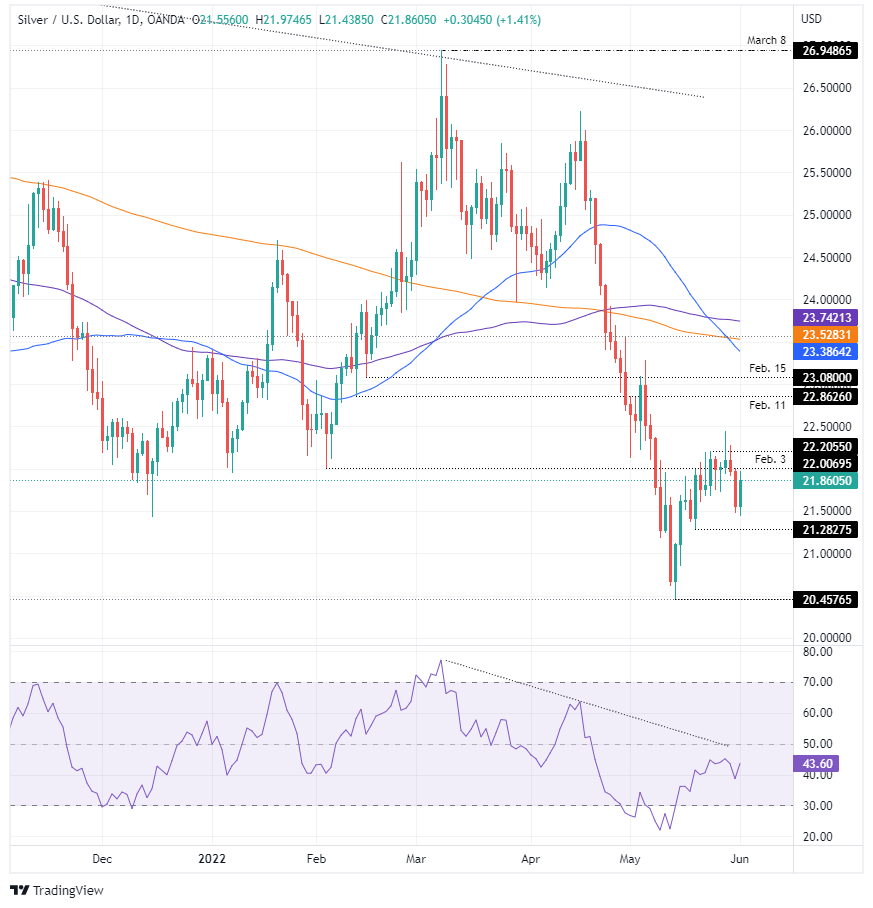
Silver (XAG/USD) snaps two days of losses and rallies above 1.50% in the day amidst a risk-off trading session, courtesy of increasing worries that restrictive monetary policies would threaten to bring the US economy into a recession. At $21.86, XAG/USD is bouncing from weekly lows at around $21.43 as XAG bulls prepare to re-test the $22.00 mark.
The white metal prices are rallying, despite higher US Treasury yields. The rate of the US 10-year T-note is advancing almost ten bps and sits at 2.949%, failing to undermine precious metals. Nevertheless, global equities fall, attributed to higher global bond yields.
Sentiment remains dismal courtesy of the increase of hostilities in the Ukraine-Russia war. Russia’s military advanced in an industrial city, according to Reuters. Meanwhile, the US is preparing to send additional military equipment to Ukraine.
In the meantime, the greenback continues its recovery during the New York session. The US Dollar Index, a measurement of the buck’s value against a basket of six currencies, climbs 0.77%, and sits at 102.557, a level last seen on May 23.
Data-wise, a busy US economic docket featured May’s US ISM Manufacturing PMI, JOLTs openings, and some Fed speakers. The ISM Manufacturing PMI came at 56.1 vs. 55.4 in April, while expectations were near 54.5. Meanwhile, the US JOLTs report showed that openings in April dropped from 11.9 million in March to 11.4 million, a relief for employers who struggle to contract or keep workers.
The St. Louis Fed President James Bullard said that “The current US macroeconomic situation is straining the Fed’s credibility with respect to its inflation target.” Furthermore, he added that the US labor markets and the US economy remain robust, but Russia’s invasion of Ukraine and a sharp slowdown in China means risk remains “substantial.”
Earlier in the day, the San Francisco Fed President, Mary Daly, said that she sees a couple of 50 bps rate hikes and emphasized the Fed’s need to get expeditiously to neutral. She added that the central bank needs to be prepared to do whatever it takes to tame inflation, though it needs to be ready to stop hiking rates if needed.
Silver Price Forecast (XAG/USD): Technical outlook
XAG/USD remains tilted to the downside, further confirmed by the daily moving averages (DMAs), residing above the spot price. If XAG/USD bulls would like to regain control, they would need a break above May’s 27 high at $22.46. Once cleared, that could pave the way for a test of the 50-DMA at $23.38. Otherwise, XAG/USD would remain vulnerable to further selling pressure, as sellers would look for rallies to enter at a better price. In that case, the XAG/USD first support would be June 1 low at $21.43. Break below would expose May’s 19 swing low at $21.28, followed by the YTD low at $20.45.
Key Technical Levels
St. Louis Federal Reserve Bank President James Bullard has crossed the wires in recent trade with comments continuing to come out.
He has explained that inflation at levels last seen in the 1970s and early 1980s is putting the US central bank's credibility at risk and has been reiterating his call for the Fed to follow through on promised rate hikes to bring down inflation, and inflation expectations.
"The current US macroeconomic situation is straining the Fed's credibility with respect to its inflation target," Bullard said in slides prepared for a presentation to the Economic Club of Memphis.
Reuters is reporting on his statements and explained that ''inflation is at more than three times the Fed's 2% target, pushed up by the collision of strong consumer demand and constrained supply of labor and parts.''
''In response, the Fed has raised interest rates by three-quarters of a percentage point this year - a pace critics say is far too timid to bring inflation under control quickly.
But on Wednesday Bullard laid out the case - as he has many times previously - that the Fed has actually tightened monetary policy far more than its actual rate hikes suggest.''
"The Fed still has to follow through to ratify the forward guidance previously given, but the effects on the economy and on inflation are already taking hold," Bullard said.
The US central bank's reduction of its massive balance sheet - a process known as "quantitative tightening" - has already been "partially successful" in pushing up longer-term borrowing costs, he said.
"We'll have to see how this plays out in the months ahead," Bullard added in a virtual appearance before the Economic Club of Memphis. The Fed began trimming its balance sheet this month.
Key notes
- Current US macro situation 'straining' Fed's credibility on inflation.
- Inflation expectations could become unmoored without credible fed action.
- Fed has taken important steps to return inflation to 2%, including rate hikes and promises of more.
- Fed must follow through on forward guidance with rate hikes.
- Effects of Fed's forward guidance on rates already taking hold on economy, inflation.
- Labor markets robust, expect continued GDP growth in 2022, risks remain substantial.
More comments:
- Not advisable to move too quickly in central banking.
- Have already announced we'll raise rates by 50 bps per meeting, that's a good path.
- Want to get to higher policy rate expeditiously.
- If unable to bring inflation under control, could be in for a very long haul.
- Hopeful to bring inflation down to 2% 'very soon'.
- Have hope that special factors driving inflation will abate.
- If pandemic had ended cleanly in 2021 Fed would have acted more quickly.
- I dont think the signals for the need to raise rates were really there until the fall of 2021.
- hopefully will be able to bring inflation down in quarters, years ahead.
- If war remains contained as it is today, i don't see it as a direct drag on US economy.
- QT has been partially successful so far in pushing up on long-term rates.
Market implications
Fed policymakers next meet June 14-15, and the markets have been trying to second guess the central banks next move and the move after that. The sentiment is fickle and the US dollar has been subsequently pushed and pulled in the last week or so along with US yields. Markets have been concerned that the US is headed to a recession, but Bullard says he is sceptical about recession probabilities, which is likely plus for the greenback, vs the likes of the euro.
Today, the US dollar is higher, lifted by higher Treasury yields as global inflation worries flared anew. The dollar index (DXY), which measures the currency against six major peers, is rising by 0.8% % to 102.59 at the time of print, extending Tuesday's gains.
Analysts at MUFG Bank explained that the weakness seen in the Turkish lira is starting to stand out again amongst Emerging Market currencies. They see the USD/TRY moving to the upside over the next months, forecasting it at 18.000 by year-end.
Key Quotes:
“The lira has resumed its slide against the US dollar bringing an abrupt end to the recent period of relative stability from mid-March to early May. Turkey’s weak economic fundamentals have been exacerbated by the negative fallout from the Ukraine invasion leaving the lira even more vulnerable to another sharp adjustment lower.”
“Headline inflation had already surged to 70.0% in April, with PPI elevated at 122%. There has been no indication that the CBRT is willing to act to tightening policy to dampen upside inflation risks. The sharp rise in inflation has resulted in the CBRT’s real policy rate moving deeply into negative territory. The lira is now very vulnerable to a further sharp adjustment lower. It stands in contrast to the hawkish shift taking place globally.”
“Turkey has limited scope to support the lira through intervention reinforcing the bearish trend. The sharp depreciation of the lira in May will bring into focus the unsustainable FX-protected deposit account scheme that will increase costs for the government as the lira weakens and will prove counter-productive in only fuelling heavier lira selling. We have therefore lowered our TRY forecasts notably through to Q1 2023.”
The nearly half-million decline in job openings in April reported on Wednesday, offers further evidence that labor shortages are no longer worsening according to analysts at Wells Fargo. They warn that the 11.4 million job openings at the end of April follows an upwardly revised figure of 11.9 million for March and underscores that the Federal Reserve still has significant work ahead balancing the labor market, inflationary pressures and wages.
Key Quotes:
“Bringing the opening rate back down to Earth has been floated as one means in which the labor market could cool without payrolls going into reverse. The job opening rate fell to 7.0% as labor shortages appear to no longer be worsening. However, the drop came from an upwardly revised 7.3% in March, underscoring that the Fed continues to play catch up and has significant work ahead in generating a more balanced labor market that relieves the inflationary pressures stemming from wages.”
“Job openings are not alone in signaling the labor market has approached a turning point. Small business hiring plans the past few months have fallen to the lowest levels since February 2021, job postings from Indeed have been on a downward slide since December, and consumers' own views of the labor market have more recently rolled over.”
“We look for Friday's jobs report to show payroll gains downshifting from the 428K monthly pace of March and April to 325K in May as demand for workers has started to ease.”
“We look for the unemployment rate to press even lower, including a tick down to 3.5% in the May jobs report. Voluntary turnover and thereby wage growth is likely to remain historically strong as a result, keeping the heat turned up on inflation.”
- The AUD/USD trims its gains but stays positive in the week, by 0.17%.
- Positive Australian Q1 GDP and China’s Caixin PMI data boosted sentiment in the Asian session.
- The greenback rallied due to US ISM Manufacturing surprising to the upside, and job openings dropped.
- AUD/USD Price Forecast: Failure to reclaim the 100-DMA opened the door for further losses.
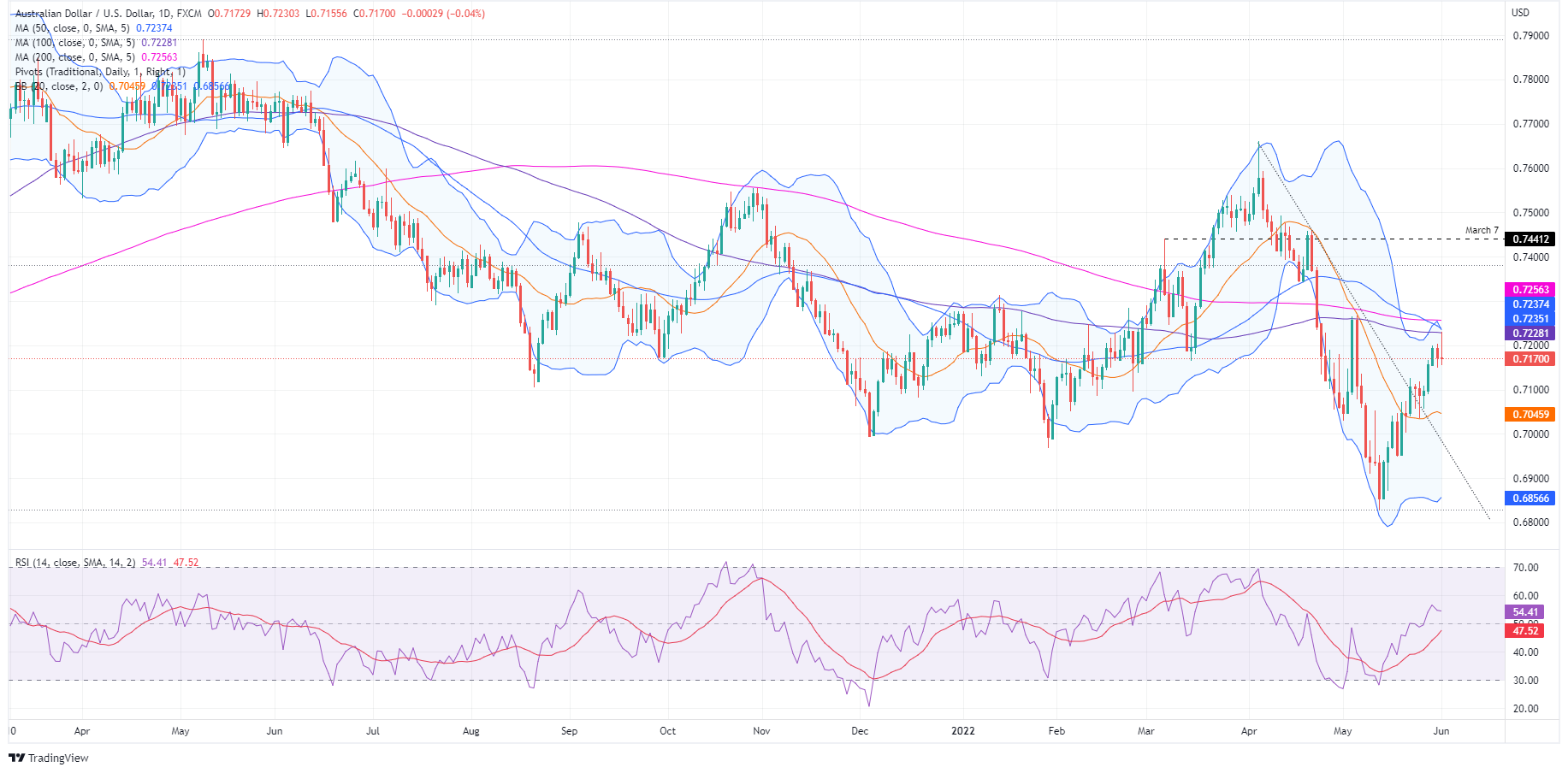
The Australian dollar retreats from weekly highs around 0.7230 and drops 70 pips during Wednesday’s North American session, towards daily lows near 0.7160s. At 0.7170, the AUD/USD is set to extend its losses as sellers prepare to break below the 0.7149 weekly high, aiming to drag the major towards 0.7100.
Negative sentiment and a strong US Dollar weigh on the AUD/USD
A dampened market sentiment, as portrayed by global equities, keeps the AUD/USD extending its losses. Albeit positive data from Australia regarding Q1 GDP, which recovered 0.75% QoQ (3.3% YoY), and China’s Caixin PMI for May aligned with expectations, worries about the US Federal Reserve tightening monetary conditions, could tip the economy into recession.
The market reaction was muted, though, in the middle of the European session, the AUD/USD jumped towards weekly highs around 0.7230s and retreated following the release of upbeat US economic data.
Regarding the US economic docket, the May ISM Manufacturing PMI advanced in May as new orders, and output growth quickened, suggesting that demand remains solid. The reading rose to 56.1 vs. 55.4 in April, while estimations were around 54.5. Meanwhile, the US JOLTs report showed that openings in April fell from 11.9 million in March to 11.4 million, offering some relief for employers who struggle to contract or keep workers.
In the meantime, the US Dollar Index, a gauge of the greenback’s value vs. a basket of six peers, rallies 0.79%, up at 102.584, underpinned by higher US Treasury yields. The 10-year benchmark note rate climbs close to 10 bps and begins June at around 2.944%.
Later in the day, the San Francisco Fed’s President Mary Daly crossed wires and said that she sees a couple of 50 bps hikes and reinforced the need to get rates to neutral expeditiously and would like to be around 2.5% by the end of 2022.
AUD/USD Price Forecast: Technical outlook
The AUD/USD remains downward biased. Failure to reclaim the 100-day moving average (DMA) at 0.7228 spurred a dip below the 0.7200 mark. Also, the Relative Strength Index (RSI), at 54.63, is in bullish territory but begins to aim lower, indicating that some selling pressure could accelerate the fall towards 0.7100.
Therefore, the AUD/USD first support would be the 0.7150 figure. Break below would expose the May 27 low at 0.7089, followed by the 20-DMA at 0.7039. Once cleared, a move towards the 0.7000 psychological figure is on the cards.
Analysts at MUFG Bank, point out that capital outflows from South Korea’s equities market eased in May, helping the won that appreciated versus the dollar. They forecast USD/KRW at 1230.00 by the end of the second quarter, and at 1210.00 by the end of 2022.
Key Quotes:
“KRW’s rebound in May was attributed to capital inflows, with foreign investors buying about a net USD 135mn of Korea equities in the month after a net selling of more than USD 4.9bn in April.”
“As the country’s economy continued to show resilience, improved sentiment helped to support the currency.”
“Amid growing concerns that inflationary pressures could hamper economic growth, the finance ministry on 30th May rolled out a set of measures to tame inflation and stabilize living conditions, including the removal of import duties on key foodstuffs. We expect those measures to help to boost confidence in Korean economy, which in turn will attract renewed capital inflows and support the currency. Having said that, external factors including China’s Covid situation and geopolictical tensions will keep the KRW volatile. Looking ahead, the US dollar’s movement will continue to play a key role in KRW’s movements in the near-term.”
The Bank of Canada, as expected, increased the key interest rate by 50 basis points. Analysts at CIBC, see another 50 basis point hike in July before a slow down in September to a 25bp hike.
Key Quotes:
“Today’s half point rate hike wasn’t a half measure in the Bank of Canada’s battle against inflation, because in short order, we’ll likely see another move of the same magnitude. The 50 basis point move, taking the overnight rate to 1.5%, was well telegraphed, as was the Bank of Canada’s well-reasoned decision to further reduce monetary stimulus. This was yet another larger-than-normal hike, so to justify it, Macklem’s team couldn’t mince words about their concern over inflationary pressures.”
“There was no announced change to its plans for quantitative tightening, which will let its bond holdings roll off with maturities.”
“Our call for another 50 basis point hike in July would fit the definition for the forceful measures it has talked about. There was, however, a threat to act “more forcefully if needed”, and no counterbalancing hint of a potential need to slow the pace of hikes. That runs counter to our forecast that we’ll see signs of a growth deceleration by early fall, allowing the BoC to slow to a 25 bp hike in September, and then a pause before a final quarter point to 2.5% in early 2023.”
“But with another half point hike on tap for July, likely with more stern language from the Bank of Canada, we expect more of May’s flight-to-safety rally in bonds to be reversed over the summer if equities can even manage to level off.”
Analysts at MUFG Bank forecast the Indian rupee will weaken gradually versus the US dollar over the next months. They see USD/INR at 78.500 by the end of the second quarter and at 79.500 by year-end.
Key Quotes:
“The Indian rupee plunged to a new record low of 77.928 against the US dollar in May on the back of mounting investor concerns over both global and domestic growth and inflation. That led to a greater amount of net foreign institutional investment outflows from Indian equities to the tune of USD 4.6bn between 2nd and 25th May based on latest available data versus a net outflow of USD 3.8bn for the entire month of April.”
“The launch of India’s largest IPO in early May did little to boost the rupee, particularly in view of a lukewarm reception from foreign investors. With India’s IPO pipeline drying up amid the challenging global risk environment, inflows into India’s capital markets are expected to dwindle which would lead to greater amounts of net portfolio outflows and have a negative impact on the rupee.”
“The impact of higher oil prices is starting to be evident on India’s trade, with a wider trade deficit seen in April at USD 20.1bn from March’s USD 18.5bn. This trend is likely to persist in the year ahead, leading to wider current account deficits and adding further downward pressure on the rupee.”
- Stocks reverse in Wall Street, Dow Jones down by more than 1%.
- US economic data surpass expectations.
- XAU/USD faces resistance around the $1850 area.
Gold prices bounced from multi-day lows under $1830 to the $1850 area after the beginning of the American session and despite higher US yields. XAU/USD holds near daily highs even as Wall Street extends losses and as the US dollar strengthens.
Earlier on Wednesday gold prices rose sharply finding resistance under $1850. After a pullback to $1838 following the release of better-than-expected US economic, prices turned again to the upside. As of writing, XAU/USD stands at $1849, fresh daily high.
The positive momentum for gold remains intact even despite the negative context for the metal. The US 10-year yield stands at weekly highs at 2.93%. The US dollar trades at daily highs across the board. The DXY is up by 0.80% above 102.55.
The positive US ISM Manufacturing report triggered a decline in equity prices as the figures reinforced expectations of aggressive monetary policy tightening from the Federal Reserve.
Silver is rising by 1.45%, erasing most of Tuesday’s losses. XAG/USD bottomed at $21.44 during the European session and recently peaked at $21.97.
Wednesday’s rally in metal could turn into a reversal if gold manages to break and hold above $1850 and silver does the same with $22.00.
Technical levels
Data released on Wednesday showed an unexpected acceleration in the US ISM Manufacturing PMI Index in May from 55.4 to 56.1. According to analysts at Wells Fargo, the report offers a mixed read on the state of the industry. “Orders and order backlogs are growing at a faster pace. Meanwhile, supplier deliveries are getting better but only incrementally, and inflation pressure is fading but not materially.”
Key Quotes:
“Swooning financial markets and a Federal Reserve bent on raising rates did little to slow activity in the manufacturing sector in May. The ISM manufacturing index rose to 56.1 signaling an even faster pace of expansion than a month earlier. The challenges confronting U.S. industry have not changed: material and input components remain in short supply as do skilled workers.”
“High demand and limited supply are keeping pressure on inflation. The prices paid component held above 80 for the third straight month. While that is blisteringly hot, the 82.2 reading in May is down a couple notches from 84.6 in April.”
“The May employment report is due out on Friday morning and our forecast is for nonfarm payrolls to increase by 325K jobs. Manufacturers have added jobs for 12-straight months, and we see no reason for any sustained disruption to that in a period when orders are still pouring in.”
“With inventories gradually being rebuilt there is some evidence that parts of the supply chain are functioning again.”
- The USD/CAD remains lower in the week, so far down 0.48%.
- The Bank of Canada raised rates and laid the ground for additional hikes.
- May’s US ISM Manufacturing surprised to the upside while price pressures have eased.
The USD/CAD is rising on Wednesday despite a negative knee-jerk reaction to the Bank of Canada's (BoC) decision to hike the overnight rate by 50 bps, lifting it to the 1.50% threshold. USD/CAD soon found its feet, however, and has rallied to 1.2663, snapping a five day losing streak, amidst a dismal market mood, with global equities falling – both factors more supportive of its USD side of the pair.
The USD/CAD dollar jerked lower to a daily low near 1.2600
The BoC lifted rates by 0.50%, using as backdrop high global inflation, driven by elevated energy prices, courtesy of the Russian invasion of Ukraine, China’s Covid-19 related lockdowns, and ongoing supply disruptions. The BoC emphasized that the war “increased uncertainty and put further upward pressure on energy and agricultural commodities prices.”
Regardings Canada’s outlook, the BoC mentioned that Canada’s CPI, at around 6.8% YoY in April, would likely move higher in the near term before showing signs of easing. The central bank noted that inflation continues to broaden, meaning that inflation has nowhere to go but up. The BoC Governing Council added that interest rates would need to rise further and that the central bank’s assessment would guide the pace of hikes. The BoC said it is prepared “to act more forcefully if needed to meet its commitment to achieving the 2% inflation target.”
Market’s reaction
The USD/CAD 1-hour chart shows the pair seesawed in a 44 pip range, between 1.2600-44, with the 20-period simple moving average (SMA) at 1.2644, where it found sellers that put a lid on the USD/CAD's upward reaction. To the downside, USD/CAD found a floor and buying pressure lifted the pair around 1.2600, so that’s the major’s key support level in the near term.
Elsewhere, the US docket revealed the ISM Manufacturing PMI for May, which surprisingly rose to 56.1 in May, from 55.4 in April and beating market forecasts of 54.5. New orders, production, and inventories witnessed jumps while price pressures eased for the second month, from 82.2 vs. 84.6.
USD/CAD Price Forecast: Technical outlook
Overall, the USD/CAD remains pressured to the downside, but USD/CAD buyers are lifting the pair above the 200-day moving average (DMA), which lies at 1.2659. Nevertheless, it’s worth noting that although they are lifting the major upwards, aiming towards 1.2700, solid ceiling levels loom ahead at around 1.2700.
If USD/CAD reaches 1.2700, its first line of resistance would be the 100 DMA at 1.2695. A break above that would send the pair towards the 50 DMA at 1.2708, followed by the May 27 high at 1.2783.
On the other hand, the USD/CAD's first support would be the 200 DMA. A breach of the latter would expose the Bollinger's bottom band at 1.2607.
- US dollar gains momentum amid risk aversion and higher US yields.
- April ISM Manufacturing PMI rises unexpectedly.
- EUR/USD approaches support area of 1.0640.
The EUR/USD broke to the downside after trading for hours in the range between 1.0730-1.0700 and dropped to 1.0650, hitting the highest level since May 25. The pair remains under pressure as the US dollar benefits from higher US yields and risk aversion.
Stocks and Treasuries slide
After a positive opening, equity prices in Wall Street reversed sharply following the release of US data. The better-than-expected figures keep the Federal Reserve on track for aggressive rate hikes.
The ISM Manufacturing PMI rose in May to 56.1 from 55.4 in April, above the 54.5 of market consensus. The unexpected increase in activity boosted the dollar and weakened the demand for Treasuries. The US 10-year yield jumped from 2.84% to 2.93%, the highest level since May 22 and the 30-year climbed to the weekly high at 3.08%.
In Wall Street, the Dow Jones is falling by 0.75% and the Nasdaq drops 0.43%. The negative turn in equity prices boosted further the dollar. The DXY is up by 0.70%, hovering around 102.50, the highest in a week.
From a technical perspective, the area between 1.0640/50 is a strong support; below the next target stands at 1.0605. If EUR/USD manages to hold above 1.0650, the euro could rebound initially to 1.0700. Above the next resistance is seen at 1.0735.
Technical levels
- WTI is a little higher on the day in the $116s, though still below Tuesday’s near-$120 highs.
- The WSJ speculated that Russia might leave OPEC+ and some other OPEC+ might up output.
- For now, Russia/OPEC+ supply woes, tight global markets, rising summer demand in the US/Europe are keeping prices supported.
Oil prices have stabilised pulling back slightly from multi-week highs hit on Tuesday. Front-month WTI futures were last trading higher by just under $1.0 on Wednesday in the $116s per barrel, having slipped back after coming close to hitting $120 on Tuesday. The pullback was sparked by a WSJ report that some OPEC+ producers are exploring the idea of excluding Russia from the OPEC+ production pact as a result of the impact of Western sanctions over Russia’s invasion of Ukraine.
The report said that while there has not yet been a push by the rest of OPEC+ to make up for the recent fall in Russian output, some Gulf nations had begun planning to increase output in the coming months. Against the backdrop of a very tight global crude oil market as North America and Europe head into peak driving season, additional supply from OPEC+ members would be welcomed by major oil-consuming nations.
Further tightening the market in the near term is the reopening of the Chinese economy as Covid-19 infections fall and lockdowns ease. Indeed, lockdowns in Chinese megacity and financial hub Shanghai have now ended after two months. For these reasons, as well as the anticipation that Russia’s oil production woes might worsen in the months ahead after the EU agreed to phase out 90% of their imports from the nation by the end of this year, many oil bulls remain confident that prices are set to remain elevated in the near future.
Indeed, WTI marked a sixth successive monthly gain on Tuesday after posting a more than $11 gain in May to close the month in the $115s. Over the course of these six months, WTI has leapt by around $50 per barrel. That is the best winning streak in more than a decade. A significant easing of global oil supply woes plus a further slowdown in global growth will likely be needed in order to see this bull run snapped and WTI fall sustainably back below $100 per barrel.
There were 11.4 million job openings in the US at the end of April, the latest JOLTs survey released on Wednesday showed. That was a decline from March's record-high number of 11.8 million job openings, but in line with consensus forecasts. The data shows that the demand for labour remained very healthy at the start of Q2 2022, as evidenced by the fact that there is still well over one job opening per unemployed person in the US at the moment.
Market Reaction
The robust JOLTs data, alongside a stronger than expected ISM Manufacturing PMI report, has given the buck a boost in recent trade.
- Headline ISM Manufacturing PMI unexpectedly rose to 56.1 from 55.4 in May.
- The strong data boosted the buck across the board.
The headline ISM Manufacturing Purchasing Manager's Index (PMI) rose to 56.1 in May from 55.4 in March versus expectations for a small decline to 54.5, according to the latest release by the Institute for Supply Management (ISM).
Subindices:
The Prices Paid Index fell slightly to 82.2 in May from 84.6 in April.
The New Orders Index rose to 55.1 from 53.5.
The Employment Index fell to 49.6 from 50.9, the first drop back below 50 since August 2021.
Market Reaction
The stronger than expected US economic data which alludes to a pick up in growth in May versus expectations for a moderation in growth has lifted the US dollar, with the DXY jumping from under 102.10 to session highs in the 102.30s in recent trade.
The Bank of Canada (BoC) lifted interest rates by 50 bps from 1.0% to 1.50% on Wednesday, a move that had been expected by most analysts, with a minority calling for a larger 75 bps hike.
According to the BoC's latest statement on monetary policy, the bank is prepared to "act more forcefully if needed" to achieve its 2.0% inflation target, in light of the risk of elevated inflation becoming more entrenched having risen. Moreover, the BoC said that inflation will likely move even higher in the near term before beginning to ease. The bank said it continues to judge that interest rates will need to rise further.
Regarding the economy, the BoC said that Canadian economic activity is strong and the economy is clearly operating in excess demand. Q2 growth is expected to be solid given robust consumer spending, as well as given expectations of strengthening exports. Moreover, activity in the Canadian housing market is moderating from exceptionally high levels.
The BoC said it plans to continue its policy of quantitative tightening and said that the Ukraine war has increased uncertainty and is putting further upwards pressure on prices for energy and agricultural commodities.
Market Reaction
The loonie saw some kneejerk weakness given the fact that money markets had been pricing in some probability of a more hawkish 75 bps rate hike. USD/CAD was last trading in the 1.2640s, about 20 pips higher versus pre-BoC announcement levels, though still flat on the day.
- A combination of supporting factors pushed USD/JPY to a two-week high on Wednesday.
- The technical set-up favours bullish traders and supports prospects for additional gains.
- Any meaningful pullback could be seen as a buying opportunity near the 129.00 mark.
The USD/JPY pair gained positive traction for the third successive day and climbed to a two-week high, around the 129.60 region on Wednesday. The risk-on impulse undermined the safe-haven JPY and acted as a tailwind amid modest US dollar strength.
From a technical perspective, the overnight move up confirmed a breakout through a descending trend-line extending from a two-decade high touched in May. The said resistance coincided with the 38.2% Fibonacci retracement level of the 121.28-131.35 rally.
The subsequent move beyond the 23.6% Fibo. level and the 129.00 round-figure mark could be seen as a fresh trigger for bulls. Given that oscillators on the daily chart have again started gaining traction, the set-up supports prospects for additional gains.
Hence, some follow-through strength, back towards reclaiming the 130.00 psychological mark, now looks like a distinct possibility. The momentum could get extended and push spot prices to the next relevant hurdle near mid-130.00s en-route the 130.80 area.
On the flip side, any meaningful pullback could be seen as a buying opportunity near the 129.00 mark. This, in turn, should help limit the downside near the daily swing low, around the 128.60 region. The latter should act as strong support for the USD/JPY pair.
Failure to defend the aforementioned support levels might prompt some technical selling and make the USD/JPY pair vulnerable to retesting sub-128.00 levels. The downfall trajectory could eventually drag spot prices towards the 127.40-127.35 confluence resistance breakpoint.
USD/JPY daily chart
-637896883087651105.png)
Key levels to watch
- GBP/USD recently fell to fresh session lows under the 1.2550 level amid focus on the weakening UK economy.
- Upcoming US data on Wednesday (ISM Manufacturing PMI) and Friday (jobs) will be worth watching and could spur fresh downside.
- A widening Fed/BoE policy and UK/US growth differentials suggests further downside is possible, with technicals also taking a bearish turn.
GBP/USD is on the back foot on Tuesday ahead of the release of key US data, despite US yields easing back from earlier session highs and US equities trading in the green, both factors that might normally lift the pair. Cable was last trading at session lows underneath the 1.2550 level and eyeing a run lower towards its 21-Day Moving Average in the mid-1.2400s, with the pair seemingly instead being driven by concerns about the weakening UK economy once again.
Final UK Manufacturing PMI data for May showed that manufacturing activity in the UK expanded at its weakest pace rate since January 2021, as producers of consumer goods struggled amid the worst cost-of-living crunch in multiple decades. Meanwhile, though the latest Nationwide house price data showed another jump in prices last month, a slowdown in the market is expected, the mortgage lender said.
At 1400GMT, US ISM Manufacturing PMI survey data for May is slated for release and should paint a comparatively more constructive picture of the health of the US economy, which could add further downside to GBP/USD. But the key data out this week will be Friday’s US labour market report. Any signs of easing inflation pressures from this week’s data might be a negative for the buck as it eases pressure on the Fed to tighten so aggressively.
However, the Fed is still set to be substantially more hawkish in the coming quarters than the BoE, with the UK’s economic outlook much more fragile than in the US. Technical selling might also be at play on Wednesday, with GBP/USD looking like it has broken the bullish uptrend of the last few weeks. That potentially means that, in the weeks ahead, a retest of May’s sub-1.2200 lows is on the cards.
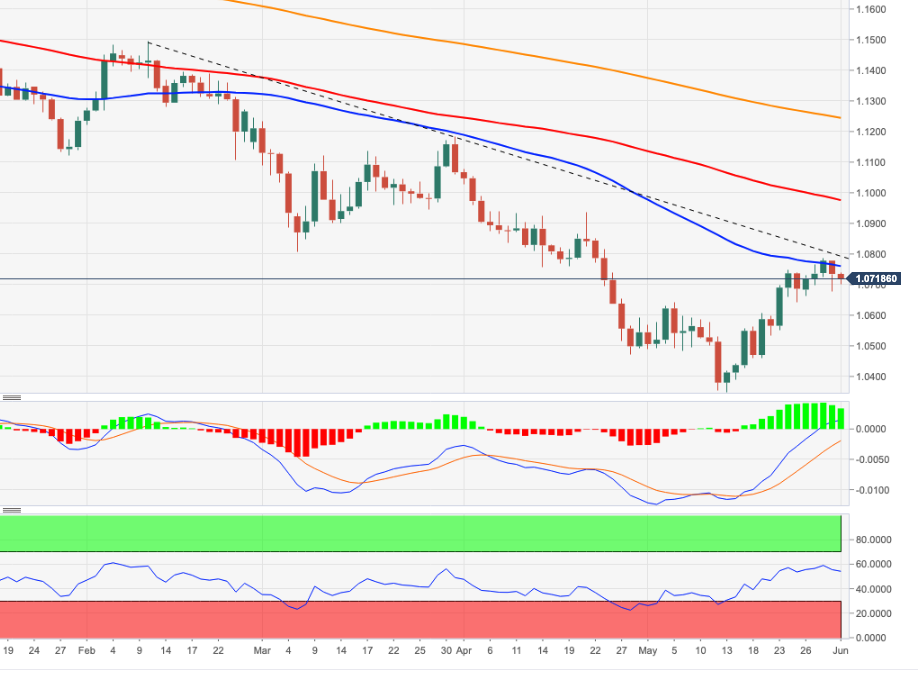
- EUR/USD appears under pressure in the low-1.0700s.
- The resistance line around 1.0790 caps the upside so far.
EUR/USD remains slightly on the defensive, although it manages well to keep the trade above the 1.0700 m ark so far on Wednesday.
The surpass of the 3-month resistance line, today around 1.0790, should see the downside pressure subsided and this could spark a fresh bout of strength in the near term. Against that, the next target of note then emerges at the weekly high at 1.0936 (April 21).
In the longer run, the pair’s bearish view is expected to prevail as long as it trades below the 200-day SMA at 1.1242.
EUR/USD daily chart
GBP/USD remains depressed below the 1.26 mark. Economists at Scotiabank highlight the key levels to watch on the cable.
The mid-1.25 area stands as support
“The pound’s failure to extend its rally past the mid-1.26s over the past few days and a break under its upward-sloping trendline since mid-May leaves the GBP-bullish picture looking weaker, but with a still broadly positive trajectory.”
“Resistance is ~1.2630 followed by firmer at 1.2660/70 (the Fri and Mon highs) and then the big figure.”
“The mid-1.25 area is support followed by the big figure zone.”
EUR/USD holds 1.07. A break below here would point to a possible reversal of some of the recent gains, according to economists at Scotiabank.
Resistance stands at 1.0740/50
“The low 1.07s and the figure area remain key support for the currency followed by yesterday’s intraday low of 1.0680 and the mid-1.06s.”
“A daily close under 1.07 would point to a possible reversal of some of the EUR’s recent gains.”
“Resistance stands at 1.0740/50 ahead of the Monday high of 1.0787.”
S&P 500 maintains a bullish “Marubozu” breakout above key resistance at 4091/28. Thus, analysst at Cerdit Suisse stay biased towards a deeper corrective move higher, with next key resistance at 4278/4314.
Short-term support at 4091/51 expected to hold
“S&P 500 posted a bullish “Marubozu” breakout on Friday above the price high and gap at 4091/4128, which confirms a short-term base to signal a more profound recovery, supported by the turn higher in daily MACD momentum.”
“We expect the market to extend the recovery to the 63-day average at 4272/4314, where we would be alert to a potential cap. At most, we can see the recovery extending towards the 200-day average and potential downtrend from the 2022 high at 4453/4510, however we have more confidence in a cap here.”
“We view this short-term recovery as corrective in nature, with the medium-term picture still pointing towards an eventual turn back lower. For now though, near-term support is seen at the recent ‘breakaway gap’ at 4091/51, which we look to hold to maintain the near-term upward pressure.”
- DXY adds to the weekly rebound on Wednesday.
- A sustainable breakout of 102.00 remains elusive so far.
DXY adds to Tuesday’s advance, although the bullish attempt ran out of steam around 102.10 so far midweek.
The upside momentum in the index seems to lack strength so far, and the inability to spark a more serious rebound could prompt sellers to return to the market and shift the focus to a potential test of the 55-day SMA, today at 101.22.
As long as the 3-month line around 100.85 holds the downside, the outlook for the index should remain constructive.
Looking at the longer run, the outlook for the dollar is seen constructive while above the 200-day SMA at 96.89.
DXY daily chart
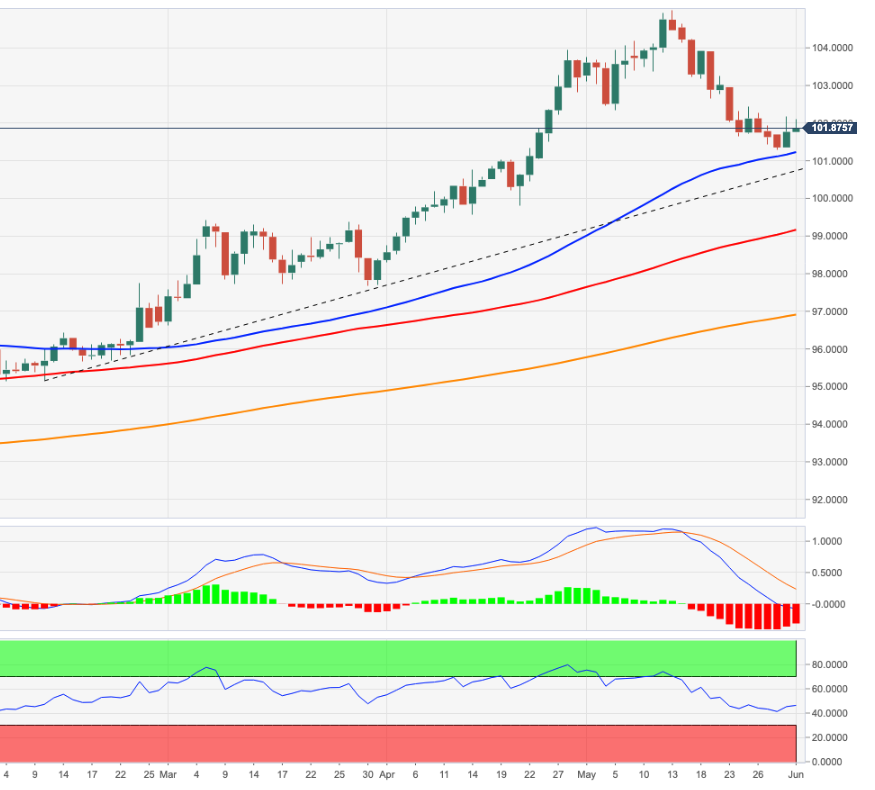
BoC Monetary Policy Decision – Overview
The Bank of Canada (BoC) is scheduled to announce its monetary policy decision this Wednesday at 14:00 GMT. The Canadian central bank is widely expected to hike its benchmark interest rate by another 50 bps for the first time since May 2000 to control spiralling inflation. Apart from this, investors will take cues from the accompanying monetary policy statement in the absence of the post-meeting press conference.
Analysts at TD Securities (TDS) offered a brief overview of the event and explained: “With little uncertainty around the decision itself, the focus will shift to the policy statement where we expect a hawkish tone. The Bank will note that growth and inflation are both tracking above the April MPR, and repeat that rates will need to rise further.”
How Could it Affect USD/CAD?
Ahead of the key release, the USD/CAD pair dropped to its lowest level since April 22 amid bullish crude oil prices, which tend to underpin the commodity-linked loonie. A more hawkish BoC stance would be enough to provide an additional boost to the Canadian dollar and continue exerting downward pressure on the major. Conversely, a neutral stance might do little to impress bullish traders, though modest US dollar strength could lend some support to the pair.
From current levels, the 1.2600 round-figure mark is likely to act as immediate support, below which the USD/CAD pair seems all set to accelerate the fall towards the 1.2530-1.2525 region. This is closely followed by the 1.2500 psychological mark, which if broken decisively would be seen as a fresh trigger for bearish traders and ave the way for an extension of the downward trajectory.
On the flip side, any meaningful recovery attempt might now confront stiff resistance near the 1.2675-1.2685 confluence support breakpoint. The said area comprised of the 100-day SMA and the 61.8% Fibonacci retracement level of the 1.2459-1.3077 move up. Some follow-through buying, leading to a subsequent move beyond the 1.2700 mark could lift the USD/CAD pair towards the 1.2730-1.2735 hurdle, en-route the 1.2770 supply zone.
Key Notes
• BOC Preview: USD/CAD set to tumble on hawkish hike and optimal conditions for bears
• BoC Preview: Forecasts from six major banks, hawkish hike
• USD/CAD to stay below 1.2700/50 as BoC is committed to fight inflation – ING
About the BoC Interest Rate Decision
BoC Interest Rate Decision is announced by the Bank of Canada. If the BoC is hawkish about the inflationary outlook of the economy and raises the interest rates it is positive, or bullish, for the CAD. Likewise, if the BoC has a dovish view on the Canadian economy and keeps the ongoing interest rate, or cuts the interest rate it is seen as negative, or bearish.
- Gold Price continues to decline following Tuesday's drop.
- XAUUSD could suffer additional losses in case $1,840 is confirmed as resistance.
- US Treasury bond yields edge higher toward 3% ahead of US data.
Gold Price stays on the back foot mid-week pressured by rising US Treasury bond yields and the renewed dollar strength. The near-term technical outlook suggests that XAUUSD could suffer additional losses with the 200-day SMA turning into resistance.
Focus shifts to US data
Investors await the May ISM Manufacturing PMI. The US economic docket will feature April Construction Spending and JOLTS Job Openings data as well. Finally, the US Federal Reserve will release its Beige Book. In case the 10-year US T-bond yield manages to build on its weekly gains and push toward 3%, gold could find it difficult to attract buyers. It's also worth noting that the Federal Reserve Bank of St. Louis' hawkish president James Bullard is scheduled to deliver a speech at 17:00 GMT.
Also read: Gold Price Forecast: XAUUSD eyes a retest of the $1,800 mark, US data in focus.
Inflation fears weigh on Gold Price
Although the latest Personal Consumption Expenditures (PCE) Price Index data from the US revived optimism that inflation may have peaked in April, analysts grow increasingly concerned over prices remaining uncomfortably high for longer than expected. In an interview with CNN's Wolf Blitzer on Tuesday, US Treasury Secretary Janet Yellen admitted that she was wrong about the path that inflation would take. Yellen further noted that they cannot rule out further inflationary shocks amid rising energy prices.
Inflation fears
On the same matter, Federal Reserve policymaker Raphael Bostic told MarketWatch that the Fed wants to move its policy rate to a range of 2% to 2.5% toward the end of 2022. Bostic added that he would be "fully comfortable" lifting rates into a range that could restrict growth if inflation were not moving down significantly at that point. In turn, the benchmark 10-year US T-bond yield is already up more than 4% this week, forcing gold to lose interest.
Reflecting the positive impact of rising US yields on the dollar's market valuation, the US Dollar Index, which closed the previous two weeks in negative territory, is already up 0.8% since Monday above 102.00. The ISM manufacturing PMI survey's Prices Paid component is forecast to rise to 86.2 in May from 84.6 in April. A stronger-than-expected increase in input prices could dampen hopes of a steady decline in inflation and allow the dollar to continue to gather strength. In such a scenario, XAUUSD could extend its weekly slide.
Meanwhile, the central bank of Russia argued that a possible seizure of its frozen reserves as part of Western sanctions could cause other central banks to rethink their saving strategies. "One could expect an increase in demand for gold and a decline in the US dollar's and the euro's role as reserve assets," the bank said in its financial stability report. Nevertheless, these remarks failed to help XAUUSD gain traction.
Gold Price technical outlook
Gold Price turned bearish in the near term after having closed below the critical 200-day SMA on Tuesday. Furthermore, the Relative Strength Index (RSI) indicator on the daily chart edged lower to 40, suggesting that sellers look to dominate the price action.
On the downside, $1,810, the end-point of the downtrend that started mid-April, aligns as the next bearish target before $1,800 (psychological level).
$1,840 (200-day SMA) aligns as initial resistance. In case XAUUSD reclaims that level and starts using it as support, buyers could take action and trigger another leg higher. In that case, $1,850 (Fibonacci 23.6% retracement of the downtrend) and $1,865 (static level) could be seen as the next hurdles.
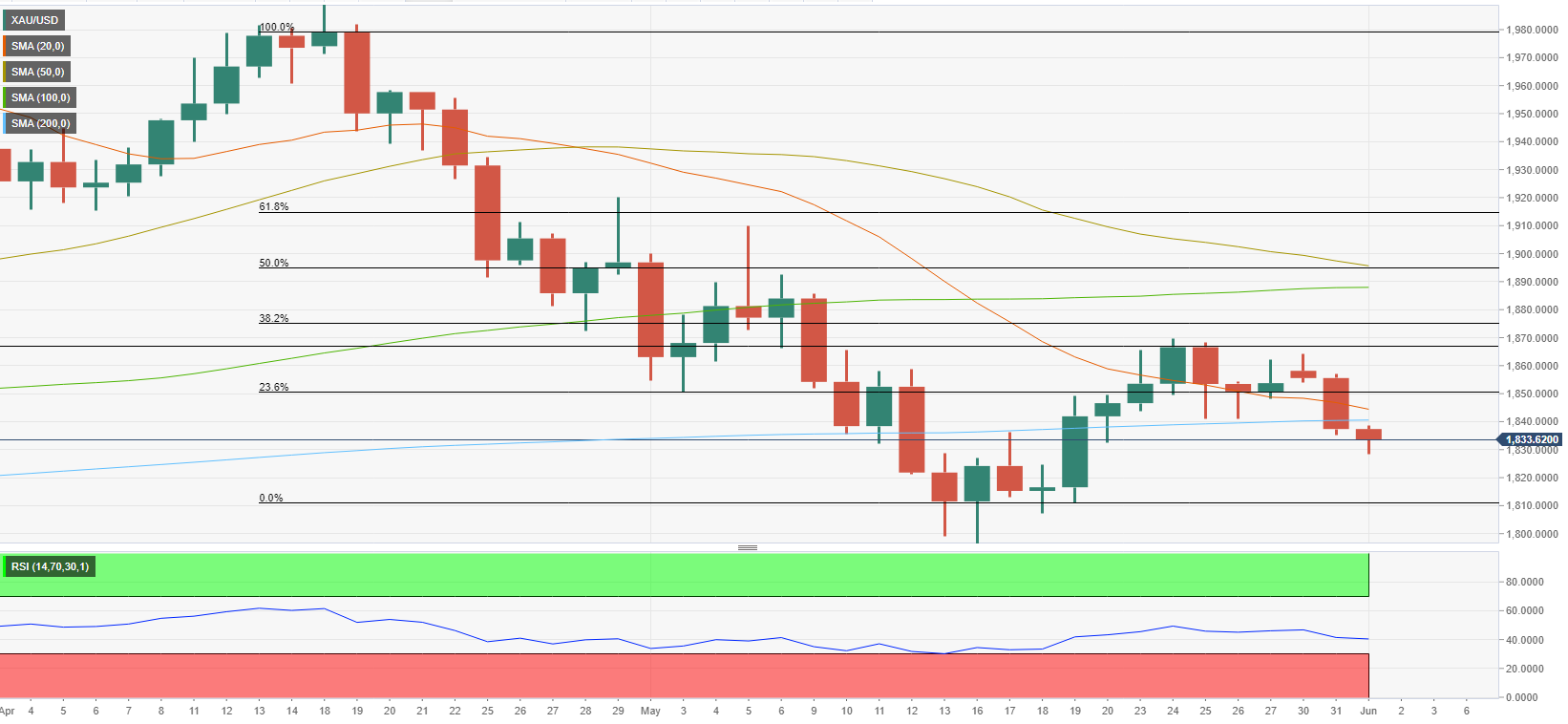
Gold Price and the commodity supercycle
- NZD/USD has recovered from an Asia session dip to the 0.6470s to the 0.6520s ahead of US ISM Manufacturing PMI.
- Conditions are likely to remain somewhat subdued ahead of Friday’s official job report.
- If risk appetite continues to stabilise, NZD/USD around 0.6500 or even extending towards 0.6600 makes sense for now.
NZD/USD has rebounded back to the 0.6525 area following a bout of selling pressure during Asia Pacific trade that saw the pair dip as low as the 0.6470s. No one specific fundamental catalyst was behind the overnight drop, with markets instead broadly in wait-and-see mode ahead of the release of a barrage of key US data points in the coming days. At current levels, the pair is trading with gains of about 0.2% on the day, though is very slightly in the red on the week.
NZD/USD traders will be on the lookout for the release of the ISM Manufacturing PMI survey for May at 1400GMT on Wednesday. The closely scrutinised report will provide a timely insight into the health of the US industrial sector and the inflationary/supply chain pressures it is facing. A key theme in FX markets in recent weeks has chatter about inflation in the US having peaked and, thus, the hawkishness of Fed policy tightening expectations having also peaked.
These themes have weighed on US yields and the buck in recent sessions (though both are higher this week). The upcoming data will thus be viewed in the context of these themes. But traders probably won’t want to place any big FX market bets on Wednesday given the proximity to the release of the May official labour market report on Friday. Nonetheless, should risk appetite continue to stabilise as has been the case in recent weeks, NZD/USD holding in the 0.6500 area or even extending on to 0.6600 makes sense for now.
US ISM Manufacturing PMI overview
The Institute of Supply Management (ISM) will release its latest manufacturing business survey result, also known as the ISM Manufacturing PMI at 14:00 GMT this Wednesday. The index is anticipated to edge down to 54.5 in May from 55.4 in the previous month. The gauge will provide a fresh update on the manufacturing sector activity and the health of the economy as a whole amid signs of slowing global growth.
As Joseph Trevisani, Senior Analyst at FXStreet, explains: “The drastic drop in new orders in the last four months suggests that the US consumer has already begun to pullback on discretionary spending for factory goods. Manufacturing is considered a leading indicator for the economy as a whole. The decline does not bode well for second quarter growth.”
How could it affect EUR/USD?
Ahead of the key release, rising US Treasury bond yields offered some support to the US dollar, which, in turn, dragged the EUR/USD pair lower for the second successive day. A stronger US macro data could result in even higher US bond yields and a stronger USD. Conversely, the weaker-than-expected print would fuel concerns about softening economic growth. This could dampen the risk sentiment and underpin the greenback's safe-haven status. This suggests that the path of least resistance for the pair is to the downside.
Eren Sengezer, Editor at FXStreet, offered a brief technical outlook and outlined important technical levels to trade the major: “The ascending trend line coming from mid-May reinforces the 1.0700 psychological level. Although the pair dropped that support several times on Tuesday, it is yet to post a four-hour close below it. In case that happens, sellers could show interest and trigger an extended slide toward 1.0660 (static level) and 1.0620 (200-period SMA).”
“On the upsşde, the 20-period SMA forms interim resistance at 1.0740 ahead of 1.0780 (static level) and 1.0800 (psychological level),” Eren added further.
Key Notes
• US ISM Manufacturing PMI May Preview: Gloom persists despite an US expanding economy
• EUR/USD Forecast: Sellers could take action if 1.0700 support fails
• EUR/USD set to retest its recent lows close at the 1.0350 mark – Rabobank
About the US ISM manufacturing PMI
The Institute for Supply Management (ISM) Manufacturing Index shows business conditions in the US manufacturing sector. It is a significant indicator of the overall economic condition in the US. A result above 50 is seen as positive (or bullish) for the USD, whereas a result below 50 is seen as negative (or bearish).
- EUR/JPY extends the rebound to the 139.00 neighbourhood.
- Further upside should now target the YTD peak around 140.00.
EUR/JPY pushes higher and advances to new highs in the boundaries of the 139.00 mark on Wednesday.
The cross left behind the May high at 138.30 and is now poised for the continuation of the bounce with the initial target at the 2022 top at 140.00 (April 21).
In the meantime, while above the 2-month support line near 135.00, the short-term outlook for the cross should remain bullish.
EUR/JPY daily chart
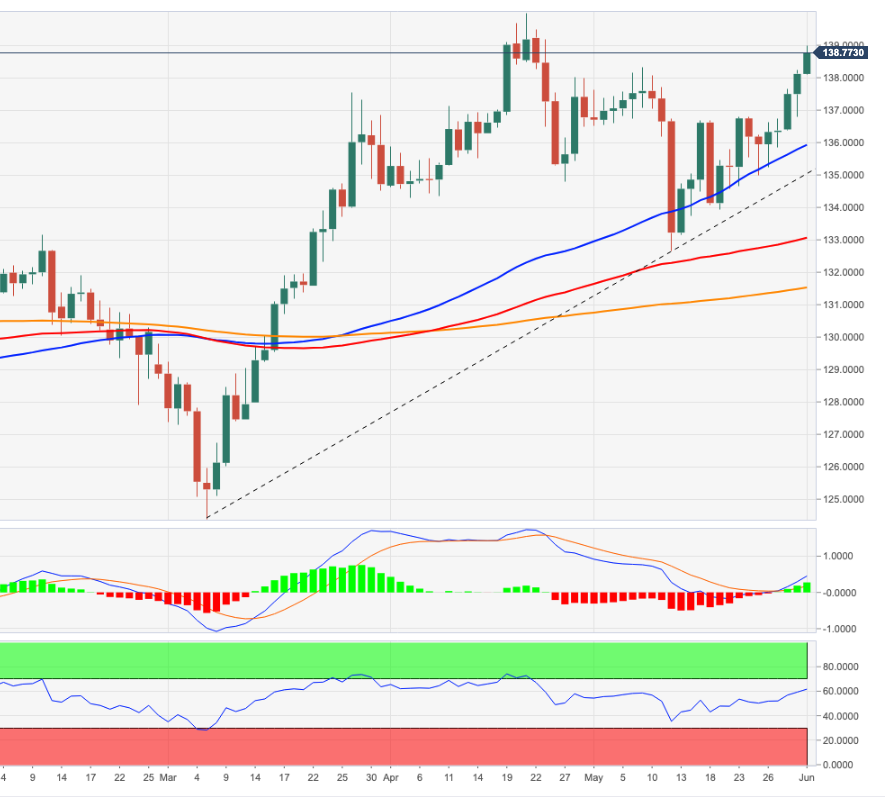
USD/JPY is up for the third straight day and trading at the highest since May 18. Economists at BBH believe that the pair could climb as high as the January 2002 high near 135.15.
Bank of Japan remains ultra-dovish
“Clean break above 129.45 sets up a test of the May 9 high near 131.35. However, we continue to look for our long-standing target of the January 2002 high near 135.15.”
“We continue to believe Governor Kuroda will maintain current loose policy through the end of his term in spring 2023, leaving it to Prime Minister Kishida to appoint a more hawkish successor to start the tightening cycle.”
Safe-haven demand is likely to be heightened in the months ahead. In the view of economists at Rabobank, this is suggestive of further bouts of USD strength, which could drag the EUR/USD pair down to recent lows in the coming month.
Only scope for a move towards the 1.10 area on a 12-month view
“We see risk that the US is heading into recession, likely in 2023. While weaker growth in the US will also impact expectations regarding the pace and extend of Fed rate rises. The USD’s function as a safe haven currency suggests that it is likely to retain a firmer profile for longer.”
“We see risk of another attempt at the recent lows close to EUR/USD 1.0350 in the coming months and see scope for only a moderate move towards the 1.10 area on a 12-month view.”
USD/JPY has unexpectedly surged higher over the past few sessions to negate its top and now looks as though it has completed a bullish continuation pattern. Thus, analysts at Credit Suisse expect the pair to move back quickly toward the 131.35 highs.
USD/JPY confirms a bullish “wedge” pattern
“USD/JPY now looks as though it has formed a clear bullish ‘wedge’ continuation pattern, which signals a quick move up to the 131.35 high, realigning the short-term setup with our long-term bullish view. Above here would open up 132.30/39 next and eventually our next core medium-term objective at 135.00/135.20.”
“Near-term support moves to 128.47/30. More important support is seen at the recent low at 126.39/37 and the 55-day average, which we now look to hold. Next important support below here is seen at the 125.11/124.87 pivot, which includes the 38.2% retracement of the rally from late February.”
In the United States and the eurozone, wages are now rising much less than prices. Economists at Natixis believe that the resulting loss of purchasing power is unsustainable cannot continue. There are then three possible scenarios to stabilise purchasing power.
Public transfer payments
“Wage growth remains low and inflation remains high. Wage-earners, therefore, do not obtain any improvement in their bargaining power, and monetary policy does not combat inflation effectively. In this first scenario, purchasing power is supported by public transfer payments to households. This policy’s limit is obviously its high cost for public finances if they have to bear the full cost of the increase in commodity prices.”
Restrictive monetary policy
“Wage growth remains low, but central banks drive down inflation with a sufficiently restrictive monetary policy. It is a fall in inflation obtained thanks to higher interest rates that gives purchasing power back to wage earners. The problem with this strategy is that to obtain a significant fall in inflation, it requires a markedly higher rise in interest rates than is currently expected The risk with this strategy obviously relates to the significant rise in interest rates: higher borrowing costs for governments, leading to more restrictive fiscal policies; collapse in asset prices; fall in investment and growth.”
Wage re-indexation
“Inflation remains high, as monetary policy remains not very restrictive, and purchasing power is protected by a re-indexation of wages to prices. The risk with this strategy is clear: if wages track prices perfectly and if prices track labour costs perfectly, equilibrium inflation after an inflationary shock becomes very high, as was seen in the early 1980s.”
- A combination of factors assisted AUD/USD to regain positive traction on Wednesday.
- The technical set-up favours bullish traders and supports prospects for further gains.
- Sustained break below the 0.7145 support zone is needed to negate the positive bias.
The AUD/USD pair attracted some dip-buying on Wednesday and inched back closer to over a three-week top touched the previous day, with bulls still awaiting a sustained move beyond the 0.7200 mark.
The Australian dollar drew some support from the better-than-expected Q1 GDP print, which raised bets for an outsized 40 bps rate hike by the Reserve Bank of Australia at its upcoming meeting next week. Apart from this, a generally positive risk tone was seen as another factor that benefitted the risk-sensitive aussie, though modest US dollar strength kept a lid on any further gains for the AUD/USD pair.
From a technical perspective, the overnight downfall stalled near the 38.2% Fibonacci retracement level of the 0.7662-0.6829 downfall. The said support, around the 0.7150-0.7145 region now coincides with the lower boundary of an ascending channel extending from the YTD low touched in May and should act as a pivotal point. A convincing break below will shift the bias in favour of bearish traders.
Some follow-through selling below the 200-period SMA on the 4-hour chart, currently around the 0.7120 region, will reaffirm the negative bias and make the AUD/USD pair vulnerable. Spot prices might then weaken further below the 0.7100 mark and accelerate the fall towards the next relevant support near the 23.6% Fibo. level, near the 0.7025-0.7020 region, en-route the 0.7000 psychological mark.
Meanwhile, oscillators on daily/4-hour charts are holding comfortably in the positive territory and support prospects for additional gains. That said, it will still be prudent to wait for a sustained move beyond the 0.7200 mark before placing fresh bullish bets. Any subsequent move up, however, is likely to confront resistance near the 100-day SMA, around the 0.7235-0.7245 region.
The said barrier also represents the 50% Fibo. level and is closely followed by the 200-day SMA, near the 0.7260 zone. A convincing breakthrough the latter would be seen as a fresh trigger for bullish traders and pave the way for an extension of a near three-week-old upward trajectory.
AUD/USD 4-hour chart
-637896817141252416.png)
Key levels to watch
- Gold is trading around $1830, having dropped back below its 200DMA as the buck/US yields rise pre-key US data releases.
- Gold bulls want to see evidence of weakening US growth/inflationary pressures and a paring of Fed tightening bets.
As the rise in longer-term US bond yields enters its third day, with the 10-year yield now up around 17 bps versus last week’s lows around 2.70%, and as the US Dollar Index’s recovery from this week’s multi-month lows extends, spot gold (XAU/USD) prices have not surprisingly come under pressure. XAU/USD was last trading around the $1830 per troy ounce mark, below its 200-Day Moving Average at $1840 and taking losses on the week to around 1.1%.
Key upcoming US economic data is in focus, the most important release being Friday’s May labour market report, though traders will also closely scrutinised Wednesday’s ISM Manufacturing PMI survey that is slated for release at 1400GMT. Gold bulls want to see evidence that inflationary pressures are backing off, meaning people will be watching the Prices Paid subindex of Wednesday’s ISM PMI survey and the wage growth component of Friday’s jobs report.
Any such evidence will lessen the pressure on the Fed to tighten monetary policy settings quite so aggressively beyond the planned 50 bps rate hikes at the June and July meetings. Gold bulls will also want to simultaneously see evidence of a slowing US economy, as this further spurs the demand for safe-haven assets (like gold) and reduces pressure on the Fed to hike. In the best-case scenario of weak/less inflationary data in the coming days, if that also spurs a drop once again in the US dollar/US yields, XAU/USD might well recover back to the north of its 200DMA and the $1850 mark.
- USD/CAD continued with its struggle to capitalize on modest intraday recovery gains.
- An uptick in oil prices underpinned the loonie and acted as a headwind for the major.
- The downside seems cushioned amid sustained USD buying and ahead of the BoC.
The USD/CAD pair surrendered modest intraday gains and slipped below mid-1.2600s during the first half of the European session, back closer to over a one-month low touched the previous day.
Crude oil prices edged higher on Wednesday and reversed a major part of the overnight retracement slide from a near three-month high amid worries over a tighter global supply. European Union leaders agreed to a partial and phased ban on oil imports from Russia. Apart from this, expectations of demand recovery in China acted as a tailwind for the black liquid. This, in turn, undermined the commodity-linked loonie and capped the USD/CAD pair's attempted recovery move.
On the other hand, a generally positive risk tone forced the safe-haven US dollar to trim a part of its strong intraday gains. This was seen as another factor that attracted some intraday selling around the USD/CAD pair. That said, rising US Treasury bond yields should help limit the downside for the buck and lend support to the major. Investors might also refrain from placing aggressive bets and prefer to wait on the sidelines ahead of the Bank of Canada monetary policy decision.
The Canadian central bank is widely expected to hike interest rates by another 50 bps. Hence, the focus would remain on the accompanying monetary policy statement. Traders will further take cues from the US economic docket, featuring the release of ISM Manufacturing PMI and JOLTS Job Openings later during the early North American session. This, along with the US bond yields and the market risk sentiment, will influence the USD and provide some meaningful impetus to the USD/CAD pair.
Technical levels to watch
Economist at UOB Group Ho Woei Chen, CFA, reviews the latest PMI releases in the Chinese economy.
Key Takeaways
“China’s official manufacturing and non-manufacturing Purchasing Manager’s Indexes (PMIs) remained in contraction in May amid prolonged pandemic lockdowns in Shanghai but the stronger-than-expected rebound from Apr suggests that China can recover quickly as lockdowns are being lifted. We expect to see further recovery in Jun.”
“The employment outlook for both the manufacturing and non-manufacturing sectors have remained weak in May despite a broad recovery in the PMIs while supply disruption is still evident. A stronger fiscal and monetary policy response remains necessary to bring the Chinese economy back to recovery.”
“Chinese blockbuster data release for May is on 15 Jun and we will be revising our GDP forecast for China at that point. A further contraction in key data such as industrial production and retail sales in May would suggest China’s GDP contracting in 2Q22.”
- EUR/USD extends the corrective downside near 1.0700.
- The greenback regains poise amidst higher yields.
- ECB’s Lagarde, US ISM Manufacturing next of note in the docket.
The offered bias remains well and sound around the European currency and puts EUR/USD under pressure near the 1.0700 mark on Wednesday.
EUR/USD focuses on Lagarde
EUR/USD sheds ground for the second straight session, as the recovery in the greenback appears to have picked up extra pace on Wednesday.
Indeed, the downtick in the pair comes amidst further rebound in US yields along the curve, while the German 10y Bund yields reached new 3-week tops past 1.15%.
No reaction around the euro after ECB’s Holzmann favoured once again hiking rates by 50 bps against the current backdrop of elevated inflation figures.
In the calendar, final figures showed the German Manufacturing PMI improve a tad to 54.8 in May and tick lower to 54.6 when it comes to the broader Euroland. Still on the latter, the Unemployment Rate remained at 6.8% in April. Later in the session, Chairwoman Lagarde will speak at a BIS event.
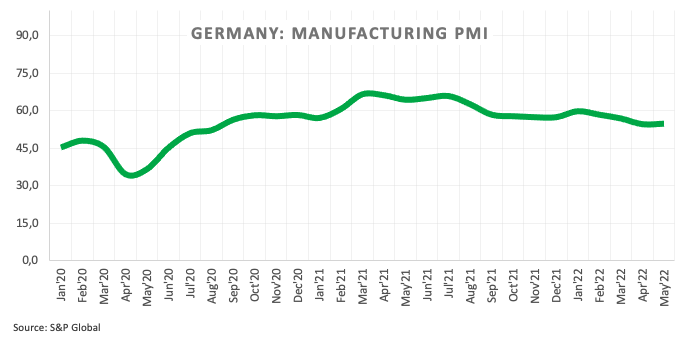
Across the pond, MBA Mortgage Applications, the final Manufacturing PMI, the ISM Manufacturing, Construction Spending and the Fed’s Beige Book are all due along with speeches by FOMC’s Williams and Bullard.
What to look for around EUR
EUR/USD’s bounce off 2022 lows near 1.0350 (May 13) has been so far underpinned by unusual hawkish ECB-speak leaning towards an initial rate hike as soon as in July, while the consensus view that the bond-purchase programme should end at some point in early Q3 has also lent legs to the European currency.
In addition, the renewed selling bias in the greenback has also collaborated with the multi-cent upside in the pair, as investors appear to have already pencilled in a couple of 50 bps rate hikes at the June and July gatherings.
However, EUR/USD is still far away from exiting the woods and it is expected to remain at the mercy of dollar dynamics, geopolitical concerns and the Fed-ECB divergence, while higher German yields, elevated inflation and a decent pace of the economic recovery in the euro bloc are also supportive of an improvement in the mood around the euro.
Key events in the euro area this week: Germany Unemployment Change, Unemployment Rate, EMU Flash Inflation Rate (Tuesday) – Germany Retail Sales, Final Manufacturing PMI, EMU Final Manufacturing PMI, ECB Lagarde (Wednesday) – Germany Balance of Trade, Final Services PMI, EMU Retail Sales, Final Services PMI (Friday).
Eminent issues on the back boiler: Speculation of the start of the hiking cycle by the ECB as soon as this summer. Asymmetric economic recovery post-pandemic in the euro area. Impact of the war in Ukraine on the region’s growth prospects.
EUR/USD levels to watch
So far, spot is retreating 0.08% at 1.0722 and a breach of 1.0678 (weekly low May 31) would target 1.0641 (low May 25) en route to 1.0532 (low May 20). On the other hand, the next up barrier emerges at 1.0786 (monthly high May 30) followed by 1.0936 (weekly high April 21) and finally 1.0974 (100-day SMA).
- GBP/USD edged lower for the second successive day amid strong follow-through USD buying.
- Rising US bond yields and the worsening global economic outlook underpinned the greenback.
- Looming recession fears weighed on the British pound and contributed to the intraday selling.
The GBP/USD pair struggled to capitalize on the previous day's late rebound from the 1.2560 area and came under some renewed selling pressure on Wednesday. This marked the second successive day of a negative move and was sponsored by sustained US dollar buying.
The US dollar gained some follow-through traction and recovered further from over a one-month low amid rising US Treasury bond yields, bolstered by Fed Governor Christopher Waller's hawkish remarks. Speaking at an event in Frankfurt, Waller backed a 50 bps rate hike for several meetings until inflation eases back toward the central bank’s goal. This, in turn, pushed the yield on the benchmark 10-year US government bond to a nearly two-week high, which, along with the worsening outlook for the global economy acted as a tailwind for the safe-haven buck.
The markets now seem sceptical that central banks can hike interest rates to curb inflation without impacting economic growth. This, along with concerns that the global supply chain disruption would push consumer prices even higher, continued weighing on investors' sentiment. Meanwhile, worries about the cost of living crisis, which the Bank of England cautioned could push the UK into recession later this year, weighed on the British pound. Furthermore, the UK-EU impasse over the Northern Ireland protocol supports prospects for further losses for the GBP/USD pair.
Furthermore, the British government's legislation - that would effectively override parts of a Brexit deal - has raised fears about a trade war. This, along with expectations that a jumbo rate hike by the BoE would take its toll on the UK economy, adds to the grim outlook for sterling. The fundamental backdrop seems tilted firmly in favour of bearish traders, suggesting that any attempted recovery move could still be seen as a selling opportunity. Traders now look forward to the US macro data - ISM Manufacturing PMI and JOLTS Job Openings - for some impetus.
Technical levels to watch
- Unemployment Rate in the euro area remained steady at 6.8% in April.
- EUR/USD continues to fluctuate in a tight range above 1.0700.
The monthly data published by Eurostat showed on Wednesday that the Unemployment Rate in the euro area and the EU stayed unchanged at 6.8% and 6.2%, respectively, in April. Markets were expecting the euro area Unemployment Rate to edge lower to 6.7%.
"Eurostat estimates that 13.264 million men and women in the EU, of whom 11.181 million in the euro area, were unemployed in April 2022," the publication further read. "Compared with April 2021, unemployment decreased by 2.543 million in the EU and by 2.175 million in the euro area."
Market reaction
The EUR/USD pair showed no immediate reaction to this report and was last seen losing 0.12% on the day at 1.0720.
The dollar has continued to find some support on Wednesday. In the view of economists at ING, data resilience and higher yields should lay the basis for a re-strengthening of the dollar.
USD finds fresh support
“We expect the dollar to find some consolidation and possibly inch higher against most G10 peers for the rest of the week, with the weak bond environment offering a short-term supporting driver (the yen is set to remain the main victim here) and US data still supporting the Fed tightening story and offering a longer-term bullish USD argument.”
“DXY may advance to the 103.00 area in the run-up to the 15 June FOMC meeting.”
The Bank of Canada (BoC) is set to raise interest rates for a third consecutive meeting. Economists at ING expect 50bp by the BoC today, but 75bp is possible. Regarding the loonie, the USD/CAD pair is unlikely to climb above the 1.2700/50 region.
Strong macro picture means that a 75bp move cannot be excluded
“50bp is our base case scenario for today, given the strong economy (and an outlook helped by high commodity prices) and jobs market, as well as elevated inflation. Against such a macroeconomic backdrop, we don’t exclude a 75bp move.”
“As we see a 50bp hike as more likely, there are some downside risks for CAD today, as markets may have to price some 10-20bp out of the CAD swap curve.”
“We think that the BoC will reiterate a very strong commitment to fighting inflation and allow markets to consolidate their bets on at least another 50bp hike in July and a terminal rate around 3.0%. Ultimately, this should put a floor under the loonie, and may not depreciate beyond the 1.2700/1.2750 area even if the 75bp bets have to be scaled back today.”
See – BoC Preview: Forecasts from six major banks, hawkish hike
- Gold edged lower for the second straight day and dropped to a nearly two-week low on Wednesday.
- Rising US bond yields continued lending support to the USD and drove flows away from the XAUUSD.
- The worsening global economic outlook could help limit deeper losses for the safe-haven commodity.
Gold witnessed some selling for the second successive day and dropped to a near two-week low, around the $1,830-$1,829 region during the early part of trading on Wednesday. The US dollar built on the previous day's solid rebound from over a one-month low and gained some follow-through traction amid rising US Treasury bond yields. This, in turn, was seen as a key factor that undermined demand for the dollar-denominated commodity.
Speaking at an event in Frankfurt on Monday, Fed Governor Christopher Waller backed a 50 bps rate hike for several meetings until inflation eases back toward the central bank’s goal. This, in turn, pushed the yield on the benchmark 10-year US government bond to a nearly two-week high, which continued acting as a tailwind for the USD and contributed to driving flows away from the non-yielding gold. Apart from this, the downfall could further be attributed to some technical selling following the overnight beak below the very important 200-day SMA.
That said, the worsening global economic outlook offered some support to the safe-haven gold. Investors remain worried that central banks can hike interest rates to curb inflation without impacting economic growth. The XAUUSD, which is often seen as a hedge against inflation, could further benefit from concerns that the global supply chain disruption would push consumer prices even higher. This, in turn, warrants some caution for aggressive bearish traders and before positioning for any further depreciating move for the metal.
Market participants now look forward to the US economic docket, featuring the ISM manufacturing PMI and JOLTS Job Openings later during the early North American session. This, along with the US bond yields, will influence the USD price dynamics and provide a fresh impetus to gold. Apart from this, traders will take cues from the broader market risk sentiment to grab short-term opportunities. The focus, however, would remain on the closely watched US monthly jobs report, popularly known as NFP, scheduled for release on Friday.
Technical levels to watch
EUR/GBP remains tied to the 0.85 level. Economists at ING expect the pair to advance toward 0.86 in the coming weeks.
Some weakness, but not a collapse ahead
“Given a deteriorating growth outlook in the UK, we expect some GBP weakness ahead and see a move to 0.86 in the coming weeks as likely. However, we do not see a sterling downtrend morphing into a collapse.”
“With UK markets closed for two days, expect reduced GBP volatility into the weekend.”
EUR/USD is re-testing the 1.07 support. The contrast with a worsening growth picture in Europe may send EUR/USD back to 1.05 in June, in the opinion of economists at ING.
Euro struggles to find any solid bullish driver at the moment
“The past few days seem to have conveyed the message that the Fed’s tightening cycle is based on a sturdier growth story than Europe's and the speculation around a September Fed pause is being kept at bay for now. Ultimately, we think all this is laying the basis for a period of gradual re-strengthening in the dollar.”
“While high inflation is keeping the ECB tightening expectations supported, the euro – which is already embedding a good deal of monetary tightening – is struggling to find any solid bullish driver at the moment.”
“We continue to target a return to the 1.05 area in EUR/USD by the end of this month.”
European Central Bank (ECB) Governing Council member Robert Holzmann argued on Wednesday that the record-high inflation print for the euro area supports the view that a 50 basis points rate hike will be needed.
Holzmann further added that it was clear that the rate hike guidance would also support the shared currency.
Market reaction
The immediate market reaction to these comments was largely muted. As of writing, the EUR/USD pair was trading at 1.0727, where it was down 0.06% on a daily basis.
- USD/JPY scaled higher for the third straight day and climbed to a two-week high on Wednesday.
- Rising US bond yields assisted the USD to gain follow-through traction and remained supportive.
- A positive risk tone undermined the safe-haven JPY and contributed to the ongoing positive move.
The USD/JPY pair gained traction for the third successive day on Wednesday and climbed to a two-week high, around mid-129.00s during the early European session.
The US dollar built on the previous day's solid rebound from over a one-month low and continued drawing support from some follow-through rise in the US Treasury bond yields. Fed Governor Christopher Waller on Monday backed a 50 bps rate hike for several meetings until inflation eases back toward the central bank’s goal. This, in turn, pushed the yield on the benchmark 10-year US government bond to a nearly two-week high, which resulted in a further widening of the US-Japanese yield differential and drove flows away from the Japanese yen.
It is worth recalling that the Bank of Japan has vowed to keep its existing ultra-loose policy settings and promised to conduct unlimited bond purchase operations to defend its near-zero target for 10-year yields. Apart from this, a generally positive risk tone undermined the safe-haven JPY and acted as a tailwind for the USD/JPY pair. Wednesday's positive move could further be attributed to some technical buying above the 129.00 round figure, which might have already set the stage for a further appreciating move. Hence, some follow-through strength, towards reclaiming the 130.00 psychological mark, now looks like a distinct possibility.
Market participants now look forward to the US economic docket, featuring the ISM manufacturing PMI and JOLTS Job Openings later during the early North American session. This, along with the US bond yields, will influence the USD price dynamics and provide a fresh impetus to the USD/JPY pair. Apart from this, traders will take cues from the broader market risk sentiment to grab short-term opportunities.
Technical levels to watch
USD/CNH remains side-lined within the 6.6500-6.8000 range in the short-term, according to FX Strategists at UOB Group Quek Ser Leang and Peter Chia.
Key Quotes
24-hour view: “We highlighted yesterday that ‘the rebound from the low amidst oversold conditions suggests that USD is unlikely to weaken further’ and we expected USD to ‘trade between 6.6580 and 6.7050’. USD subsequently trade within a narrower range than expected (6.6605/6.6927). We continue to view the price actions as part of a consolidation and we expect USD to trade within a range of 6.6590/6.6880.”
Next 1-3 weeks: “There is no change in our view from Monday (30 May, spot at 6.7200). As highlighted, the recent choppy price actions have resulted in a mixed outlook and USD could trade within a broad range of 6.6500/6.8000 for now.”
- DXY adds to Tuesday’s gains and approaches 102.00.
- US yields resume the uptrend along the curve.
- US ISM Manufacturing, Fed’s Beige Book next on tap.
The greenback, when tracked by the US Dollar Index (DXY), extends the bounce off Monday’s multi-week lows and looks to regain the area beyond the 102.00 mark midweek.
US Dollar Index looks to risk trends, data
The index advances for the second session in a row and flirts with the 102.00 neighbourhood in a context where the risk complex remains on the defensive and US yields regain composure.
Indeed, the selling pressure gathers traction in the US bond markets and motivates yields to resume the upside along the curve. That said, the short end hovers around 2.60%, the belly approaches 2.90% and the long end retargets 3.10%.
Busy day in the US calendar, as weekly Mortgage Applications are due in the first turn seconded by final Manufacturing PMI, the ISM Manufacturing, Construction Spending and the Fed’s Beige Book.
In addition, NY Fed J.Williams (permanent voter, centrist) and St. Louis Fed J.Bullard (voter, hawk) are due to speak later in the NA session.
What to look for around USD
The dollar rebounds from recent multi-week lows as the risk rally seems to be taking a breather.
Renewed weakness in the dollar came in response to the rising perception that inflation might have peaked in April, which in turn supports the idea that the Fed may not need to be as aggressive as market participants expect when it comes to raising the Fed Funds rates.
In the meantime, the Fed’s divergence vs. most of its G10 peers coupled with bouts of geopolitical effervescence, higher US yields and a potential “hard landing” of the US economy are all factors still supportive of a stronger dollar in the next months.
Key events in the US this week: MBA Mortgage Applications, Final Manufacturing PMI, ISM Manufacturing, Construction Spending, Fed Beige Book (Wednesday) – ADP Employment Change, Initial Claims, Factory Orders (Thursday) – Nonfarm Payrolls, Unemployment Rate, Final Services PMI, ISM Non-Manufacturing (Friday).
Eminent issues on the back boiler: Powell’s “softish” landing… what does that mean? Escalating geopolitical effervescence vs. Russia and China. Fed’s more aggressive rate path this year and 2023. US-China trade conflict. Future of Biden’s Build Back Better plan.
US Dollar Index relevant levels
Now, the index is advancing 0.20% at 101.98 and the breakout of 105.00 (2022 high May 13) would open the door to 105.63 (high December 11 2002) and finally 106.00 (round level). On the other hand, the next support emerges at 101.29 (monthly low May 30) seconded by 101.22 (55-day SMA) and then 99.81 (weekly low April 21).
In the latest note, economists at Deutsche Bank lifted their expectations for the European Central Bank (ECB) rate hikes, predicting one of the two interest rate hikes in the third quarter to be a 50 basis points hike in September.
Key quotes
"A 50bp hike is not inconsistent with the reaction function presented in President Lagarde’s policy normalization blog.”
“We believe the ECB is continuing to underestimate inflation and we expect support for a 50bp hike will increase as the summer progresses.”
The German bank had previously expected back-to-back 25 bps ECB hikes from July.
Here is what you need to know on Wednesday, June 1:
The dollar capitalized on safe-haven flows on Tuesday and the US Dollar Index snapped a three-day losing streak. The benchmark 10-year US Treasury bond yield continues to edge higher and helps the greenback hold its ground early Wednesday while the market mood remains cautious. ISM Manufacturing PMI for May will be featured in the US economic docket later in the day. The Bank of Canada (BOC) will announce its interest rate decision and the US Federal Reserve will publish its Beige Book.
Atlanta Fed President Raphael Bostic explained that his view about the Fed taking a "pause" in its rate hike cycle in September should not be seen as a suggestion that the central bank will come to rescue markets. Bostic further added that he would be "fully comfortable" with continuing to hike rates if inflation were not to move down significantly. Meanwhile, US Treasury Secretary Janet Yellen told CNN that they cannot rule out further inflationary shocks with crude oil prices remaining high.
In the early Asian session on Wednesday, the data from China showed that the Caixin Manufacturing PMI improved to 48.1 in May. Although this print came in better than the market expectation of 47, it pointed to an ongoing contraction in the manufacturing sector's business activity. Reuters reported that China admitted on Wednesday that it conducted military exercises near Taiwan earlier this week. Nevertheless, US stock index futures post modest gains in the early European morning.
EUR/USD dropped below 1.0700 on Tuesday amid broad dollar strength. The data published by Eurostat showed that the HICP in the euro area jumped to 8.1% on a yearly basis in May but the hot inflation print failed to help the shared currency gather strength. The pair stays relatively quiet early Wednesday and consolidates its losses above 1.0700.
USD/CAD fell to its lowest level in more than a month and closed the fifth straight day in negative territory on Tuesday. Statistics Canada reported that the Canadian economy grew at an annualized pace of 3.1% in the first quarter, compared to analysts' estimate of 5.4%, limiting the pair's downside in the second half of the day. The BOC is expected to hike its policy rate by 50 basis points later in the day and USD/CAD fluctuates in a narrow range around the mid-1.2600s beforehand.
BOC Preview: USD/CAD set to tumble on hawkish hike and optimal conditions for bears.
AUD/USD clings to its weekly gains near 0.7200 early Wednesday. The data from Australia revealed in the Asian session that the GDP expanded by 3.3% on a yearly basis in Q1, slightly better than the market forecast of 3%.
GBP/USD posts small daily gains and holds above 1.2600 in the European morning.
Gold broke below its weekly trading range amid rising US T-bond yields and extended its slide toward $1,830 on Wednesday.
Bitcoin struggled to gather bullish momentum following Monday's upsurge and closed virtually flat on Tuesday. BTC/USD continues to move sideways above $31,000 in the European morning. Ethereum staged a downward correction and lost nearly 3% on Tuesday after failing to reclaim $2,000. ETH/USD was last seen posting small daily losses at $1,930.
The US Dollar Index (DXY) hit a near 20-year high in mid-May. Even after a recent retreat, the DXY is still up 13.3% over the past year and 6.3% year-to-date. But economists at UBS think the USD rally has run its course, and see limited upside from here.
US dollar’s best days may be behind us
“We now see the risks to the greenback as being more balanced, especially against the Swiss franc and the Japanese yen, both of which are also traditional safe-haven currencies. Any worsening of geopolitical concerns should support those two low-yielding currencies.”
“We see another 10% upside in broad commodity indexes over the next six months, supported by structural imbalance, bans in various forms (sanctions, export restrictions) and weather risks. This bodes well for commodity-linked currencies against the USD.”
“We have lowered our USD preference to neutral. We expect any further USD gains to be modest and short-lived.”
“Despite the ECB’s plans to begin rate hikes, we see limited gains for the euro due to economic headwinds. Instead, we favor commodity-linked currencies including the Australian dollar, New Zealand dollar, Norwegian krone, and the Canadian dollar, which should benefit from stronger investment activity and improving balance of payments positions.”
The US dollar recovered some of the lost ground recorded over the previous week on Tuesday as risk turned less favourable. Economists at MUFG Bank note that the USD sell-off may run out of steam over the short-term.
Fed may need to keep talking tougher for longer
“While the US economy is slowing, and we believe is set to slow further, a sharp slowdown into some period of recession may not be imminent.”
“The near 10% rally in the US equity markets from the low-point on 20th May will probably not be that welcomed by central bankers who need to orchestrate tighter financial conditions as a means of influencing inflation expectations. It suggests the Fed may need to keep talking tougher for longer.”
“With more work to be done by the Fed on slowing the economy, it seems more likely that this US dollar sell-off may run out of steam over the short-term.”
- AUD/USD gained some traction in reaction to the better-than-expected Australian GDP print.
- Some follow-through USD buying, global growth concerns continued acting as a headwind.
- A positive risk tone helped limit the downside as traders eye US data for a fresh impetus.
The AUD/USD pair attracted some buying during the early part of trading on Wednesday, albeit struggled to capitalize on the move and met with a fresh supply in the vicinity of the 0.7200 mark. The pair was last seen trading with modest intraday gains, around the 0.7180-0.7185 region, up over 0.15% for the day.
The US dollar built on the overnight solid bounce from over a one-month low and remained well supported by rising US Treasury bond yields, bolstered by Fed Governor Christopher Waller's hawkish remarks. Speaking at an event in Frankfurt on Monday, Waller backed the case for a 50 bps rate hike for several meetings until inflation eases back toward the central bank’s goal.
Furthermore, concerns about softening global economic growth turned out to be another factor that benefitted the greenback's relative safe-haven status. This, to a larger extent, overshadowed the better-than-expected Australian GDP print and failed to assist the AUD/USD pair to capitalize on its modest uptick, rather attracted some selling near the multi-week high touched the previous day.
The government data showed that the Australian economy expanded by 0.8% during the first quarter of 2022 as against the 0.7% rise anticipated. This, however, marked a sharp deceleration from the 3.4% growth reported in the previous quarter and failed to provide any meaningful impetus to the AUD/USD pair. The subsequent pullback supports prospects for additional intraday losses.
The downside, however, remains cushioned amid a goodish recovery in the US equity futures. The mixed fundamental backdrop warrants some caution before placing aggressive directional bets. Traders now look forward to the US economic docket, featuring the release of IS Manufacturing PMI and JOLTS Job Openings, for some impetus later during the early North American session.
Technical levels to watch
GBP/USD has stalled below key resistance at the May high and the 23.6% retracement of the entire fall from 2021 at 1.2638/48. Economists at Credit Suisse look for a move to 1.2073/13 in due course.
Break above 1.2638/48 to face more solid cap at the crucial 55-DMA of 1.2788
“With the falling medium-term moving averages and negative MACD momentum painting a clear bearish picture, we look for further weakness to develop from the May high and the 23.6% retracement of the entire fall from 2021 at 1.2638/48, with an eventual objective of the May 2020 low and the 78.6% retracement of the entire 2020/2021 uptrend at 1.2073/13.”
“Should a break above 1.2638/48 take place, we would look for a more solid cap at the crucial 55-day moving average at 1.2788, which we would look to hold to resume the broader downtrend.”
Strategists at Credit Suisse maintain the view that silver (XAG/USD) has established a top. Nonetheless, the short-term consolidation continues with the $18.95/40 support zone set to hold.
Only a move above $23.52 would stabilize silver more meaningfully
“Silver remains within a short-term consolidation phase after having removed long-term price support at $21.68/42 previously, which we believe completed a large and significant top to mark an important change of trend lower.”
“Support is seen at $19.65 initially, then $18.95/40, which we look to hold at first for a consolidation phase.”
“Only above the 200-day average, currently at $23.52, would stabilize the precious metal more meaningfully, which is not our base case.”
Economists at Credit Suisse think that the Reserve Bank of India (RBI) will maintain a “weak rupee” policy. Therefore, in the short-term, the RBI will limit rupee weakness to the 78 level per dollar.
RBI will eventually allow the 78 level to break
“We think that strong Indian consumption and imports will continue to put weakening pressure on the rupee, while the RBI’s ‘permitted’ USD/INR trading range (currently 76-78) will shift higher. Still, in the short-term, we think the RBI will limit rupee weakness to the 78 level in USD/INR.”
“We expect the central bank will eventually allow the 78 level to break sometime in June-July. Thereafter, we expect a USD/INR trading range of 78-80.”
- USD/RUB stays depressed for the third consecutive day.
- DXY cheers hawkish Fed, mostly firmer data to extend recovery from monthly low.
- US President Biden shows readiness for more hardships for Russia.
- Firmer oil prices, ruble’s decoupling from global currencies also weigh on prices.
USD/RUB takes offers to renew intraday low around 61.00 during the initial European session on Wednesday.
The Russian ruble (RUB) pair drops for the third consecutive day amid Moscow’s policies to defend the local currency, due to sanctions from the West and the firmer oil prices, Moscow’s main export. Also weighing on the USD/RUB could be the recent chatters surrounding a delay in the total ban of Russian oil exports to the US, Europe and the UK.
On the other hand, a firmer US dollar and cautious mood ahead of the key data/events seem to restrict the quote’s further downside.
US Dollar Index (DXY) extends Tuesday’s recovery from the monthly low, up 0.26% intraday near 102.05 by the press time, as hawkish Fedspeak and mostly upbeat data recall the greenback buyers. Also underpinning the greenback could be the reassessment of market bets that previously doubted the Fed’s aggression post-September.
Elsewhere, US President also sounded harsh on Russia and exerted additional downside pressure on the bright metal. “If Russia does not pay a heavy price for its actions, it will send a message to other would-be aggressors that they too can seize territory and subjugate other countries,” said Biden per The New York Times.
It should be noted that the Central Bank of the Russian Federation (CBR) announced a surprise rate cut of 300 basis points to trigger the USD/RUB pair’s rebound during the last week. However, the bears returned to the table after the quote reversed from 68.25.
Looking forward, the US ISM Manufacturing PMI for May, expected 54.5 versus 55.4 prior, as well as hawkish Fedspeak, are eyed to forecast further downside of USD/RUB. Additionally, Russian Industrial Production and Unemployment Rate for April, prior 3.0% and 4.1% respectively, will also be important to forecast immediate moves of the pair.
Technical analysis
Unless crossing the 21-day EMA level of 65.50, USD/RUB stays on the way to the recently flashed four-year low surrounding 55.90.
Gold has dropped t below the 200-day moving average (DMA) of $1,837.60. In the view of strategists at TD Securities, more gold downside is on the cards and so are higher lease rates.
Fed may have no choice but to stick to a hawkish policy stance
“With inflation still raging, the Fed may have no choice but to stick to a hawkish policy stance for a while yet. As such, it is likely that spec interest will lighten up on length, as real rates rise, which should drive gold lower.”
“At the current $1,837.60, prices are at risk of falling below support and may well end up in below $1,800/oz. While this is not accretive for capital value of portfolios weighted with gold, it may be a positive for those who wish to derive a yield from lending the metal.”
“Higher real rates and reduced spec length tend to be a positive catalyst for lease rates.”
USD/INR is trading around the high in mid-May of 77.60. Economists at Commerzbank expect the pair to trend higher.
USD/INR to remain well-supported near term
“USD/INR is likely to remain well-supported near term due to liquidity outflows and the firm USD tone.”
“At best, RBI’s rate hikes should help mitigate the upside but it is unlikely to offset it altogether.”
“INR is likely to remain on the backfoot for now. This is reflected in the fact that USD/INR is still holding around the high in mid-May, around the 77.60 level, even though most of the other USD-Asia pairs have fallen back in recent weeks.”
FX option expiries for June 1 NY cut at 10:00 Eastern Time, via DTCC, can be found below.
- EUR/USD: EUR amounts
- 1.0600 380m
- 1.0640-50 1.0b
- 1.0700 354m
- 1.0740-50 1.26b
- 1.0760 848m
- 1.0770-75 1.18b
- 1.0790-00 1.0b
- USD/JPY: USD amounts
- 127.25 230m
- 127.50-55 1.27b
- 128.00 235m
- AUD/USD: AUD amounts
- 0.7170-75 1.29b
- 0.7190 272m
- USD/CAD: USD amounts
- 1.2465 600m
- 1.2650-60 755m
- 1.2700 751m
- EUR/CHF: EUR amounts
- 1.0150 255m
- EUR/SEK: EUR amounts
- 10.4600 717m
- 10.4900 1.08b
- 10.5600 729m
- USD/ZAR: USD amounts
- 15.5700 500m
- 15.6400 730m
Pressure on the Turkish lira is set to persist for now. Nevertheless, economists at Credit Suisse are not convinced that buying USD/TRY at current levels necessarily offers a favourable risk-reward trade-off for short-term trading purposes.
Scope for USD/TRY to rally towards its next “rounded level” of 17.00
“Persisting demand for dollars is likely to push USD/TRY higher to the next ‘rounded’ level of 17.00 in the short run. However, introductions of new policies/instruments by the government aiming to curb dollar demand by locals seem on the cards.
“Although the lira remains vulnerable we do not necessarily see favourable risk-reward trade-off for buying USD/TRY at current levels for short-term trading purposes.”
The expectation that the Bank of Canada (BoC) will hike its key rate by a further 50bp has largely been priced in by the market. Economists at Commerzbank expect the loonie to be unimpressed with the central bank decision.
Unlikely to be any surprises in the BoC statement
“The market is unlikely to focus on the rate decision but the statement today. However, there are unlikely to be any surprises on that front either.”
“Only the decision in July, once the next monetary policy report is due and the projections are being adjusted is likely to provide further insights as regards the rate outlook.”
“We expect no significant momentum for the rate expectations as a result of today’s BoC meeting, so that CAD exchange rates should be unimpressed.”
See – BoC Preview: Forecasts from six major banks, hawkish hike
Following a multi-week rally in EUR/HUF, economists at Credit Suisse see scope for a drop towards 380 if the central bank hikes the one-week depo rate by 50bps or more, while EUR/HUF could rally towards 410 if the bank under delivers.
Two-way risk to EUR/HUF ahead of the one-week depo auction
“A rate increase of less than 30bps will probably pave the way for a rally in EUR/HUF above the 400 mark and towards the 410 area.”
“A sizable increase in the one-week depo (e.g. 50bps or more) will probably be enough to revive the notion that the central bank is determined to tackle inflation. In this case, a drop in EUR/HUF all the way to the 380 within a span of a few days looks feasible.
The Norwegian krone has enjoyed a recovery since the end of last week. Economists at Commerzbank expect the EUR/NOK pair to extend its decline towards the 10 zone.
ECB’s rate hikes are now priced in
“I am still of the view that levels in the area of 10 in EUR/NOK are quite possible in the foreseeable future, above all if Norges Bank was to signal faster rate hikes at its next meeting on 23 June.”
“The ECB’s rate hikes are now priced in. That is why I stick to my EUR/NOK projections which imply a slightly stronger NOK against the euro.”
The upcoming days feature two key central bank rate decisions: the Bank of Canada (BoC) today, and the Reserve Bank of Australia (RBA) on 7 June. Economists at Credit Suisse think AUD/CAD shorts remain an attractive expression of relative monetary policy dynamics in the commodity FX space.
Scope for AUD/CAD to break below Jan lows of 0.8950
“We see value in crosses, specifically in AUD/CAD downside, as we remain sceptical the RBA is poised to deliver on the market’s priced-in policy expectations.”
“We believe there is scope for AUD/CAD to break below Jan lows of 0.8950.”
See – BoC Preview: Forecasts from six major banks, hawkish hike
- USD/TRY struggles to find direction around yearly high, fades two-day rebound.
- Downbeat RSI, clear break of short-term support line favor sellers to aim for 200-HMA.
- Bulls need clear break of $16.47 to challenge late 2021 peak.
USD/TRY remains pressured around 16.40, after multiple days of inaction, during early Wednesday morning in Europe.
In doing so, the Turkish Lira (TRY) pair justifies the recent downside break of a one-week-old rising trend line amid softer RSI, not oversold.
Given the USD/TRY pair’s multiple failures to refresh the yearly high, as well as the latest trend line break and steady RSI, the quote is likely declining towards the 200-HMA level near 16.20.
During the pair’s weakness past 16.20, multiple tops marked during May 25-26 can test the USD/TRY bears around 16.15, a break of which could direct them to the 16.00 threshold.
Meanwhile, a convergence of the previous support line and recent tops near $16.47 guards the short-term USD/TRY upside. Ahead of that, a one-week-old horizontal line near 16.43 may test pair buyers.
It’s worth noting that the USD/TRY run-up beyond 16.47 won’t hesitate to cross the 17.00 round figure while eyeing the late 2021 high surrounding 18.35.
USD/TRY: Hourly chart

Trend: Pullback expected
The euro was unable to benefit further from higher than expected inflation data. Economists at Commerzbank expect the EUR/USD to hover around the 1.07 zone as gradual rate hikes still seem to be the European Central Bank's (ECB) choice of action.
ECB to take a cautious approach
“For the euro to find additional support there would have to be increasing signs that the ECB is hiking rates more quickly and that it might even be considering 50bp steps. However, there are no signs of that happening as yet.”
“I can imagine the euro to slowly be taking a wait-and-see approach in the area around 1.07.”
USD/JPY now faces the next up barrier at 129.30, commented FX Strategists at UOB Group Quek Ser Leang and Peter Chia.
Key Quotes
24-hour view: “We highlighted yesterday that ‘solid upward momentum suggests USD could rise above 128.30’. We added, ‘the next resistance at 128.60 is likely out of reach for now’. The anticipated USD strength exceeded our expectations as USD surged to a high of 128.88. Upward momentum is still strong and USD could extend its advance to 129.30 (minor resistance is at 129.05). Support is at 128.50 followed by 128.30.”
Next 1-3 weeks: “Yesterday (31 May, spot at 128.00), we highlighted that the recent weak phase has ended and we held the view that the rebound in USD could extend to 128.60. Our view turned out to be correct even though we did expect rapid manner by which USD moved above 128.60 (USD rose to a high of 128.88). The price actions suggest further USD strength would not be surprising. The next resistance is at 129.30 followed by 129.80. Overall, only a break of 128.00 (‘strong support’ level was at 127.20 yesterday) would indicate that the rapid build-up in momentum has fizzled out.”
Open interest in natural gas futures markets increased for the third session in a row on Tuesday, now by around 9.1K contracts according to advanced prints from CME Group. In the same line, volume partially reversed the previous drop and went up by around 81.5K contracts.
Natural Gas: Next on the downside comes $7.837
Tuesday’s strong pullback in prices of natural gas was in tandem with rising open interest and volume, exposing further correction in the very near term. That said, the commodity now risks a decline to the $7.40 region per MMBtu in the short-term horizon (May 20 low).
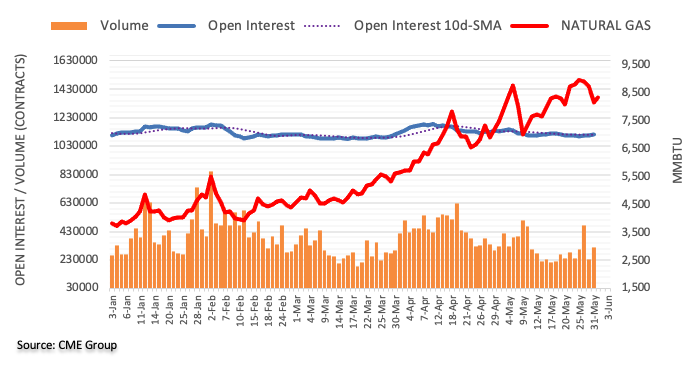
The kiwi is lower and trades below the 0.65 level. Economists at ANZ Bank note that the outlook remains complicated.
Volatility and a period of range trading
“The medium-term outlook is complicated: NZ enjoys higher interest rates, but that’s offset by growing fears of a hard landing (here and, to complicate things, in the US too), and blockages in the FX forwards market that are suppressing carry. It all speaks to volatility and a period of range trading rather than the need to radically adjust levels.”
“Support 0.6230/0.6410 Resistance 0.6545/0.6625/0.6840.”
- Gold Price remains on the back foot for the third consecutive day, refreshes multi-day low.
- Bears cheer US dollar’s recovery amid hawkish Fed, firmer yields.
- US ADP, ISM Manufacturing PMI, Fedspeak eyed for fresh impulse.
Gold Price (XAU/USD) takes offers to refresh a fortnight low as bears keep reins during the third consecutive day amid a firmer US dollar. That said, precious metal remains pressured around $1,830 by the press time of pre-European session trading on Wednesday. It’s worth noting, however, that the cautious mood ahead of the key data/events seems to restrict the quote’s further downside.
DXY rebound keeps sellers hopeful
US Dollar Index (DXY) extends Tuesday’s recovery from the monthly low, up 0.26% intraday near 102.05 by the press time, as hawkish Fedspeak and mostly upbeat data recall the greenback buyers. Also underpinning the greenback could be the reassessment of market bets that previously doubted the Fed’s aggression post-September.
Also read: May is over, but worries are here to stay
US Federal Reserve (Fed)
While Fed Chair Jerome Powell didn’t express much during his meeting with US President Joe Biden, Fed Board of Governors member Christopher Waller and Atlanta Fed President Raphael Bostic were the latest hawks who renewed expectations of faster rate hikes. Fed’s Waller said, “Waller said that he supports lifting interest rates by another 50 bps at the next several Fed meetings and that the policy rate should be above neutral by the end of the year to reduce demand,” reported Reuters. On the same line, Fed’s Bostic crossed wires during an interview with MarketWatch as he said that his suggestion that the central bank takes a September “pause” in its push to raise interest rates should not be construed in any way as a “Fed put,” or belief that the central bank would come to the rescue of markets.
Not only the hawkish Fed but recently positive economics also favored the US dollar buyers, which in turn weighed on the XAUUSD prices of late. That said, the US Chicago Purchasing Managers’ Index and CB Consumer Confidence both rose past forecasts for May whereas the Dallas Fed Manufacturing Business Index dropped to the lowest levels in two years.
Additionally, US President Biden and Treasury Secretary Janet Yellen’s lauding of the Fed’s action and showing utmost interest in taming inflation also weigh on the Gold Price. “US Treasury Secretary Janet Yellen said on Tuesday that she was wrong in the past about the path inflation would take, but said taming price hikes is President Joe Biden's top priority and he supports the Federal Reserve's actions to achieve that,” said Reuters. It’s worth noting that US President also sounded harsh on Russia and exerted additional downside pressure on the bright metal. “If Russia does not pay a heavy price for its actions, it will send a message to other would-be aggressors that they too can seize territory and subjugate other countries,” said Biden per The New York Times.
To sum up, gold prices are likely to extend recent weakness amid multiple catalysts stated above. However, firmer prints of the US ISM Manufacturing PMI for May, expected 54.5 versus 55.4 prior, as well as hawkish Fedspeak, are awaited to forecast further downside of XAUUSD.
Gold Price technical analysis
Gold Price portrays a bearish moving average crossover as the 50-HMA pierces off the 200-HMA from above. However, the oversold RSI conditions and the 61.8% Fibonacci retracement of May 18-24 upside, around $1,830, test the metal sellers.
Even if the quote drops below $1,830, the mid-May swing high, near $1,825 can act as an intermediate halt before directing the XAUUSD prices towards the previous month’s bottom close to $1,786. However, the May 18 low near $1,807 and the $1,800 threshold may offer breathing space to sellers.
Alternatively, an immediate descending trend line surrounding $1,836 guards the bullion’s recovery moves ahead of the 200-HMA and the previous support line from May 18, respectively near $1,851 and $1,860.
Gold: Hourly chart

Trend: Limited downside expected
- Loonie bulls are losing momentum after finding a responsive buying action near the 61.8% Fibo retracement.
- The RSI (14) is attempting to violate its bearish range of 20.00-40.00.
- For an upside move, the greenback bulls need to overstep the 20-EMA at 1.2690.
The USD/CAD pair has witnessed a firmer rebound after hitting a low of 1.2629 on Tuesday. A significant responsive buying action indicates signs of a value bet, which has pushed the asset to near 1.2670. Some exhaustion signs near the crucial support of 1.2650 are also advocating a bullish reversal in the counter.
On a four-hour scale, the asset has experienced a cushion of around 61.8% Fibonacci retracement at 1.2663. The Fibo retracement tool is placed from April’s low at 1.2403 to May’s high at 1.3077.
The 20- and 50-period Exponential Moving Averages (EMAs) at 1.2690 and 1.2748 respectively are declining, which still favors the downside filters.
However, the Relative Strength Index (RSI) (14) is attempting to overstep the bearish range of 20.00-40.00, which signals a reversal in the counter.
An upside move above the 20-EMA at 1.2690 will drive the asset towards the 50-EMA at 1.2748. Breach of the latter will expose the asset for an upside move towards the round-level resistance at 1.2800.
On the flip side, the loonie bulls could tighten their grip if the asset drops below Tuesday’s low at 1.2629 decisively. An occurrence of the same will drag the asset towards March 28 high at 1.2593, followed by April 14 low at 1.2521.
USD/CAD four-hour chart
-637896606108655348.png)
Gold Price remains exposed to downside risks. As FXStreet’s Dhwani Mehta notes, XAUUSD eyes a retest of the $1,800 mark.
Inflation-led growth fears undermine risk sentiment amid geopolitical woes
“Gold is extending losses for the third straight day, heading further towards the $1,800 mark, as the US dollar finds fresh demand amid a souring market mood.”
“ Inflation-linked growth risks continue to loom amid brewing geopolitical tensions between US-China over Taiwan while Russia’s nuclear drills also spooked investors’ sentiment. The dollar remains the preferred safe-haven asset while the yields preserve the previous gains.”
“Looking ahead, a fresh batch of US macro releases will be closely followed for fresh hints on the economy, with the ADP jobs and ISM Manufacturing PMI standing. The downbeat data could add to the slowdown worries, which will bode well for the greenback and knock XAUUSD down further.”
The continuation of the upside bias could lift AUD/USD to the 0.7230 region in the next weeks, suggested FX Strategists at UOB Group Quek Ser Leang and Peter Chia.
Key Quotes
24-hour view: “We highlighted yesterday that ‘the overbought advance in AUD could extend to 0.7215’. Our expectations did not materialize as AUD edged to a high of 0.7203, dropped briefly to 0.7150 before rebounding. While upward pressure has waned, there is scope for AUD to test 0.7215 first before a more sustained pullback is likely. Support is at 0.7170 followed by 0.7150.”
Next 1-3 weeks: “We have expected AUD to head higher since early last week. As AUD advanced, we highlighted yesterday (31 May, spot at 0.7195) that AUD could strengthen to 0.7230. While upward momentum is beginning to ease, we still see room for AUD to advance. That said, a sustained rise above 0.7230 is unlikely. On the downside, a break of 0.7125 (no change in ‘strong support’ level from yesterday) would indicate that the current upward pressure has dissipated.”
- German Retail Sales arrived at -0.4% YoY in April vs. 4.0% expected.
- Retail Sales in Germany stood at -5.4% MoM in April vs. 0% expected.
Germany's Retail Sales dropped by 5.4% MoM in April versus 0% expected and 0.9% last, the official figures released by Destatis showed on Wednesday.
On an annualized basis, the bloc’s Retail Sales came in at -0.4% in April versus 4.0% expected and -1.7% booked in March.
FX implications
The euro is little changed on the downbeat German data. At the time of writing, the major trades at 1.0711, down 0.18% on the day.
About German Retail Sales
The Retail Sales released by the Statistisches Bundesamt Deutschland is a measure of changes in sales of the German retail sector. It shows the performance of the retail sector in the short term. Percent changes reflect the rate of changes of such sales. The changes are widely followed as an indicator of consumer spending. The positive economic growth is usually anticipated as "bullish" for the EUR, while a low reading is seen as negative, or bearish, for the EUR.
Considering preliminary readings from CME Group for crude oil futures markets, traders increased their open interest positions for the fourth consecutive session on Tuesday, this time by around 20.3K contracts. Volume followed suit and went up by around 481.3K contracts, the largest single-day build since March 31.
WTI risks a drop to $105.00
Following new peaks around $120.00 per barrel, prices of the WTI ended Tuesday’s session with moderate losses amidst rising open interest and volume, paving the way for further correction in the very near term. Against that, the next support of note for crude oil emerges at the $105.00 region (May 19 low).
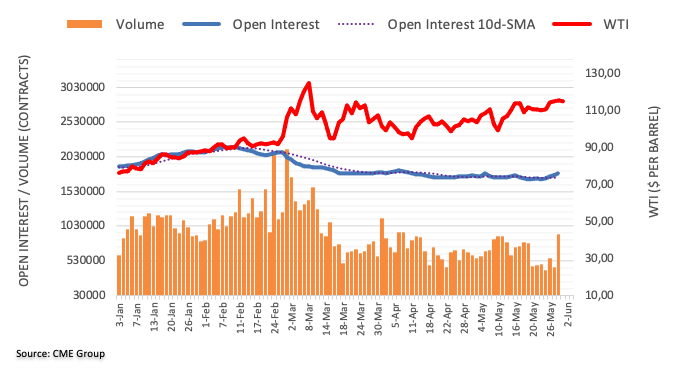
In the year to date, the British pound is the third worse-performing G10 currency after the JPY and the SEK. Economists at Rabobank expect the pound to continue facing headwinds over the coming months.
Concerns about growth are central to the poor performance of the pound
“The current cost of living crisis in the UK is consistent with even greater concerns about demand erosion which is likely to weigh on UK investment further. This in turn appears to be creating headwinds for the pound.”
“For GBP to rise above the weight of negative sentiment, optimism about the UK growth outlook will have to improve.”
“We maintain our view that GBP remains a vulnerable currency. Our three-month EUR/GBP forecast stands at 0.86”
French Finance Minister Bruno Le Maire said in a Le Figaro Interview on Wednesday, the economy should pass the inflation peak at the end of 2023.
His comments come after Consumer prices in the euro area’s second-largest economy accelerated 5.8% from a year ago in May, hitting a record high.
Market reaction
EUR/USD is flirting with lows just above 1.0700 amid a broad US dollar comeback and firmer yields. The spot is down 0.20% on the day, awaiting a busy docket.
-
EUR/USD flirts with 1.0700 support ahead of ECB’s Lagarde, US ISM PMI
In the opinion of FX Strategists at UOB Group Quek Ser Leang and Peter Chia, GBP/USD is now seen trading between 1.2530 and 1.2640 in the next weeks.
Key Quotes
24-hour view: “We expected GBP to ‘trade sideways between 1.2585 and 1.2660’ yesterday. GBP subsequently dropped to 1.2561 before rebounding. The movement appears to be part of a consolidation and GBP is likely to trade between 1.2565 and 1.2640 for today.”
Next 1-3 weeks: “On Monday (30 May, spot at 1.2625), we highlighted that while upward momentum has not improved by much, the risk for GBP is on the upside towards 1.2700. Yesterday (31 May), GBP dropped to within 1 pip of our ‘strong support’ level of 1.2560 (low of 1.2561) before rebounding. While there is no clear break of our ‘strong support’ level, upward momentum has more or less dissipated. From here, GBP is likely to consolidate and trade between 1.2530 and 1.2670 for several days before making another attempt to move to 1.2700.”
- Oil prices may slip further on expectations of liquidity shrinkage from the world economy.
- Europe’s embargo on oil from Russia failed to keep the oil bulls strengthened.
- The majority of the central banks may elevate their interest rates by 50 bps.
West Texas Intermediate (WTI), futures on NYMEX, is oscillating in a narrow range of $113.42-114.27 in the early European session. The black gold witnessed a steep fall on Tuesday after failing to sustain above a two-month high at $118.62. A sheer downside move has been recorded in the oil prices despite the renewed supply concerns.
The announcements in the European Union (EU) Leaders Summit held on Tuesday inculcated an embargo on 90% of the oil imports from Russia. The EU considered the opposition from Hungary and exempted the latter amid its significant dependency on their pipeline imports. Prohibition of a huge amount of oil will impact vigorously the already tight oil market. Despite the galloping supply concerns, oil prices tumbled strongly.
Investors should be aware of the fact that the majority of the giant central banks are going to step up their interest rates in June. Starring from the Federal Reserve (Fed) to the Bank of Canada (BOC), Bank of England (BOE), and European Central Bank (ECB) to Asia Pacific’s Reserve Bank of Australia (RBA), every central bank is expected to announce an interest rate hike by 50 basis points (bps).
The deployment of extreme quantitative measures will squeeze liquidity from the market, which will decline the volume of economic activities and the requirement of oil by the corporate.
CME Group’s flash data for gold futures markets noted open interest extended the downtrend on Tuesday, this time by around 5.7K contracts. Volume, instead, reversed two consecutive daily pullbacks and went up by around 56.7K contracts.
Gold: A drop to $1,800 should not be ruled out
Gold prices extended the corrective downside and broke below the key 200-day SMA on Tuesday, opening the door to further decline in the very near term. The move, however, was on the back of shrinking open interest and removed some strength from potential extra weakness. Against this, the $1,800 mark is expected to offer decent contention.
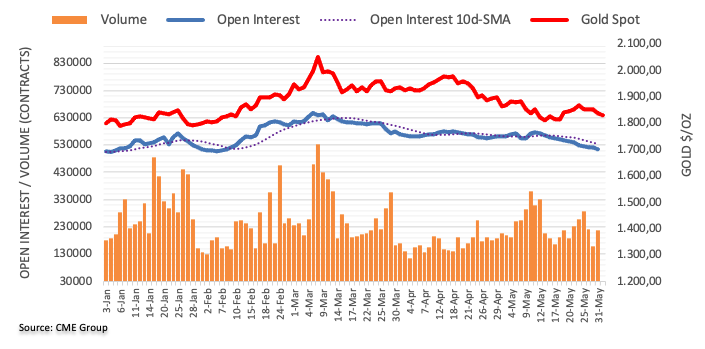
The “need for additional monetary easing is not very high now,” Bank of Japan’s (BOJ) Deputy Governor Masazumi Wakatabe said in a statement on Wednesday.
Key quotes
Widening range around BOJ’s 10-year JGB yield target would be tantamount to a rate hike.
BOJ must leave itself means for easing policy further.
There is a significant downside risk to Japan’s economy.
Moves in services prices are crucial to whether rise in inflation will be sustainable.
Hard to say for how long prices must rise to say rises in inflation are sustainable.
Undesirable to target forex in guiding monetary policy.
Desirable for forex to move reflecting fundamentals.
Sharp forex moves would make it hard for firms to set business plans, so would be undesirable.
It may be hard for cost-push inflation to lead to broader price rises driven by higher wages, inflation expectations.
Market reaction
As of writing, USD/JPY is trading 0.42% higher on the day, at 129.20, underpinned by the rebound in the US dollar and the Treasury yields.
FX Strategists at UOB Group Quek Ser Leang and Peter Chia noted EUR/USD could now navigate within the 1.0625-1.790 range.
Key Quotes
24-hour view: “The sharp drop in EUR to 1.0677 and the subsequent bounce from the low came as a surprise (we were of the view that EUR could test the major resistance at 1.0800). The movement appears to be part of consolidation and EUR is likely to trade between 1.0685 and 1.0765 for today.”
Next 1-3 weeks: “We highlighted yesterday (31 May, spot at 1.0775) that the chance for EUR to break the major resistance at 1.0800 has increased a tad. However, USD dropped sharply to 1.0677 before rebounding. The breach of our ‘strong support’ level at 1.0695 indicates that the strong phase in EUR that started early last week (see annotations in the chart below) has run its course. EUR has likely moved into a consolidation phase and could trade between 1.0625 and 1.0790. Looking ahead, EUR has to break and close above the major resistance at 1.0800 before a sustained advance is likely.”
- EUR/GBP picks up bids to reverse early Asian session losses.
- Bulls stay hopeful on concerns that record EU inflation could push ECB’s Lagarde to repeat her hawkish bias.
- Eurozone job numbers, German Retail Sales and risk catalysts are extra factors to watch for clear directions.
EUR/GBP licks its wounds around 0.8515 heading into Wednesday’s London open as the Euro gains upside momentum ahead of the key data/events. Also underpinning the cross-currency pair’s latest rebound could be the cautious optimism in the market.
Tuesday’s record high Eurozone Harmonised Index of Consumer Prices (HICP) highlights today’s speech from European Central Bank (ECB) President Christine Lagarde, considering the recently hawkish bias of the bloc’s policymakers. Also important are figures relating to Germany’s Retail Sales for April, expected 4.0% YoY versus 2.7% prior, as well as Eurozone Unemployment Rate for the said month, anticipated to ease to 6.7% from 6.8%.
It’s worth noting that the improvement in market sentiment, especially after an upbeat performance in May, also propels the EUR/GBP prices of late.
Underpinning the market’s cautious optimism are mixed concerns over the Fed’s next moves after US Treasury Secretary Janet Yellen and President Joe Biden praised Fed Chairman Jerome Powell while altering their bias towards inflation.
Also, better-than-expected Australia GDP and China PMI numbers favor the market’s firmer sentiment and help EUR/GBP to consolidate recent losses.
Additionally, agitations over UK PM Boris Johnson’s party during the covid-led lockdowns join the disappointment of British business leaders over the Northern Ireland Protocol (NIP) to weigh on the GBP/USD prices. On the same line are the doubts over the Bank of England’s (BOE) role in taming inflation. “In a downbeat assessment of the UK’s economic prospects, the impact of Brexit and the potential ‘politicization’ of monetary policy, the US investment bank (Bank of America) believes that investors will dump the pound after sustained weakness,” per The Times.
To sum up, EUR/GBP buyers brace for further upside but it all depends upon the scheduled catalysts and risk factors for now.
Technical analysis
Tuesday’s Dragonfly Doji bullish candlestick joins the EUR/GBP pair’s sustained trading beyond the 21-DMA, around 0.8510 by the press time, keeping the pair buyers hopeful to aim for a three-week-old resistance line near 0.8560.
- Asian equities are trading mixed as DXY strengthens on hawkish Fed bets.
- The re-opening of Shanghai after a two-month lockdown may bolster the economic activities.
- Chinese equities have failed to capitalize on strong PMI numbers.
Markets in the Asian domain are displaying a subdued performance as the US dollar index (DXY) is performing stronger on expectations of a hawkish stance from the Federal Reserve (Fed) in its June monetary policy meeting. Higher price pressures have raised concerns over the aggregate demand in the US economy. To accelerate the growth prospects, the Fed will do whatever it takes to combat the galloping inflation.
For sure, the deployment of material quantitative measures will be required and elevation of interest rates at a quicker pace will be observed. Therefore, the DXY has regained its glory and is advancing higher. The DXY has touched an intraday high of 102.00.
At the press time, Japan’s Nikkei225 added 0.60%, China A50 eased 0.12%, Hang Seng tumbled 0.62% and the Nifty50 displayed at par performance.
Chinese equities are not performing well despite the re-opening of Shanghai after a two-month lockdown imposed by the Chinese administration to contain the spread of the Covid-19. The administration has withdrawn restrictions on the movement of men, materials, and machines, therefore investors could expect a rebound in the volume of economic activities. Also, the respective indices failed to capitalize on the upbeat Caixin Manufacturing PMI. The IHS Markit has reported the PMI data at 48.1, which has outperformed the consensus of 47 and the prior print of 46.
- USD/INR remains sidelined inside a 12-day-old symmetrical triangle.
- 100-SMA restricts immediate downside, 200-SMA acts as additional support.
- Descending RSI (14) keeps bears hopeful unless crossing 78.00.
USD/INR pares intraday losses around 77.60, staying within a fortnight-long triangle, during early Wednesday morning in Europe.
While a short-term trading range below 78.00 restricts USD/INR upside, the pair bears have recently turned hopeful as the RSI hints at receding bullish momentum.
Even so, the USD/INR sellers need to conquer the 100-SMA and the stated triangle’s support, respectively around 77.50 and 77.50, to retake control.
Following that, May 10 swing low near 77.10 will precede the 200-SMA level surrounding 77.05 to restrict the short-term USD/INR downside.
Alternatively, recovery moves remain elusive until the quote stays below the aforementioned triangle’s resistance line near 77.75. Also acting as the key upside hurdle is the 78.00 psychological manget.
Should the USD/INR prices cross the 78.00 resistance, the odds of witnessing the 80.00 threshold on the chart can’t be ruled out.
USD/INR: Four-hour chart
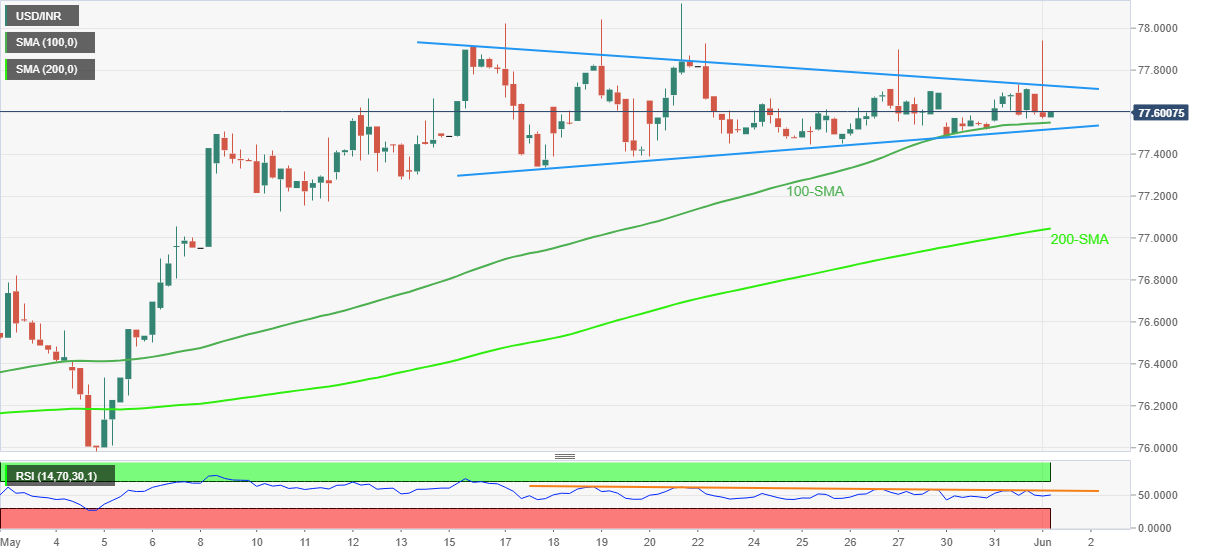
Trend: Further weakness expected
- AUD/USD has slipped to near 0.7160 despite upbeat aussie GDP.
- Firmer US Treasury yields have infused fresh blood into the DXY.
- The DXY has touched the round-level resistance of 102.00.
The AUD/USD pair has witnessed a steep fall after a downside break of the crucial support at 0.7172. On a broader note, the asset has remained in a consolidation phase this week. The major has traded back and forth in a range of 0.7200-0.7149 after a bullish week. More downside looks visible if the asset drops below Tuesday’s low at 0.7149.
Aussie bulls have failed to capitalize on higher-than-expected Gross Domestic Product (GDP) numbers released in the Asian session. The Australian Bureau of Statistics reported the quarterly GDP numbers at 0.8% against the estimates of 0.7% and the prior print of 3.4%. While the annual figure landed at 3.3% vs. the expectation of 3% and the former figure of 4.2%.
Although the April figures have outperformed the forecasts, the economic data has displayed an impoverished performance in comparison with the former figures. A negative deviation in the GDP numbers has weakened the aussie bulls for a longer period.
Meanwhile, the US dollar index (DXY) is marching firmly towards Tuesday’s high at 102.17. Advancing chances of an extreme hawkish stance by the Federal Reserve (Fed) in its June monetary policy has strengthened the greenback basket. The DXY has refreshed its intraday high after hitting the round-level resistance of 102.00. Now, the DXY bulls will strive for an establishment above 102.00. Also, the advancing US Treasury yields have empowered the DXY. The 10-year US Treasury yields have climbed above 2.86%.
- EUR/USD fades bounce off intraday low, stretches pullback from monthly top.
- Treasury yields underpin US dollar strength ahead of Fedspeak, ISM Manufacturing PMI for May.
- Lagarde’s reaction to record high Eurozone inflation will be important to note.
EUR/USD drops back to intraday lows surrounding 1.0710, extending the previous day’s U-turn from a one-month high, as the US dollar keeps the latest gains ahead of the key data/events. That said, the major currency pair declines towards short-term key support during early Wednesday morning in Asia.
US Dollar Index (DXY) extends Tuesday’s recovery from the monthly low, up 0.22% intraday near 102.00 by the press time, as hawkish Fedspeak and mostly upbeat data recall the greenback buyers.
Among them, comments from US Treasury Secretary Janet Yellen and Atlanta Fed President Raphael Bostic, as well as US President Joe Biden’s readiness for using harsh measures on Russia, gained major attention.
“US Treasury Secretary Janet Yellen said on Tuesday that she was wrong in the past about the path inflation would take, but said taming price hikes is President Joe Biden's top priority and he supports the Federal Reserve's actions to achieve that,” said Reuters. Further, Fed’s Bostic crossed wires during an interview with MarketWatch as he said that his suggestion that the central bank takes a September “pause” in its push to raise interest rates should not be construed in any way as a “Fed put,” or belief that the central bank would come to the rescue of markets.
On the same line, US President Biden said, “If Russia does not pay a heavy price for its actions, it will send a message to other would-be aggressors that they too can seize territory and subjugate other countries,” per The New York Times.
It’s worth noting, that the US Chicago Purchasing Managers’ Index and CB Consumer Confidence both rose past forecasts for May whereas the Dallas Fed Manufacturing Business Index dropped to the lowest levels in two years. On the other hand, the Eurozone Harmonised Index of Consumer Prices (HICP) soared by 8.1% in May vs. the previous reading of 7.4%, refreshing the record high marked in the last month.
Given the recently hawkish comments from the Fed, the US 10-year Treasury yields extend yesterday’s recovery moves to 2.864%, up two basis points (bps). However, the S&P 500 Futures also print mild gains after bouncing from the yearly low during May.
The mixed sentiment and challenges EUR/USD traders ahead of a speech from the European Central Bank (ECB) President Christine Lagarde who will be observed closely after the latest Eurozone inflation data. Should Lagarde repeat her hawkish bias, the pair may reverse the recent losses.
However, firmer prints of the US ISM Manufacturing PMI for May, expected 54.5 versus 55.4 prior, as well as hawkish Fedspeak, can defend the US dollar buyers.
Read: US ISM Manufacturing PMI May Preview: Gloom persists despite an US expanding economy
Technical analysis
EUR/USD’s U-turn from 38.2% Fibonacci retracement (Fibo.) of February-May downside, around 1.0790 at the latest, gains support from RSI (14) retreat to favor sellers. Also keeping the bears hopeful is the clear downside break of the 50-day EMA, near 1.0740 by the press time.
However, an upward sloping support line from mid-May, around 1.0700, challenges the EUR/USD pair’s further declines.
- USD/CNH has touched an intraday high of 6.7012 amid rising odds of a hawkish Fed.
- The upbeat Caixin Manufacturing PMI has failed to support the Chinese yuan.
- This week, US NFP will remain in focus, which is seen at 320k.
The USD/CNH pair is scaling sharply higher after an upside break of the consolidation formed in a range of 6.6552-6.6926 this week. The asset has displayed an initiative buying action and is heading north with stellar velocity despite upbeat Caixin Manufacturing PMI data.
The IHS Markit has reported the economic data at 48.1, higher than the forecasts and the prior print of 47 and 46 respectively. It would be justified to claim that investors had already discounted the outperformance from China’s economic data and the ‘Buy on rumor and Sell on News’ indicator is triggered now.
The dominating currency, the US dollar index (DXY) is struggling to overstep the crucial resistance of 102.00. However, the overall momentum is bullish and investors are awaiting a potential trigger that will drive the asset higher. The DXY has been strengthened as odds of an extreme tightening monetary policy announcement by the Federal Reserve (Fed) are advancing vigorously.
Mounting price pressures in the US economy are restricting the households to keep up their consumption quantities. Soaring inflation is elevating the total consumption expenditure along with keeping a lid on the volume of goods and services purchased by the households. Therefore, the inflation mess is for real and seeks an instant remedy.
This week, investors’ focus will remain on the US Nonfarm Payrolls (NFP) data, which is due on Friday. As per the market consensus, the US Labor force is flooded with 320k jobs in April against the addition of 428k jobs recorded for March.
- GBP/USD fades bounce off key EMAs, keeps the previous day’s downside break of 13-day-old support.
- Steady RSI, trend line breakdown keep sellers hopeful.
- Convergence of the 21-day EMA and 10-day EMA tests bears, bulls remain away unless crossing descending resistance line from late March.
GBP/USD remains on the back foot around the intraday low as the previous day’s downside break of short-term key support, now resistance, favors sellers. That said, the cable pair stays depressed near 1.2590 by the press time, down for the second consecutive day while extending the pullback from the monthly high.
Not only the cable pair’s downside break of the previously important support but steady RSI also hints at the quote’s further weakness.
However, a confluence of the 21-day EMA and the 10-day EMA around 1.2560-50 puts a floor under the short-term GBP/USD downside.
Should the bears manage to conquer the 1.2550 support, the odds of the pair’s further south-run towards the five-week-old horizontal support near 1.2400 can’t be ruled out.
Alternatively, the support-turned-resistance line, close to 1.2680 by the press time, guards the GBP/USD pair's recovery moves.
Also acting as an upside filter is the descending trend line from March 23, around 1.2810 by the press time.
To sum up, GBP/USD’s latest jump on the bear’s table is likely to prevail for a bit longer.
GBP/USD: Daily chart
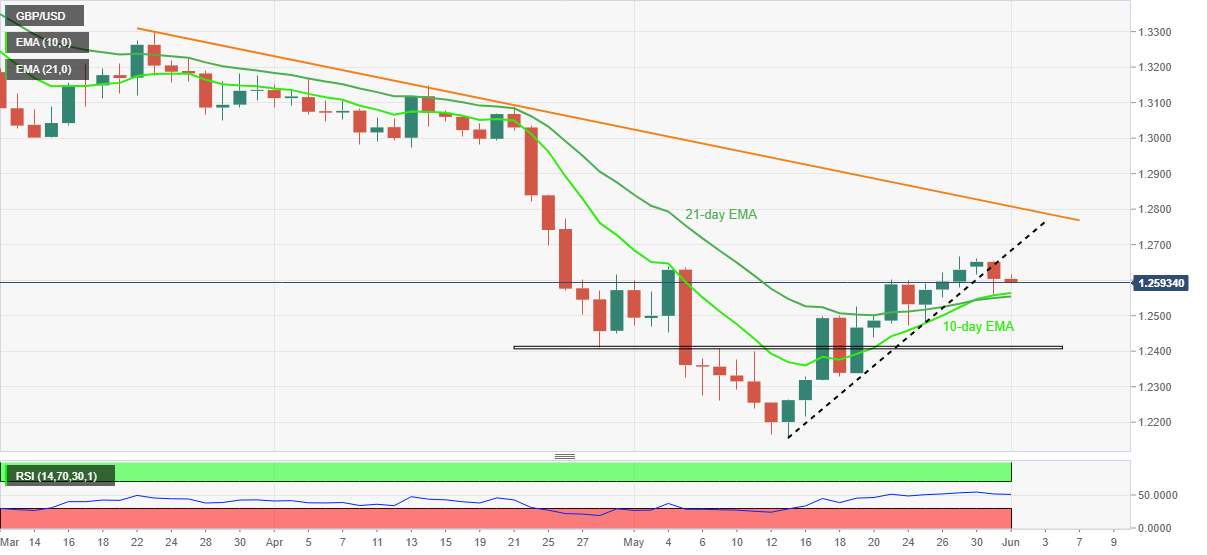
Trend: Further weakness expected
- Gold price has displayed a rebound after hitting a low of $1,832.41 ahead of US ISM Manufacturing PMI.
- Mounting inflationary pressures are hurting the real income of the households.
- The US ISM Manufacturing PMI is expected to land at 54.5 vs. 55.4 recorded earlier.
Gold price (XAU/USD) has witnessed a rebound after a sheer downside move near a two-week low at $1,832.41. The precious metal has recovered its entire intraday losses and may display a bullish open rejection-reverse trading session after overstepping Wednesday’s high at $1,838.62. However, the fundamentals are still favoring gold bears.
The bright metal delivered a poor performance on Tuesday as investors started discounting an extreme hawkish tone from the Federal Reserve (Fed) in its June interest rate decision announcement. No one could deny the fact that the inflation ghost has created havoc for the households. Rising price pressures are hurting their real income and a sudden meeting between Fed chair Jerome Powell and US President Joe Biden has indicated loud and clear that the inflation ghost is for real and will stay a little longer.
On the dollar front, the US dollar index (DXY) is consolidating below 102.00 as investors are awaiting the release of the ISM Manufacturing PMI. The economic data is seen at 54.5 against the prior print of 55.4. An outperformance from the economic catalyst will bolster the DXY.
Gold technical analysis
The breakdown of the Symmetrical Triangle on an hourly scale indicates the dominance of the bears. The ascending triangle of the above-discussed chart pattern is placed from May 20 low at $1,832.41 while the descending trendline is plotted from May 24 high at $1,869.75. The widening gap between 20- and 50- period Exponential Moving Averages (EMAs) at $1,841.00 and $1846.20 respectively will infuse fresh blood into the greenback bulls. The Relative Strength Index (RSI) (14) is oscillating in a bearish range of 20.00-40.00, which indicates more downside ahead.
Gold hourly chart
-637896502053829251.png)
Following the release of the March quarter GDP release, Australian Treasurer Jim Chalmers is commenting on the persisting risks to the country’s economic outlook.
Australia’s new Treasurer said that China's zero-COVID policy poses risks to the economy.
The economy expanded firmly in the first quarter, shrugging off omicron and east-coast flood-related disruptions earlier in the year, with cashed-up consumers continuing to drive the growth.
Market reaction
AUD/USD was last seen trading at 0.7180, up 0.11% on the day.
- AUD/NZD has displayed a subdued performance despite the release of the aussie GDP.
- The quarterly and annualized GDP figures have landed at 0.8% and 3.3% respectively.
- Caixin Manufacturing PMI has been recorded at 48.1 higher than the forecast of 47.
The AUD/NZD pair is trading lackluster in the Asian session despite upbeat Gross Domestic Product (GDP) numbers by the Australian Bureau of Statistics. It looks like the higher GDP numbers in relation to its expectations have failed to cheer the aussie bulls. The cross is consolidating in a narrow range of 1.1014-1.1022 and a similar performance is expected amid the unavailability of any potential trigger.
The Australian agency has reported the quarterly GDP numbers at 0.8% against the estimates of 0.7% and the prior print of 3.4%. While the annual figure landed at 3.3% vs. the expectation of 3% and the former figure of 4.2%.
The GDP numbers seem a little lucrative in comparison with the forecasts, however, a comparison with the previous figures indicates a dismal performance from the Aussie economy. This may bring exhaustion in the ongoing uptrend after a thorough interpretation of the economic data by the market participants.
On the kiwi front, investors are still worried over galloping price pressures. The Reserve Bank of New Zealand (RBNZ) has already stretched its Official Cash Rate (OCR) to 2%. The central bank announced a 50 basis point (bps) interest rate hike last week.
Also, the IHS Markit has reported the Caixin China Manufacturing PMI in the Tokyo session. The Caixin PMI has outperformed the estimates of 47 and the previous figure of 46 after landing at 48.1.
Russia's nuclear forces are conducting drills in Ivanovo Province, north-east of Moscow, Reuters reports, citing Interfax’s headlines from the Russian Defence Ministry.
Interfax reported that “some 1,000 servicemen are exercising in intense manoeuvres using over 100 vehicles including Yars intercontinental ballistic missile launchers.”
No further details are provided on the same.
Market reaction
The market mood is lifted overall, despite brewing US-China tensions over Taiwan and the Russian nuclear woes. The same is reflected by the 0.50% advance in the S&P 500 futures.
The Asian stocks market ex-China is in the green after the upbeat Australian growth and Chinese manufacturing data.
- Markets edge higher as traders welcome June after an upbeat May.
- S&P 500 Future reverse the previous day’s pullback from monthly top.
- US 10-year Treasury yields print three-day uptrend to pare the biggest monthly loss since late 2021.
Global traders offer a warm welcome to June following the first upbeat month for equities in five, as well as recalling the bond bears after four months of a rise in Treasury bond yields.
While portraying the mood, the US Treasury yields underpin the US dollar rebound, up two basis points to 2.86% by the press time. However, the S&P 500 Futures rise half a percent near 4,150 and confused traders.
The cautious optimism could be linked to mixed comments from the US policymakers and unclear data from the US. However, firmer yields and the US dollar rebound challenge bulls ahead of the key US ISM Manufacturing PMI for May, expected 54.5 versus 55.4 prior, as well as Fedspeak.
It’s worth noting that doubts over the Fed’s next moves, despite recently hawkish rhetoric, keep the risk barometer S&P 500 Futures on the front foot despite the firmer US Treasury yields and the US dollar.
Even so, comments from US Treasury Secretary Janet Yellen and Atlanta Fed President Raphael Bostic, as well as US President Joe Biden’s readiness for using harsh measures on Russia, challenge the recent positivity in the market.
“US Treasury Secretary Janet Yellen said on Tuesday that she was wrong in the past about the path inflation would take, but said taming price hikes is President Joe Biden's top priority and he supports the Federal Reserve's actions to achieve that,” said Reuters. On the other hand, Fed’s Bostic crossed wires during an interview with MarketWatch as he said that his suggestion that the central bank takes a September “pause” in its push to raise interest rates should not be construed in any way as a “Fed put,” or belief that the central bank would come to the rescue of markets.
Also weighing on the gold prices could be comments from US President Joe Biden as he said, “If Russia does not pay a heavy price for its actions, it will send a message to other would-be aggressors that they too can seize territory and subjugate other countries,” per The New York Times.
It needs to be observed that the US Chicago Purchasing Managers’ Index and CB Consumer Confidence both rose past forecasts for May whereas the Dallas Fed Manufacturing Business Index dropped to the lowest levels in two years. Also, Australia’s Q1 GDP and China’s Caixin Manufacturing PMI for May both came in better than expected and stop the bears from retaking control.
To sum up, mixed concerns and data test the market’s sentiment as traders brace for second-tier US data/events.
Zhang Ming, a senior fellow of the Institute of Finance and Banking at the Chinese Academy of Social Sciences said on Wednesday, “China should maintain rapid economic growth to absorb its growing debt, and avoid a quick rise in domestic interest rates to keep “the current high level of debt sustainable and avoid systemic financial risks.
Key quotes (via Reuters)
“China's macro leverage ratio, meaning overall debt-to-GDP ratio could be as high as 303.8% by end-2021 if local government implicit debts and debts raised by their financing vehicles re included.”
“At present, local governments bear the highest default risk and their debt-to-GDP ratio is as high as 106.6%.”
Related reads
- The Caixin China Manufacturing PMI: Shrinks less sharply
- China admits it conducted military exercises near Taiwan this week – Reuters
- AUD/JPY retreats from monthly high as buyers jostle with the 61.8% Fibonacci retracement level.
- Overbought RSI (14), weekly resistance line also challenge bulls.
- 200-SMA holds the key for bear’s entry but ascending trend line from mid-May appears important support.
AUD/JPY bulls take a breather around a one-month high, even as data from Australia and China came in better than expected during early Wednesday. That said, the cross-currency pair jostles with a one-week-old resistance around 92.80-75 by the press time.
Australia’s first quarter (Q1) Gross Domestic Product (GDP) rose by 0.8% versus 0.7% expected and 3.4% prior. The annualized GDP also increased 3.3% compared to 3.0% YoY market consensus and 4.2% previous readouts. Further, China’s Caixin Manufacturing PMI rose past 47.0 forecast and 46.0 prior readings to 48.1.
The AUD/JPY pair’s latest struggle could be linked to the overbought RSI conditions, as well as the one-week-old rising trend line, around 92.80.
However, the quote keeps the previous breakouts of the 200-SMA and a downward sloping trend line from late April, which in turn pushes back the sellers.
Hence, AUD/JPY bulls seem running out of fuel but not out of the game yet.
It’s worth noting that late April swing high around 93.50 and May’s peak of 94.03 are extra hurdles for the pair buyers if at all they manage to cross 92.80 immediate resistance.
On the contrary, a convergence of the 200-SMA and 50% Fibonacci retracement of April 20 to May 12 downside, around 91.60, limits short-term declines of the AUD/JPY pair.
Following that, the resistance-turned-support from April 20 and a three-week-old rising trend line, respectively around 91.00 and 90.50, will be in focus.
AUD/JPY: Four-hour chart
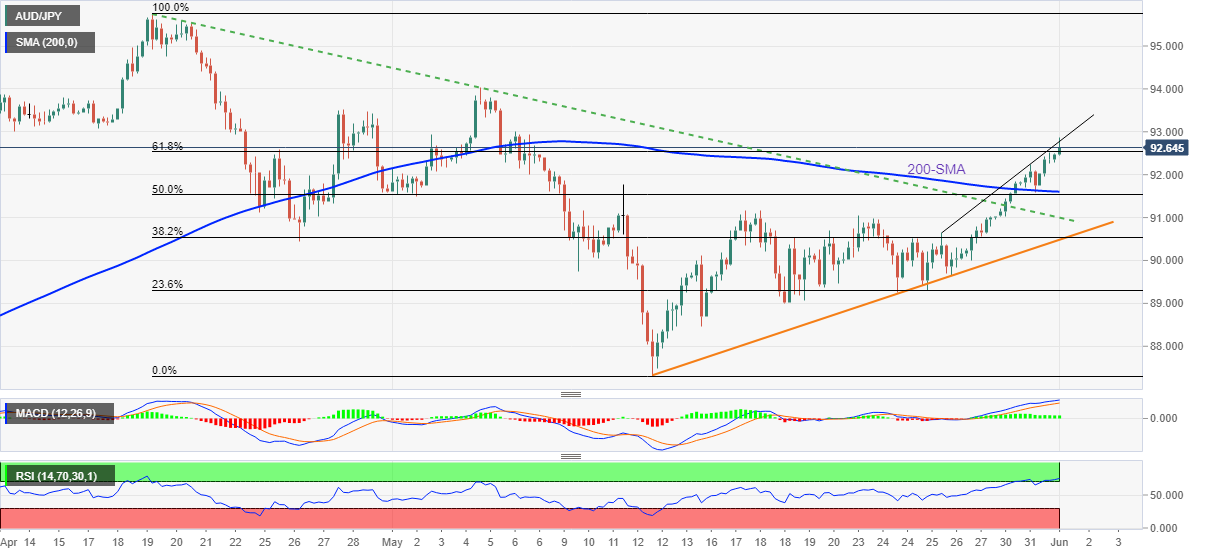
Trend: Pullback expected
The Caixin China Manufacturing PMI™, released by Markit Economics, is out as follows:
Caixin China PMI Mfg May:
- 48.1 (est 49, prev 46).
AUD/USD has been stacked up below a key level of resistance on the 4-hour chart and under pressure.
About China Caixin China Manufacturing PMI
The Caixin China Manufacturing PMI™, released by Markit Economics, is based on data compiled from monthly replies to questionnaires sent to purchasing executives in over 400 private manufacturing sector companies.
China admitted on Wednesday that it conducted the second-largest incursion into Taiwan’s air defense zone this year, per Reuters.
Taiwan’s defense ministry said late on Monday that 30 Chinese jets entered the area, including more than 20 fighters.
developing story ....
- AUD/USD takes offers to pare daily gains after Australia’s first quarter GDP.
- Aussie Q1 GDP rose past 0.7% QoQ and 3.0% YoY market consensus.
- Firmer US dollar, yields test upside momentum amid mixed clues over inflation.
- US ISM Services PMI, risk catalysts in focus for fresh impetus.
AUD/USD reverses the early Asian session gains as it drops to 0.7170 following the Aussie Q1 GDP release on Wednesday. In doing so, the Aussie pair seems to respect the firmer US dollar.
Australia’s first quarter (Q1) Gross Domestic Product (GDP) rose by 0.8% versus 0.7% expected and 3.4% prior. The annualized GDP also increased 3.3% compared to 3.0% YoY market consensus and 4.2% previous readouts. The firmer-than-expected Aussie GDP numbers couldn’t help AUD/USD prices to consolidate the previous day’s losses, the biggest in a week, around a one-month high.
Read: Australia Q1 GDP stronger than expected, supportive of AUD
It’s worth noting that doubts over the Fed’s next moves, despite recently hawkish rhetoric keeps the risk barometer pair on the front foot despite the US dollar’s latest rebound from the monthly low.
That said, the US Dollar Index (DXY) rise 0.12% intraday to 101.83 at the latest, stretching the previous day’s U-turn from a one-month low. The reason for the greenback’s strength could be linked to comments from US Treasury Secretary Janet Yellen and Atlanta Fed President Raphael Bostic, suggesting further tightening of policies at the Fed.
“US Treasury Secretary Janet Yellen said on Tuesday that she was wrong in the past about the path inflation would take, but said taming price hikes is President Joe Biden's top priority and he supports the Federal Reserve's actions to achieve that,” said Reuters. On the other hand, Fed’s Bostic crossed wires during an interview with MarketWatch as he said that his suggestion that the central bank takes a September “pause” in its push to raise interest rates should not be construed in any way as a “Fed put,” or belief that the central bank would come to the rescue of markets.
Also weighing on the gold prices could be comments from US President Joe Biden as he said, “If Russia does not pay a heavy price for its actions, it will send a message to other would-be aggressors that they too can seize territory and subjugate other countries,” per The New York Times.
Against this backdrop, the US Treasury yields underpin the US dollar rebound, up two basis points to 2.86% by the press time. However, the S&P 500 Futures rise half a percent near 4,150 and probe gold sellers.
That said, AUD/USD bears need validation from the US ISM Manufacturing PMI for May, expected 54.5 versus 55.4 prior, as well as Fedspeak.
Technical analysis
The AUD/USD pair’s pullback the previous day portrays a rising wedge bearish chart pattern on the four-hour play. The downside bias also gains support from the RSI (14) retreat. However, the 200-SMA offers an additional barrier to the south around 0.7120, in addition to the stated wedge’s support line near 0.7135.
On the flip side, recovery moves need to reject the wedge formation, by crossing the 0.7220 immediate hurdle, to convince short-term buyers.
Bank of Japan (BOJ) Deputy Governor Masazumi Wakatabe, in his scheduled appearance on Wednesday, said that the central bank must maintain powerful easing.
Additional quotes
Sustain environment where wages can rise.
BOJ shouldn't rule out taking additional easing steps if risks to economy materialise.
cost-push inflation must be dealt with by means other than monetary policy.
fiscal policy, energy policy aimed at reducing Japan's reliance on oil and gas imports could be among steps to deal with cost-push inflation.
if inflation sharply exceeds central banks' targets through spiral of soaring wages and inflation expectations that could cause sustained inflation in an undesirable way.
China's covid lockdowns are hurting not just China's economy but global trade and output activity through supply chain disruptions.
must be mindful of risk US Fed's rate hikes and balance sheet reduction could cause global stock market adjustment, outflow of capital from emerging economies.
Japan's economy showing some signs of weakness but picking up as a trend.
Japan's economy likely to recover as a trend.
If impact of pandemic, supply constraints lasts longer than expected, that could weigh on Japan's private spending.
Japan's consumer inflation has not yet achieved BOJ’s price goal in sustained, stable manner.
for Japan to achieve BOJ’s price target, prices must rise for wide range of goods backed by improvement in output gap, heightening of inflation expectations.
I am doubtful the global economy will enter an era of big inflation.
For Japan, I am more worried about the chance that low growth, low inflation and the low interest rate environment will persist.
Market reaction
USD/JPY is gaining 0.35% on the day to trade near-daily highs of 129.18, in part due to the dovish comments from the BOJ policymaker.
Australia’s first-quarter Gross Domestic Product data has been released as follows:
Aussie GDP
- Australia Q1 real GDP +0.8 pct QoQ, seasonally adjusted,s/adj, (Reuters poll +0.5 pct).
Australia Q1 real GDP +3.3 pct YoY, s/adj (Reuters poll +2.9 pct).
Australia Q1 final consumption expenditure +1.9 pct, s/adj.
Australia Q1 gross fixed capital expenditure +0.7 pct, s/adj.
Australia Q1 chain price index +4.9 pct.
A softer print in activity was anticipated given the disruptions associated with omicron and severe flooding in NSW and Queensland, analysts at Westpac explained in a note ahead of the data today.
''Consumer spending and public demand were expected to add to growth, while business investment and housing should remain subdued.''
From a policy perspective, analysts at ANZ Bank said ''the most important number from today’s Q1 GDP report will be the average earnings measure of wages.''
They said in a note prior to the data that ''partial data suggest a sharp acceleration in annual growth to around 5%. If we’re right, this will keep speculation of a 40bp move at the June meeting very much alive.''
AUD/USD update
AUD/USD has been reluctant to rally on the knee jerk, but the data is solid and could be supportive for the Aussie.
About Aussie GDP
The Gross Domestic Product released by the Australian Bureau of Statistics is a measure of the total value of all goods and services produced by Australia. The GDP is considered as a broad measure of the economic activity and health. A rising trend has a positive effect on the AUD, while a falling trend is seen as negative (or bearish) for the AUD.
- EUR/USD extends previous day’s pullback from one-month high.
- Clear break of 50-day EMA, RSI retreat favor sellers.
- 38.2% Fibonacci retracement holds the key to further advances.
EUR/USD remains pressured around the intraday low, stretching Tuesday’s pullback from the monthly peak during Wednesday’s Asian session. That said, the major currency pair seesaws around 1.0730-25 by the press time.
It’s worth noting that the quote’s U-turn from 38.2% Fibonacci retracement (Fibo.) of February-May downside gains support from RSI (14) retreat to favor sellers. Also keeping the bears hopeful is the clear downside break of the 50-day EMA.
However, an upward sloping support line from mid-May, around 1.0700, challenges the EUR/USD pair’s further declines.
Following that, 23.6% Fibo. and early May’s high near 1.0640 can lure the pair sellers before directing them to the sub-1.0500 zone.
Alternatively, the 50-day EMA and the latest swing high, respectively near 1.0740 and 1.0785, limit the EUR/USD pair’s short-term recovery. Also acting as an upside filter is March’s low surrounding 1.0810.
Should the quote rise past 1.0810, the odds of its run-up towards late April top close to 1.0940 can’t be ruled out.
EUR/USD: Daily chart

Trend: Further weakness expected
In recent trade today, the People’s Bank of China (PBOC) set the yuan (CNY) at 6.6651vs. the last close of 6.6720.
About the fix
China maintains strict control of the yuan’s rate on the mainland.
The onshore yuan (CNY) differs from the offshore one (CNH) in trading restrictions, this last one is not as tightly controlled.
Each morning, the People’s Bank of China (PBOC) sets a so-called daily midpoint fix, based on the yuan’s previous day's closing level and quotations taken from the inter-bank dealer.
US inflation expectations, as per the 10-year breakeven inflation rate per the St. Louis Federal Reserve (FRED) data, rose for the fourth consecutive day by the end of Tuesday’s North American session.
That said, the inflation gauge rose from 2.63% to 2.64% amid hawkish Fedspeak and mostly upbeat US data.
On Tuesday, hawkish Fedspeak and upbeat US data favored the US dollar to recover from the multi-day low. Fed Board of Governors member Christopher Waller said that he supports lifting interest rates by another 50 bps at the next several Fed meetings and that the policy rate should be above neutral by the end of the year to reduce demand, reported Reuters. On the other hand, the US Chicago Purchasing Managers’ Index and CB Consumer Confidence both rose past forecasts for May whereas the Dallas Fed Manufacturing Business Index dropped to the lowest levels in two years.
It’s worth noting that the increase in inflation expectations contrasts with the softer prints of the Fed’s preferred inflation gauge, namely the US Core PCE Price Index for May. However, the latest comments from US Treasury Secretary Janet Yellen highlight inflation fears and hints at the further tightening of the Fed’s policies.
The firmer inflation expectations join the fears of increasing price pressure and may help the US dollar to extend recovery moves from the monthly low, marked on Tuesday.
Read: US Dollar Index aims to balance above 101.80, focus shifts to hawkish Fed bets, US PMI eyed
- EUR/JPY is struggling to surpass the crucial resistance of 138.30 ahead of ECB Lagarde’s speech.
- Higher HICP numbers in the eurozone have raised the odds of a rate hike by the ECB.
- The yen bulls are underperforming despite upbeat employment data.
The EUR/JPY pair is attracting mild offers in the Asian session around 138.30 after a vertical upside move below 137.00. A rangebound move is highly expected from the market participants as investors are awaiting the speech from European Central Bank (ECB) President Christine Lagarde, which is due in the European session.
Investors should brace for a hawkish commentary from ECB’s Lagarde as inflationary pressures have reached the rooftop and the households are going to be the major victim of the mounting price pressures.
On Tuesday, the annual eurozone Harmonized Index of Consumer Prices (HICP) rose to 8.1% vs. the expectation of 7.7% and the prior print of 7.4%. A significant surge in the price rise is demanding an announcement of an interest rate hike by the ECB in its June monetary policy meeting. Considering the inflation figure above 8%, the ECB is needed to reverse its interest rate curve and elevate it in time. It is worth noting that the ECB has not hiked its interest rates since the pandemic, unlike the other Western leaders which are in mid-way of returning to neutral rates.
On the Japanese front, the Bank of Japan (BOJ) has witnessed failures in elevating inflation in its economy. BOJ Governor Harihuko Kuroda has stated that the price rise could only sustain above the benchmark if a wage hike is also being taken into consideration. The upbeat employment data released on Tuesday failed to support the yen bulls. The jobless rate improved to 2.5% against the prior print of 2.6%.
The Reserve Bank of Newzealand's Deputy Governor Christian Hawkesby is crossing the wires and has stated that there is a need keep inflation expectations anchored.
More to come...
- NZD/USD pares the biggest daily loss in two weeks, picks up bids to refresh intraday high of late.
- 12-day-old support line, 200-SMA challenge bears from retaking control.
- RSI conditions hint at further recovery, bulls need validation from five-week-old horizontal resistance.
NZD/USD refreshes intraday high around 0.6530 as it consolidates the biggest daily fall in a fortnight during Wednesday’s Asian session.
In doing so, the Kiwi pair stretches the previous day’s rebound from the 200-SMA towards a horizontal area comprising multiple levels marked since late April, around 0.6560.
The recovery moves also gain support from RSI (14) as the oscillator bounced off the 50 level as the NZD/USD prices improve.
Should the quote manage to successfully cross the 0.6560 hurdle, the late April swing high around 0.6650 and the 0.6700 threshold may entertain the pair buyers.
Meanwhile, an upward sloping trend line from mid-May, around 0.6490, could challenge the NZD/USD pullback ahead of the 200-SMA level near 0.6480.
However, the pair’s weakness below the key moving average won’t hesitate to direct the bears towards the monthly horizontal support zone near 0.6410.
NZD/USD: Four-hour chart

Trend: Further recovery expected
Reuters reports that Russian Foreign minister Sergei Lavrov on Tuesday met Saudi counterpart Prince Faisal bin Farhan Al Saud and both men praised the level of cooperation inside OPEC+, the Russian foreign ministry said.
"They noted the stabilising effect that the tight cooperation between Russia and Saudi Arabia has on world markets for hydrocarbons in this strategically important sector," the ministry said in a statement.
On Tuesday, The Wall Street Journal reported that while there are no formal plans to push for OPEC to increase output, some members are planning for it.
This sent oil off a cliff:
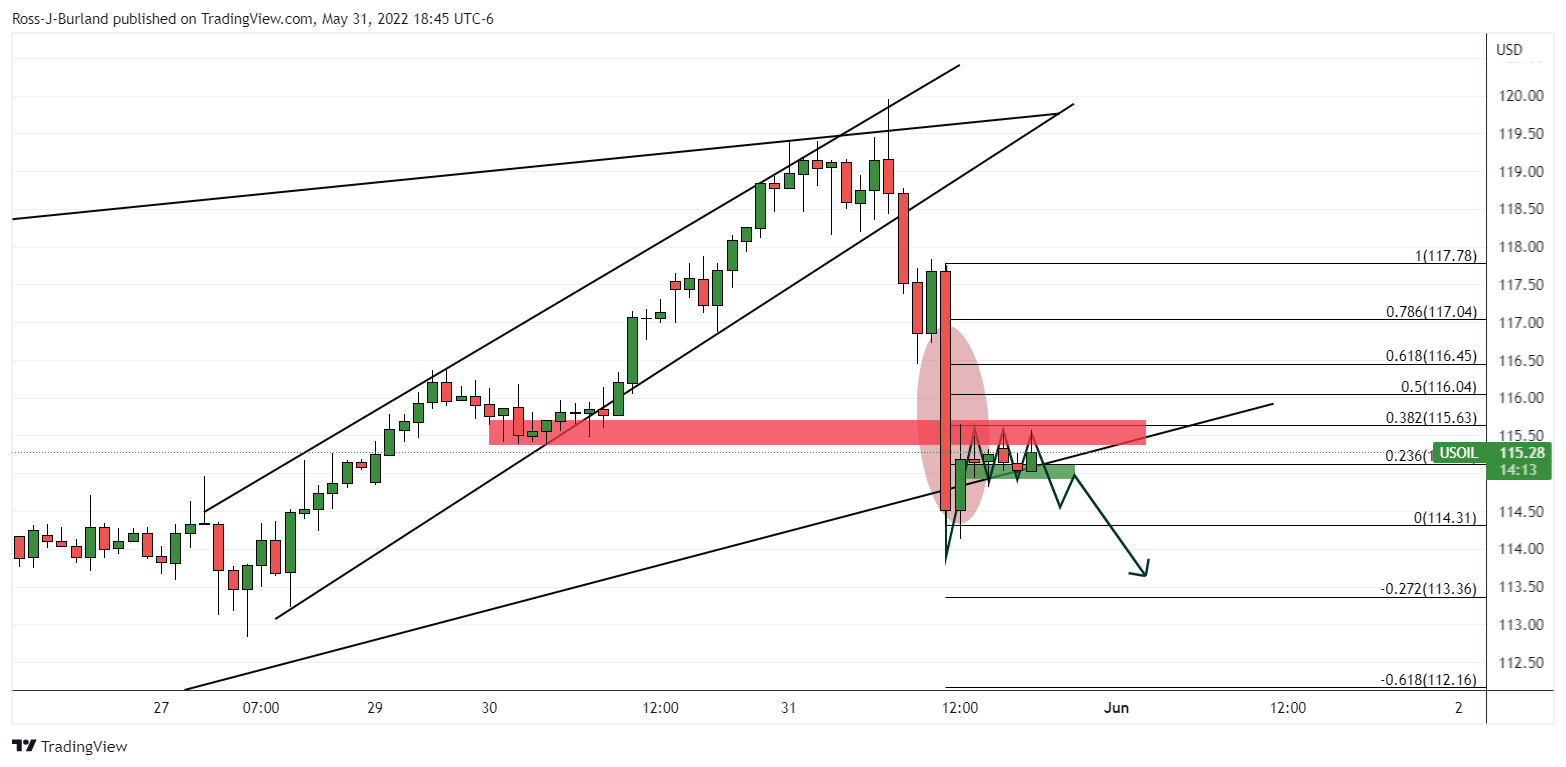
The price is pressured within its phase of consolidation and the retest of the 38.2% Fibonacci retracement area around the highs could be all that is left in the bull's fuel tank for the immediate future, opening the risk of a fresh low of the day ahead.
- The DXY is expected to resume its upside move ahead of ISM Manufacturing PMI.
- A sudden Biden-Powell meeting indicates that the inflation ghost is for real.
- Investors should brace for higher volatility as the US PMI is seen lower at 54.5.
The US dollar index (DXY) has remained lackluster in early Tokyo after a sheer downside move from 102.17. A failed attempt of establishment above 102.00 brought significant offers in the counter, which dragged the asset to near 101.70.
Odds of an extreme hawkish stance from the Fed advances
US President Joe Biden had a meeting with Federal Reserve (Fed) Jerome Powell on Tuesday to discuss the deployment of the quantitative measures that could tackle the strike from price pressures. Although the discussions didn’t result in a potential outcome, a sudden meeting between the top-tier officials of the US economy claims that inflation fears are real and are needed to be addressed as early as possible.
Also, Fed Governor Christopher Waller in his speech at Institute for Monetary and Financial Stability has advocated a spree of 50 basis points (bps) interest rate announcements by the Fed until it finds a substantial reduction in the inflation rate.
US ISM Manufacturing PMI
In today’s session, investors’ focus will remain on the release of the ISM Manufacturing Purchase Managers Index (PMI). A preliminary estimate of the ISM Manufacturing PMI is hinting at underperformance. The economic catalyst is expected to land at 54.5 against the prior print of 55.4.
Key events this week: ISM Manufacturing PMI, ADP Employment Change, Initial Jobless Claims, Nonfarm Productivity, Nonfarm Payrolls (NFP), Unemployment Rate, and ISM Services PMI.
Major events this week: Bank of Canada (BOC) interest rate decision, European Central Bank (ECB) President Christine Lagarde speech.
Australian GDP overview
Reserve Bank of Australia’s (RBA) optimism, despite the virus-led lockdowns and severe flooding in early 2022, highlights Australia’s first-quarter (Q1) Gross Domestic Product (GDP) figures, up for publishing at 01:30 GMT on Wednesday, for AUD/USD traders.
The recent data from Australia portray a mixed picture as downbeat Retail Sales and mixed employment report jostles with strong consumer inflation expectations. However, the economic outcome for Q1 2022 is likely to be an easy and one-off event considering the abnormal events that offered a shaky start to the year.
That said, forecasts suggest the annualized pace of economic growth to come in at 03.0%, below the previous period's 4.2%, while the quarter-on-quarter (QoQ) numbers could mark the 0.7% growth figures versus 3.4% prior.
Ahead of the outcome, Westpac said:
A softer print in activity is anticipated given the disruptions associated with omicron and severe flooding in NSW and Qld. Consumer spending and public demand are expected to add to growth, while business investment and housing should remain subdued. Westpac’s forecast of 0.6%qtr, 2.9%yr is close to the market median (0.7%qtr, 3.0%yr).
On the same line, FXStreet’s Dhwani Mehta said,
Even as Australia experiences a meager growth, it is unlikely to alter the RBA’s hawkish shift on the monetary policy stance. The country’s solid labor market, pent-up consumer demand and elevated household saving ratio continue to paint a rosy picture of the economy for this year.
How could it affect the AUD/USD?
AUD/USD consolidates the biggest daily loss in a fortnight around 0.7190 ahead of the key data release on Wednesday.
While the Aussie pair’s latest rebound could be linked to the mildly bid stock futures, as well as hopes of a positive surprise from the scheduled data, firmer US Treasury yields helped the US dollar to extend its previous rebound from the monthly low and challenge the AUD/USD bulls.
That said, Australia’s Q1 GDP is likely to carry less importance for the pair traders, considering the abnormal factors that may weigh on growth figures. Hence, the actual readings could offer a knee-jerk reaction to the data in case the outcome meets expectations or GDP drops further. On the contrary, a surprise positive may help the AUD/USD prices to extend recent recovery moves.
Technically, The AUD/USD pair’s pullback the previous day portrays a rising wedge bearish chart pattern on the four-hour play. The downside bias also gains support from the RSI (14) retreat. However, the 200-SMA offers an additional barrier to the south around 0.7120, in addition to the stated wedge’s support line near 0.7135.
On the flip side, recovery moves need to reject the wedge formation, by crossing the 0.7220 immediate hurdle, to convince short-term buyers.
Key notes
AUD/USD bulls are moving in again within bullish territory ahead of GDP
AUD/USD Price Analysis: Trades mixed below 0.7200 ahead of Aussie GDP, rising wedge eyed
AUD/USD Forecast: Bulls hesitate but don’t give up
Australian GDP Preview: A hit to economic activity ahead of next week’s RBA
About the Aussie GDP release
The Gross Domestic Product released by the Australian Bureau of Statistics is a measure of the total value of all goods and services produced by Australia. The GDP is considered a broad measure of economic activity and health. A rising trend has a positive effect on the AUD, while a falling trend is seen as negative (or bearish) for the AUD.
- Gold renews fortnight low, extends downside break of 200-DMA.
- Yields underpin US dollar rebound, policymakers’ praise to Fed’s tightening adds to the greenback’s strength.
- US ISM PMIs for May, Fedspeak may entertain traders during NFP week, risk catalysts are also important for clear directions.
- Gold Price Forecast: XAUUSD extends slump to fresh weekly lows
Gold (XAU/USD) pares intraday losses around $1,835, despite keeping the previous day’s bearish move, as the US dollar remains firmer during Wednesday’s initial Asian session.
The yellow metal dropped the most in three weeks on Tuesday on the greenback’s rebound from its monthly low. That said, the quote’s latest weakness could be linked to comments from US Treasury Secretary Janet Yellen and Atlanta Fed President Raphael Bostic, suggesting further tightening of policies at the Fed.
“US Treasury Secretary Janet Yellen said on Tuesday that she was wrong in the past about the path inflation would take, but said taming price hikes is President Joe Biden's top priority and he supports the Federal Reserve's actions to achieve that,” said Reuters. On the other hand, Fed’s Bostic crossed wires during an interview with MarketWatch as he said that his suggestion that the central bank takes a September “pause” in its push to raise interest rates should not be construed in any way as a “Fed put,” or belief that the central bank would come to the rescue of markets.
Also weighing on the gold prices could be comments from US President Joe Biden as he said, “If Russia does not pay a heavy price for its actions, it will send a message to other would-be aggressors that they too can seize territory and subjugate other countries,” per The New York Times.
On Tuesday, hawkish Fedspeak and upbeat US data favored the US dollar to recover from the multi-day low. Fed Board of Governors member Christopher Waller said that he supports lifting interest rates by another 50 bps at the next several Fed meetings and that the policy rate should be above neutral by the end of the year to reduce demand, reported Reuters. On the other hand, the US Chicago Purchasing Managers’ Index and CB Consumer Confidence both rose past forecasts for May whereas the Dallas Fed Manufacturing Business Index dropped to the lowest levels in two years.
That said, the market sentiment remains mixed and the US Treasury yields underpin the US dollar rebound, up two basis points to 2.86% by the press time. However, the S&P 500 Futures rise half a percent near 4,150 and probe gold sellers.
Moving on, the US ISM Manufacturing PMI for May, expected 54.5 versus 55.4 prior, will decorate the calendar while Fedspeak and other risk catalysts to direct short-term gold move.
Technical analysis
Gold prices remain on the back foot, justifying the first daily closing below the 200-DMA, as well as sustained trading below the 100-SMA and bullish channel breakdown on the four-hour (4H) play.
Gold: Daily chart
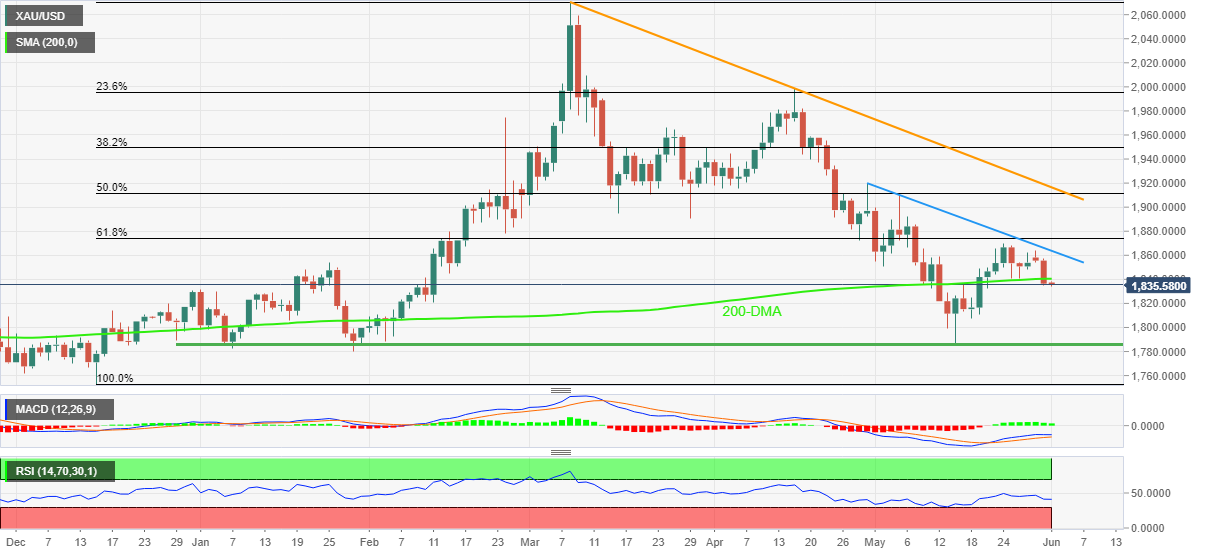
Trend: Further weakness expected
Although the RSI and MACD signals back the metal’s further declines, multiple supports surrounding the $1,815-10 region join nearly oversold RSI on 4H to challenge the bears.
Gold: Four-hour chart
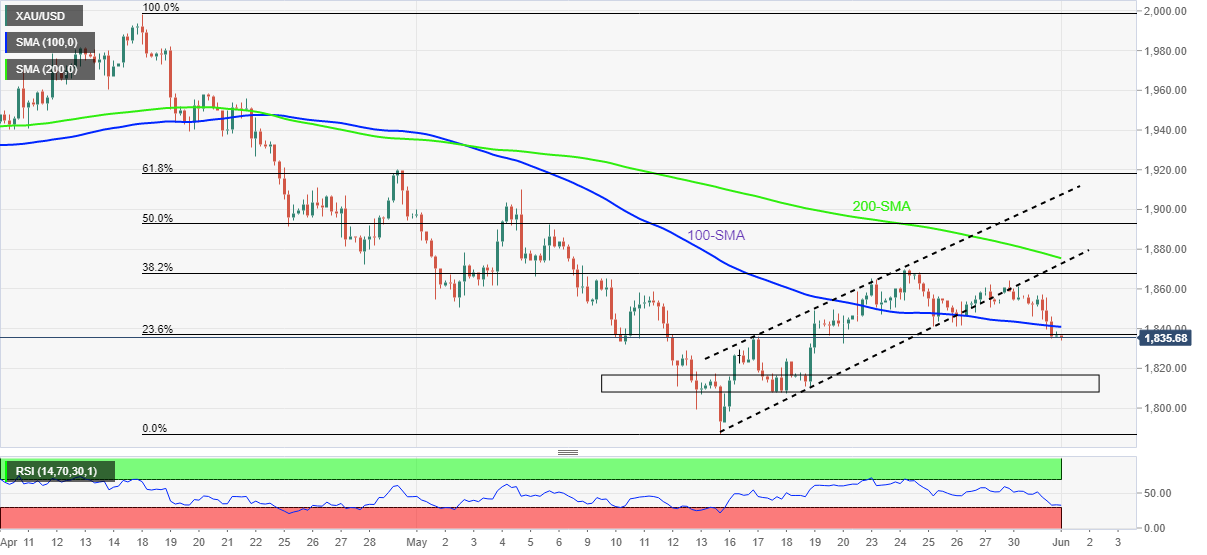
Trend: On the back foot
However, a clear downside break of $1,810 won’t hesitate to direct XAU/USD towards May’s low of $1,786.
Alternatively, the 100-SMA on 4H joins the 200-DMA to highlight $1,840 as the key immediate hurdle on the upside.
Following that, a monthly resistance line on D1 and the 200-SMA on the four-hour play, respectively near $1,864 and $1,875, could lure the gold buyers.
- AUD/USD bulls driving higher, but a correction could be on the cards.
- The GDP data today will be keenly eyed for further clues as to the path of interest rates in Australia.
At 0.7183, AUD/USD is near the highs of the Asian session pre-Tokyop open and 0.15% higher and moving up from a session low of 0.7171 to a recent high of 0.7184. The Australian dollar was hit during Tuesday's business following a bullish open on Monday in positive territory as the greenback bounced back to life on soaring US yields.
Renewed global inflation fears lifted the US counterpart, but positive economic data in Australia pointed to steady growth and kept selling contained which is making the basis for higher prices for the sessions ahead. Australian first-quarter Gross Domestic Product (GDP) data is due today and partial indicators on Tuesday suggested growth despite a fall in net exports. Better-than-expected Chinese factory activity data is also a helping hand, however, investors remain cautious because the figures indicated activity was shrinking in May following a steep contraction in April.
For today's data, Westpac has upgraded its forecast for Australian first-quarter GDP, now seeing it 0.6% higher than in the previous quarter, instead of 0.2%, and 2.9% higher than a year earlier. ''A softer print in activity is anticipated given the disruptions associated with omicron and severe flooding in NSW and Qld. Consumer spending and public demand are expected to add to growth, while business investment and housing should remain subdued.''
The data will be closely watched by central bank observers. Australian inflation hit a 20-year high in the first quarter and the Reserve Bank of Australia lifted its benchmark cash rate to 0.35% in May. Markets are priced for another hike to 0.6% next week and more to around 2.5% by year's end.
As for the greenback, the US dollar was broadly stronger overnight. The dollar was supported by demand for safe havens as hawkish comments from a US Federal Reserve official rattled investors' nerves. Fed Governor Christopher Waller said the Fed should be prepared to raise interest rates by a half percentage point at every meeting from now on until inflation is decisively capped.
Consequently, the analysts at Brown Brothers Harriman explained that WIRP suggests 50 bp is fully priced in for June and July. ''However, a third 50 bp that was fully priced in for September is now about 50% priced in vs. 35% last week. After September, two more 25 bp hikes are fully priced in and a third is partially priced in that would take the Fed Funds ceiling to between 3.0-3.25%.''
This has fuelled a bid in the greenback. The US Dollar Currency Index (DXY), which measures the greenback against six other major currencies, was on pace for its best one-day gain in nearly two weeks. The dollar index, is higher by about 6.4% for the year, but was down 1.4% for May for its worst monthly loss in a year. The dollar index has not closed below its 50-day moving average since mid-February but has drifted closer to it over the last several sessions.
Meanwhile, President Joe Biden told Fed Chair Jerome Powell on Tuesday that he will give the central bank the space and independence to address inflation as it sees fit.
- Biden and Powell to discuss inflation, US dollar on a knife's edge
The Nonfarm Payrolls and other important survey data will be reported. We get the regional Fed manufacturing surveys wrap-up and May ISM manufacturing PMI will be reported tomorrow and is expected at 54.5 vs. 55.4 in April.
AUD/USD technical analysis
The price had been respecting the support structures in a pursuit of the price imbalance between recent highs and the May 4 highs at 0.7266. The price would be expected to mitigate this area of imbalance with relative ease:
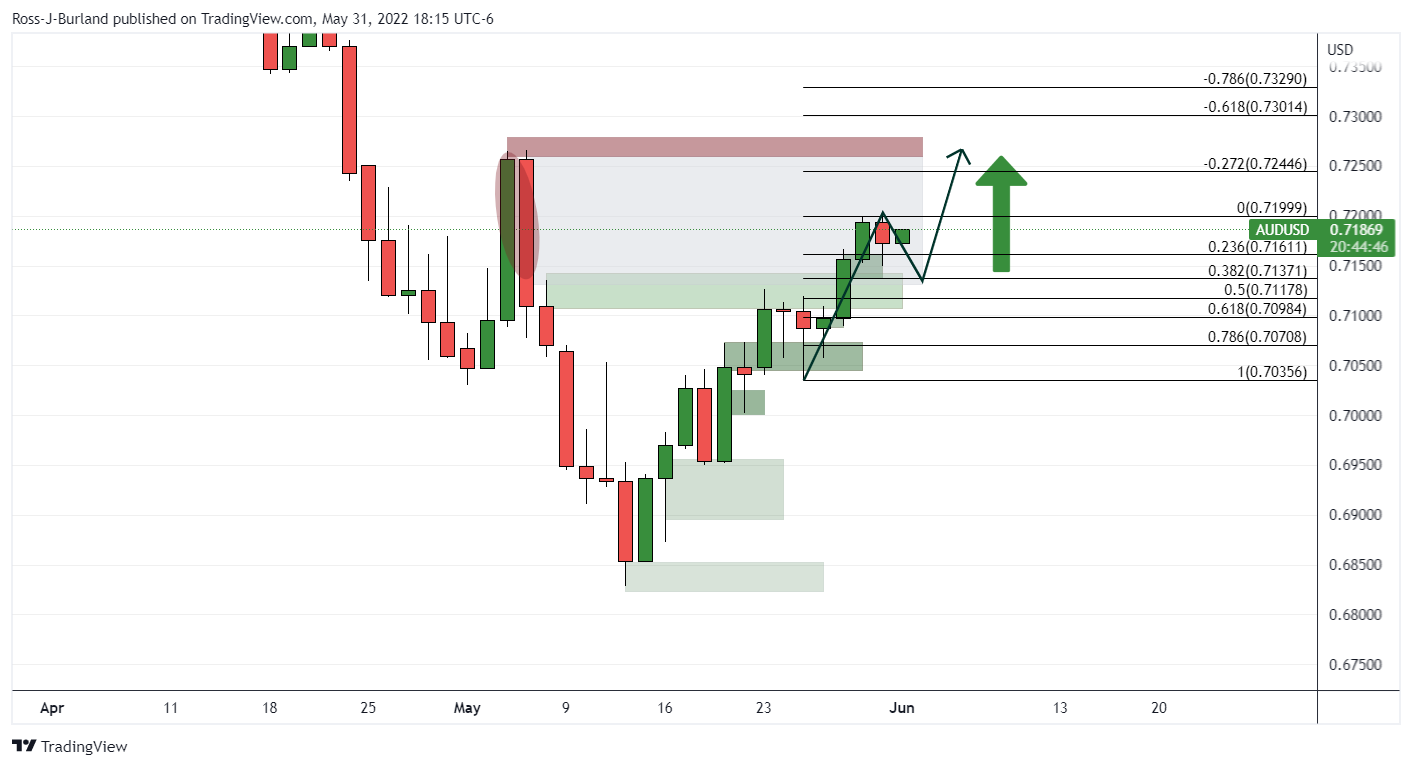
| Pare | Closed | Change, % |
|---|---|---|
| AUDUSD | 0.71758 | -0.27 |
| EURJPY | 138.118 | 0.42 |
| EURUSD | 1.07325 | -0.41 |
| GBPJPY | 162.098 | 0.42 |
| GBPUSD | 1.25988 | -0.42 |
| NZDUSD | 0.65129 | -0.66 |
| USDCAD | 1.26505 | -0.05 |
| USDCHF | 0.95935 | 0.19 |
| USDJPY | 128.691 | 0.84 |
- AUD/JPY has touched a high of 92.55 as investors await Aussie GDP.
- A downward print at 0.7% is expected vs. 3.4% previously recorded on a quarterly basis.
- The upbeat Japan employment data failed to cheer the Japanese bulls.
The AUD/JPY pair has overstepped 92.50 despite investors expecting a slippage in the Gross Domestic Product (GDP) numbers to be reported by the Australian Bureau of Statistics in the Asian session. The quarterly GDP is seen as extremely lower at 0.7% against the prior print of 3.4%. Also, the annual GDP numbers would tumble to 3% in comparison with the former figure of 4.2%.
An underperformance from the aussie economic data might put some pressure on the risk barometer, however, the ongoing ultra-loose monetary policy by the Bank of Japan (BOJ) will keep the Japanese yen on the tenterhooks.
The antipodean is performing better against yen as investors are betting over more rate hike announcements by the Reserve Bank of Australia (RBA) as mounting inflationary pressures is complicating the situation for the households. Firing oil and commodity prices are affecting the real income of the households and eventually posing challenging tasks for RBA policymakers.
The risk barometer has remained stronger this week despite the upbeat employment data from the Japanese economy. The Statistics Bureau of Japan reported the Jobs/Applicants Ratio at 1.23% against the prior print of 1.22%. Also, the Unemployment Rate landed at 2.5% against the prior print of 2.6%. The tight labor market in Japan is not sufficient to force the BOJ to feature even a neutral stance. The BOJ will stick to its ultra-loose monetary policy till it finds sufficient evidence of higher growth forecasts.







© 2000-2026. All rights reserved.
This site is managed by Teletrade D.J. LLC 2351 LLC 2022 (Euro House, Richmond Hill Road, Kingstown, VC0100, St. Vincent and the Grenadines).
The information on this website is for informational purposes only and does not constitute any investment advice.
The company does not serve or provide services to customers who are residents of the US, Canada, Iran, The Democratic People's Republic of Korea, Yemen and FATF blacklisted countries.
Making transactions on financial markets with marginal financial instruments opens up wide possibilities and allows investors who are willing to take risks to earn high profits, carrying a potentially high risk of losses at the same time. Therefore you should responsibly approach the issue of choosing the appropriate investment strategy, taking the available resources into account, before starting trading.
Use of the information: full or partial use of materials from this website must always be referenced to TeleTrade as the source of information. Use of the materials on the Internet must be accompanied by a hyperlink to teletrade.org. Automatic import of materials and information from this website is prohibited.
Please contact our PR department if you have any questions or need assistance at pr@teletrade.global.


 Bank
Bank transfers


