- Phân tích
- Tin tức và các công cụ
- Tin tức thị trường
Tin tức thì trường
- EUR/USD shed 0.25% and fell back into the 1.0300 handle on Wednesday.
- Despite the midweek downside push, Fiber is holding above two year lows for now.
- EU Retail Sales, German Industrial Production, and US Challenger Job Cuts on the docket.
EUR/USD fell back once again on Wednesday, dipping back into the 1.0300 handle as Fiber traders weigh mixed EU data while sitting in the shadow of Friday’s looming US Nonfarm Payrolls (NFP) jobs data dump.
European data broadly recovered early Wednesday, with German Retail Sales and pan-European Producer Price Index (PPI) figures both rising from previous prints, but most data printed with below-average caveats, especially EU PPI inflation which remains in contraction territory. Euro traders will be hoping for an upside swing in pan-EU Retail Sales figures for the year ended in December, due early Thursday, but not until after German Industrial Production figures kick off the European trading session.
A raft of speeches from Federal Reserve (Fed) policymakers await traders on Thursday, as well as Challenger Job Cuts for December, which will serve as the last punch of NFP preview data before the bumper labor print on Friday.
ADP Employment Change in December showed slower hiring at 122K compared to 140K expected and 146K in November. Wage data is at its slowest since mid-2021.
The Federal Reserve's latest Meeting Minutes indicated greater concern over President Trump's tariff plans than initially thought. Despite earlier reassurances from Fed speakers about immigration and trade policies' minimal impact, the minutes highlighted four discussion points on major US policy changes affecting central banking. Additionally, the Fed agreed it was time to slow rate cuts, stressing that policy uncertainty is driving expectations for fewer cuts in 2025 than previously anticipated.
EUR/USD price forecast
EUR/USD near-term battle with the 1.0300 handle leaves Fiber traders pushed firmly onto the backfoot as bidders struggle to keep price action north of multi-year lows. The pair has slumped consistently since kicking off a bearish trend near the end of September. EUR/USD fell 8.82% top-to-bottom, knocking into 26-month lows in the process.
A bullish turnaround is on the cards with bids testing into arguably oversold territory, but Euro bulls will need to first contend with the 50-day Exponential Moving Average (EMA), which is grinding down into the 1.0500 handle.
EUR/USD daily chart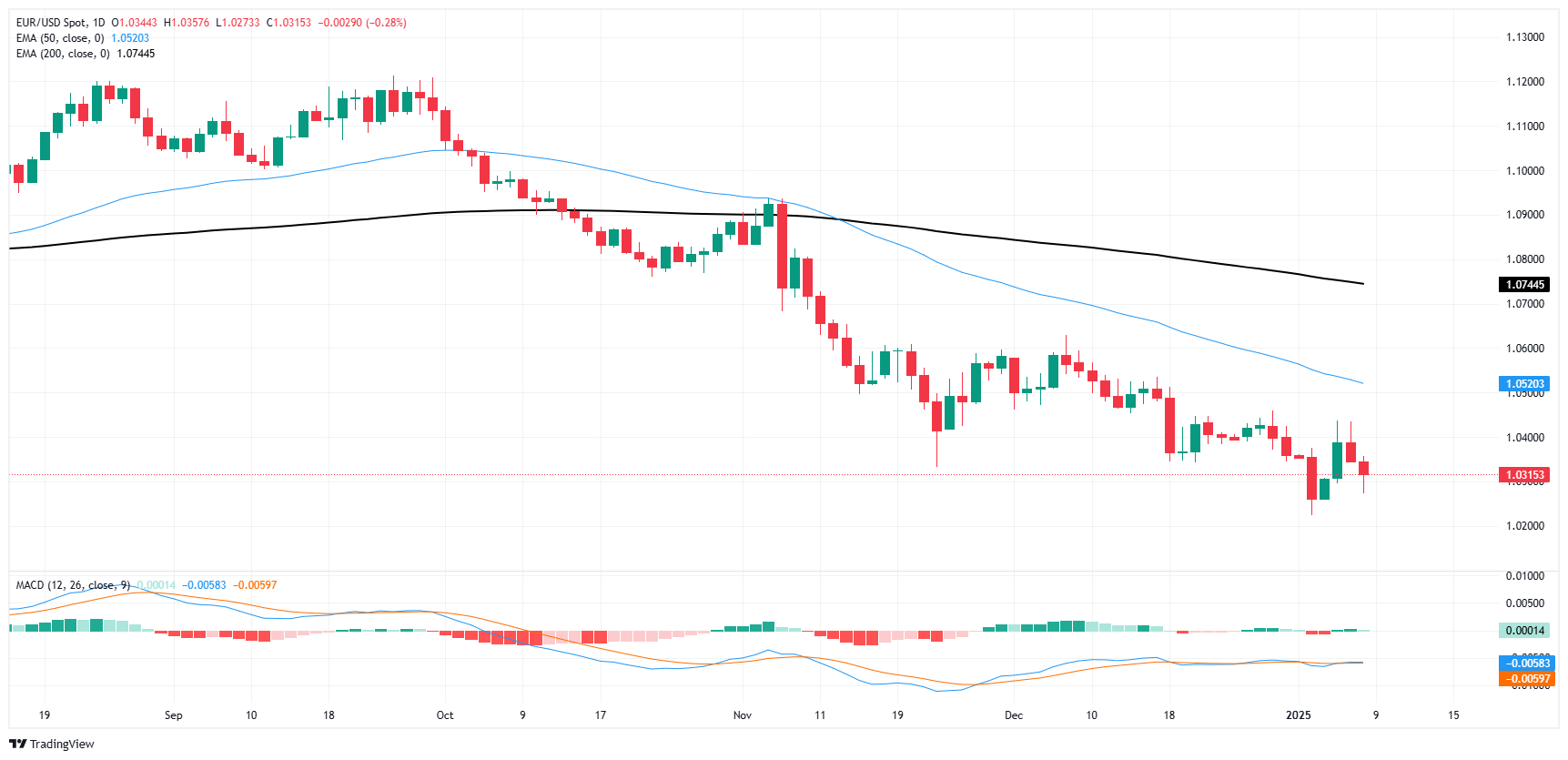
Euro FAQs
The Euro is the currency for the 19 European Union countries that belong to the Eurozone. It is the second most heavily traded currency in the world behind the US Dollar. In 2022, it accounted for 31% of all foreign exchange transactions, with an average daily turnover of over $2.2 trillion a day. EUR/USD is the most heavily traded currency pair in the world, accounting for an estimated 30% off all transactions, followed by EUR/JPY (4%), EUR/GBP (3%) and EUR/AUD (2%).
The European Central Bank (ECB) in Frankfurt, Germany, is the reserve bank for the Eurozone. The ECB sets interest rates and manages monetary policy. The ECB’s primary mandate is to maintain price stability, which means either controlling inflation or stimulating growth. Its primary tool is the raising or lowering of interest rates. Relatively high interest rates – or the expectation of higher rates – will usually benefit the Euro and vice versa. The ECB Governing Council makes monetary policy decisions at meetings held eight times a year. Decisions are made by heads of the Eurozone national banks and six permanent members, including the President of the ECB, Christine Lagarde.
Eurozone inflation data, measured by the Harmonized Index of Consumer Prices (HICP), is an important econometric for the Euro. If inflation rises more than expected, especially if above the ECB’s 2% target, it obliges the ECB to raise interest rates to bring it back under control. Relatively high interest rates compared to its counterparts will usually benefit the Euro, as it makes the region more attractive as a place for global investors to park their money.
Data releases gauge the health of the economy and can impact on the Euro. Indicators such as GDP, Manufacturing and Services PMIs, employment, and consumer sentiment surveys can all influence the direction of the single currency. A strong economy is good for the Euro. Not only does it attract more foreign investment but it may encourage the ECB to put up interest rates, which will directly strengthen the Euro. Otherwise, if economic data is weak, the Euro is likely to fall. Economic data for the four largest economies in the euro area (Germany, France, Italy and Spain) are especially significant, as they account for 75% of the Eurozone’s economy.
Another significant data release for the Euro is the Trade Balance. This indicator measures the difference between what a country earns from its exports and what it spends on imports over a given period. If a country produces highly sought after exports then its currency will gain in value purely from the extra demand created from foreign buyers seeking to purchase these goods. Therefore, a positive net Trade Balance strengthens a currency and vice versa for a negative balance.
- NZD/USD edges lower to near 0.5610 in Thursday’s early Asian session.
- Fed officials said they will slow the pace of rate cuts due to the uncertainty, minutes of the meeting showed Wednesday.
- Chinese December CPI inflation data will be released on Thursday.
The NZD/USD pair trades with mild losses to around 0.5610 during the early Asian session on Thursday. The expectation of a slower rate cut by the Federal Reserve (Fed) continues to underpin the US Dollar (USD) broadly.
Minutes released on Wednesday showed that Fed policymakers expressed concern about inflation and the impact that President-elect Donald Trump’s policies could have. Fed officials indicated they would be moving more slowly on rate reductions because of the uncertainty.
Fed officials pencilled the expected cuts in 2025 to two from four in the previous estimate at September’s meeting. A more hawkish stance of the US central bank and the signal that it would slow the pace of rate cuts in 2025 provide some support to the Greenback and act as the headwind for NZD/USD.
Investors await the Chinese December Consumer Price Index (CPI) inflation data, which is due later on Thursday. Several Fed officials are scheduled to speak later in the day. On Friday, the US Nonfarm Payrolls (NFP) for December will be in the spotlight.
On Tuesday, the National Development and Reform Commission (NDRC), China's top economic planner, issued a guideline for building a unified national market, breaking down market barriers to boost domestic demand while enhancing openness. The fresh supportive measures from China could boost the Kiwi, as China is a major trading partner for New Zealand.
New Zealand Dollar FAQs
The New Zealand Dollar (NZD), also known as the Kiwi, is a well-known traded currency among investors. Its value is broadly determined by the health of the New Zealand economy and the country’s central bank policy. Still, there are some unique particularities that also can make NZD move. The performance of the Chinese economy tends to move the Kiwi because China is New Zealand’s biggest trading partner. Bad news for the Chinese economy likely means less New Zealand exports to the country, hitting the economy and thus its currency. Another factor moving NZD is dairy prices as the dairy industry is New Zealand’s main export. High dairy prices boost export income, contributing positively to the economy and thus to the NZD.
The Reserve Bank of New Zealand (RBNZ) aims to achieve and maintain an inflation rate between 1% and 3% over the medium term, with a focus to keep it near the 2% mid-point. To this end, the bank sets an appropriate level of interest rates. When inflation is too high, the RBNZ will increase interest rates to cool the economy, but the move will also make bond yields higher, increasing investors’ appeal to invest in the country and thus boosting NZD. On the contrary, lower interest rates tend to weaken NZD. The so-called rate differential, or how rates in New Zealand are or are expected to be compared to the ones set by the US Federal Reserve, can also play a key role in moving the NZD/USD pair.
Macroeconomic data releases in New Zealand are key to assess the state of the economy and can impact the New Zealand Dollar’s (NZD) valuation. A strong economy, based on high economic growth, low unemployment and high confidence is good for NZD. High economic growth attracts foreign investment and may encourage the Reserve Bank of New Zealand to increase interest rates, if this economic strength comes together with elevated inflation. Conversely, if economic data is weak, NZD is likely to depreciate.
The New Zealand Dollar (NZD) tends to strengthen during risk-on periods, or when investors perceive that broader market risks are low and are optimistic about growth. This tends to lead to a more favorable outlook for commodities and so-called ‘commodity currencies’ such as the Kiwi. Conversely, NZD tends to weaken at times of market turbulence or economic uncertainty as investors tend to sell higher-risk assets and flee to the more-stable safe havens.
- GBP/USD shed over 0.9% on Wednesday as market sentiment droops.
- A thin data schedule on the UK side leaves Cable traders to face looming NFP figures.
- The Fed may be more concerned about government policy than previously believed.
GBP/USD sank nearly a full percent on Wednesday, falling away from the 1.2500 handle which is proving too difficult for Pound Sterling bidders to reclaim. The pair tested below 1.2350 briefly, and Cable is poised for a further dip into multi-month lows.
Meaningful economic data is absent on the UK side, a running theme for the first full trading week of 2025. Cable traders will remain exposed to broad-market flows into and out of the US Dollar as traders gear up for a hectic end to the week. A raft of speeches from Federal Reserve (Fed) policymakers await traders on Thursday, as well as Challenger Job Cuts for December, which will serve as the last punch of Nonfarm Payrolls (NFP) preview data before the bumper labor print on Friday.
On Wednesday, the ADP Employment Change report indicated a slower hiring rate than anticipated for December, with a total of 122K jobs added compared to the expected 140K and November’s 146K. Additionally, ADP wage data showed its slowest growth since mid-2021.
In the same day, the Federal Reserve's latest Meeting Minutes disclosed that policymakers might be more apprehensive about President Donald Trump's proposed tariffs than previously thought. Over the past few weeks, Fed officials had downplayed the possible effects of immigration and trade policies on their decisions, but the recent policy meeting included four discussions about significant shifts in U.S. policy that could profoundly affect central banking. Furthermore, the Fed reached a consensus that it was time to reduce the speed of rate cuts, underscoring that policy uncertainty plays a crucial role in their lowered expectations for fewer rate reductions in 2025 than the market had earlier anticipated.
GBP/USD price forecast
GBP/USD briefly tested a new nine-month low at 1.2321 on Wednesday before a half-hearted upswing later in the day, pushing the pair back above 1.2350. January trading just started, but Cable is already on pace to close in the red for a fourth consecutive month. A technical floor is priced in at the 1.2300 price level thanks to a sharp drop and turnaround at the key level back in April.
GBP/USD daily chart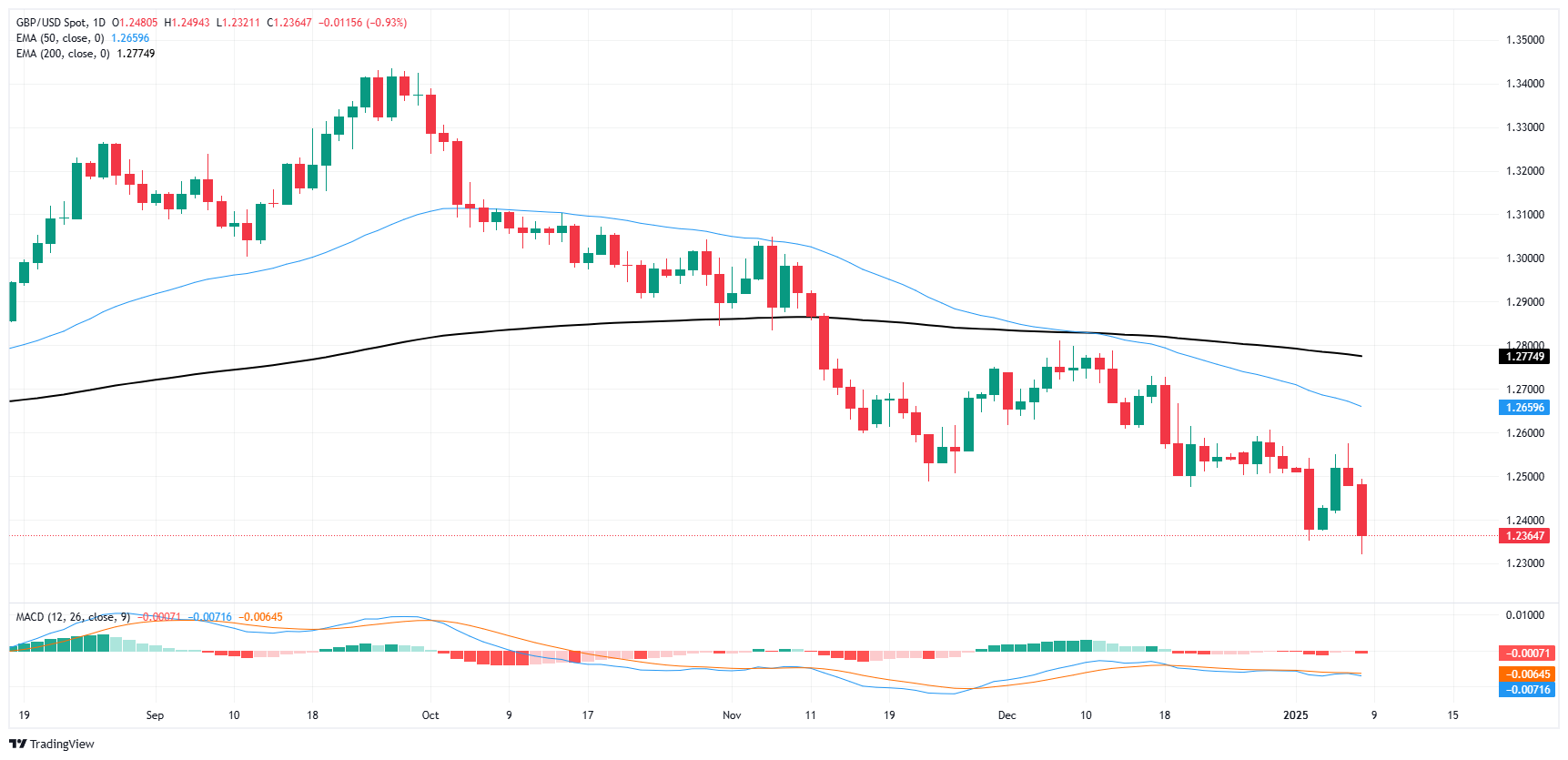
Pound Sterling FAQs
The Pound Sterling (GBP) is the oldest currency in the world (886 AD) and the official currency of the United Kingdom. It is the fourth most traded unit for foreign exchange (FX) in the world, accounting for 12% of all transactions, averaging $630 billion a day, according to 2022 data. Its key trading pairs are GBP/USD, also known as ‘Cable’, which accounts for 11% of FX, GBP/JPY, or the ‘Dragon’ as it is known by traders (3%), and EUR/GBP (2%). The Pound Sterling is issued by the Bank of England (BoE).
The single most important factor influencing the value of the Pound Sterling is monetary policy decided by the Bank of England. The BoE bases its decisions on whether it has achieved its primary goal of “price stability” – a steady inflation rate of around 2%. Its primary tool for achieving this is the adjustment of interest rates. When inflation is too high, the BoE will try to rein it in by raising interest rates, making it more expensive for people and businesses to access credit. This is generally positive for GBP, as higher interest rates make the UK a more attractive place for global investors to park their money. When inflation falls too low it is a sign economic growth is slowing. In this scenario, the BoE will consider lowering interest rates to cheapen credit so businesses will borrow more to invest in growth-generating projects.
Data releases gauge the health of the economy and can impact the value of the Pound Sterling. Indicators such as GDP, Manufacturing and Services PMIs, and employment can all influence the direction of the GBP. A strong economy is good for Sterling. Not only does it attract more foreign investment but it may encourage the BoE to put up interest rates, which will directly strengthen GBP. Otherwise, if economic data is weak, the Pound Sterling is likely to fall.
Another significant data release for the Pound Sterling is the Trade Balance. This indicator measures the difference between what a country earns from its exports and what it spends on imports over a given period. If a country produces highly sought-after exports, its currency will benefit purely from the extra demand created from foreign buyers seeking to purchase these goods. Therefore, a positive net Trade Balance strengthens a currency and vice versa for a negative balance.
- NZD/JPY slips on Wednesday, hovering around 88.75 after failing to overcome a mid-week ceiling.
- RSI dips to 53 in positive territory, signaling a sudden loss of bullish momentum.
- MACD histogram shows flat green bars, hinting that the recent upside may be running out of steam.
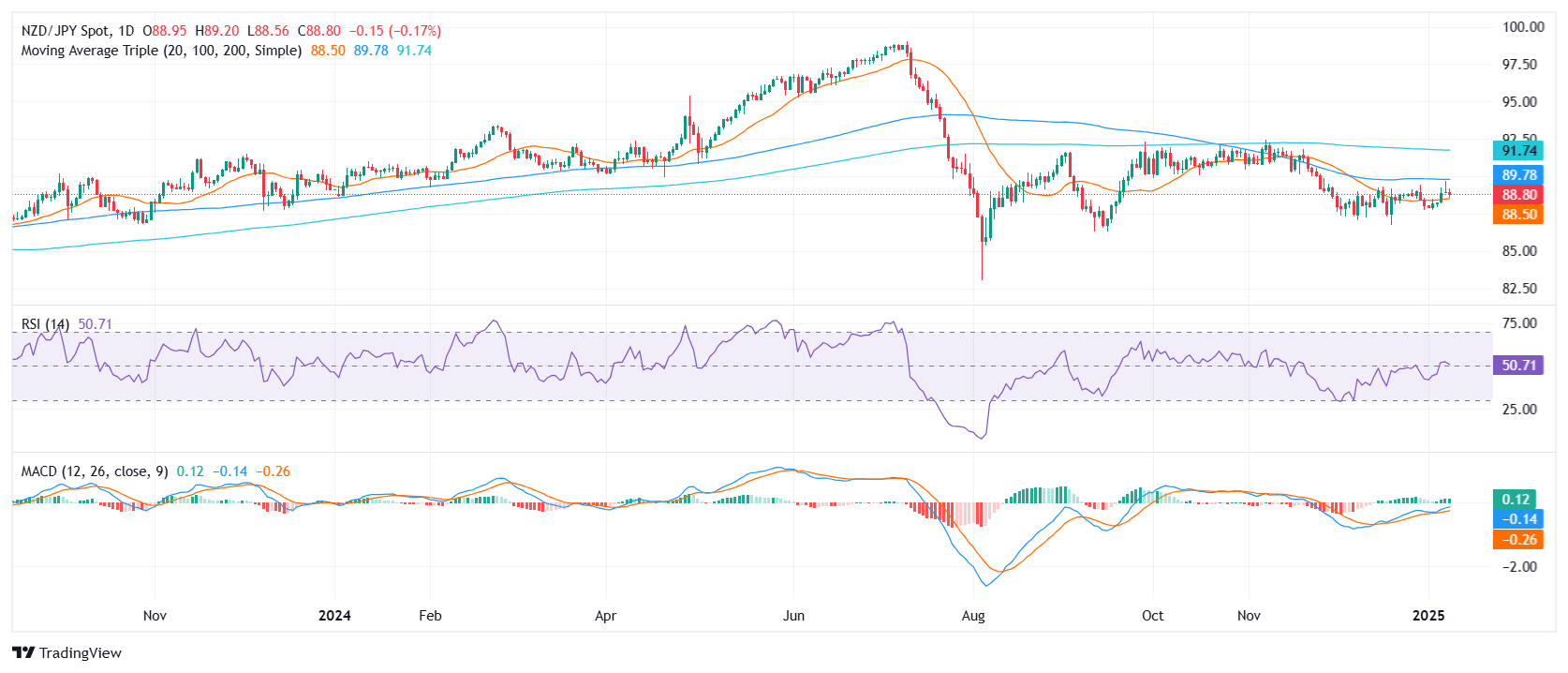
NZD/JPY retreated on Wednesday, declining by 0.33% to settle near 88.75. Earlier attempts to break above the 100-day Simple Moving Average (SMA) near 90.00 faltered, curbing the pair’s recent rebound. The Relative Strength Index (RSI) has pulled back to 53, indicating fading buying interest, while the Moving Average Convergence Divergence (MACD) histogram remains flat, suggesting limited follow-through on the upside push.
Should the bulls continue to struggle at the 100-day SMA, the pair may face additional downside pressure. Immediate support levels could appear around 88.50, with a deeper drop targeting 88.00 if selling accelerates. Conversely, a clean break above the 100-day SMA might reignite bullish momentum, paving the way toward the 89.50 zone before encountering potential psychological resistance at 90.00.
NZD/JPY daily chart
- USD/JPY ascends to 158.34, supported by hawkish hints in Fed's December minutes and positive US employment figures.
- Technical indicators suggest potential resistance at 159.00, with a pivotal target of 160.00 in sight, under watch for possible Japanese intervention.
- Downside risks remain, with immediate support at the Tenkan-Sen line of 157.28, followed by December’s low at 156.02.
The USD/JPY edged higher late in the North American session after the Federal Reserve revealed its December meeting minutes. This, along with US jobs data and risk aversion, keeps the Greenback underpinned throughout the day. The pair trades at 158.34, up 0.19%.
USD/JPY Price Forecast: Technical outlook
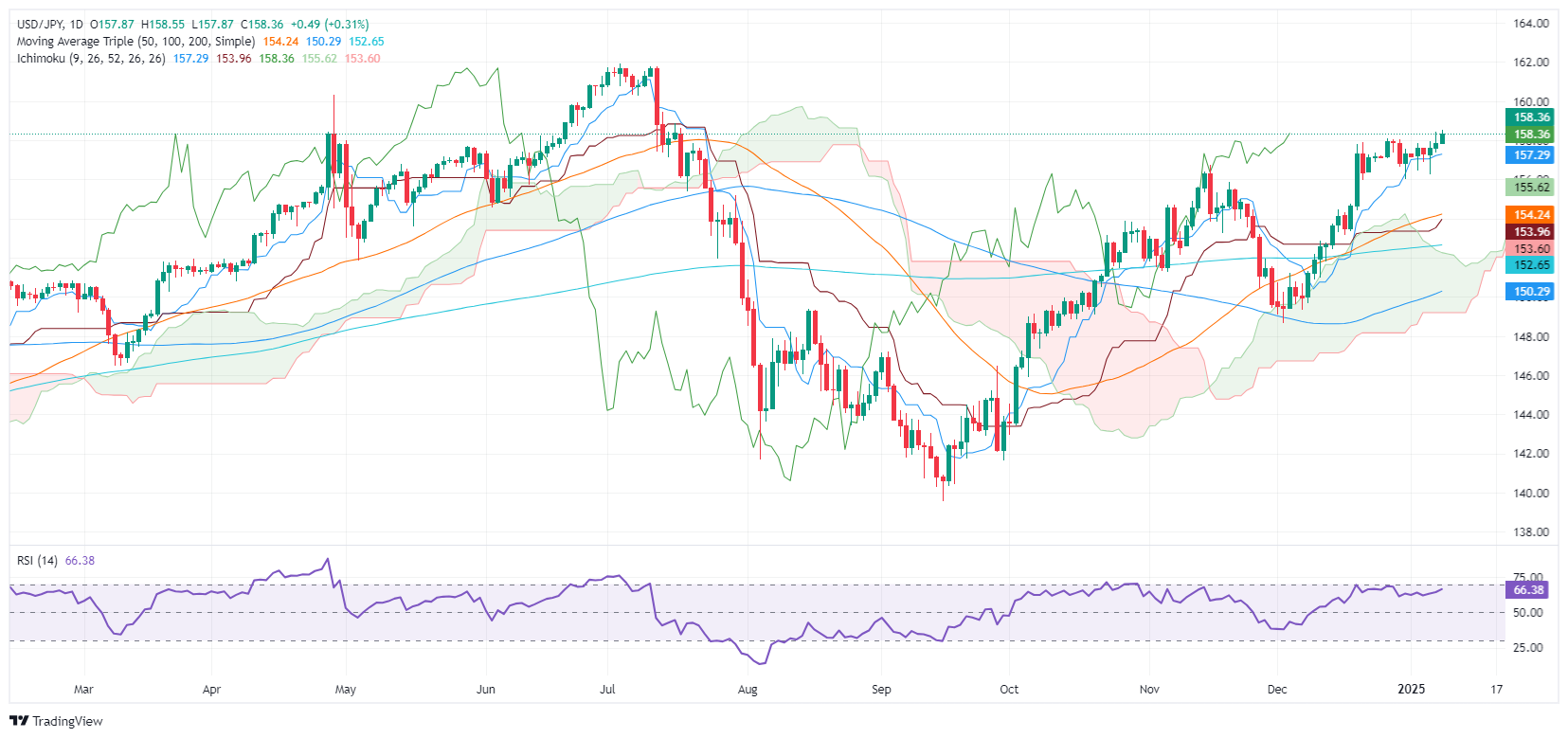
The USD/JPY has risen above December’s high before the US Nonfarm Payrolls report, opening the door to challenge the 160.00 figure. Due to being close to the latter, Japanese authorities would likely begin their intervention jawboning to halt the Greenback’s advance.
That said, the USD/JPY first key resistance would be 159.00. Once cleared, the next stop would be 160.00 ahead of testing last year’s peak at 161.95.
Conversely, if sellers moved in and kept the USD/JPY from rising above 159.00, the first support would be the Tenkan-Sen at 157.28. A breach of the latter will expose the December 31 swing low of 156.02.
USD/JPY Price Chart – Daily
Japanese Yen FAQs
The Japanese Yen (JPY) is one of the world’s most traded currencies. Its value is broadly determined by the performance of the Japanese economy, but more specifically by the Bank of Japan’s policy, the differential between Japanese and US bond yields, or risk sentiment among traders, among other factors.
One of the Bank of Japan’s mandates is currency control, so its moves are key for the Yen. The BoJ has directly intervened in currency markets sometimes, generally to lower the value of the Yen, although it refrains from doing it often due to political concerns of its main trading partners. The BoJ ultra-loose monetary policy between 2013 and 2024 caused the Yen to depreciate against its main currency peers due to an increasing policy divergence between the Bank of Japan and other main central banks. More recently, the gradually unwinding of this ultra-loose policy has given some support to the Yen.
Over the last decade, the BoJ’s stance of sticking to ultra-loose monetary policy has led to a widening policy divergence with other central banks, particularly with the US Federal Reserve. This supported a widening of the differential between the 10-year US and Japanese bonds, which favored the US Dollar against the Japanese Yen. The BoJ decision in 2024 to gradually abandon the ultra-loose policy, coupled with interest-rate cuts in other major central banks, is narrowing this differential.
The Japanese Yen is often seen as a safe-haven investment. This means that in times of market stress, investors are more likely to put their money in the Japanese currency due to its supposed reliability and stability. Turbulent times are likely to strengthen the Yen’s value against other currencies seen as more risky to invest in.
- AUD dips 0.36% to 0.6215 on Wednesday.
- Wall Street trims Trump-inspired losses, aiding brief Aussie rebound.
- Australian Retail Sales, Trade figures eyed in Asian session.
- FOMC Minutes confirm gradual approach to 2025 rate cuts.
The Australian Dollar declined by 0.36% to 0.6215 on Wednesday despite Wall Street reversing some earlier risk-off moves tied to President-elect Donald Trump’s tariff threats. Although the Aussie drew marginal support from the late US equity bounce, it remains vulnerable ahead of key November Retail Sales and External Trade data due in the Asian session. Traders look for fresh catalysts after the Federal Open Market Committee (FOMC) Meeting Minutes and local inflation data failed to offer much optimism.
Daily digest market movers: Aussie weakens after US labor market data, local inflation data
- The Australian Dollar shed over 0.40% at one point versus the USD, pressured by Trump’s potential emergency tariff move and strong labor market data.
- On the US data front, US Initial Jobless Claims dropped from 211K to 201K, below forecasts of 218K, underscoring a strong labor market.
- ADP data showed 122K private jobs added in December, missing the 140K forecast, as hiring and pay gains slowed.
- On the local front, Australian Weighted CPI for November rose 2.3% YoY, slightly above estimates, but the trimmed mean dipped from 3.5% to 3.2%.
- FOMC Meeting Minutes indicated a cautious approach to further rate cuts and highlighted inflation risks from trade policy.
- Traders turn to Aussie Retail Sales and Trade Balance data, due Thursday, for additional insight into domestic economic momentum.
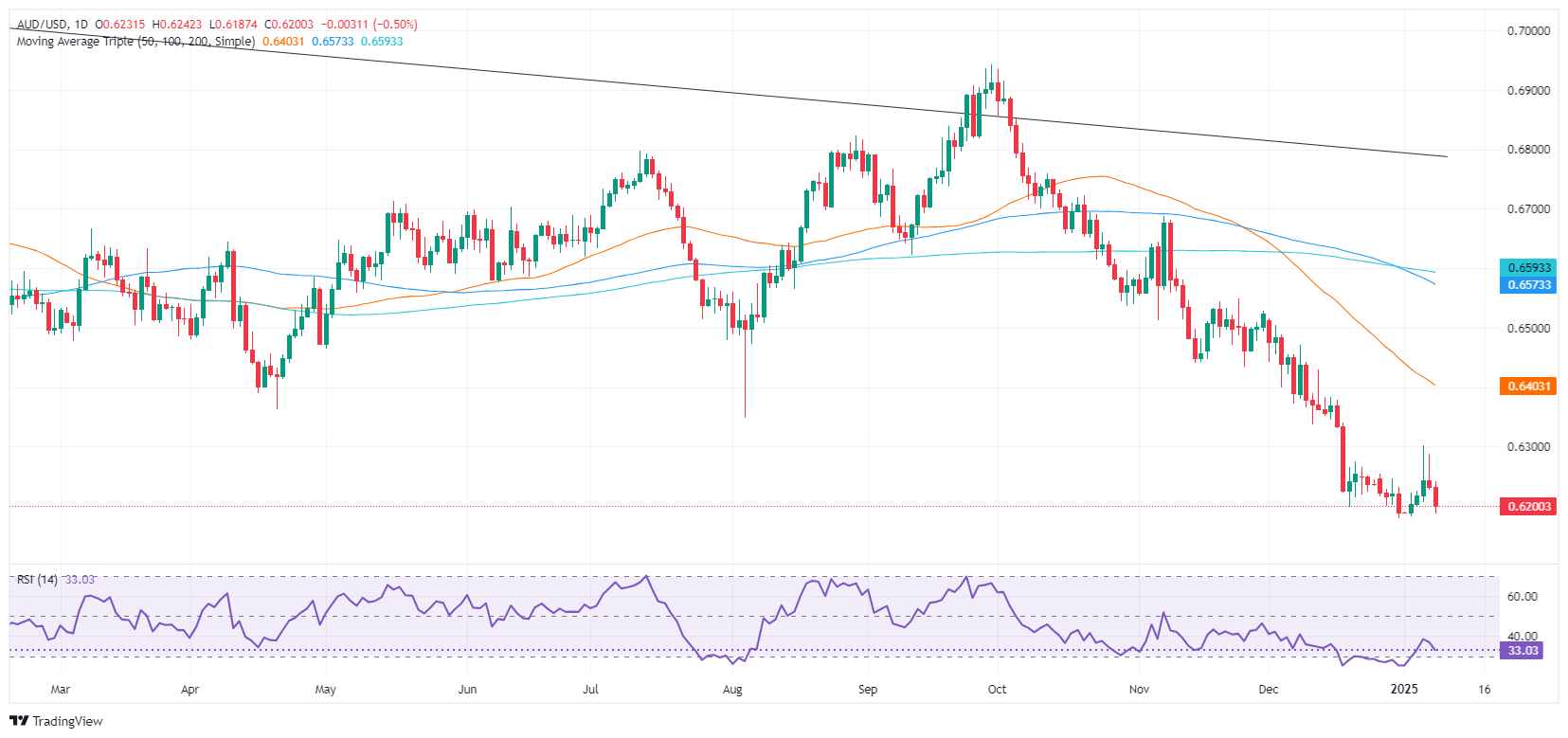
AUD/USD technical outlook: Aussie falters at 20-day SMA amid fading momentum
The Relative Strength Index (RSI) stands at 35, drifting lower in negative territory, while the Moving Average Convergence Divergence (MACD) histogram prints decreasing green bars. The pair faced resistance at its 20-day Simple Moving Average (SMA), losing traction as risk sentiment deteriorated.
Without a clear catalyst, downside risks may persist if tariff fears escalate and US economic data remain supportive of the US Dollar.
Australian Dollar FAQs
One of the most significant factors for the Australian Dollar (AUD) is the level of interest rates set by the Reserve Bank of Australia (RBA). Because Australia is a resource-rich country another key driver is the price of its biggest export, Iron Ore. The health of the Chinese economy, its largest trading partner, is a factor, as well as inflation in Australia, its growth rate and Trade Balance. Market sentiment – whether investors are taking on more risky assets (risk-on) or seeking safe-havens (risk-off) – is also a factor, with risk-on positive for AUD.
The Reserve Bank of Australia (RBA) influences the Australian Dollar (AUD) by setting the level of interest rates that Australian banks can lend to each other. This influences the level of interest rates in the economy as a whole. The main goal of the RBA is to maintain a stable inflation rate of 2-3% by adjusting interest rates up or down. Relatively high interest rates compared to other major central banks support the AUD, and the opposite for relatively low. The RBA can also use quantitative easing and tightening to influence credit conditions, with the former AUD-negative and the latter AUD-positive.
China is Australia’s largest trading partner so the health of the Chinese economy is a major influence on the value of the Australian Dollar (AUD). When the Chinese economy is doing well it purchases more raw materials, goods and services from Australia, lifting demand for the AUD, and pushing up its value. The opposite is the case when the Chinese economy is not growing as fast as expected. Positive or negative surprises in Chinese growth data, therefore, often have a direct impact on the Australian Dollar and its pairs.
Iron Ore is Australia’s largest export, accounting for $118 billion a year according to data from 2021, with China as its primary destination. The price of Iron Ore, therefore, can be a driver of the Australian Dollar. Generally, if the price of Iron Ore rises, AUD also goes up, as aggregate demand for the currency increases. The opposite is the case if the price of Iron Ore falls. Higher Iron Ore prices also tend to result in a greater likelihood of a positive Trade Balance for Australia, which is also positive of the AUD.
The Trade Balance, which is the difference between what a country earns from its exports versus what it pays for its imports, is another factor that can influence the value of the Australian Dollar. If Australia produces highly sought after exports, then its currency will gain in value purely from the surplus demand created from foreign buyers seeking to purchase its exports versus what it spends to purchase imports. Therefore, a positive net Trade Balance strengthens the AUD, with the opposite effect if the Trade Balance is negative.
- Gold climbs following Fed minutes hinted at a potential slowdown in the rate easing cycle.
- US Dollar Index maintains gains, while US Treasury yields show a slight pullback from recent highs.
- Gold market watchers eye US Nonfarm Payrolls report and UoM Consumer Sentiment data.
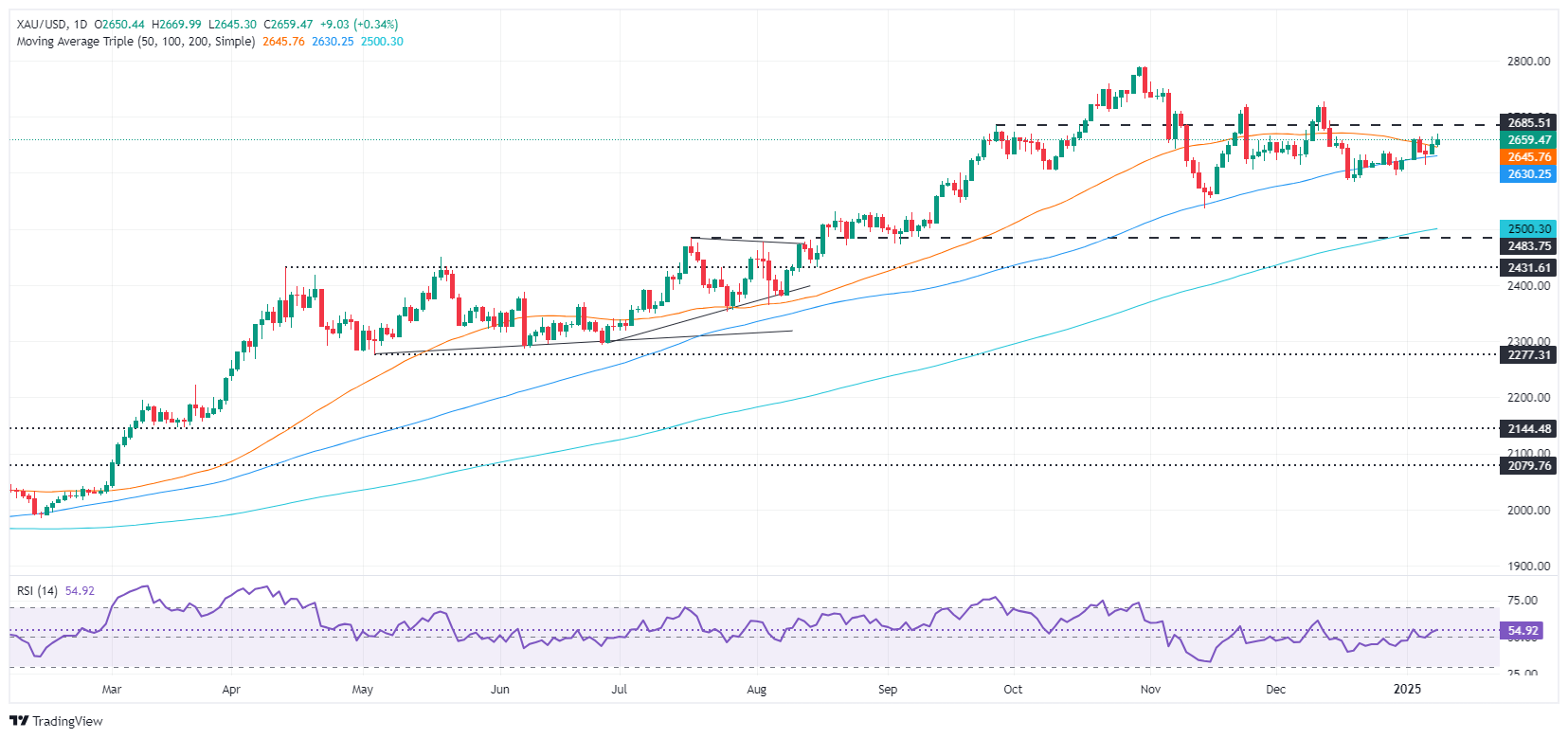
Gold price climbed during the North American session after the United States (US) Federal Reserve (Fed) struck a neutral to slightly hawkish tone in last December meeting minutes, hinting that it “would be appropriate to slow pace of easing.” At the time of writing, XAU/USD trades at $2,659, up by 0.34%.
During the December meeting, officials decided to lower borrowing costs by 25 basis points. However, “some participants said there was merit in keeping rates unchanged at that meeting, citing the higher risk of persistently elevated inflation.” Following the minutes’ release, XAU/USD edged towards $2,658 before paring some of those gains.
The US Dollar Index (DXY), which measures the Greenback’s performance against a basket of six currencies, holds to earlier gains of 0.33% at 109.04. The US 10-year benchmark note coupon retraced after hitting 4.73% to 4.699%, up by three basis points (bps).
Earlier, market participants shifted wary of a CNN article revealing that US President-elect Donald Trump might consider a national economic emergency declaration, allowing him to impose tariffs on adversaries and allies.
Bullion buyers ignored mixed US jobs reports, as private companies hired fewer people than expected. However, the US Department of Labor revealed that Americans' applications for jobless benefits were reduced compared to the previous week and came below forecasts.
Fed Governor Christopher Waller crossed the wires and said that tariffs would not cause persistent inflation, which would continue to fall towards the Fed’s 2% goal. Waller added that he favors further rate cuts, which would be data-dependent.
In the meantime, Gold traders are eyeing Friday's release of the US Nonfarm Payroll report and the University of Michigan (UoM) Consumer Sentiment. If both readings come stronger than expected, the XAU/USD might edge lower on broad US Dollar strength.
Daily digest market movers: Gold price climbs amid high US yields, ignore US data
- Gold shrugs off higher US real yields, rising three bps to 2.31%.
- Initial Jobless Claims in the US dropped to 201K for the week ending January 3, down from 211K and well below the forecast of 218K, according to the Department of Labor.
- ADP reported that private sector hiring totaled 122K in December, falling short of the 140K expected by economists.
- Market expectations indicate the Federal Reserve may implement two rate cuts in 2025, with the December Fed funds futures contract pricing in 54 basis points of easing.
- Gold surged to a two-day high of $2,664 following news that China’s central bank increased its reserves for the second consecutive month, adding 300K ounces to reach 73.3 million. The People's Bank of China (PBoC) resumed bullion purchases, which could keep XAU/USD prices skewed to the upside.
XAU/USD technical outlook: Gold price surges above $2,650
Gold price remains consolidated but slightly tilted to the upside after reclaiming the 50-day Simple Moving Average (SMA) at $2,648. If bulls push prices above $2,660, it will pave the way to challenge $2,700 before testing the December 12 peak at $2,726, ahead of the record high at $2,790.
On the flip side, if sellers drag the XAU/USD below the 100-day SMA of $2,628, look for a test of $2,500 before Gold extends its losses to the 200-day SMA at $2,498.
Gold FAQs
Gold has played a key role in human’s history as it has been widely used as a store of value and medium of exchange. Currently, apart from its shine and usage for jewelry, the precious metal is widely seen as a safe-haven asset, meaning that it is considered a good investment during turbulent times. Gold is also widely seen as a hedge against inflation and against depreciating currencies as it doesn’t rely on any specific issuer or government.
Central banks are the biggest Gold holders. In their aim to support their currencies in turbulent times, central banks tend to diversify their reserves and buy Gold to improve the perceived strength of the economy and the currency. High Gold reserves can be a source of trust for a country’s solvency. Central banks added 1,136 tonnes of Gold worth around $70 billion to their reserves in 2022, according to data from the World Gold Council. This is the highest yearly purchase since records began. Central banks from emerging economies such as China, India and Turkey are quickly increasing their Gold reserves.
Gold has an inverse correlation with the US Dollar and US Treasuries, which are both major reserve and safe-haven assets. When the Dollar depreciates, Gold tends to rise, enabling investors and central banks to diversify their assets in turbulent times. Gold is also inversely correlated with risk assets. A rally in the stock market tends to weaken Gold price, while sell-offs in riskier markets tend to favor the precious metal.
The price can move due to a wide range of factors. Geopolitical instability or fears of a deep recession can quickly make Gold price escalate due to its safe-haven status. As a yield-less asset, Gold tends to rise with lower interest rates, while higher cost of money usually weighs down on the yellow metal. Still, most moves depend on how the US Dollar (USD) behaves as the asset is priced in dollars (XAU/USD). A strong Dollar tends to keep the price of Gold controlled, whereas a weaker Dollar is likely to push Gold prices up.
Markets roiled on Wednesday but mostly stuck within tight ranges as investors gear up for a hectic release schedule ahead of Friday’s key US NFP jobs print.
Here’s what you need to know heading into Thursday, January 9:
The US Dollar Index (DXY) explored higher ground on Wednesday as tepid investor sentiment kept one foot solidly in the safe haven Greenback. However, traders are proving to be unwilling to tilt too far in either direction, stopping short of pushing the DXY into fresh 26-month highs. A raft of speeches from Federal Reserve (Fed) policymakers await traders on Thursday, as well as Challenger Job Cuts for December, which will serve as the last punch of Nonfarm Payrolls (NFP) preview data before the bumper labor print on Friday.
FOMC Minutes show officials weigh in potential changes to trade and immigration policies
EUR/USD is back testing the 1.0300 handle after flubbing a near-term bullish recovery. The pair is one bad day away from touching the 1.0200 level for the first time in over two years, and Euro traders will be hoping for an upside swing in pan-EU Retail Sales figures for the year ended in December, due early Thursday, but not until after German Industrial Production figures kick off the European trading session.
GBP/USD tested a fresh nine-month low on Wednesday, tapping 1.2320 as the UK side of the economic calendar remains thin and Cable traders struggle to find the buy button. One last bearish push into the low side will see GBP/USD crossing below 1.3200 and setting fresh 14-month lows.
AUD/USD traders have an unwieldy data schedule to contend with on Thursday. Australian Retail Sales figures for November are due early in the Antipodean session, which are expected to swing upwards, while Australia’s Trade Balance is expected to contract slightly. China will follow-up with its own data release, which could see knock-on impacts for the Aussie. Chinese Consumer Price Index (CPI) inflation for December is expected to cool to next to flat.
USD/JPY continues to grind its way higher as the Bank of Japan (BoJ) struggles to find a way to overcome the Yen’s wide interest rate differential that doesn’t involve raising interest rates. USD/JPY hit multi-decade highs last summer, and the BoJ’s efforts to directly intervene on the Yen’s behalf has turned out to be not only exorbitantly expensive, but also temporary. The pair is up almost 14% after reaching a technical bottom near 140.00 in September.
Fed FAQs
Monetary policy in the US is shaped by the Federal Reserve (Fed). The Fed has two mandates: to achieve price stability and foster full employment. Its primary tool to achieve these goals is by adjusting interest rates. When prices are rising too quickly and inflation is above the Fed’s 2% target, it raises interest rates, increasing borrowing costs throughout the economy. This results in a stronger US Dollar (USD) as it makes the US a more attractive place for international investors to park their money. When inflation falls below 2% or the Unemployment Rate is too high, the Fed may lower interest rates to encourage borrowing, which weighs on the Greenback.
The Federal Reserve (Fed) holds eight policy meetings a year, where the Federal Open Market Committee (FOMC) assesses economic conditions and makes monetary policy decisions. The FOMC is attended by twelve Fed officials – the seven members of the Board of Governors, the president of the Federal Reserve Bank of New York, and four of the remaining eleven regional Reserve Bank presidents, who serve one-year terms on a rotating basis.
In extreme situations, the Federal Reserve may resort to a policy named Quantitative Easing (QE). QE is the process by which the Fed substantially increases the flow of credit in a stuck financial system. It is a non-standard policy measure used during crises or when inflation is extremely low. It was the Fed’s weapon of choice during the Great Financial Crisis in 2008. It involves the Fed printing more Dollars and using them to buy high grade bonds from financial institutions. QE usually weakens the US Dollar.
Quantitative tightening (QT) is the reverse process of QE, whereby the Federal Reserve stops buying bonds from financial institutions and does not reinvest the principal from the bonds it holds maturing, to purchase new bonds. It is usually positive for the value of the US Dollar.
- The Canadian Dollar shed another 0.2% on Wednesday as the Loonie shrivels.
- Canada saw a data-light day on the calendar, market flows continue to tilt toward the Greenback.
- US jobs data cooled, keeping investor sentiment tepid.
The Canadian Dollar (CAD) shed another one-fifth of one percent on Wednesday as the Loonie continues to flub chances for a technical recovery from multi-year lows against the US Dollar. CAD flows remains subdued, and the Loonie is backsliding into near-term congestion against the Greenback.
Canada was largely absent from the economic data docket on Wednesday as markets broadly focus on US jobs data, with the ADP Employment Change for December easing more than expected in December and serving as a tepid preview of Friday’s upcoming US Nonfarm Payrolls (NFP) report.
Daily digest market movers: US jobs data bodes poorly for the Loonie as risk sentiment weighs
- A clear lack of Canadian economic data keeps market flows decidedly in the Greenback’s court.
- US ADP job gains shrank to 122K in December, below the expected 140K. Slowing US jobs growth could put a hamper on investor sentiment as signs of economic softening risk blowing past rate cutting territory directly into the recession zone.
- The Fed’s latest Meeting Minutes revealed Fed policymakers are pumping the brakes on further rate cuts due in no small part to incoming US President Donald Trump’s plans to unilaterally apply steep tariffs to all of the US’ main allies and trading partners in an effort to fund his scattershot government policy plans.
- In the face of a volatile new chapter in US-Canadian relations, Canadian Prime Minister Justin Trudeau has vacated his position, leaving Canadian parliament prorogued until the end of March as Canadian politicians select a new leader from the Canadian Liberal Party.
- Canadian employment and labor figures are due on Friday, but market reactions will be eclipsed by the US’ latest Nonfarm Payrolls (NFP) jobs data dump.
Canadian Dollar price forecast
The Canadian Dollar (CAD) continues to recede against the US Dollar as Loonie traders struggle to find reasons to hit the buy button. USD/CAD has been caught in rough sideways churn since the Loonie fell to multi-year lows against the Greenback in mid-December, bolstering the USD/CAD pair to its highest bids since the pandemic.
Despite a near-term freeze in momentum, the pair is still leaning firmly into bull country, though buyers are struggling to finish the journey to the 1.4500 handle. The 1.4400 level is proving to be the barrier to beat, and Loonie bidders could force the pair back down to the 50-day Exponential Moving Average (EMA) which is rising into 1.4200.
USD/CAD daily chart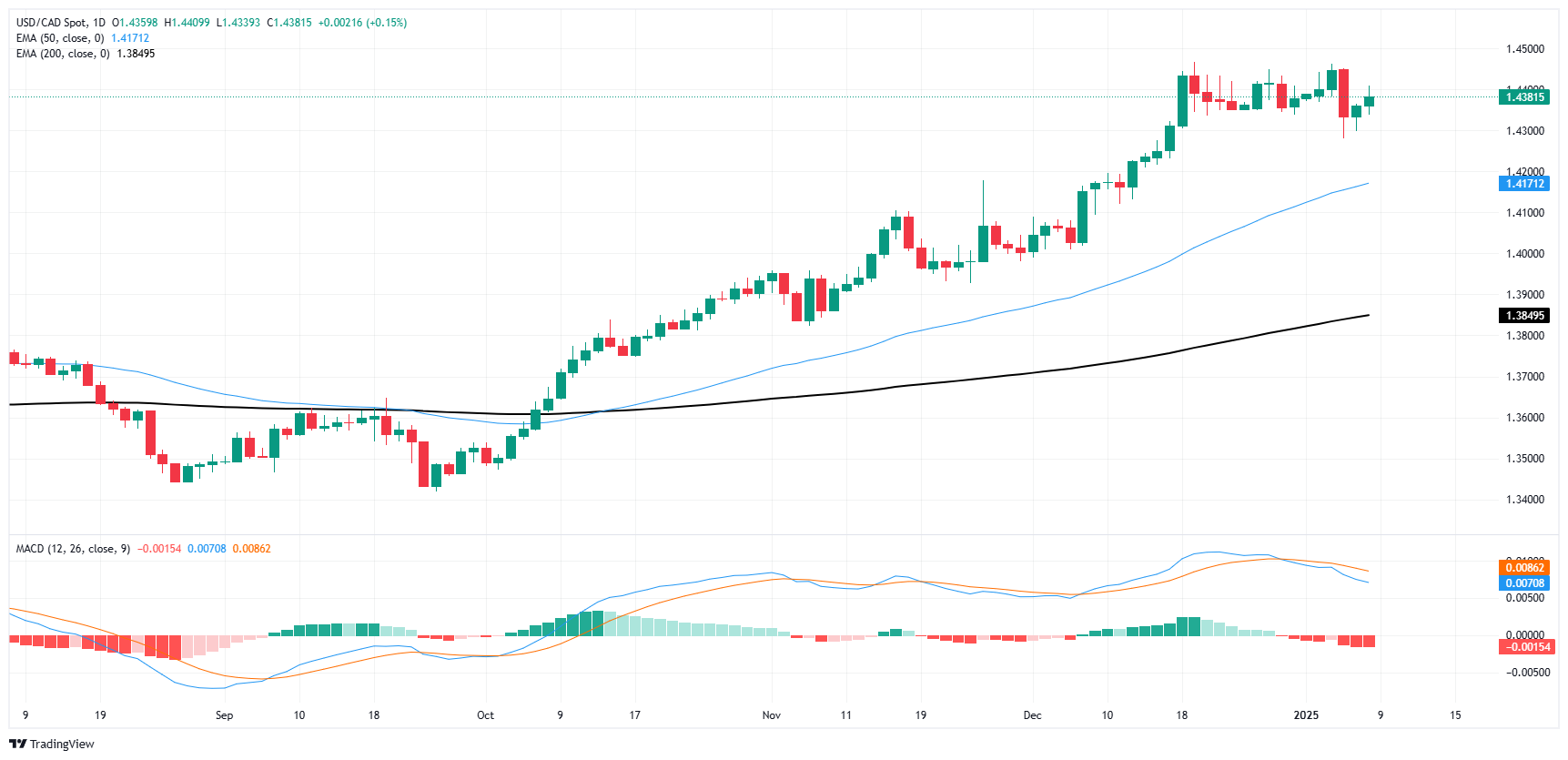
Canadian Dollar FAQs
The key factors driving the Canadian Dollar (CAD) are the level of interest rates set by the Bank of Canada (BoC), the price of Oil, Canada’s largest export, the health of its economy, inflation and the Trade Balance, which is the difference between the value of Canada’s exports versus its imports. Other factors include market sentiment – whether investors are taking on more risky assets (risk-on) or seeking safe-havens (risk-off) – with risk-on being CAD-positive. As its largest trading partner, the health of the US economy is also a key factor influencing the Canadian Dollar.
The Bank of Canada (BoC) has a significant influence on the Canadian Dollar by setting the level of interest rates that banks can lend to one another. This influences the level of interest rates for everyone. The main goal of the BoC is to maintain inflation at 1-3% by adjusting interest rates up or down. Relatively higher interest rates tend to be positive for the CAD. The Bank of Canada can also use quantitative easing and tightening to influence credit conditions, with the former CAD-negative and the latter CAD-positive.
The price of Oil is a key factor impacting the value of the Canadian Dollar. Petroleum is Canada’s biggest export, so Oil price tends to have an immediate impact on the CAD value. Generally, if Oil price rises CAD also goes up, as aggregate demand for the currency increases. The opposite is the case if the price of Oil falls. Higher Oil prices also tend to result in a greater likelihood of a positive Trade Balance, which is also supportive of the CAD.
While inflation had always traditionally been thought of as a negative factor for a currency since it lowers the value of money, the opposite has actually been the case in modern times with the relaxation of cross-border capital controls. Higher inflation tends to lead central banks to put up interest rates which attracts more capital inflows from global investors seeking a lucrative place to keep their money. This increases demand for the local currency, which in Canada’s case is the Canadian Dollar.
Macroeconomic data releases gauge the health of the economy and can have an impact on the Canadian Dollar. Indicators such as GDP, Manufacturing and Services PMIs, employment, and consumer sentiment surveys can all influence the direction of the CAD. A strong economy is good for the Canadian Dollar. Not only does it attract more foreign investment but it may encourage the Bank of Canada to put up interest rates, leading to a stronger currency. If economic data is weak, however, the CAD is likely to fall.
- The Federal Reserve’s hawkish monetary stance contributes to rising Treasury yields, reinforcing the US Dollar’s current strength.
- Rumors of a potential national economic emergency declaration bolster safe-haven demand and support the Greenback’s appeal.
- Encouraging labor market figures, including lower jobless claims and steady employment gains, further amplify bullish sentiment.
The US Dollar Index (DXY), which measures the value of the USD against a basket of currencies, gained towards 109.00 on Wednesday, mainly due to strong labor market figures. The Federal Reserve’s (Fed) hawkish shift still supports elevated United States (US) bond yields, favoring the USD bulls. Meanwhile, geopolitical risks and trade war concerns help maintain safe-haven flows, capping any Greenback’s pullback.
Daily digest market movers: US Dollar sees gains as markets assess fresh labor data
- US upcoming President Donald Trump may declare a national economic emergency to enact large-scale tariffs, spurring safe-haven bids for the US Dollar.
- Long-term US bond yields continue climbing on heavy supply; the 10-year hovers near 4.70%, while the 30-year approaches 4.93%.
- December’s Federal Open Market Committee (FOMC) minutes loom large after the Federal Reserve’s latest 25 basis point cut and pivot to a more hawkish stance, with some officials pushing for steady rates.
- Labor data shine: Weekly initial jobless claims fell to 201,000, beating the 218,000 consensus. Private sector employment rose by 122,000 in December, though below market expectations.
- Automatic Data Processing (ADP) notes a slowdown in hiring and pay gains, but health care leads job creation in the second half of 2024.
- Reports of strong US economic outperformance continue, delaying the market’s Fed cut expectations.
DXY technical outlook: Indicators maintain momentum above key support
The US Dollar Index defended its 20-day Simple Moving Average, confirming underlying bullish momentum. Technical indicators show continued upward traction, yet they are not near overbought territory, suggesting room for additional gains. Any dips may be shallow, with buyers emerging on safe-haven flows and robust yield appeal. Unless a significant shift in sentiment occurs, the DXY looks poised to sustain its constructive bias in the sessions ahead.
Fed FAQs
Monetary policy in the US is shaped by the Federal Reserve (Fed). The Fed has two mandates: to achieve price stability and foster full employment. Its primary tool to achieve these goals is by adjusting interest rates. When prices are rising too quickly and inflation is above the Fed’s 2% target, it raises interest rates, increasing borrowing costs throughout the economy. This results in a stronger US Dollar (USD) as it makes the US a more attractive place for international investors to park their money. When inflation falls below 2% or the Unemployment Rate is too high, the Fed may lower interest rates to encourage borrowing, which weighs on the Greenback.
The Federal Reserve (Fed) holds eight policy meetings a year, where the Federal Open Market Committee (FOMC) assesses economic conditions and makes monetary policy decisions. The FOMC is attended by twelve Fed officials – the seven members of the Board of Governors, the president of the Federal Reserve Bank of New York, and four of the remaining eleven regional Reserve Bank presidents, who serve one-year terms on a rotating basis.
In extreme situations, the Federal Reserve may resort to a policy named Quantitative Easing (QE). QE is the process by which the Fed substantially increases the flow of credit in a stuck financial system. It is a non-standard policy measure used during crises or when inflation is extremely low. It was the Fed’s weapon of choice during the Great Financial Crisis in 2008. It involves the Fed printing more Dollars and using them to buy high grade bonds from financial institutions. QE usually weakens the US Dollar.
Quantitative tightening (QT) is the reverse process of QE, whereby the Federal Reserve stops buying bonds from financial institutions and does not reinvest the principal from the bonds it holds maturing, to purchase new bonds. It is usually positive for the value of the US Dollar.
- The Dow Jones fell 150 points on Wednesday after US jobs figures missed the mark.
- ADP hiring data slowed more than expected, and wage growth shrank to a two-year low.
- Investors await the Fed’s latest Meeting Minutes from December’s rate cut assessment.
The Dow Jones Industrial Average (DJIA) ground its way lower once again on Wednesday. The index backslid a choppy 150 points after equities turned tepid on the back of a misfire in preview jobs data ahead of this week’s key Nonfarm Payrolls (NFP) report.
ADP Employment Change showed a slower pace of hiring than markets expected in December, easing to 122K versus the expected 140K and November’s 146K. ADP wage data also pumped the brakes and hit its slowest pace since mid-2021.
The key print on Wednesday will be the Federal Reserve’s (Fed) latest Meeting Minutes from the December rate call. The Fed trimmed interest rates one final time by 25 bps to wrap up 2024, but now it looks set to hold off on any further rate cuts until the midpoint of 2025 as the US economy chugs along. Policy concerns about incoming President Donald Trump weigh on policymakers, even as they insist they don’t.
US markets will close early on Thursday, so traders should expect a tightening in market volumes during the American trading window. US operations are winding down in observance of the passing of former US President Jimmy Carter, who died in late December at the age of 100.
Dow Jones news
Equities listed on the Dow Jones were split roughly down the middle on Wednesday, but concentrated losses in key stocks are dragging the average to the low side. Johnson & Johnson (JNJ) tumbled to a new yearly low despite reaching ‘Fast Track’ status with the Food & Drug Administration for several of its new pharmaceutical offerings. JNJ is now down around 3% on the day and pushing below $142 per share.
Dow Jones price forecast
The Dow Jones’ bearish tilt, which began in late November, continues to weigh on the major equity index. The DJIA is on pace to close in the red for a sixth consecutive week and remains down nearly 6% from its all-time peak of 45,071 in November. Of the last 19 consecutive trading days, the Dow Jones has closed flat or in the red for all but three of them, including a record-setting run of 11 straight bearish sessions.
Despite a near-term bearish swing, downside momentum still faces significant headwinds. The DJIA is still trading north of the 200-day Exponential Moving Average (EMA) near 41,200, and bidders are still trying to get their feet under them and muscle price action back above the 50-day EMA near 43,150.
Dow Jones daily chart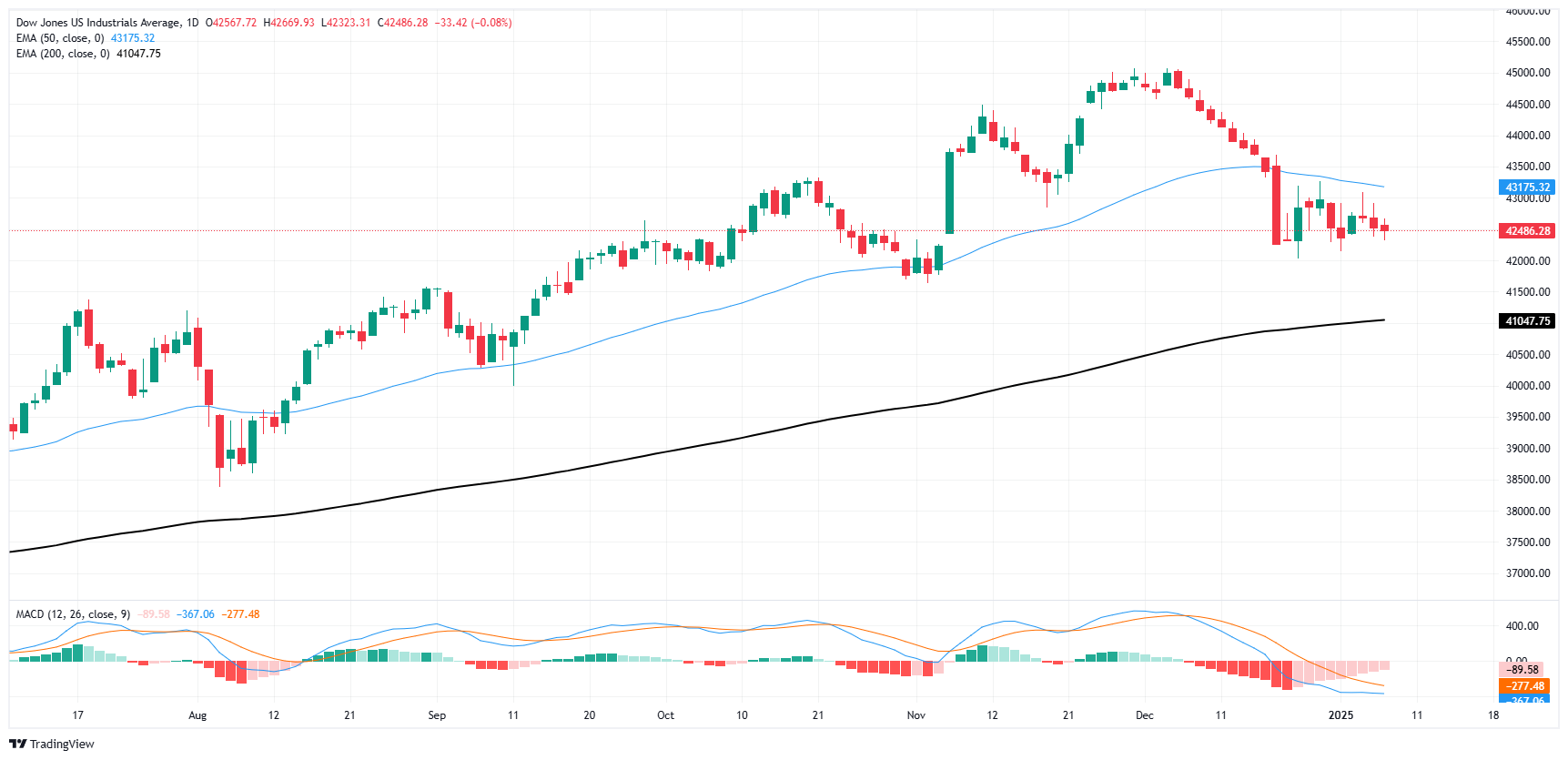
Dow Jones FAQs
The Dow Jones Industrial Average, one of the oldest stock market indices in the world, is compiled of the 30 most traded stocks in the US. The index is price-weighted rather than weighted by capitalization. It is calculated by summing the prices of the constituent stocks and dividing them by a factor, currently 0.152. The index was founded by Charles Dow, who also founded the Wall Street Journal. In later years it has been criticized for not being broadly representative enough because it only tracks 30 conglomerates, unlike broader indices such as the S&P 500.
Many different factors drive the Dow Jones Industrial Average (DJIA). The aggregate performance of the component companies revealed in quarterly company earnings reports is the main one. US and global macroeconomic data also contributes as it impacts on investor sentiment. The level of interest rates, set by the Federal Reserve (Fed), also influences the DJIA as it affects the cost of credit, on which many corporations are heavily reliant. Therefore, inflation can be a major driver as well as other metrics which impact the Fed decisions.
Dow Theory is a method for identifying the primary trend of the stock market developed by Charles Dow. A key step is to compare the direction of the Dow Jones Industrial Average (DJIA) and the Dow Jones Transportation Average (DJTA) and only follow trends where both are moving in the same direction. Volume is a confirmatory criteria. The theory uses elements of peak and trough analysis. Dow’s theory posits three trend phases: accumulation, when smart money starts buying or selling; public participation, when the wider public joins in; and distribution, when the smart money exits.
There are a number of ways to trade the DJIA. One is to use ETFs which allow investors to trade the DJIA as a single security, rather than having to buy shares in all 30 constituent companies. A leading example is the SPDR Dow Jones Industrial Average ETF (DIA). DJIA futures contracts enable traders to speculate on the future value of the index and Options provide the right, but not the obligation, to buy or sell the index at a predetermined price in the future. Mutual funds enable investors to buy a share of a diversified portfolio of DJIA stocks thus providing exposure to the overall index.
- Mexican Peso tumbled and hit a daily low of 20.52 as risk aversion boosted the Greenback.
- Mixed US job reports show resilience, with fewer unemployment claims than expected, supporting the US Dollar.
- Traders await FOMC December minutes and Mexico’s CPI data, eyeing insights into future monetary policy and inflation trends.
The Mexican Peso (MXN) was pressured by broad US Dollar (USD) strength on Wednesday, as risk-aversion capped the Mexican currency's advance due to reiterated tariff threats by United States (US) President-elect Donald Trump. This, alongside solid US jobs data, keeps the USD/MXN pair rising and exchanging hands at 20.37, up by 0.29%.
Risk aversion is driving the financial markets after CNN revealed that, according to sources, President-elect Donald Trump is considering “a national economic emergency declaration to allow for a new tariff program.”
The CNN article stated: “In 2019, Trump used the International Economic Emergency Powers Act (IEEPA) to threaten a 5% tariff on all Mexican imports that would rise to 25% if Mexico declined to take action to reduce the number of undocumented immigrants crossing the border with the United States.”
Consequently, USD/MXN jumped in the headlines to a daily peak of 20.52 before retreating to current exchange rates.
Meanwhile, the US economy continues to fare better than expected after the mixed US jobs data release. Although the ADP Employment Change for December fell shy of expectations, the US Department of Labor revealed that the number of people applying for unemployment benefits fell short of estimates.
Federal Reserve (Fed) Governor Christopher Waller stated that he does not anticipate tariffs causing persistent inflation and noted that the labor market is not exhibiting signs of overheating. While he supports additional rate cuts in 2025, he emphasized that the decision would depend on inflation progress.
Meanwhile, USD/MXN traders are eyeing the release of the December meeting minutes of the Federal Open Market Committee (FOMC). Mexico’s inflation data will also be in the spotlight on Thursday, with the release of the Consumer Price Index (CPI) for December, which is expected to continue showing the evolution of the disinflation process.
Daily digest market movers: Mexican Peso dives ahead of FOMC minutes
- Mexico’s inflation in December is expected to drop from 4.55% to 4.28% YoY in headline figures. According to analysts, core CPI is projected to rise from 3.58% to 3.62% YoY.
- In addition, traders will watch the release of the Banco de Mexico (Banxico) December meeting minutes on Thursday.
- According to the US Department of Labor, Initial Jobless Claims for the week ending January 3 fell to 201K from 211K, below estimates of 218K.
- Automatic Data Processing (ADP) revealed that private companies hired 122K people, below the 140K foreseen by economists.
- Interest rate probabilities suggest that the Federal Reserve would cut rates twice during the year, as the December 2025 Fed funds rate futures contract priced in 54 basis points (bps) of easing.
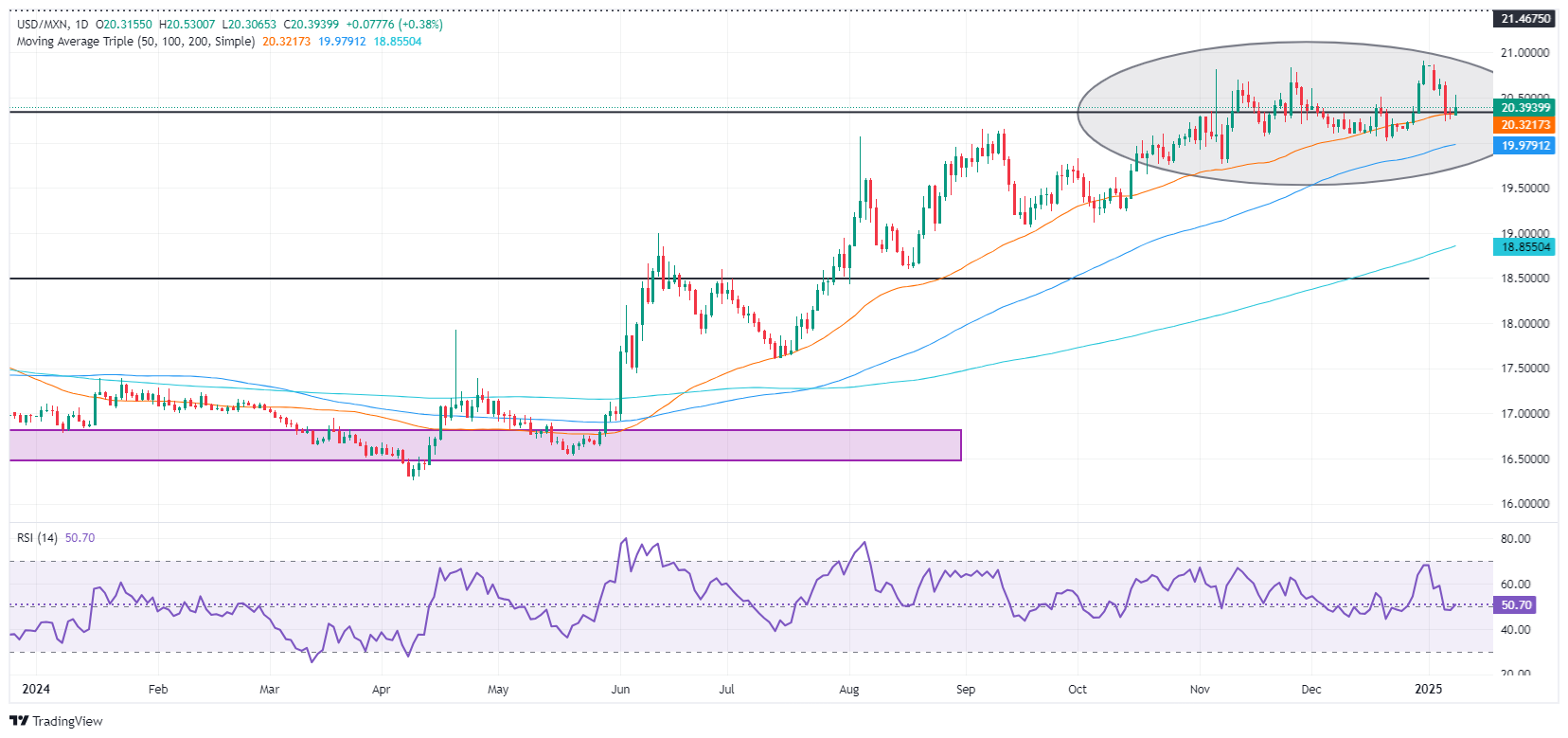
USD/MXN technical outlook: Mexican Peso remains heavy as USD/MXN climbs above 20.35
The uptrend in the exotic pair is expected to continue as the Fed turns slightly hawkish. USD/MXN bulls are leaning to the 50-day Simple Moving Average (SMA) at 20.28, and each of the three times that prices had hit the latter, the pair climbed above the 20.30 mark.
The Relative Strength Index (RSI) shifted bullish, indicating buyers are gathering steam.
If USD/MXN clears the 20.50 price level, the next resistance would be the year-to-date (YTD) high of 20.90, ahead of 21.00, and the March 8, 2022, peak of 21.46. Conversely, if USD/MXN tumbles below the 50-day SMA of 20.28, the next support would be the 20.00 figure, ahead of the 100-day SMA at 19.93, followed by the 19.50 figure.
Mexican Peso FAQs
The Mexican Peso (MXN) is the most traded currency among its Latin American peers. Its value is broadly determined by the performance of the Mexican economy, the country’s central bank’s policy, the amount of foreign investment in the country and even the levels of remittances sent by Mexicans who live abroad, particularly in the United States. Geopolitical trends can also move MXN: for example, the process of nearshoring – or the decision by some firms to relocate manufacturing capacity and supply chains closer to their home countries – is also seen as a catalyst for the Mexican currency as the country is considered a key manufacturing hub in the American continent. Another catalyst for MXN is Oil prices as Mexico is a key exporter of the commodity.
The main objective of Mexico’s central bank, also known as Banxico, is to maintain inflation at low and stable levels (at or close to its target of 3%, the midpoint in a tolerance band of between 2% and 4%). To this end, the bank sets an appropriate level of interest rates. When inflation is too high, Banxico will attempt to tame it by raising interest rates, making it more expensive for households and businesses to borrow money, thus cooling demand and the overall economy. Higher interest rates are generally positive for the Mexican Peso (MXN) as they lead to higher yields, making the country a more attractive place for investors. On the contrary, lower interest rates tend to weaken MXN.
Macroeconomic data releases are key to assess the state of the economy and can have an impact on the Mexican Peso (MXN) valuation. A strong Mexican economy, based on high economic growth, low unemployment and high confidence is good for MXN. Not only does it attract more foreign investment but it may encourage the Bank of Mexico (Banxico) to increase interest rates, particularly if this strength comes together with elevated inflation. However, if economic data is weak, MXN is likely to depreciate.
As an emerging-market currency, the Mexican Peso (MXN) tends to strive during risk-on periods, or when investors perceive that broader market risks are low and thus are eager to engage with investments that carry a higher risk. Conversely, MXN tends to weaken at times of market turbulence or economic uncertainty as investors tend to sell higher-risk assets and flee to the more-stable safe havens.
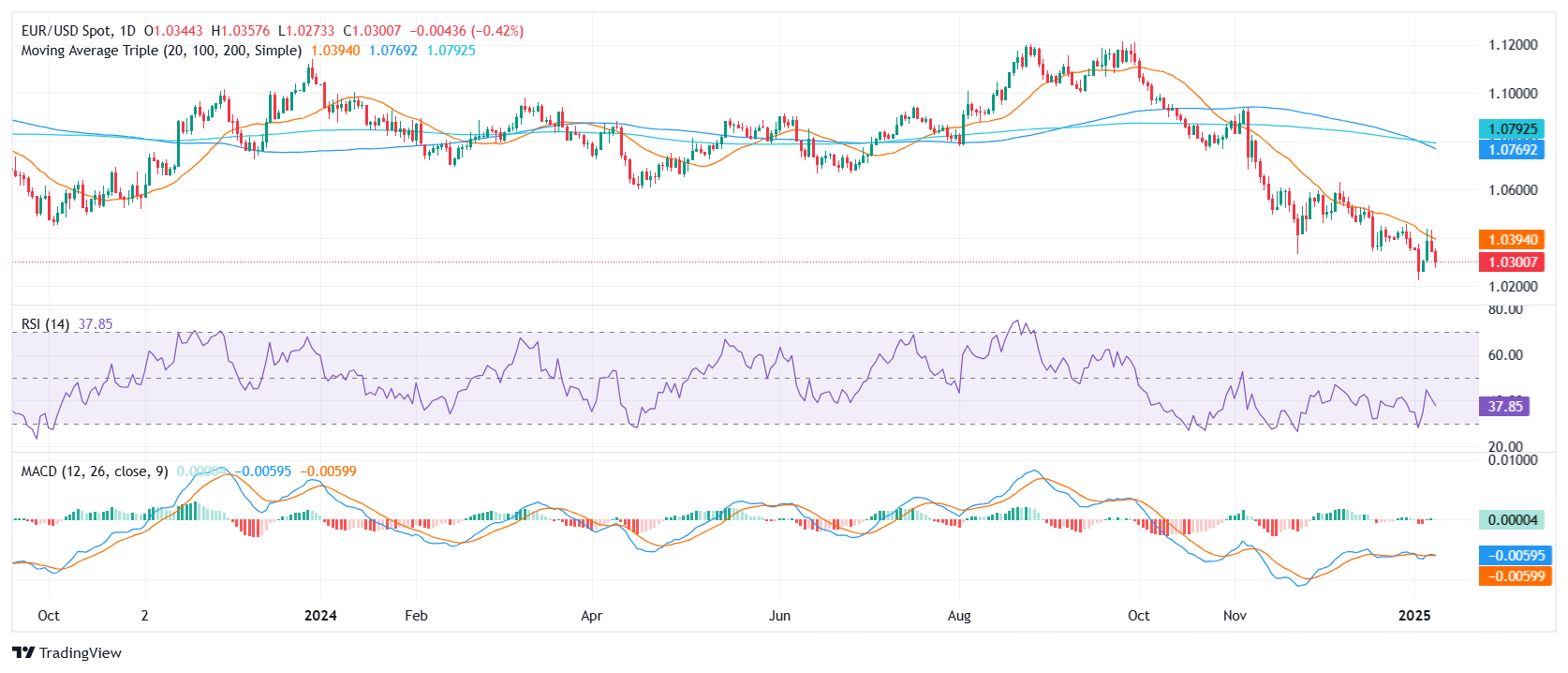
- EUR/USD declines by 0.48% on Wednesday, settling near 1.0295 after failing to break above the 20-day SMA.
- RSI falls sharply to 39 in negative territory, revealing intensified selling pressure.
- MACD histogram prints decreasing green bars, suggesting waning bullish momentum and a renewed downside tilt.
EUR/USD struggled on Wednesday, shedding 0.48% to trade around 1.0295. This latest drop underscores the pair’s inability to sustain any meaningful recovery, as multiple attempts to breach the 20-day Simple Moving Average (SMA) since early 2025 have been met with forceful selling. As a result, bullish momentum appears to be receding, leaving sellers firmly in control of the near-term price action.
Technical readings paint a downbeat picture. The Relative Strength Index (RSI) has dropped to 39, reinforcing the notion that downward pressure is picking up pace. Meanwhile, the Moving Average Convergence Divergence (MACD) histogram shows a decline in green bars, hinting that any previous efforts by buyers have begun to fade. Despite these setbacks, a definitive move above the 20-day SMA would still represent the clearest signal of a reversal, should buyers regroup and attempt another push higher.
Until that materializes, however, the path of least resistance remains tilted to the downside. Traders will keep a close watch on incoming macro catalysts and price action around the 20-day SMA for early signs of a possible turnaround.
EUR/USD daily chart
- AUD/USD falls with Trump's tariff threats and robust US labor data fueling gains in the US Dollar.
- US initial jobless claims drop significantly, underscoring the labor market's strength.
- Australian inflation data shows slight increase but fails to boost the Aussie as traders awaited FOMC minutes.
The Australian dollar posted losses of over 0.40% against the US Dollar, and the latter remains supported by US President-elect Donald Trump’s tariff threats. At the time of writing, the AUD/USD trades at 0.6204 after bouncing off daily lows of 0.6187.
AUD/USD faces downward pressure as Trump's potential economic emergency declaration looms
Recently, US data showed that the labor market remains strong, as Initial Jobless Claims for the week ending January 4 dropped from 211K to 201K, according to the US Department of Labor. The figures were below the consensus of 218K.
Earlier, Automatic Data Processing (ADP) revealed that private companies hired 122K people, below the 140K foreseen by economists.
Nonetheless, the main driver continues to be Donald Trump, as CNN revealed that he is considering a national economic emergency declaration to impose new tariffs, sources said.
In the central bank space, Federal Reserve Governor Christopher Waller commented that he doesn’t expect tariffs to produce persistent inflation, adding that the labor market is not behaving like an economy is overheating. He supports further cuts in 2025, but it will depend on the progress of inflation.
On the Australian side, inflation figures were released yet failed to increase appetite for the Aussie Dollar. Australian Weighted CPI for November, rose 2.3% YoY, above expectations and October’s readings of 2.2% and 2.1% each. The CPI Annual Trimmed Mean for the same period cooled slightly, from 3.5% to 3.2% YoY.
Ahead in the day, traders eye the release of the Federal Open Market Committee (FOMC) December meeting minutes, which are expected to show the committee's reasons for lowering borrowing costs in 2025.
AUD/USD Price Forecast: Technical outlook
The AUD/USD downtrend remains intact, after carving successive series of lower highs and lower lows since October 2024. Although the pair bottomed out at around 0.6178, further downside is seen as the pair hovers near 0.6200. A breach of the latter will expose the October 2022 swing low of 0.6169, followed by April’s 2020 monthly low of 0.5991.
On the upside, 0.6250 would be the first resistance level before traders could challenge the current week's peak at 0.6301.
Australian Dollar PRICE Today
The table below shows the percentage change of Australian Dollar (AUD) against listed major currencies today. Australian Dollar was the strongest against the British Pound.
| USD | EUR | GBP | JPY | CAD | AUD | NZD | CHF | |
|---|---|---|---|---|---|---|---|---|
| USD | 0.49% | 1.20% | 0.32% | 0.26% | 0.50% | 0.68% | 0.18% | |
| EUR | -0.49% | 0.70% | -0.13% | -0.23% | 0.00% | 0.19% | -0.32% | |
| GBP | -1.20% | -0.70% | -0.84% | -0.93% | -0.69% | -0.51% | -1.01% | |
| JPY | -0.32% | 0.13% | 0.84% | -0.06% | 0.18% | 0.35% | -0.15% | |
| CAD | -0.26% | 0.23% | 0.93% | 0.06% | 0.24% | 0.42% | -0.09% | |
| AUD | -0.50% | -0.01% | 0.69% | -0.18% | -0.24% | 0.18% | -0.31% | |
| NZD | -0.68% | -0.19% | 0.51% | -0.35% | -0.42% | -0.18% | -0.51% | |
| CHF | -0.18% | 0.32% | 1.01% | 0.15% | 0.09% | 0.31% | 0.51% |
The heat map shows percentage changes of major currencies against each other. The base currency is picked from the left column, while the quote currency is picked from the top row. For example, if you pick the Australian Dollar from the left column and move along the horizontal line to the US Dollar, the percentage change displayed in the box will represent AUD (base)/USD (quote).
- The Minutes of the Fed’s December 17-18 policy meeting will be published on Wednesday.
- Details surrounding the discussions on the decision to trim interest rates by 25 basis points will be scrutinized by investors.
- The publication could influence the market pricing of the Fed’s policy outlook and the US Dollar’s valuation.
The Minutes of the United States (US) Federal Reserve’s (Fed) December 17-18 monetary policy meeting will be published on Wednesday at 19:00 GMT. Policymakers lowered the rate by 25 basis points (bps) to the range of 4.25%-4.5% at the last policy meeting of 2024. However, the revised Summary of Economic Projections (SEP), also known as the dot plot, highlighted a cautious stance on further policy easing moving forward.
Jerome Powell and co decided to cut rates after December meeting
The Federal Open Market Committee (FOMC) voted 11 to 1 in favor of a 25 bps rate cut, with Cleveland Fed President Beth Hammack preferring to leave the policy rate unchanged. The Fed refrained from making significant changes to its policy statement from the November meeting, reiterating that it will assess incoming data, the evolving outlook and balance of risks when considering the extent and timing of additional rate adjustments.
"Based on my estimate that monetary policy is not far from a neutral stance, I prefer to hold policy steady until we see further evidence that inflation is resuming its path to our 2% objective,” Hammack said in explaining her decision to dissent.
Meanwhile, the revised SEP showed a majority of policymakers forecasted two more 25 bps rate cuts in 2025, down from four in September’s dot plot. In the post-meeting press conference, Fed Chairman Jerome Powell noted that they can be more cautious in reducing rates going forward and explained that a slower pace of cuts was reflecting expectations of higher inflation.
Speaking on the policy outlook over the weekend, Fed Governor Adriana Kugler said that their job on taming inflation is not yet done, while San Francisco Fed President Mary Daly noted that inflation is still “uncomfortably” above the Fed’s target.
Economic Indicator
FOMC Minutes
FOMC stands for The Federal Open Market Committee that organizes 8 meetings in a year and reviews economic and financial conditions, determines the appropriate stance of monetary policy and assesses the risks to its long-run goals of price stability and sustainable economic growth. FOMC Minutes are released by the Board of Governors of the Federal Reserve and are a clear guide to the future US interest rate policy.
Read more.Next release: Wed Jan 08, 2025 19:00
Frequency: Irregular
Consensus: -
Previous: -
Source: Federal Reserve
Minutes of the Federal Open Market Committee (FOMC) is usually published three weeks after the day of the policy decision. Investors look for clues regarding the policy outlook in this publication alongside the vote split. A bullish tone is likely to provide a boost to the greenback while a dovish stance is seen as USD-negative. It needs to be noted that the market reaction to FOMC Minutes could be delayed as news outlets don’t have access to the publication before the release, unlike the FOMC’s Policy Statement.
When will FOMC Minutes be released, and how could it affect the US Dollar?
The FOMC will release the minutes of the December 17-18 policy meeting at 19:00 GMT on Wednesday. Investors will scrutinize the discussions surrounding the policy outlook.
In case the publication shows that policymakers considered holding the policy rate steady but voted for a cut with anticipation of a slowdown in policy easing in 2025, the immediate reaction could support the USD. On the other hand, the USD could come under pressure if the document suggests that policymakers are willing to continue with rate reductions once they are convinced that President-elect Donald Trump’s policies, especially regarding import tariffs, will not stoke inflation.
According to the CME FedWatch Tool, markets are currently pricing in a nearly 90% probability of the Fed leaving the policy rate unchanged at the January meeting. This market positioning suggests that the USD doesn’t have a lot of room left on the upside. Additionally, investors could refrain from taking large positions based on FOMC Minutes and opt to wait until Friday’s December jobs report, causing the market reaction to remain short-lived.
Eren Sengezer, European Session Lead Analyst at FXStreet, shares a brief outlook for the USD Index:
“The Relative Strength Index (RSI) indicator on the daily chart declined below 60 on Monday, reflecting a loss of bullish momentum. On the downside, the Fibonacci 23.6% retracement level of the October-January uptrend forms key support for the USD Index at 107.00 ahead of 105.80 (Fibonacci 38.2% retracement) and the 105.80-105.50 area , where the Fibonacci 38.2% retracement and the 200-day Simple Moving Average is located.”
“Looking north, immediate resistance could be spotted at 109.30 (end-point of the uptrend) before 110.00 (round level, static level) and 110.60 (static level from November 2022).”
US Dollar FAQs
The US Dollar (USD) is the official currency of the United States of America, and the ‘de facto’ currency of a significant number of other countries where it is found in circulation alongside local notes. It is the most heavily traded currency in the world, accounting for over 88% of all global foreign exchange turnover, or an average of $6.6 trillion in transactions per day, according to data from 2022. Following the second world war, the USD took over from the British Pound as the world’s reserve currency. For most of its history, the US Dollar was backed by Gold, until the Bretton Woods Agreement in 1971 when the Gold Standard went away.
The most important single factor impacting on the value of the US Dollar is monetary policy, which is shaped by the Federal Reserve (Fed). The Fed has two mandates: to achieve price stability (control inflation) and foster full employment. Its primary tool to achieve these two goals is by adjusting interest rates. When prices are rising too quickly and inflation is above the Fed’s 2% target, the Fed will raise rates, which helps the USD value. When inflation falls below 2% or the Unemployment Rate is too high, the Fed may lower interest rates, which weighs on the Greenback.
In extreme situations, the Federal Reserve can also print more Dollars and enact quantitative easing (QE). QE is the process by which the Fed substantially increases the flow of credit in a stuck financial system. It is a non-standard policy measure used when credit has dried up because banks will not lend to each other (out of the fear of counterparty default). It is a last resort when simply lowering interest rates is unlikely to achieve the necessary result. It was the Fed’s weapon of choice to combat the credit crunch that occurred during the Great Financial Crisis in 2008. It involves the Fed printing more Dollars and using them to buy US government bonds predominantly from financial institutions. QE usually leads to a weaker US Dollar.
Quantitative tightening (QT) is the reverse process whereby the Federal Reserve stops buying bonds from financial institutions and does not reinvest the principal from the bonds it holds maturing in new purchases. It is usually positive for the US Dollar.
- Initial Jobless Claims in the US declined by 10,000 in the week ending January 4.
- US Dollar Index clings to daily gains above 109.00 after the data.
There were 201,000 initial jobless claims in the week ending January 4, the weekly data published by the US Department of Labor (DOL) showed on Wednesday. This print followed the previous week's print of 211,000 and came in better than the market expectation of 218,000.
Further details of the publication revealed that the advance seasonally adjusted insured unemployment rate was 1.2%.
"The advance number for seasonally adjusted insured unemployment during the week ending December 28 was 1,867,000, an increase of 33,000 from the previous week's revised level," the DOL noted in its press release. "The 4-week moving average was 1,865,500, a decrease of 3,000 from the previous week's revised average."
Market reaction
The US Dollar Index stays in positive territory after the data and was last seen rising 0.5% on the day at 109.20.
Federal Reserve Governor Christopher Waller said on Wednesday that he will support additional rate cuts in 2025 but the pace will depend on further inflation progress, per Reuters.
Key takeaways
"Inflation will continue to make progress towards 2%."
"Economy overall on solid footing, nothing to suggest labor market will weaken dramatically in coming months."
"Though recent inflation progress has been slow, much of that is due to imputed prices for housing and non-market services that are a less reliable guide to underlying price pressures."
"Base effects will improve inflation in 2025; more recent monthly and other shorter-term data also indicates improvement to come."
"Geopolitical conflicts and tariffs could be a source of renewed price pressure."
"Do not expect tariffs to produce persistent inflation and thus are not likely to influence views on appropriate monetary policy."
"Central bankers have a broad set of challenges ahead, from aging populations to geopolitical conflict and challenges to globalization."
Market reaction
The US Dollar Index showed no immediate reaction to these comments and was last seen gaining 0.4% on the day at 109.12.
Fed FAQs
Monetary policy in the US is shaped by the Federal Reserve (Fed). The Fed has two mandates: to achieve price stability and foster full employment. Its primary tool to achieve these goals is by adjusting interest rates. When prices are rising too quickly and inflation is above the Fed’s 2% target, it raises interest rates, increasing borrowing costs throughout the economy. This results in a stronger US Dollar (USD) as it makes the US a more attractive place for international investors to park their money. When inflation falls below 2% or the Unemployment Rate is too high, the Fed may lower interest rates to encourage borrowing, which weighs on the Greenback.
The Federal Reserve (Fed) holds eight policy meetings a year, where the Federal Open Market Committee (FOMC) assesses economic conditions and makes monetary policy decisions. The FOMC is attended by twelve Fed officials – the seven members of the Board of Governors, the president of the Federal Reserve Bank of New York, and four of the remaining eleven regional Reserve Bank presidents, who serve one-year terms on a rotating basis.
In extreme situations, the Federal Reserve may resort to a policy named Quantitative Easing (QE). QE is the process by which the Fed substantially increases the flow of credit in a stuck financial system. It is a non-standard policy measure used during crises or when inflation is extremely low. It was the Fed’s weapon of choice during the Great Financial Crisis in 2008. It involves the Fed printing more Dollars and using them to buy high grade bonds from financial institutions. QE usually weakens the US Dollar.
Quantitative tightening (QT) is the reverse process of QE, whereby the Federal Reserve stops buying bonds from financial institutions and does not reinvest the principal from the bonds it holds maturing, to purchase new bonds. It is usually positive for the value of the US Dollar.
The Pound Sterling (GBP) plunged more than a cent in response to the Trump tariff headlines, leaving it the worst-performing major currency on the session, Scotiabank’s Chief FX Strategist Shaun Osborne notes.
GBP/USD slumps on tariff report
“Losses are steadying in the mid/upper 1.23s but scope for recovery may remain limited in the short run. The GBP’s tone was already a little soft, reflecting building market concerns about rising domestic yields. Cable losses extended to a new, short-term cycle low at 1.2325 earlier. Spot is within reach of the 1.2300 major low reached in April last year.”
“Spot losses are stabilizing around 1.2350, close to last week’s low, but new lows and broadly bearish trend momentum suggest the GBP’s soft tone is liable to extend moving forward and likely means potential for near-term rebounds is very limited. Resistance is likely to be firm around 1.2450/75 now.”
Weak German data (soft November Retail Sales and a sharp, 5.4% plunge in Factory Orders over the November month are pushing the EUR lower, Scotiabank’s Chief FX Strategist Shaun Osborne notes.
EUR/USD extends losses on tariff report
“Spot losses have accelerated on the Trump tariff headlines in early dealing. The EUR could not hold gains above 1.04 yesterday and losses extended further than I had expected through the mid/upper 1.03s. Losses means the EUR is straying even further from out fair value estimate, leaving it one standard deviation below equilibrium at 1.0528.”
“The EUR’s failure to advance through the mid1.04 zone and yesterday’s loss of support in the mid/upper 1.03s leaves spot looking vulnerable again. Short-term trend momentum has shifted again—reflecting a weak EUR undertone—which may add to pressure for a retest of the mid/upper 1.02s.”
The Canadian Dollar (CAD) was little changed against the generally stronger USD overnight—which is no mean feat considering the amount of attention Canada is getting from the US president-elect, Scotiabank’s Chief FX Strategist Shaun Osborne notes.
CAD slips after holding steady overnight
“Markets perhaps don’t quite know what to make of the political vacuum at home and Trump’s apparent wish to co-opt Canada as the US’ 51st state. That may all be deflection, considering perhaps some more obvious foreign policy challenges for the incoming administration. Renewed tariff threats from Trump are weighing more obviously on the CAD as our session gets underway.”
“USD/CAD’s dithering around the 1.4335 technical breakdown point leaves the CAD’s position on the charts weaker now than at the start of the week when a mild rebound looked possible. A reversion to range trading around the 1.44 point looks more likely now, with near-term downside risk for USD/CAD alleviated. Resistance is 1.4465.”
The US Dollar (USD) is tracking higher. Headlines indicating that Trump might cite a national economic emergency as the justification for a new round of broadly applied tariffs is driving the USD higher in early trade, Scotiabank’s Chief FX Strategist Shaun Osborne notes.
Trump mulls ‘emergency’ basis for broad tariffs
“Stocks weakened on the headline, as did bonds—with Gilts underperforming. Rising US yields after yesterday’s US data round (highest ISM Services prices in two years or so and the strongest JOLTS report in 6 months) extends the recent pattern of firmer term rates and cautious expectations for additional Fed easing through the year ahead—less than 50bps of easing is now expected over the next 12 months, swaps suggest.”
“Rising US rates may not be as powerful a support fort the USD as they have been in the past few months. That’s because 1) rates are rising elsewhere, keeping spreads stable or even driving some narrowing in differentials and 2) to some extent, rising US term rates reflect a rising term premium— additional yield investors are demanding for the risk of holding US Treasury debt.”
“That may reflect investor concerns about the risk of a loosening fiscal policy as president-elect Trump’s term is about to start. Markets are long USDs, the DXY remains strongly overvalued and we continue to see the USD closely track its post-2016 election performance when it tumbled quite sharply in January of 2017. Despite the USD’s advance today, it’s not entirely clear that gains are sustainable in the longer run.”
- USD/JPY climbed to its highest level since July above 158.50 on Wednesday.
- The US Dollar benefits from the souring risk mood after Trump tariff news.
- ADP Employment Change data and FOMC Minutes coming up next.
USD/JPY continued to stretch higher and touched its strongest level since July above 158.50 on Wednesday. At the time of press, the pair was trading at 158.48, rising 0.27% on a daily basis.
Rising US Treasury bond yields support USD
US President-elect Donald Trump is considering declaring a national economic emergency to allow for a new tariff program, CNN reported on Wednesday, citing four sources familiar with the matter. With the immediate reaction, the benchmark 10-year US Treasury bond yield rose above 4.7%, boosting the US Dollar (USD).
In the early American session, the Automatic Data Processing (ADP) will release the private sector employment data for December, which is forecast to show an increase of 140,000 after November's print of 146,000.
Later in the day, the Federal Reserve will publish the minutes of the December policy meeting. Investors will scrutinize the details surrounding the discussions on the policy outlook for 2025 after the revised Summary of Economic Projections showed a majority of policymakers were forecasting two 25 basis points rate cuts this year.
Japanese Yen FAQs
The Japanese Yen (JPY) is one of the world’s most traded currencies. Its value is broadly determined by the performance of the Japanese economy, but more specifically by the Bank of Japan’s policy, the differential between Japanese and US bond yields, or risk sentiment among traders, among other factors.
One of the Bank of Japan’s mandates is currency control, so its moves are key for the Yen. The BoJ has directly intervened in currency markets sometimes, generally to lower the value of the Yen, although it refrains from doing it often due to political concerns of its main trading partners. The BoJ ultra-loose monetary policy between 2013 and 2024 caused the Yen to depreciate against its main currency peers due to an increasing policy divergence between the Bank of Japan and other main central banks. More recently, the gradually unwinding of this ultra-loose policy has given some support to the Yen.
Over the last decade, the BoJ’s stance of sticking to ultra-loose monetary policy has led to a widening policy divergence with other central banks, particularly with the US Federal Reserve. This supported a widening of the differential between the 10-year US and Japanese bonds, which favored the US Dollar against the Japanese Yen. The BoJ decision in 2024 to gradually abandon the ultra-loose policy, coupled with interest-rate cuts in other major central banks, is narrowing this differential.
The Japanese Yen is often seen as a safe-haven investment. This means that in times of market stress, investors are more likely to put their money in the Japanese currency due to its supposed reliability and stability. Turbulent times are likely to strengthen the Yen’s value against other currencies seen as more risky to invest in.
- Gold price edges higher for the second day in a row on Wednesday around the technical level of $2,655.
- President-elect Donald Trump reiterated that US rates need to come down further.
- Gold price remains stuck in a broad pennant technical formation, though starting to test upside levels.
Gold’s price (XAU/USD) edges higher for the second consecutive day and trades around $2,655 on Wednesday after the Institute of Supply Management (ISM) revealed on Tuesday that the prices paid component in the Services sector is turning red hot. The ISM Services Prices Paid index rose to 64.4 in December from 58.2 the previous month. As if that was not enough to push yields higher on inflation concerns, President-elect Donald Trump said at a press conference in Mar-a-Lago that US rates are too high and need to come down substantially, according to Bloomberg.
On the economic data front, this Wednesday, all eyes will be on the Minutes from the Federal Open Market Committee (FOMC). Traders will look for clues about the interest rate path and comments from policymakers from the last Federal Reserve (Fed) meeting in December. Meanwhile, the US Treasury will allocate a 10-year Note, with the benchmark rate just hitting a nine-month high at 4.697%.
Daily digest market movers: Yields are pushing
- At 13:30 GMT, Christopher J. Waller, member of the Board of Governors of the Federal Reserve system, will speak on the US economic outlook at an event in Paris.
- At 18:00 GMT, the US Treasury will allocate a 10-year Note. The size of the auction, the already elevated rate levels, and the fact that recent shorter-term auctions faced tepid demand, where demand is normally plentiful, are raising concerns in the market.
- At 19:00 GMT, the Fed will release the FOMC Minutes from its policy decision in December.
- In the fallout of the ISM Services Purchasing Managers Index (PMI) release for December, traders quickly pushed back the first possible rate cut from the Fed in 2025 to July. An interest rate cut was foreseen for June before the data came out.
- President-elect Donald Trump reiterated at a press conference in Mar-a-Lago that US rates will need to come down, according to Bloomberg.
Technical Analysis: Testing the waters
The Gold price is testing the waters on the upside. After a few failed attempts to break above the 55-day Simple Moving Average (SMA), Gold is willing to finally snap above it. With help from the ISM data, the upcoming US bond auctions could be the catalysts needed to finally see the Gold price sprint higher.
On the downside, the 100-day Simple Moving Average (SMA) at $2,630 is holding again after a false break on Monday. Further down, the ascending trend line of the pennant pattern should provide support around $2,610 as it did in the past three occasions. In case that support line snaps, a quick decline to $2,531 (August 20, 2024, high) could come back into play as support level.
On the upside, the 55-day SMA at $2,654 is the first level to beat and is being tested at the time of writing. It will not be an easy task as it was already proved twice last week as a firm resistance. In case it breaks through, $2,686 will be the ultimate upside level in the form of the descending trendline in the pennant formation.
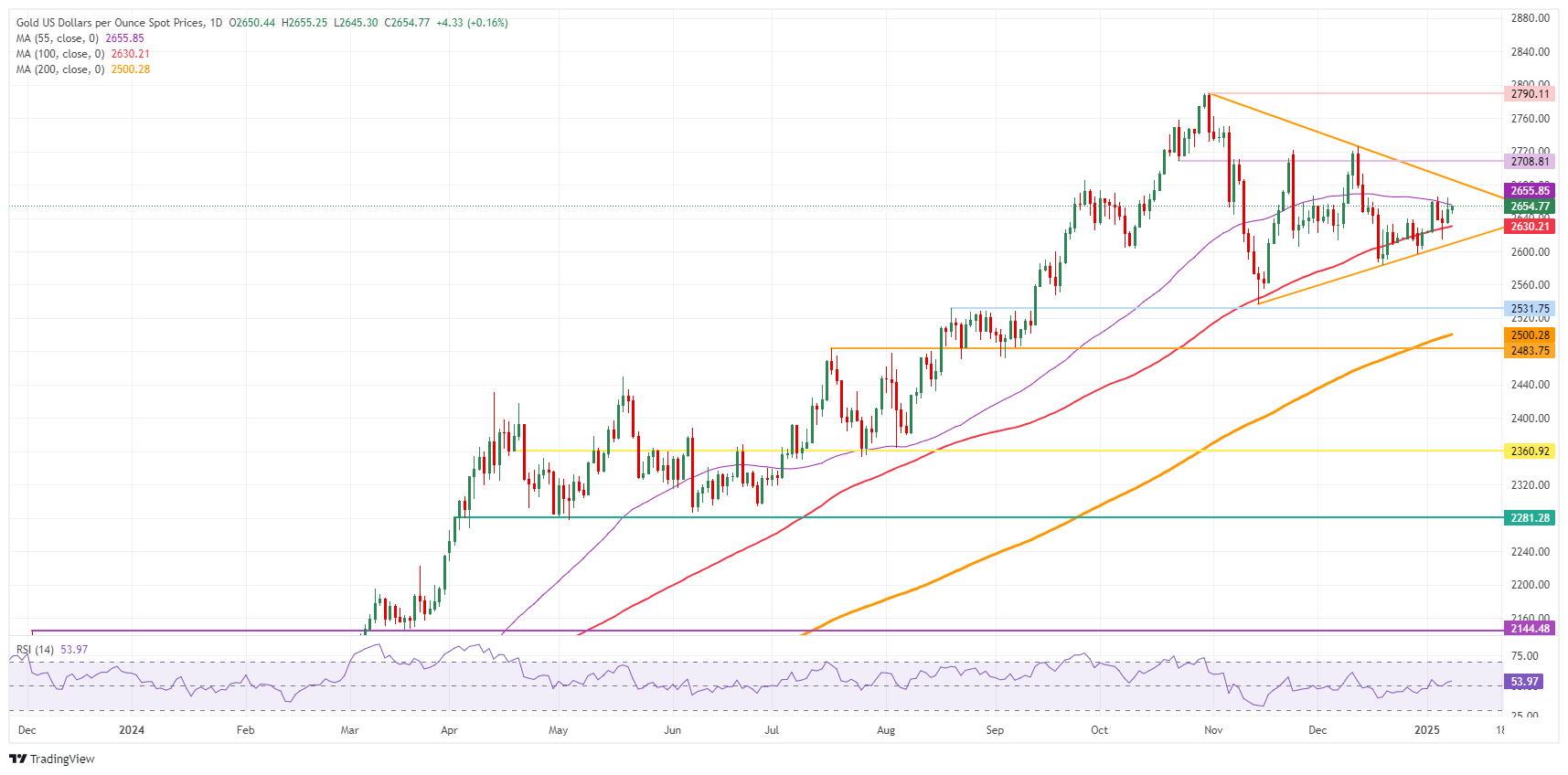
XAU/USD: Daily Chart
Gold FAQs
Gold has played a key role in human’s history as it has been widely used as a store of value and medium of exchange. Currently, apart from its shine and usage for jewelry, the precious metal is widely seen as a safe-haven asset, meaning that it is considered a good investment during turbulent times. Gold is also widely seen as a hedge against inflation and against depreciating currencies as it doesn’t rely on any specific issuer or government.
Central banks are the biggest Gold holders. In their aim to support their currencies in turbulent times, central banks tend to diversify their reserves and buy Gold to improve the perceived strength of the economy and the currency. High Gold reserves can be a source of trust for a country’s solvency. Central banks added 1,136 tonnes of Gold worth around $70 billion to their reserves in 2022, according to data from the World Gold Council. This is the highest yearly purchase since records began. Central banks from emerging economies such as China, India and Turkey are quickly increasing their Gold reserves.
Gold has an inverse correlation with the US Dollar and US Treasuries, which are both major reserve and safe-haven assets. When the Dollar depreciates, Gold tends to rise, enabling investors and central banks to diversify their assets in turbulent times. Gold is also inversely correlated with risk assets. A rally in the stock market tends to weaken Gold price, while sell-offs in riskier markets tend to favor the precious metal.
The price can move due to a wide range of factors. Geopolitical instability or fears of a deep recession can quickly make Gold price escalate due to its safe-haven status. As a yield-less asset, Gold tends to rise with lower interest rates, while higher cost of money usually weighs down on the yellow metal. Still, most moves depend on how the US Dollar (USD) behaves as the asset is priced in dollars (XAU/USD). A strong Dollar tends to keep the price of Gold controlled, whereas a weaker Dollar is likely to push Gold prices up.
- GBP/USD declined to a fresh multi-month low below 1.2400 on Wednesday.
- US President-elect Trump is reportedly considering declaring a national economic emergency.
- The Federal Reserve will publish the minutes of the December meeting.
GBP/USD came under renewed bearish pressure and declined to its weakest level since April below 1.2400. At the time of press, the pair was trading at 1.2365, losing 0.9% on the day.
Trump tariff headline boosts USD
Citing four sources familiar with the matter, CNN reported that US President-elect Donald Trump is considering declaring a national economic emergency to allow for a new tariff program. This headline triggered a flight to safety and allowed the US Dollar (USD) to outperform its rivals. As of writing, the USD Index was up 0.5% on the day near 109.20.
Reflecting the negative shift in risk mood, US stock index futures turned negative on the day.
The ADP Employment Change report from the US will be watched closely. Market participants expect private sector payrolls to rise by 140,000 in December following the 146,000 increase recorded in November. Later in the American session, the Federal Reserve will release the minutes of the December policy meeting.
US Dollar FAQs
The US Dollar (USD) is the official currency of the United States of America, and the ‘de facto’ currency of a significant number of other countries where it is found in circulation alongside local notes. It is the most heavily traded currency in the world, accounting for over 88% of all global foreign exchange turnover, or an average of $6.6 trillion in transactions per day, according to data from 2022. Following the second world war, the USD took over from the British Pound as the world’s reserve currency. For most of its history, the US Dollar was backed by Gold, until the Bretton Woods Agreement in 1971 when the Gold Standard went away.
The most important single factor impacting on the value of the US Dollar is monetary policy, which is shaped by the Federal Reserve (Fed). The Fed has two mandates: to achieve price stability (control inflation) and foster full employment. Its primary tool to achieve these two goals is by adjusting interest rates. When prices are rising too quickly and inflation is above the Fed’s 2% target, the Fed will raise rates, which helps the USD value. When inflation falls below 2% or the Unemployment Rate is too high, the Fed may lower interest rates, which weighs on the Greenback.
In extreme situations, the Federal Reserve can also print more Dollars and enact quantitative easing (QE). QE is the process by which the Fed substantially increases the flow of credit in a stuck financial system. It is a non-standard policy measure used when credit has dried up because banks will not lend to each other (out of the fear of counterparty default). It is a last resort when simply lowering interest rates is unlikely to achieve the necessary result. It was the Fed’s weapon of choice to combat the credit crunch that occurred during the Great Financial Crisis in 2008. It involves the Fed printing more Dollars and using them to buy US government bonds predominantly from financial institutions. QE usually leads to a weaker US Dollar.
Quantitative tightening (QT) is the reverse process whereby the Federal Reserve stops buying bonds from financial institutions and does not reinvest the principal from the bonds it holds maturing in new purchases. It is usually positive for the US Dollar.
US President-elect Donald Trump is considering declaring a national economic emergency to allow for a new tariff program, CNN reported, citing four sources familiar with the matter on Wednesday.
"The declaration would allow Trump to construct a new tariff program by using the International Economic Emergency Powers Act, known as “IEEPA,” which unilaterally authorizes a president to manage imports during a national emergency," the report read.
Market reaction
The US Dollar (USD) gathers strength against its rivals following this headline. At the time of press, the USD Index was up 0.62% on the day at 109.35.
Sweden’s inflation figures released this morning came in less hot than expected, with headline CPIF slowing down to 1.5% and the key core measure (CPIF excluding energy) decelerating from 2.4% to 2.1% in December, ING’s FX analyst Francesco Pesole notes.
EUR/SEK to trade in the 11.30-11.50 range for most of this year
“That further endorses our view that the Riksbank will take rates to the 2.0% mark with two back-to-back 25bp reductions on 29 January and 20 March. Markets are broadly pricing in a similar scenario, meaning the impact on the currency should not be material.”
“Three-month historical volatility on EUR/SEK has plummeted of late and is at the lowest since 2021, a quite welcome development for the Riksbank which is likely to tolerate the pair trading around 11.50 while still flagging the krona’s rebound potential.”
“Sweden’s sounder economic prospects compared to the eurozone means that in the event of Trump’s tariff threat materialising, the Riksbank should not have to cut rates as much as the ECB. That explains our view of a stable or modestly lower EUR/SEK in the 11.30-11.50 range for most of this year.”
US Dollar (USD) could edge higher to 7.3550 before levelling off; the major resistance at 7.3700 is not expected to come into view. In the longer run, room for USD to retest the 7.3700 level; it is too early to determine if it can break and remain above this level, UOB Group’s FX analysts Quek Ser Leang and Lee Sue Ann note.
Some room for USD/CNH to retest the 7.3700 level
24-HOUR VIEW: “We noted yesterday (Tuesday) that the price action from Monday ‘did not result in an increase in either downward or upward momentum.’ We expected USD to ‘trade in a sideways range of 7.3210/7.3610.’ USD then traded in a narrower range than expected (7.3310/7.3500), closing largely unchanged at 7.3415 (-0.05%). Despite the quiet price action, upward momentum appears to be building, albeit tentatively. Today, USD could edge higher to 7.3550 before levelling off. The major resistance at 7.3700 is not expected to come into view. Support levels are at 7.3350 and 7.3250.”
1-3 WEEKS VIEW: “Yesterday (07 Jan, spot at 7.3465), we pointed out that ‘as long as 7.3050 is not breached, there is room for USD to retest the 7.3700 level.’ We added, ‘at this time, it is too early to determine if USD can break and remain above this level.’ USD then traded in a subdued manner, and we continue to hold the same view for now.”
Eurozone inflation re-accelerated from 2.2% to 2.4% in December, a largely base-effect-driven move that was fully expected, ING’s FX analyst Francesco Pesole notes.
EUR/USD may find decent support at 1.0300 for now
“The core rate was unchanged at 2.7%. The ECB’s survey of inflation expectations showed a significant rebound from 2.1% to 2.4% for three years ahead, but we doubt any of yesterday’s numbers will be enough to make the ECB tweak its dovish narrative at this stage. Markets agree and are still pricing in four cuts this year.”
“Our short-term fair value model still returns a 1.3-1.5% risk premium in EUR/USD, which is above the 1.5 standard deviation and in theory a buy signal. But the strong US macro story is fighting technical short-term bullish factors on the pair. Incidentally, markets won’t necessarily need to completely close that risk premium anytime soon, as part of it is still generally justified by downside risks to the eurozone on the back of Trump’s protectionism threats.”
“There is only a speech by French central bank governor Villeroy to watch in the eurozone calendar today. EUR/USD may find decent support at 1.0300 for now.”
Scope for US Dollar (USD) to test 158.50; a breach above this level is not ruled out, but any further advance is highly unlikely to reach 159.00. In the longer run, USD is expected to trade with an upward bias against the Japanese Yen (JPY); any advance is expected to face significant resistance at 159.00, UOB Group’s FX analysts Quek Ser Leang and Lee Sue Ann note.
Any advance is expected to face significant resistance at 159.00
24-HOUR VIEW: “When USD was trading at 158.15 yesterday, we indicated that it ‘could rise, but it does not appear to have enough momentum to reach 159.00 (there is another resistance level at 158.50).’ USD subsequently rose less than expected, reaching a high of 158.42. It then closed at 158.02, higher by 0.27%. While there has been no significant increase in upward momentum, there is scope for USD to test 158.50. A break of this level this not ruled, but any further advance is highly unlikely to reach the major resistance at 159.00. On the downside, a breach of 157.30 (minor support is at 157.70) would mean that USD is more likely to trade in a range instead of testing 158.50.”
1-3 WEEKS VIEW: “There is not much to add to our update from yesterday (07 Jan, spot at 158.15). As highlighted, ‘upward momentum is building, and we expect USD to trade with an upward bias.’ We also highlighted that, ‘any advance is expected to face significant resistance at 159.00.’ We continue to hold the same view provided that 156.80 (no change in ‘strong support level) is not breached.”
- EUR/USD dips for a second day in a row after being rejected above 1.0400 this week.
- German factory orders are sinking lower and could not have come at a worse time.
- Meanwhile, President-elect Donald Trump is ramping up geopolitical rhetoric on the global stage.
The EUR/USD pair extends its correction and trades around 1.0320 at the time of writing on Wednesday after being rejected above 1.0400 earlier in the week. The pair erases most of the initial weekly gains after German factory orders data for November came out. The heavily industrialized core European country saw Factory Orders shrink by 5.4% in November, compared to a 1.5% decline in October. The data could not have come at a worse time, given the political campaigning ahead of the German snap elections on February 23.
Meanwhile, markets are on edge over President-elect Donald Trump, who is further shaking up the geopolitical scene. In a statement held at Mar-a-Lago on Tuesday, Trump reiterated his desire to incorporate Greenland, the Panama Canal, and Canada into the United States. Trump also mentioned again that he will address the US rates, which are too high at the moment and need to come down substantially, Bloomberg reports.
Daily digest market movers: Red and Blood Red
- German Factory Orders sank in November, contracting by 5.4% on the month compared to the 0% expected. On a yearly basis, factory orders fell by 1.7%, compared to the rise of 5.7% last seen in October.
- German Retail Sales decreased by 0.6% in November, missing the positive 0.5% expectation. At least the actual number is better than the -1.5% seen in October.
- December’s French Consumer Confidence came in at 89, a touch lower than the 90 from November.
- Eurozone Consumer Confidence for December remains unchanged at -14.5, while Industrial Confidence misses its estimate and falls to -14.1, lower than the -11.7 expected and below the revised -11.4 from November.
- November Producer Price Index data for the Eurozone sees a 1.6% uptick against the previous 0.4% increase, and beating the 1.5% consensus view.
- German Bunds ticked up further to hit a near-fresh six-month high of 2.517%, which is no longer far off from the 2.642% high seen in July last year.
- European equities are mildly positive, beating the negative tone seen in Asia, where equities across the region are set to close in red numbers on Wednesday.
Technical Analysis: EUR/USD back on track to 1.02
The EUR/USD revival at the beginning of this week looks dead and buried. With a firm correction during the US trading session on Tuesday, it looks like US Dollar (USD) bulls are dominating again. With the resurgence to 1.0440, a window of opportunity was offered for US Dollar bulls that had missed the earlier entry at the end of December.
For the EUR/USD recovery to continue, the first big level to break is 1.0448, the low of October 3, 2023. Once through that level, the 55-day Simple Moving Average (SMA) at 1.0549 comes into play. Another catalyst will be needed for this kind of move, as it could squeeze the Dollar bulls.
On the downside, ahead of the current two-year low of 1.0224, the 1.0294 level is now acting as the new first line of defence. It was a pivotal point on Monday, offering room for buyers in EUR/USD to get involved and push price action higher. Further down, the round level at 1.02 would mean a fresh two-year low. Breaking below that level would open up the room to head to parity, with 1.0100 as the last man standing before that magical 1.00 level.
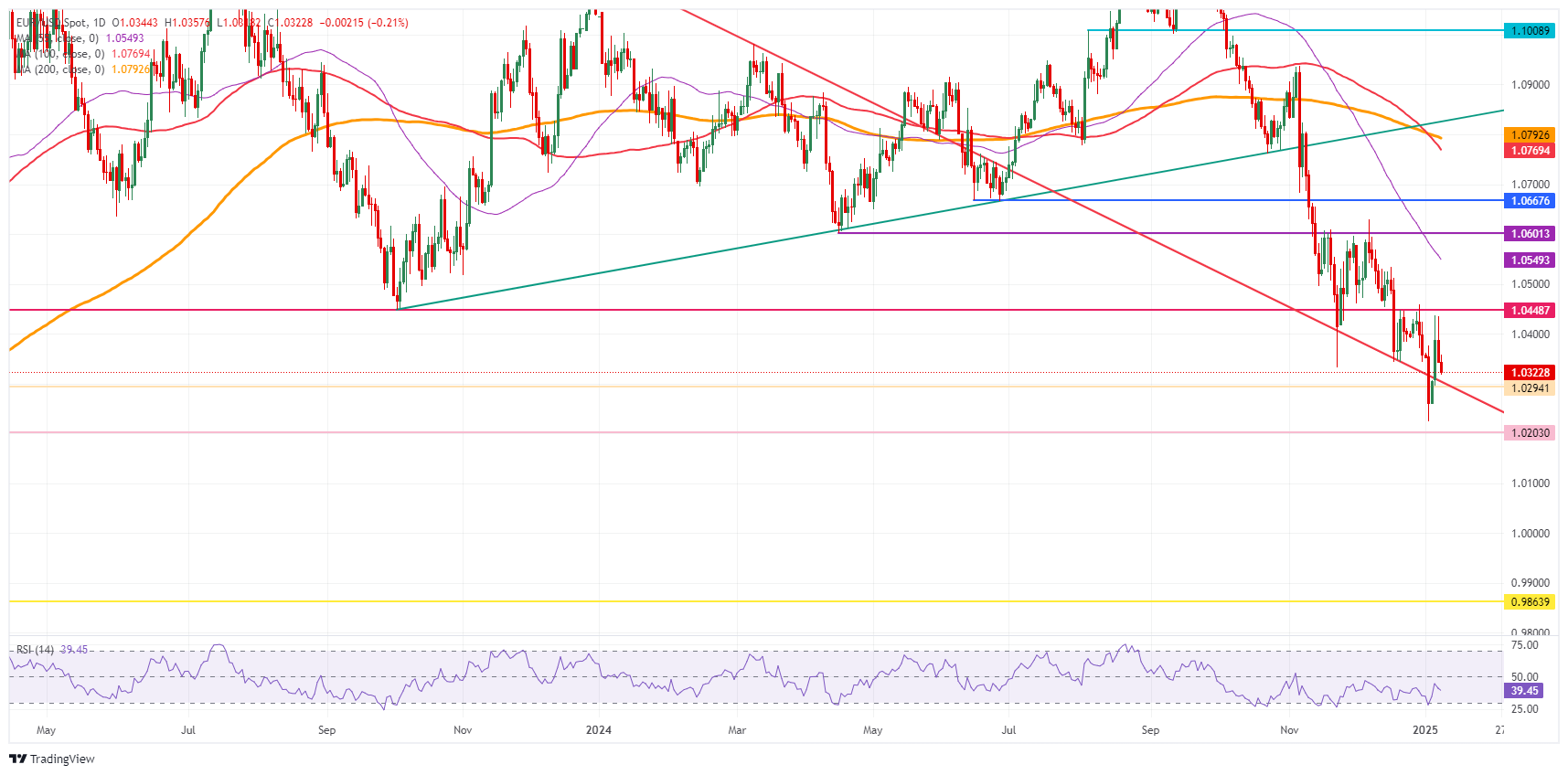
EUR/USD: Daily Chart
Euro FAQs
The Euro is the currency for the 19 European Union countries that belong to the Eurozone. It is the second most heavily traded currency in the world behind the US Dollar. In 2022, it accounted for 31% of all foreign exchange transactions, with an average daily turnover of over $2.2 trillion a day. EUR/USD is the most heavily traded currency pair in the world, accounting for an estimated 30% off all transactions, followed by EUR/JPY (4%), EUR/GBP (3%) and EUR/AUD (2%).
The European Central Bank (ECB) in Frankfurt, Germany, is the reserve bank for the Eurozone. The ECB sets interest rates and manages monetary policy. The ECB’s primary mandate is to maintain price stability, which means either controlling inflation or stimulating growth. Its primary tool is the raising or lowering of interest rates. Relatively high interest rates – or the expectation of higher rates – will usually benefit the Euro and vice versa. The ECB Governing Council makes monetary policy decisions at meetings held eight times a year. Decisions are made by heads of the Eurozone national banks and six permanent members, including the President of the ECB, Christine Lagarde.
Eurozone inflation data, measured by the Harmonized Index of Consumer Prices (HICP), is an important econometric for the Euro. If inflation rises more than expected, especially if above the ECB’s 2% target, it obliges the ECB to raise interest rates to bring it back under control. Relatively high interest rates compared to its counterparts will usually benefit the Euro, as it makes the region more attractive as a place for global investors to park their money.
Data releases gauge the health of the economy and can impact on the Euro. Indicators such as GDP, Manufacturing and Services PMIs, employment, and consumer sentiment surveys can all influence the direction of the single currency. A strong economy is good for the Euro. Not only does it attract more foreign investment but it may encourage the ECB to put up interest rates, which will directly strengthen the Euro. Otherwise, if economic data is weak, the Euro is likely to fall. Economic data for the four largest economies in the euro area (Germany, France, Italy and Spain) are especially significant, as they account for 75% of the Eurozone’s economy.
Another significant data release for the Euro is the Trade Balance. This indicator measures the difference between what a country earns from its exports and what it spends on imports over a given period. If a country produces highly sought after exports then its currency will gain in value purely from the extra demand created from foreign buyers seeking to purchase these goods. Therefore, a positive net Trade Balance strengthens a currency and vice versa for a negative balance.
Markets have been tempted in the past couple of days to believe there is some truth behind the Washington Post’s report – quickly rebuked by Trump – that US tariffs will be only on selected products. Markets are also looking with interest at the timeline for the US Congress’ plan to pass a three-in-one bill for taxes, border and energy. Speaker Mike Johnson has set a rather ambitious April deadline, and that could suggest the new administration will have to focus efforts on domestic policies and at least delay a large-scale protectionism program, ING’s FX analyst Francesco notes.
DXY to consolidate just below the 109.0 mark
“For now, markets have been left guessing on tariffs, which allowed the US macro story to take over and unmistakably offer support to the US Dollar (USD). Yesterday’s US data releases were hawkish for the Fed, and the implied probability of a March rate cut has now dropped below 40%. Treasuries had another soft session yesterday, and stocks slipped, adding support to the safe-haven USD.”
“Aside from the stronger-than-expected JOLTS job market opening and the headline ISM services index, the most remarkable print was the ISM prices paid subcomponent, which spiked to the highest level since January 2023. If a generally resilient economy was already accounted for when the Fed met in December, a resurgence in inflation concerns could drive an even further hawkish tuning in the policy message.”
“The details of December’s FOMC will be released in today’s minutes, which could throw a bit more support behind the USD. Expect also some reaction to the ADP payrolls, even if they seldom predict official payrolls. Maybe more importantly, there is a planned speech by Chris Waller at 1400 CET: let’s see if he joins other members in flagging lingering inflation risks. We could see opposing forces on the USD today, as the technical/positioning picture still points to correction risk, but the Fed/macro picture may well continue to attract USD bulls. We could see a consolidation just below the 109.0 mark in DXY.”
Current price movements appear to be part of a range trading phase, expected to be between 0.5615 and 0.5665. In the longer run, NZD is likely to trade in a 0.5590/0.5705 range for now, UOB Group’s FX analysts Quek Ser Leang and Lee Sue Ann note.
NZD has probably entered a consolidation phase
24-HOUR VIEW: “NZD swung between 0.5612 and 0.5685 two days ago. Yesterday, we indicated that ‘the price action lacks clarity, and further choppy trading is not ruled out, probably in a range of 0.5605/0.5665.’ However, NZD rose to 0.5693 before pulling sharply to close at 0.5635 (- 0.15%). The current price movements appear to be part of a range trading phase, expected to be between 0.5615 and 0.5665.”
1-3 WEEKS VIEW: “We continue to hold the same view as yesterday (07 Jan, spot at 0.8640). As indicated, NZD has probably entered a consolidation phase, and it is likely to trade in a 0.5590/0.5705 range for now.”
Industrial metals have had a muted start to 2025 with the market weighing the outlook for the year amid geopolitical tensions, the uncertain path for China’s economic recovery and rising protectionism, ING’s commodity analyst Ewa Manthey and Warren Patterson note.
US tariffs and a stronger USD can depress industrial metals prices
“The US election has further complicated the outlook for the complex with a threat of tariffs on Chinese goods looming over the market. Industrial metals all fell after Trump on Monday denied a report that his team was planning weaker import tariffs than those announced during his presidential campaign. We believe that potential US tariffs and a stronger dollar could further depress industrial metals prices.”
“Requests to withdraw aluminum from LME warehouses rose by 42,850 tons to 380,050 tons , the highest since 7 October 2024. The majority of cancellations were reported in Malaysia’s Port Klang warehouses.”
“Meanwhile, exchange inventories for aluminum fell by 2,500 tons to 624,275 tons (the lowest since 9 May 2024), while on-warrant inventories decreased by 45,350 tons to 244,225 tons as of yesterday.”
Silver prices (XAG/USD) rose on Wednesday, according to FXStreet data. Silver trades at $30.18 per troy ounce, up 0.52% from the $30.02 it cost on Tuesday.
Silver prices have increased by 4.44% since the beginning of the year.
| Unit measure | Silver Price Today in USD |
|---|---|
| Troy Ounce | 30.18 |
| 1 Gram | 0.97 |
The Gold/Silver ratio, which shows the number of ounces of Silver needed to equal the value of one ounce of Gold, stood at 87.94 on Wednesday, down from 88.29 on Tuesday.
Silver FAQs
Silver is a precious metal highly traded among investors. It has been historically used as a store of value and a medium of exchange. Although less popular than Gold, traders may turn to Silver to diversify their investment portfolio, for its intrinsic value or as a potential hedge during high-inflation periods. Investors can buy physical Silver, in coins or in bars, or trade it through vehicles such as Exchange Traded Funds, which track its price on international markets.
Silver prices can move due to a wide range of factors. Geopolitical instability or fears of a deep recession can make Silver price escalate due to its safe-haven status, although to a lesser extent than Gold's. As a yieldless asset, Silver tends to rise with lower interest rates. Its moves also depend on how the US Dollar (USD) behaves as the asset is priced in dollars (XAG/USD). A strong Dollar tends to keep the price of Silver at bay, whereas a weaker Dollar is likely to propel prices up. Other factors such as investment demand, mining supply – Silver is much more abundant than Gold – and recycling rates can also affect prices.
Silver is widely used in industry, particularly in sectors such as electronics or solar energy, as it has one of the highest electric conductivity of all metals – more than Copper and Gold. A surge in demand can increase prices, while a decline tends to lower them. Dynamics in the US, Chinese and Indian economies can also contribute to price swings: for the US and particularly China, their big industrial sectors use Silver in various processes; in India, consumers’ demand for the precious metal for jewellery also plays a key role in setting prices.
Silver prices tend to follow Gold's moves. When Gold prices rise, Silver typically follows suit, as their status as safe-haven assets is similar. The Gold/Silver ratio, which shows the number of ounces of Silver needed to equal the value of one ounce of Gold, may help to determine the relative valuation between both metals. Some investors may consider a high ratio as an indicator that Silver is undervalued, or Gold is overvalued. On the contrary, a low ratio might suggest that Gold is undervalued relative to Silver.
(An automation tool was used in creating this post.)
- EUR/GBP gains ground following the economic data from Germany, the Eurozone's largest economy.
- Germany's Retail Sales grew by 2.5% YoY in November, exceeding the expected 1.9% increase and outperforming the 1.0% growth in October.
- The Pound Sterling may strengthen as traders expect the BoE to implement two 25 basis points rate cuts this year.
EUR/GBP retraces its recent losses from the previous day, trading around 0.8290 during the European session on Wednesday. The Euro remains steady after Germany, the Eurozone's largest economy, reported stronger-than-expected Retail Sales growth of 2.5% year-over-year in November, surpassing the 1.9% forecast and the 1.0% recorded in October. However, on a monthly basis, Retail Sales dipped 0.6% in November, following a 1.5% decline in October.
On Tuesday, the Eurozone Harmonized Index of Consumer Prices (HICP) rose by 2.4% year-over-year in December, up from 2.2% in November, matching market expectations. Similarly, the core HICP increased by 2.7% YoY in December, maintaining the same pace as November and aligning with forecasts.
Meanwhile, the bloc's overall HICP rebounded with a 0.4% year-over-year increase, recovering from the previous 0.3% decline. Monthly core HICP inflation also turned positive, coming in at 0.5% in December, compared to a -0.6% reading in November.
Despite rising inflation, traders continue to anticipate aggressive European Central Bank (ECB) rate cuts in 2025. This outlook could place additional selling pressure on the Euro (EUR) against its peers. The ECB is widely expected to cut rates by 25 basis points (bps) at its upcoming meeting on January 30.
However, the upside for the EUR/GBP cross may be capped, as the Pound Sterling (GBP) could find support from shifting market expectations. Traders now anticipate fewer interest rate cuts from the Bank of England (BoE), with projections lowered to just two 25bps reductions this year, compared to earlier forecasts of more than three at the beginning of last month.
On Tuesday, The British Retail Consortium (BRC) Like-For-Like Retail Sales saw a notable 3.1% increase in December 2024, a sharp rebound from the previous month's 3.4% decline. Despite the December uptick, the BRC reported that overall retail performance in the fourth quarter of 2024 remained lackluster, with year-on-year sales growth of just 0.4%. For the entire year, total retail sales increased by 0.7%, while like-for-like sales rose by a modest 0.5%.
Economic Indicator
Retail Sales (YoY)
The Retail Sales released by the Statistisches Bundesamt Deutschland is a measure of changes in sales of the German retail sector. It shows the performance of the retail sector in the short term. Percent changes reflect the rate of changes of such sales.The changes are widely followed as an indicator of consumer spending. The positive economic growth anticipates "Bullish" for the EUR, while a low reading is seen as negative, or bearish, for the EUR.
Read more.Last release: Wed Jan 08, 2025 07:00
Frequency: Monthly
Actual: 2.5%
Consensus: 1.9%
Previous: 1%
Slight increase in downward momentum is likely to result in a lower trading range of 0.6215/0.6265. In the longer run, for the time being, AUD is expected to trade between 0.6180 and 0.6310, UOB Group’s FX analysts Quek Ser Leang and Lee Sue Ann note.
AUD is likely to trade in a range for the time being
24-HOUR VIEW: “After the choppy trading in AUD on Monday, we indicated yesterday (when AUD was trading at 0.6240) that ‘the sharp but brief swings have resulted in a mixed outlook.’ We held the view that AUD ‘could trade sideways, probably between 0.6210 and 0.6280.’ AUD then traded in a 0.6228/0.6288 range, closing lower by 0.25% at 0.6231. Although the price action has led to a slight increase in downward momentum, this is likely to result in a lower trading range of 0.6215/0.6265 instead of a sustained decline.”
1-3 WEEKS VIEW: “We pointed out yesterday (07 Jan, spot at 0.6240) that AUD ‘may have found an interim bottom at 0.6179 last week.’ However, we noted that ‘as there has been no significant increase in upward momentum, AUD is likely to trade in a range for the time being, expected to be between 0.6180 and 0.6310.’ There is no change in our view.”
China’s central bank added to its Gold reserves for a second month in December, ING’s commodity analyst Ewa Manthey and Warren Patterson note.
PBoC buys more gold in December
“Gold held by the People’s Bank of China rose to 73.29 million troy ounces in December, from 72.96 million in the previous month.”
“The central bank resumed adding to its Gold reserves in November after a six-month pause. The purchase by the central bank comes even with Gold prices near record levels”
GBP is expected to trade sideways between 1.2440 and 1.2535. In the longer run, GBP is expected to trade in a range, likely between 1.2420 and 1.2620, UOB Group’s FX analysts Quek Ser Leang and Lee Sue Ann note.
GBP is expected to trade in a range
24-HOUR VIEW: “Our expectation for GBP to ‘consolidate in a range between 1.2450 and 1.2550’ turned out to be incorrect as GBP rose to 1.2575. GBP pulled back sharply from the high to close at 1.2479 (-0.34%). Despite the sharp pullback, there has been no significant increase in downward momentum. Today, we expect GBP to trade sideways, likely between 1.2440 and 1.2535.”
1-3 WEEKS VIEW: “We continue to hold the same view as yesterday (07 Jan, spot at 1.2510). As indicated, we expect GBP to trade in a range between 1.2420 and 1.2620 for the time being.”
ICE Brent pushed above US$77/bbl yesterday with sentiment still largely supportive following a stronger physical market, ING’s commodity analyst Ewa Manthey and Warren Patterson note.
Strength in the market continues in early morning trading
“Concerns over Iranian and Russian oil flows will also be providing some support. There were reports yesterday that a port operator in Shandong, China, has told ports not to accept tankers sanctioned by the US. Refiners in the region are large buyers of Iranian crude oil and so if these ports follow through, it potentially provides more obstacles to Iranian oil flows.”
“Strength in the market continued in early morning trading today after API numbers showed that US crude oil inventories fell by 4m barrels over the last week, while Cushing stocks declined by 3.1m barrels. It was less bullish on the product side with gasoline and distillate stocks increasing by 7.3m barrels and 3.2m barrels respectively. The more widely followed EIA inventory report will be released later today.”
“European gas prices initially came under pressure yesterday with TTF trading just below EUR46/MWh. However, the market strengthened in the latter part of the trading session, which saw TTF settling marginally higher on the day. EU storage is 69% full at the moment, down from 85% at the same stage last year and below the five-year average of 75%. A faster-than-expected fall in inventory will leave the market nervous, particularly with the colder weather Europe is facing at the moment.”
The Euro (EUR) could edge lower and test 1.0320; the major support at 1.0300 is unlikely to come under threat. In the longer run, bias for EUR is tilted to the upside; any advance is likely part of a higher trading range of 1.0300/1.0465, UOB Group’s FX analysts Quek Ser Leang and Lee Sue Ann note.
The major support at 1.0300 is unlikely to come under threat
24-HOUR VIEW: “Two days ago, EUR surged to 1.0436 before pulling back. Yesterday, we indicated that ‘although the sharp and swift rise appears to be running ahead of itself, there is scope for EUR to retest the 1.0435 level before a more sustained pullback can be expected.’ We added, ‘a clear break above 1.0435 seems unlikely.’ The subsequent price action aligned with our view as EUR rose to a high of 1.0434. EUR pulled back from the high, closing lower by 0.49% at 1.0339. There has been a slight increase in downward momentum, and today, EUR could edge lower and test 1.0320. The major support at 1.0300 is unlikely to come under threat. On the upside, resistance levels are at 1.0370 and 1.0395.”
1-3 WEEKS VIEW: “Yesterday (07 Jan), when EUR was trading at 1.0380, we were of the view that ‘the near-term bias is tilted to the upside, even though any advance is likely part of a higher trading range of 1.0300/1.0465.’ We were also of the view that EUR ‘is unlikely to break clearly above 1.0465.’ Our view remains unchanged.”
- USD/CAD may gain ground as the US Dollar receives support from a hawkish policy shift by the Federal Reserve.
- Atlanta Fed President Raphael Bostic emphasized policymakers should proceed cautiously with policy decisions, citing uneven progress in bringing down inflation.
- Traders assess the impact of Canadian PM Trudeau's resignation as the country faces rising tariff threats and political uncertainty.
USD/CAD retraces its recent gains from the previous session, trading around 1.4350 during the European hours on Wednesday. However, the pair downside risks for the pair could be restrained as the US Dollar (USD) strengthens by a hawkish shift in investor sentiment regarding the Federal Reserve's (Fed) interest rate outlook, following robust US economic data.
The latest ISM services report suggested increased activity and rising prices in the United States (US), intensifying concerns about persistent inflation. Traders are now focused on the upcoming Federal Open Market Committee (FOMC) Minutes, scheduled for release later in the day, as well as the US jobs data, including the Nonfarm Payroll (NFP) report on Friday, for additional insights into policy direction.
According to Bloomberg, Federal Reserve Bank of Atlanta President Raphael Bostic stated on Tuesday that Fed officials should exercise caution with policy decisions due to uneven progress in reducing inflation. Bostic emphasized the need to lean toward keeping interest rates elevated to ensure the achievement of price stability goals.
Traders are evaluating the implications of Canadian Prime Minister (PM) Justin Trudeau's resignation after nine years in office, amid escalating tariff threats, political instability, and declining approval ratings, which could pave the way for snap elections. Trudeau announced on Monday that he would step down as the leader of Canada’s ruling Liberal Party once a successor is chosen.
On the data front, Canada’s seasonally adjusted Ivey Purchasing Managers Index rose to 54.7 in December, up from 52.3 in November but falling short of market expectations of 55.4. This indicates steady economic expansion for the fourth consecutive month. Meanwhile, traders are shifting their focus to the upcoming employment report, including December’s Net Change in Employment and Unemployment Rate, set for release on Friday.
Canadian Dollar PRICE Today
The table below shows the percentage change of Canadian Dollar (CAD) against listed major currencies today. Canadian Dollar was the strongest against the Swiss Franc.
| USD | EUR | GBP | JPY | CAD | AUD | NZD | CHF | |
|---|---|---|---|---|---|---|---|---|
| USD | 0.19% | 0.25% | 0.22% | -0.03% | 0.07% | 0.15% | 0.26% | |
| EUR | -0.19% | 0.06% | 0.02% | -0.21% | -0.12% | -0.03% | 0.07% | |
| GBP | -0.25% | -0.06% | -0.02% | -0.27% | -0.18% | -0.09% | 0.01% | |
| JPY | -0.22% | -0.02% | 0.02% | -0.25% | -0.16% | -0.08% | 0.03% | |
| CAD | 0.03% | 0.21% | 0.27% | 0.25% | 0.09% | 0.18% | 0.28% | |
| AUD | -0.07% | 0.12% | 0.18% | 0.16% | -0.09% | 0.09% | 0.18% | |
| NZD | -0.15% | 0.03% | 0.09% | 0.08% | -0.18% | -0.09% | 0.10% | |
| CHF | -0.26% | -0.07% | -0.01% | -0.03% | -0.28% | -0.18% | -0.10% |
The heat map shows percentage changes of major currencies against each other. The base currency is picked from the left column, while the quote currency is picked from the top row. For example, if you pick the Canadian Dollar from the left column and move along the horizontal line to the US Dollar, the percentage change displayed in the box will represent CAD (base)/USD (quote).
- The ADP Employment Change will likely have a limited impact on financial markets.
- The US private sector is expected to have added 139,000 new positions in December.
- The US Dollar Index corrected extreme overbought conditions, retains its bullish stance.
Financial markets slowly return from the winter holidays and the macroeconomic calendar starts to be packed. These days, the focus has been on the United States (US) and President-elect Donald Trump’s proposed tariffs. Market sentiment has led the way in the absence of relevant data, with the mood seesawing between hopes and despair of what the new US administration would mean to the global economy.
US employment, however, is taking centre stage. The ADP Research Institute will release the December Employment Change report on Wednesday, a survey that estimates the number of new jobs created by the private sector.
It is worth remembering that the ADP report is typically released two days before the official Nonfarm Payrolls (NFP) report. The ADP data is often viewed as an early preview of the Bureau of Labor Statistics (BLS) jobs report. However, the connection between the two has proven inconsistent over time.
Employment growth and its role in shaping Fed policy
Employment is critical, as is one of the two legs of the Federal Reserve’s (Fed) dual mandate. The US central bank should maintain price stability and pursue maximum employment. As inflationary pressures receded, the focus temporarily shifted to employment in the second quarter of 2024, as a strong labor market somehow posed a risk to inflation.
Still, the focus returned to inflation after the 2024 presidential election. Former president Donald Trump won the run and will return to the White House as the 47th US president in a few days. Not only did he achieve victory, but the Republican party also won control of Congress, leading in both houses.
Fears that Trump’s policies will result in fresh inflationary pressures have helped the Fed to adopt a more cautious approach to interest rate cuts. The Fed trimmed the benchmark interest rate for the first time in September, delivering cuts also in November and December to a total of 100 basis points (bps) in 2024.
In the December monetary policy meeting, however, US policymakers anticipated through the Summary of Economic Projections (SEP) or dot plot, that the pace of interest rate cuts will slow down this year, foreseeing just two potential trims in 2025.
At this point, it seems unlikely the ADP report, or even the upcoming NFP report on Friday, could affect expectations of two modest rate cuts. One-month figures on their own hardly affect the central bank’s stance.
According to the CME FedWatch Tool, the odds for an interest rate cut overcome those for an on-hold decision only in June.
With that in mind, ADP figures will probably be taken with a pinch of salt.
When will the ADP Report be released, and how could it affect the USD Index?
The ADP Employment Change report for December will be released on Wednesday at 13:15 GMT. It’s expected to show that the US private sector added 140K new jobs after gaining 146K in November.
Ahead of the release, the US Dollar Index (DXY) has retreated from a multi-year peak of 109.56 posted on Jan 2 and hovers around the 108.00 mark. A reading in line with expectations should have no impact on the DXY, particularly considering that the Federal Open Market Committee (FOMC) will release the Minutes of the December meeting later in the day. Speculative interest will likely wait for the document, hoping it could offer some clues on upcoming monetary policy decisions.
An upbeat figure could signal a stronger labour market, keeping the Fed on the hawkish side. As a result, the US Dollar Index should regain its prevalent strength. The opposite scenario, however, will not be as straightforward. A poor report will not be enough to boost speculation of a soon-to-come interest rate cut. The DXY may fall as an immediate reaction to the news, but the decline will likely be short-lived.
From a technical perspective, Valeria Bednarik, Chief Analyst at FXStreet, says: “The US Dollar Index (DXY) corrected overbought conditions in the daily chart, with the downward run losing steam. In the mentioned time frame, a bullish 20 Simple Moving Average (SMA) provides dynamic support at around 107.90, attracting buyers for a second consecutive day. Technical indicators, in the meantime, are turning flat above their midlines, reflecting easing buying interest.”
Bednarik adds: “Buyers will likely take their chances on dips, with immediate support at 107.74, the December 30 intraday low. Additional slides may see DXY falling towards 107.18, the December 13 high, with a break below 107.00 unlikely with the ADP release. Initial resistance lies at 108.55, the December 20 intraday high, with gains beyond the latter exposing the aforementioned 109.56 multi-year high.
Employment FAQs
Labor market conditions are a key element to assess the health of an economy and thus a key driver for currency valuation. High employment, or low unemployment, has positive implications for consumer spending and thus economic growth, boosting the value of the local currency. Moreover, a very tight labor market – a situation in which there is a shortage of workers to fill open positions – can also have implications on inflation levels and thus monetary policy as low labor supply and high demand leads to higher wages.
The pace at which salaries are growing in an economy is key for policymakers. High wage growth means that households have more money to spend, usually leading to price increases in consumer goods. In contrast to more volatile sources of inflation such as energy prices, wage growth is seen as a key component of underlying and persisting inflation as salary increases are unlikely to be undone. Central banks around the world pay close attention to wage growth data when deciding on monetary policy.
The weight that each central bank assigns to labor market conditions depends on its objectives. Some central banks explicitly have mandates related to the labor market beyond controlling inflation levels. The US Federal Reserve (Fed), for example, has the dual mandate of promoting maximum employment and stable prices. Meanwhile, the European Central Bank’s (ECB) sole mandate is to keep inflation under control. Still, and despite whatever mandates they have, labor market conditions are an important factor for policymakers given its significance as a gauge of the health of the economy and their direct relationship to inflation.
Economic Indicator
ADP Employment Change
The ADP Employment Change is a gauge of employment in the private sector released by the largest payroll processor in the US, Automatic Data Processing Inc. It measures the change in the number of people privately employed in the US. Generally speaking, a rise in the indicator has positive implications for consumer spending and is stimulative of economic growth. So a high reading is traditionally seen as bullish for the US Dollar (USD), while a low reading is seen as bearish.
Read more.Next release: Wed Jan 08, 2025 13:15
Frequency: Monthly
Consensus: 140K
Previous: 146K
Source: ADP Research Institute
Traders often consider employment figures from ADP, America’s largest payrolls provider, report as the harbinger of the Bureau of Labor Statistics release on Nonfarm Payrolls (usually published two days later), because of the correlation between the two. The overlaying of both series is quite high, but on individual months, the discrepancy can be substantial. Another reason FX traders follow this report is the same as with the NFP – a persistent vigorous growth in employment figures increases inflationary pressures, and with it, the likelihood that the Fed will raise interest rates. Actual figures beating consensus tend to be USD bullish.
- The USD/CNH pair strengthens as the US Dollar gains support from the Federal Reserve's hawkish policy shift.
- The latest ISM services report indicated higher activity and rising prices, fueling concerns about persistent inflation in the United States.
- PBoC official Peng Lifeng announced that the central bank will support banks in expanding loans under the trade-in initiative.
USD/CNH, the offshore Yuan, retraces its recent losses from the previous two days, trading around 7.3490 during the early European hours on Wednesday. The People’s Bank of China (PBoC) set the USD/CNY central rate for the trading session ahead at 7.1887 as compared to the previous day's fix of 7.1879 and 7.3435 Reuters estimates.
The upside of the USD/CNH pair could be attributed to the strength of the US Dollar (USD), driven by a hawkish shift in investor sentiment regarding the Federal Reserve's (Fed) interest rate outlook, following robust US economic data.
The latest ISM services report suggested increased activity and rising prices in the United States (US), intensifying concerns about persistent inflation. Traders are now focusing on upcoming US jobs data, including the Nonfarm Payroll (NFP) report, as well as the latest FOMC Minutes, for further policy insights.
Meanwhile, the Chinese Yuan faced downward pressure after President-elect Donald Trump dismissed reports claiming that his aides were considering a targeted strategy aimed at sectors vital to US national and economic security.
The People’s Bank of China (PBoC) is collaborating with the State Planner to bolster the country's economy. PBoC official Peng Lifeng announced that the central bank will assist banks in expanding loans under the trade-in initiative.
Commerzbank’s FX analyst, Volkmar Baur, noted in a report that the interest rate market remains unconvinced that China’s economic situation will improve in the near future. Over recent weeks, the yield on 10-year government bonds has declined further to 1.58%, while the yield on 2-year government bonds briefly dipped below 1% on Monday. This suggests that the market anticipates additional significant easing measures from the PBoC and the continuation of low interest rates in China.
Traders shift their focus to China’s upcoming economic data releases later this week, including inflation figures, which are anticipated to offer greater insight into the health of the world’s second-largest economy.
Central banks FAQs
Central Banks have a key mandate which is making sure that there is price stability in a country or region. Economies are constantly facing inflation or deflation when prices for certain goods and services are fluctuating. Constant rising prices for the same goods means inflation, constant lowered prices for the same goods means deflation. It is the task of the central bank to keep the demand in line by tweaking its policy rate. For the biggest central banks like the US Federal Reserve (Fed), the European Central Bank (ECB) or the Bank of England (BoE), the mandate is to keep inflation close to 2%.
A central bank has one important tool at its disposal to get inflation higher or lower, and that is by tweaking its benchmark policy rate, commonly known as interest rate. On pre-communicated moments, the central bank will issue a statement with its policy rate and provide additional reasoning on why it is either remaining or changing (cutting or hiking) it. Local banks will adjust their savings and lending rates accordingly, which in turn will make it either harder or easier for people to earn on their savings or for companies to take out loans and make investments in their businesses. When the central bank hikes interest rates substantially, this is called monetary tightening. When it is cutting its benchmark rate, it is called monetary easing.
A central bank is often politically independent. Members of the central bank policy board are passing through a series of panels and hearings before being appointed to a policy board seat. Each member in that board often has a certain conviction on how the central bank should control inflation and the subsequent monetary policy. Members that want a very loose monetary policy, with low rates and cheap lending, to boost the economy substantially while being content to see inflation slightly above 2%, are called ‘doves’. Members that rather want to see higher rates to reward savings and want to keep a lit on inflation at all time are called ‘hawks’ and will not rest until inflation is at or just below 2%.
Normally, there is a chairman or president who leads each meeting, needs to create a consensus between the hawks or doves and has his or her final say when it would come down to a vote split to avoid a 50-50 tie on whether the current policy should be adjusted. The chairman will deliver speeches which often can be followed live, where the current monetary stance and outlook is being communicated. A central bank will try to push forward its monetary policy without triggering violent swings in rates, equities, or its currency. All members of the central bank will channel their stance toward the markets in advance of a policy meeting event. A few days before a policy meeting takes place until the new policy has been communicated, members are forbidden to talk publicly. This is called the blackout period.
- NZD/USD struggles to gain any meaningful traction as traders now await FOMC meeting Minutes.
- The Fed’s hawkish shift remains supportive of elevated US bond yields and favors the USD bulls.
- Geopolitical risks and trade war fears also contribute to capping the upside for risk-sensitive Kiwi.
The NZD/USD pair stalls the previous day's retracement slide from a nearly three-week high, albeit it struggles to attract any meaningful buyers and trades around the 0.5630-0.5625 area during the early European session on Wednesday. Traders seem reluctant and opt to await the release of FOMC meeting Minutes before placing fresh directional bets.
Traders on Wednesday will also confront a duo of US labor market report – the ADP report on private-sector employment and the usual Weekly Initial Jobless Claims data. In the meantime, the US Dollar (USD) struggles to capitalize on the overnight move-up led by the upbeat US data, which acts as a tailwind for the NZD/USD pair. The fundamental backdrop, however, warrants some caution before confirming that spot prices have formed a near-term bottom and positioning for an extension of the recent bounce from the 0.5585 area, or the lowest level since October 2022 touched last week.
The Federal Reserve (Fed) adopted a more hawkish stance at the end of the December policy meeting and signaled that it would slow the pace of rate cuts in 2025. This remains supportive of a further rise in the US Treasury bond yields and favors the USD bulls. Apart from this, persistent geopolitical risks, concerns about US President-elect Donald Trump's tariff plans and the US-China trade war support prospects for the emergence of some dip-buying around the safe-haven buck. This, along with the cautious market mood, should contribute to capping the risk-sensitive Kiwi and the NZD/USD pair.
New Zealand Dollar FAQs
The New Zealand Dollar (NZD), also known as the Kiwi, is a well-known traded currency among investors. Its value is broadly determined by the health of the New Zealand economy and the country’s central bank policy. Still, there are some unique particularities that also can make NZD move. The performance of the Chinese economy tends to move the Kiwi because China is New Zealand’s biggest trading partner. Bad news for the Chinese economy likely means less New Zealand exports to the country, hitting the economy and thus its currency. Another factor moving NZD is dairy prices as the dairy industry is New Zealand’s main export. High dairy prices boost export income, contributing positively to the economy and thus to the NZD.
The Reserve Bank of New Zealand (RBNZ) aims to achieve and maintain an inflation rate between 1% and 3% over the medium term, with a focus to keep it near the 2% mid-point. To this end, the bank sets an appropriate level of interest rates. When inflation is too high, the RBNZ will increase interest rates to cool the economy, but the move will also make bond yields higher, increasing investors’ appeal to invest in the country and thus boosting NZD. On the contrary, lower interest rates tend to weaken NZD. The so-called rate differential, or how rates in New Zealand are or are expected to be compared to the ones set by the US Federal Reserve, can also play a key role in moving the NZD/USD pair.
Macroeconomic data releases in New Zealand are key to assess the state of the economy and can impact the New Zealand Dollar’s (NZD) valuation. A strong economy, based on high economic growth, low unemployment and high confidence is good for NZD. High economic growth attracts foreign investment and may encourage the Reserve Bank of New Zealand to increase interest rates, if this economic strength comes together with elevated inflation. Conversely, if economic data is weak, NZD is likely to depreciate.
The New Zealand Dollar (NZD) tends to strengthen during risk-on periods, or when investors perceive that broader market risks are low and are optimistic about growth. This tends to lead to a more favorable outlook for commodities and so-called ‘commodity currencies’ such as the Kiwi. Conversely, NZD tends to weaken at times of market turbulence or economic uncertainty as investors tend to sell higher-risk assets and flee to the more-stable safe havens.
- EUR/JPY declines to 163.35 in Wednesday’s early European session.
- German Factory Orders fell 5.4% MoM in November vs. 0% expected.
- Traders remain cautious about the timing of the next interest rate hike, which might weigh on the JPY.
The EUR/JPY cross pares recent gains to around 163.35 during the early European trading hours on Wednesday. The Euro (EUR) faces some selling pressure after the Germany's economic data. However, the downside for the cross might be limited amid the uncertainty about the timing of the Bank of Japan's (BoJ) next interest rate hike.
Data released by the Federal Statistics Office on Wednesday showed that Germany's Factory Orders unexpectedly slumped in November, highlighting the industry’s woes just weeks before Chancellor Olaf Scholz faces elections. German Factory Orders fell by 5.4% MoM in November, compared to a decline of 1.5% in the previous reading. This figure came in weaker than the 0% expected. The shared currency weakens against the Japanese Yen (JPY) in an immediate reaction to the downbeat German data.
Furthermore, the verbal intervention by Japanese authorities and the risk-off mood amid concerns about the ongoing geopolitical tensions in the Middle East could boost the safe-haven currency like the JPY and act as a headwind for EUR/JPY. On the other hand, the uncertainty surrounding the BoJ’s monetary policy next move might keep the JPY at a relatively weak level. BoJ Governor Kazuo Ueda said on Monday that the central bank will raise the policy interest rate to adjust the degree of monetary easing if economic and price conditions keep improving.
Euro FAQs
The Euro is the currency for the 19 European Union countries that belong to the Eurozone. It is the second most heavily traded currency in the world behind the US Dollar. In 2022, it accounted for 31% of all foreign exchange transactions, with an average daily turnover of over $2.2 trillion a day. EUR/USD is the most heavily traded currency pair in the world, accounting for an estimated 30% off all transactions, followed by EUR/JPY (4%), EUR/GBP (3%) and EUR/AUD (2%).
The European Central Bank (ECB) in Frankfurt, Germany, is the reserve bank for the Eurozone. The ECB sets interest rates and manages monetary policy. The ECB’s primary mandate is to maintain price stability, which means either controlling inflation or stimulating growth. Its primary tool is the raising or lowering of interest rates. Relatively high interest rates – or the expectation of higher rates – will usually benefit the Euro and vice versa. The ECB Governing Council makes monetary policy decisions at meetings held eight times a year. Decisions are made by heads of the Eurozone national banks and six permanent members, including the President of the ECB, Christine Lagarde.
Eurozone inflation data, measured by the Harmonized Index of Consumer Prices (HICP), is an important econometric for the Euro. If inflation rises more than expected, especially if above the ECB’s 2% target, it obliges the ECB to raise interest rates to bring it back under control. Relatively high interest rates compared to its counterparts will usually benefit the Euro, as it makes the region more attractive as a place for global investors to park their money.
Data releases gauge the health of the economy and can impact on the Euro. Indicators such as GDP, Manufacturing and Services PMIs, employment, and consumer sentiment surveys can all influence the direction of the single currency. A strong economy is good for the Euro. Not only does it attract more foreign investment but it may encourage the ECB to put up interest rates, which will directly strengthen the Euro. Otherwise, if economic data is weak, the Euro is likely to fall. Economic data for the four largest economies in the euro area (Germany, France, Italy and Spain) are especially significant, as they account for 75% of the Eurozone’s economy.
Another significant data release for the Euro is the Trade Balance. This indicator measures the difference between what a country earns from its exports and what it spends on imports over a given period. If a country produces highly sought after exports then its currency will gain in value purely from the extra demand created from foreign buyers seeking to purchase these goods. Therefore, a positive net Trade Balance strengthens a currency and vice versa for a negative balance.
Here is what you need to know on Wednesday, January 8:
Following a bearish opening to the week, the US Dollar (USD) gathered strength against its rivals on Tuesday, supported by the upbeat macroeconomic data releases and the cautious market mood. Private sector employment data from the US will be watched closely by market participants on Wednesday. Later in the American session, the Federal Reserve (Fed) will publish the minutes of the December policy meeting.
US Dollar PRICE This week
The table below shows the percentage change of US Dollar (USD) against listed major currencies this week. US Dollar was the weakest against the Canadian Dollar.
| USD | EUR | GBP | JPY | CAD | AUD | NZD | CHF | |
|---|---|---|---|---|---|---|---|---|
| USD | -0.35% | -0.48% | 0.51% | -0.70% | -0.22% | -0.34% | -0.02% | |
| EUR | 0.35% | -0.14% | 0.80% | -0.27% | 0.18% | 0.06% | 0.37% | |
| GBP | 0.48% | 0.14% | 0.97% | -0.15% | 0.32% | 0.19% | 0.51% | |
| JPY | -0.51% | -0.80% | -0.97% | -1.20% | -0.70% | -0.81% | -0.29% | |
| CAD | 0.70% | 0.27% | 0.15% | 1.20% | 0.41% | 0.32% | 0.66% | |
| AUD | 0.22% | -0.18% | -0.32% | 0.70% | -0.41% | -0.12% | 0.19% | |
| NZD | 0.34% | -0.06% | -0.19% | 0.81% | -0.32% | 0.12% | 0.31% | |
| CHF | 0.02% | -0.37% | -0.51% | 0.29% | -0.66% | -0.19% | -0.31% |
The heat map shows percentage changes of major currencies against each other. The base currency is picked from the left column, while the quote currency is picked from the top row. For example, if you pick the US Dollar from the left column and move along the horizontal line to the Japanese Yen, the percentage change displayed in the box will represent USD (base)/JPY (quote).
The data from the US showed on Tuesday that the ISM Services PMI improved to 54.1 in December from 52.1 in November, pointing to an ongoing expansion in the services sector's activity at an accelerating pace. Additionally, JOLTS Job Openings rose to 8.09 million in November from 7.84 million in October. After losing more than 0.5% on Monday, the USD Index staged a rebound on Tuesday and gained nearly 0.4% on the day. Meanwhile, Wall Street's main indexes registered large losses. Early Wednesday, US stock index futures trade marginally higher on the day and the USD Index holds steady above 108.50.
Early Wednesday, Germany's Destatis reported that Factory Orders declined by 5.4% on a monthly basis in November. In the same period, Retail Sales contracted by 0.6%. Both of these figures came in worse than analysts' estimates. EUR/USD showed no immediate reaction to these data and was last seen moving sideways slightly below 1.0350. During the European trading hours, the European Commission will publish business and consumer sentiment data for December and Eurostat will release Producer Price Index figures for November.
The data from Australia showed on Wednesday that the Monthly Consumer Price Index (YoY) rose to 2.3% in November from 2.1% in October. AUD/USD pays no attention to this data and fluctuates in a tight range above 0.6200 to begin the European session.
Following a two-day rally, GBP/USD reversed its direction and closed in negative territory on Tuesday. The pair stays in a consolidation phase below 1.2500 in the European morning.
Gold struggled to gather bullish momentum on Tuesday and registered small gains. XAU/USD hols steady slightly above $2,650 in the early European session on Wednesday.
USD/JPY posted small gains for the second consecutive day on Tuesday. The pair trades in a narrow channel at around 158.00 on Wednesday. Former Bank of Japan (BoJ) Governor Haruhiko Kuroda presented a research paper on Wednesday, predicting more interest rate hikes over the coming years.
Fed FAQs
Monetary policy in the US is shaped by the Federal Reserve (Fed). The Fed has two mandates: to achieve price stability and foster full employment. Its primary tool to achieve these goals is by adjusting interest rates. When prices are rising too quickly and inflation is above the Fed’s 2% target, it raises interest rates, increasing borrowing costs throughout the economy. This results in a stronger US Dollar (USD) as it makes the US a more attractive place for international investors to park their money. When inflation falls below 2% or the Unemployment Rate is too high, the Fed may lower interest rates to encourage borrowing, which weighs on the Greenback.
The Federal Reserve (Fed) holds eight policy meetings a year, where the Federal Open Market Committee (FOMC) assesses economic conditions and makes monetary policy decisions. The FOMC is attended by twelve Fed officials – the seven members of the Board of Governors, the president of the Federal Reserve Bank of New York, and four of the remaining eleven regional Reserve Bank presidents, who serve one-year terms on a rotating basis.
In extreme situations, the Federal Reserve may resort to a policy named Quantitative Easing (QE). QE is the process by which the Fed substantially increases the flow of credit in a stuck financial system. It is a non-standard policy measure used during crises or when inflation is extremely low. It was the Fed’s weapon of choice during the Great Financial Crisis in 2008. It involves the Fed printing more Dollars and using them to buy high grade bonds from financial institutions. QE usually weakens the US Dollar.
Quantitative tightening (QT) is the reverse process of QE, whereby the Federal Reserve stops buying bonds from financial institutions and does not reinvest the principal from the bonds it holds maturing, to purchase new bonds. It is usually positive for the value of the US Dollar.
Germany's Retail Sales fell 0.6% MoM in November after declining 1.5% in October, the official data released by Destatis showed on Wednesday.
Annually, Retail Sales in the Eurozone's top economy rose by 2.5% in November versus 1.9% expected and 1.0% in October.
EUR/USD reaction to the German data
Mixed German data serves negative for the Euro, driving EUR/USD slightly lower at around 1.0345, flat on the day, as of writing.
Euro PRICE Today
The table below shows the percentage change of Euro (EUR) against listed major currencies today. Euro was the weakest against the Canadian Dollar.
| USD | EUR | GBP | JPY | CAD | AUD | NZD | CHF | |
|---|---|---|---|---|---|---|---|---|
| USD | 0.00% | -0.03% | 0.05% | -0.07% | 0.02% | -0.01% | 0.03% | |
| EUR | -0.00% | -0.03% | 0.05% | -0.07% | 0.02% | -0.01% | 0.03% | |
| GBP | 0.03% | 0.03% | 0.10% | -0.04% | 0.05% | 0.02% | 0.07% | |
| JPY | -0.05% | -0.05% | -0.10% | -0.12% | -0.04% | -0.07% | -0.02% | |
| CAD | 0.07% | 0.07% | 0.04% | 0.12% | 0.08% | 0.06% | 0.09% | |
| AUD | -0.02% | -0.02% | -0.05% | 0.04% | -0.08% | -0.02% | 0.01% | |
| NZD | 0.01% | 0.00% | -0.02% | 0.07% | -0.06% | 0.02% | 0.04% | |
| CHF | -0.03% | -0.03% | -0.07% | 0.02% | -0.09% | -0.01% | -0.04% |
The heat map shows percentage changes of major currencies against each other. The base currency is picked from the left column, while the quote currency is picked from the top row. For example, if you pick the Euro from the left column and move along the horizontal line to the US Dollar, the percentage change displayed in the box will represent EUR (base)/USD (quote).
The official data published by the Federal Statistics Office showed Wednesday that Germany's Factory Orders unexpectedly slumped in November, suggesting that the country’s manufacturing sector resumed its downturn.
Over the month, contracts for goods ‘Made in Germany’ plunged by 5.4% in November after the 1.5% decline reported in October. Data missed the estimates of a 0% print.
Germany’s Industrial Orders dropped 1.7% year-on-year (YoY) in November, against the previous jump of 5.7%.
FX implications
The Euro sees some mild selling after the German data, with EUR/USD flat on the day at 1.0343, as of writing.
FX option expiries for Jan 8 NY cut at 10:00 Eastern Time via DTCC can be found below.
EUR/USD: EUR amounts
- 1.0350 721m
- 1.0500 833m
USD/JPY: USD amounts
- 157.50 1.7b
- 158.95 670m
AUD/USD: AUD amounts
- 0.6400 435m
USD/CAD: USD amounts
- 1.4130 730m
- 1.4350 855m
- 1.4460 1.4b
EUR/GBP: EUR amounts
- 0.8300 1.7b
- 0.8385 576m
- USD/CHF may gain ground due to the hawkish policy shift by the Federal Reserve.
- The latest ISM services report indicated higher activity and rising prices, fueling concerns about persistent inflation in the United States.
- The Swiss 10-year bond yield climbed to 0.37%, marking its highest level in over a month.
USD/CHF steadies following gains from the previous day, trading around 0.9090 during the Asian session on Wednesday. The pair may strengthen as the US Dollar (USD) gains support from the hawkish shift in investor sentiment toward the Federal Reserve's (Fed) interest rate outlook, following strong US economic data.
The latest ISM services report suggested increased activity and rising prices in the United States (US), intensifying concerns about persistent inflation. Traders are now focusing on upcoming US jobs data, including the Nonfarm Payroll (NFP) report, as well as the latest FOMC Minutes, for further policy insights.
The US ISM Services PMI increased to 54.1 in November, up from 52.1, exceeding the market expectation of 53.3. The Prices Paid Index, which reflects inflation, rose significantly to 64.4 from 58.2, while the Employment Index dipped slightly to 51.4 from 51.5.
The US Dollar Index (DXY), which measures the US Dollar’s (USD) performance against six major currencies, holds its position above 108.50 at the time of writing. The Greenback strengthened as the 10-year yield on US Treasury bonds rose by over 1% in the previous session, currently standing at 4.68%.
On the Swiss side, the yield on the 10-year government bond rose to 0.37%, its highest level in over a month, as traders assessed the outlook for interest rates and the global economy. In December, Swiss consumer price inflation eased to 0.6%, matching October’s lowest level since June 2021, down from 0.7% the previous month.
Traders have increased their expectations for further policy easing by the Swiss National Bank (SNB) this year, likely in March and June, due to ongoing strong disinflationary risks. SNB Chairman Martin Schlegel recently signaled that more rate cuts are probable, with negative interest rates remaining a potential tool to manage the Swiss Franc (CHF) and protect exports.
Swiss Franc FAQs
The Swiss Franc (CHF) is Switzerland’s official currency. It is among the top ten most traded currencies globally, reaching volumes that well exceed the size of the Swiss economy. Its value is determined by the broad market sentiment, the country’s economic health or action taken by the Swiss National Bank (SNB), among other factors. Between 2011 and 2015, the Swiss Franc was pegged to the Euro (EUR). The peg was abruptly removed, resulting in a more than 20% increase in the Franc’s value, causing a turmoil in markets. Even though the peg isn’t in force anymore, CHF fortunes tend to be highly correlated with the Euro ones due to the high dependency of the Swiss economy on the neighboring Eurozone.
The Swiss Franc (CHF) is considered a safe-haven asset, or a currency that investors tend to buy in times of market stress. This is due to the perceived status of Switzerland in the world: a stable economy, a strong export sector, big central bank reserves or a longstanding political stance towards neutrality in global conflicts make the country’s currency a good choice for investors fleeing from risks. Turbulent times are likely to strengthen CHF value against other currencies that are seen as more risky to invest in.
The Swiss National Bank (SNB) meets four times a year – once every quarter, less than other major central banks – to decide on monetary policy. The bank aims for an annual inflation rate of less than 2%. When inflation is above target or forecasted to be above target in the foreseeable future, the bank will attempt to tame price growth by raising its policy rate. Higher interest rates are generally positive for the Swiss Franc (CHF) as they lead to higher yields, making the country a more attractive place for investors. On the contrary, lower interest rates tend to weaken CHF.
Macroeconomic data releases in Switzerland are key to assessing the state of the economy and can impact the Swiss Franc’s (CHF) valuation. The Swiss economy is broadly stable, but any sudden change in economic growth, inflation, current account or the central bank’s currency reserves have the potential to trigger moves in CHF. Generally, high economic growth, low unemployment and high confidence are good for CHF. Conversely, if economic data points to weakening momentum, CHF is likely to depreciate.
As a small and open economy, Switzerland is heavily dependent on the health of the neighboring Eurozone economies. The broader European Union is Switzerland’s main economic partner and a key political ally, so macroeconomic and monetary policy stability in the Eurozone is essential for Switzerland and, thus, for the Swiss Franc (CHF). With such dependency, some models suggest that the correlation between the fortunes of the Euro (EUR) and the CHF is more than 90%, or close to perfect.
- EUR/USD edges higher to around 1.0350 in Wednesday’s early European session.
- Solid US economic data supports a Fed rate pause, which could lift the USD.
- Markets expect aggressive rate cuts by the ECB in 2025 despite the rise in inflation.
The EUR/USD pair gains ground to near 1.0350 during the early European session on Wednesday. However, the potential upside of the major pair might be limited amid the prospects for slower interest rate cuts by the Federal Reserve (Fed) in 2025. The Federal Open Market Committee (FOMC) Minutes will be closely monitored later in the day.
The upbeat US economic data could give the US central bank ample room to continue leaving interest rates higher for longer, supporting the Greenback. The US Services Purchasing Managers Index (PMI) rose to 54.1 in December versus 52.1 prior, according to the Institute for Supply Management (ISM) on Tuesday. This reading came in above the market consensus of 53.3. Meanwhile, US JOLTS Job Openings increased to 8.09 million in November, compared to 7.83 million in October. The market expected 7.7 million Job Openings in November.
Additionally, hawkish comments from the Fed officials might contribute to the USD’s upside. Federal Reserve Bank of Atlanta President Raphael Bostic said on Tuesday that inflation is expected to gradually decline this year to the Fed’s 2% target. However, Fed policymakers should be cautious with policy decisions given uneven progress on lowering inflation and err on the side of keeping interest rates elevated to achieve their price stability goals. Earlier on Monday, Fed Governor Lisa Cook noted Fed officials can move more cautiously with interest rate cuts, pointing to a sturdy labor market and sticky inflation.
Across the pond, markets continue to anticipate aggressive European Central Bank (ECB) rate cuts in 2025 despite the rise in inflation. This, in turn, might exert some selling pressure on the Euro (EUR) against the USD. The ECB is expected to cut rates by 25 basis points (bps) at the next meeting on January 30. For the whole year, traders are expecting slightly more than 100 bps of cumulative cuts.
Later on Wednesday, traders will keep an eye on the German Retail Sales, along with the Eurozone Consumer Confidence and Producer Price Index (PPI). If the report shows a stronger-than-expected outcome, this could lift the shared currency.
Euro FAQs
The Euro is the currency for the 19 European Union countries that belong to the Eurozone. It is the second most heavily traded currency in the world behind the US Dollar. In 2022, it accounted for 31% of all foreign exchange transactions, with an average daily turnover of over $2.2 trillion a day. EUR/USD is the most heavily traded currency pair in the world, accounting for an estimated 30% off all transactions, followed by EUR/JPY (4%), EUR/GBP (3%) and EUR/AUD (2%).
The European Central Bank (ECB) in Frankfurt, Germany, is the reserve bank for the Eurozone. The ECB sets interest rates and manages monetary policy. The ECB’s primary mandate is to maintain price stability, which means either controlling inflation or stimulating growth. Its primary tool is the raising or lowering of interest rates. Relatively high interest rates – or the expectation of higher rates – will usually benefit the Euro and vice versa. The ECB Governing Council makes monetary policy decisions at meetings held eight times a year. Decisions are made by heads of the Eurozone national banks and six permanent members, including the President of the ECB, Christine Lagarde.
Eurozone inflation data, measured by the Harmonized Index of Consumer Prices (HICP), is an important econometric for the Euro. If inflation rises more than expected, especially if above the ECB’s 2% target, it obliges the ECB to raise interest rates to bring it back under control. Relatively high interest rates compared to its counterparts will usually benefit the Euro, as it makes the region more attractive as a place for global investors to park their money.
Data releases gauge the health of the economy and can impact on the Euro. Indicators such as GDP, Manufacturing and Services PMIs, employment, and consumer sentiment surveys can all influence the direction of the single currency. A strong economy is good for the Euro. Not only does it attract more foreign investment but it may encourage the ECB to put up interest rates, which will directly strengthen the Euro. Otherwise, if economic data is weak, the Euro is likely to fall. Economic data for the four largest economies in the euro area (Germany, France, Italy and Spain) are especially significant, as they account for 75% of the Eurozone’s economy.
Another significant data release for the Euro is the Trade Balance. This indicator measures the difference between what a country earns from its exports and what it spends on imports over a given period. If a country produces highly sought after exports then its currency will gain in value purely from the extra demand created from foreign buyers seeking to purchase these goods. Therefore, a positive net Trade Balance strengthens a currency and vice versa for a negative balance.
Peng Lifeng, an official at the People’s Bank of China (PBOC), said in a statement on Wednesday that the central bank “will help banks in increasing loans for trade-in initiative.”
Additional takeaways
Will step up financial support for private and small firms in equipment upgrades.
Will allocate 100bn yuan loans for select small technology firms.
China to provide up to 15% or price subsidy for smartphones.
Market reaction
AUD/USD found some buyers on the PBOC headlines, erasing losses to trade flat at 0.6230 at the press time.
Australian Dollar FAQs
One of the most significant factors for the Australian Dollar (AUD) is the level of interest rates set by the Reserve Bank of Australia (RBA). Because Australia is a resource-rich country another key driver is the price of its biggest export, Iron Ore. The health of the Chinese economy, its largest trading partner, is a factor, as well as inflation in Australia, its growth rate and Trade Balance. Market sentiment – whether investors are taking on more risky assets (risk-on) or seeking safe-havens (risk-off) – is also a factor, with risk-on positive for AUD.
The Reserve Bank of Australia (RBA) influences the Australian Dollar (AUD) by setting the level of interest rates that Australian banks can lend to each other. This influences the level of interest rates in the economy as a whole. The main goal of the RBA is to maintain a stable inflation rate of 2-3% by adjusting interest rates up or down. Relatively high interest rates compared to other major central banks support the AUD, and the opposite for relatively low. The RBA can also use quantitative easing and tightening to influence credit conditions, with the former AUD-negative and the latter AUD-positive.
China is Australia’s largest trading partner so the health of the Chinese economy is a major influence on the value of the Australian Dollar (AUD). When the Chinese economy is doing well it purchases more raw materials, goods and services from Australia, lifting demand for the AUD, and pushing up its value. The opposite is the case when the Chinese economy is not growing as fast as expected. Positive or negative surprises in Chinese growth data, therefore, often have a direct impact on the Australian Dollar and its pairs.
Iron Ore is Australia’s largest export, accounting for $118 billion a year according to data from 2021, with China as its primary destination. The price of Iron Ore, therefore, can be a driver of the Australian Dollar. Generally, if the price of Iron Ore rises, AUD also goes up, as aggregate demand for the currency increases. The opposite is the case if the price of Iron Ore falls. Higher Iron Ore prices also tend to result in a greater likelihood of a positive Trade Balance for Australia, which is also positive of the AUD.
The Trade Balance, which is the difference between what a country earns from its exports versus what it pays for its imports, is another factor that can influence the value of the Australian Dollar. If Australia produces highly sought after exports, then its currency will gain in value purely from the surplus demand created from foreign buyers seeking to purchase its exports versus what it spends to purchase imports. Therefore, a positive net Trade Balance strengthens the AUD, with the opposite effect if the Trade Balance is negative.
- GBP/USD could test the upper boundary around the 1.2560 level to re-enter into the descending channel.
- The 14-day RSI stays below the 50 level, indicating sustained bearish pressure.
- The initial resistance appears at its nine-day EMA at 1.2494 level.
The GBP/USD pair maintains its position after registering losses in the previous session, hovering around 1.2480 during Wednesday's Asian hours. Technical analysis on the daily chart points to a weakening bearish trend, as the pair is trading above the upper boundary of a descending channel pattern.
Despite this, the 14-day Relative Strength Index (RSI) remains below the 50 level, signaling continued bearish pressure. Furthermore, the pair is positioned below both the nine- and 14-day Exponential Moving Averages (EMAs), indicating weak short-term price momentum. A clear breakout above these EMAs could signal a shift from a bearish to a bullish outlook.
On the downside, GBP/USD could test the upper boundary near the 1.2560 level, potentially re-entering the descending channel. A reversal into the channel would reinforce the bearish bias, possibly driving the pair toward the nine-month low of 1.2352, recorded on January 2. The next support level is at 1.2299, the lowest since November 2023, last seen on April 22.
The GBP/USD pair faces immediate resistance at its nine-day Exponential Moving Average (EMA) at 1.2494, followed by the 14-day EMA at 1.2516. A successful breakout above these levels could boost short-term price momentum, opening the door for a move toward the two-month high of 1.2811, reached on December 6.
GBP/USD: Daily Chart
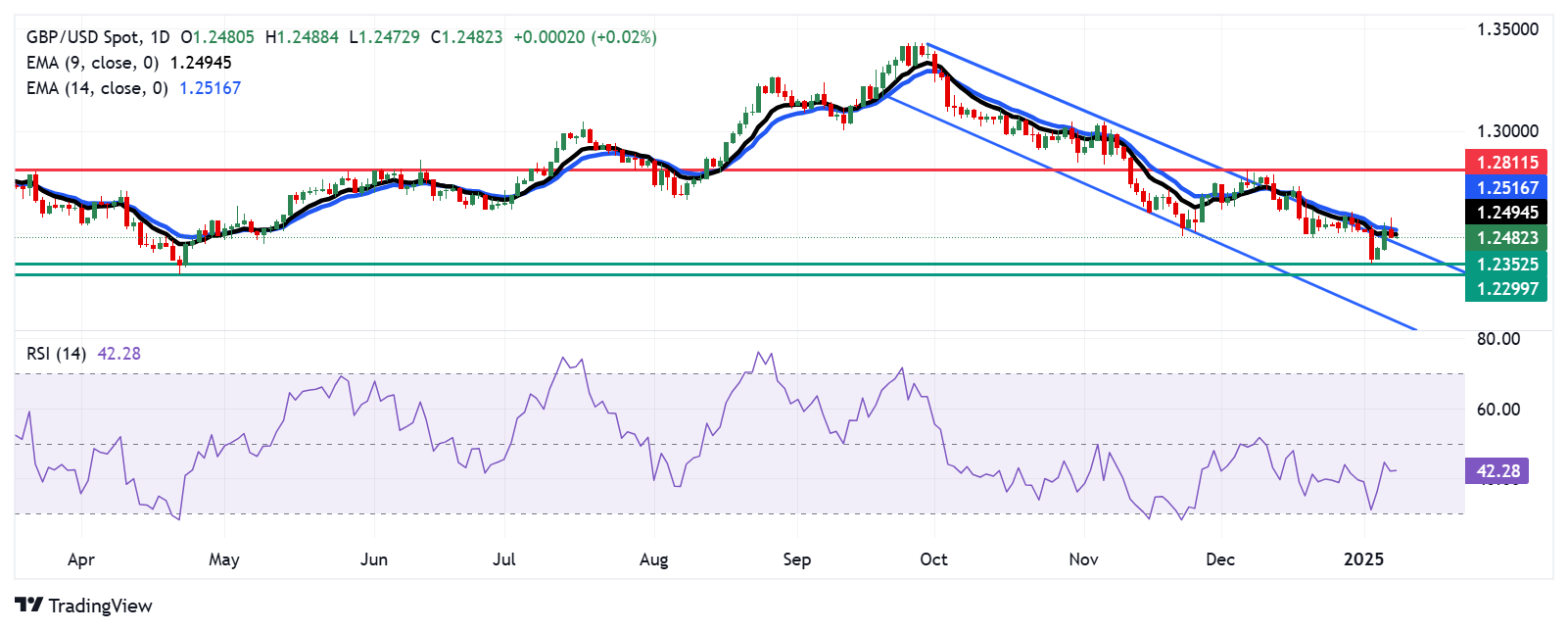
British Pound PRICE Today
The table below shows the percentage change of British Pound (GBP) against listed major currencies today. British Pound was the strongest against the Japanese Yen.
| USD | EUR | GBP | JPY | CAD | AUD | NZD | CHF | |
|---|---|---|---|---|---|---|---|---|
| USD | -0.04% | -0.01% | 0.24% | -0.07% | 0.05% | 0.05% | -0.00% | |
| EUR | 0.04% | 0.04% | 0.29% | -0.02% | 0.09% | 0.10% | 0.04% | |
| GBP | 0.00% | -0.04% | 0.26% | -0.06% | 0.04% | 0.06% | 0.00% | |
| JPY | -0.24% | -0.29% | -0.26% | -0.31% | -0.19% | -0.19% | -0.24% | |
| CAD | 0.07% | 0.02% | 0.06% | 0.31% | 0.11% | 0.12% | 0.06% | |
| AUD | -0.05% | -0.09% | -0.04% | 0.19% | -0.11% | 0.00% | -0.05% | |
| NZD | -0.05% | -0.10% | -0.06% | 0.19% | -0.12% | -0.01% | -0.06% | |
| CHF | 0.00% | -0.04% | -0.01% | 0.24% | -0.06% | 0.05% | 0.06% |
The heat map shows percentage changes of major currencies against each other. The base currency is picked from the left column, while the quote currency is picked from the top row. For example, if you pick the British Pound from the left column and move along the horizontal line to the US Dollar, the percentage change displayed in the box will represent GBP (base)/USD (quote).
- USD/CAD drifts lower on Wednesday and is pressured by a combination of factors.
- Bullish Crude Oil prices underpin the Loonie and weigh on the pair amid a softer USD.
- The Fed’s hawkish stance could help limit any further losses ahead of FOMC Minutes.
The USD/CAD pair struggles to capitalize on the previous day's bounce from sub-1.4300 levels and attracts some sellers during the Asian session on Wednesday. Spot prices, however, hold comfortably above the lowest level in over two weeks touched on Monday and currently trade around mid-1.4300s, less than 0.10% for the day.
As investors digest the recent political developments in Canada, hopes that Canada's economy could escape broad-based US tariffs turn out to be a key factor lending some support to the domestic currency. Furthermore, Crude Oil prices stand firm near a multi-month peak, which further seems to underpin the commodity-linked Loonie and exert some downward pressure on the USD/CAD pair amid a softer US Dollar (USD).
Any meaningful downside for the buck, however, seems limited amid the prospects for slower interest rate cuts by the Federal Reserve (Fed) in 2025. The bets were reaffirmed by Tuesday's upbeat US macro data, which pointed to a still resilience economy amid the optimism over US President-elect Donald Trump's expansionary policies. This remains supportive of elevated US Treasury bond yields and favors the USD bulls.
Apart from this, persistent geopolitical tensions stemming from the protracted Russia-Ukraine war and tensions in the Middle East, along with trade war fears, support prospects for the emergence of some dip-buying around the safe-haven buck. This, in turn, warrants some caution before placing aggressive bearish bets around the USD/CAD pair and positioning for an extension of the recent pullback from a multi-year peak.
Investors now look forward to the US economic docket – featuring the release of the ADP report on private-sector employment and the usual Weekly Initial Jobless Claims data – for some impetus later during the early North American session. The focus, however, will remain glued to the FOMC meeting Minutes, which will influence the USD price dynamics and produce some meaningful trading opportunities around the USD/CAD pair.
Canadian Dollar FAQs
The key factors driving the Canadian Dollar (CAD) are the level of interest rates set by the Bank of Canada (BoC), the price of Oil, Canada’s largest export, the health of its economy, inflation and the Trade Balance, which is the difference between the value of Canada’s exports versus its imports. Other factors include market sentiment – whether investors are taking on more risky assets (risk-on) or seeking safe-havens (risk-off) – with risk-on being CAD-positive. As its largest trading partner, the health of the US economy is also a key factor influencing the Canadian Dollar.
The Bank of Canada (BoC) has a significant influence on the Canadian Dollar by setting the level of interest rates that banks can lend to one another. This influences the level of interest rates for everyone. The main goal of the BoC is to maintain inflation at 1-3% by adjusting interest rates up or down. Relatively higher interest rates tend to be positive for the CAD. The Bank of Canada can also use quantitative easing and tightening to influence credit conditions, with the former CAD-negative and the latter CAD-positive.
The price of Oil is a key factor impacting the value of the Canadian Dollar. Petroleum is Canada’s biggest export, so Oil price tends to have an immediate impact on the CAD value. Generally, if Oil price rises CAD also goes up, as aggregate demand for the currency increases. The opposite is the case if the price of Oil falls. Higher Oil prices also tend to result in a greater likelihood of a positive Trade Balance, which is also supportive of the CAD.
While inflation had always traditionally been thought of as a negative factor for a currency since it lowers the value of money, the opposite has actually been the case in modern times with the relaxation of cross-border capital controls. Higher inflation tends to lead central banks to put up interest rates which attracts more capital inflows from global investors seeking a lucrative place to keep their money. This increases demand for the local currency, which in Canada’s case is the Canadian Dollar.
Macroeconomic data releases gauge the health of the economy and can have an impact on the Canadian Dollar. Indicators such as GDP, Manufacturing and Services PMIs, employment, and consumer sentiment surveys can all influence the direction of the CAD. A strong economy is good for the Canadian Dollar. Not only does it attract more foreign investment but it may encourage the Bank of Canada to put up interest rates, leading to a stronger currency. If economic data is weak, however, the CAD is likely to fall.
Gold prices fell in India on Wednesday, according to data compiled by FXStreet.
The price for Gold stood at 7,303.81 Indian Rupees (INR) per gram, down compared with the INR 7,313.69 it cost on Tuesday.
The price for Gold decreased to INR 85,189.29 per tola from INR 85,305.47 per tola a day earlier.
| Unit measure | Gold Price in INR |
|---|---|
| 1 Gram | 7,303.81 |
| 10 Grams | 73,037.31 |
| Tola | 85,189.29 |
| Troy Ounce | 227,184.50 |
FXStreet calculates Gold prices in India by adapting international prices (USD/INR) to the local currency and measurement units. Prices are updated daily based on the market rates taken at the time of publication. Prices are just for reference and local rates could diverge slightly.
Gold FAQs
Gold has played a key role in human’s history as it has been widely used as a store of value and medium of exchange. Currently, apart from its shine and usage for jewelry, the precious metal is widely seen as a safe-haven asset, meaning that it is considered a good investment during turbulent times. Gold is also widely seen as a hedge against inflation and against depreciating currencies as it doesn’t rely on any specific issuer or government.
Central banks are the biggest Gold holders. In their aim to support their currencies in turbulent times, central banks tend to diversify their reserves and buy Gold to improve the perceived strength of the economy and the currency. High Gold reserves can be a source of trust for a country’s solvency. Central banks added 1,136 tonnes of Gold worth around $70 billion to their reserves in 2022, according to data from the World Gold Council. This is the highest yearly purchase since records began. Central banks from emerging economies such as China, India and Turkey are quickly increasing their Gold reserves.
Gold has an inverse correlation with the US Dollar and US Treasuries, which are both major reserve and safe-haven assets. When the Dollar depreciates, Gold tends to rise, enabling investors and central banks to diversify their assets in turbulent times. Gold is also inversely correlated with risk assets. A rally in the stock market tends to weaken Gold price, while sell-offs in riskier markets tend to favor the precious metal.
The price can move due to a wide range of factors. Geopolitical instability or fears of a deep recession can quickly make Gold price escalate due to its safe-haven status. As a yield-less asset, Gold tends to rise with lower interest rates, while higher cost of money usually weighs down on the yellow metal. Still, most moves depend on how the US Dollar (USD) behaves as the asset is priced in dollars (XAU/USD). A strong Dollar tends to keep the price of Gold controlled, whereas a weaker Dollar is likely to push Gold prices up.
(An automation tool was used in creating this post.)
- Gold price struggles to attract buyers amid the Fed’s hawkish stance and elevated US bond yields.
- Trade war fears and geopolitical risks lend support to the XAU/USD amid a modest USD downtick.
- Investors look to the US macro data and FOMC meeting Minutes for some meaningful impetus.
Gold price (XAU/USD) stabilizes following the previous day's late pullback from the $2,665 hurdle as traders opt to move to the sidelines ahead of Wednesday's release of the FOMC Minutes later during the US session. In the meantime, the prospects for slower rate cuts by the Federal Reserve (Fed) continue to push the US Treasury bond yields higher and act as a headwind for the non-yielding yellow metal. Apart from this, the underlying strong US Dollar (USD) bullish tone turns out to be another factor that contributes to capping the commodity.
The downside for the Gold price, however, remains cushioned in the wake of the uncertainty around US President-elect Donald Trump's tariff plans. Furthermore, expectations that Trump's protectionist policies could reignite inflation should benefit the bullion's status as a hedge against rising prices. This, along with trade war fears, geopolitical risks and the risk-off mood, should continue to offer some support to the safe-haven precious metal and warrants some caution before placing aggressive bets or positioning for a firm intraday direction.
Gold price traders seem non-committed amid mixed fundamental cues
- The US Treasury bond yields and the US Dollar jumped on Tuesday after strong US data reaffirmed market expectations that the Federal Reserve will slow the pace of its rate-cutting cycle this year.
- The Institute for Supply Management reported that its Non-Manufacturing Purchasing Managers' Index (PMI) rose to 54.1 in December and the Prices Paid component rose to a nearly two-year high.
- Separately, the Job Openings and Labor Turnover Survey, or JOLTS report, showed that job openings unexpectedly increased to 8.098 million by the last day of November from the 7.839 million previous.
- The data pointed to a still resilient US economy and support prospects for fewer Fed rate cuts in 2025, lifting the yield on the benchmark 10-year US government bond to its highest level since April.
- Atlanta Fed President Raphael Bostic said that the central bank should be cautious with policy decisions amid the uneven progress on lowering inflation and err on the side of keeping rates elevated.
- US President-elect Donald Trump denied a Washington Post story that his administration will pursue a less aggressive tariff regime and target certain sectors critical to US national or economic security.
- Trump hinted at possible military intervention if Israeli captives held in Gaza are not released before he takes office, raising the risk of a further escalation of geopolitical tensions in the Middle East.
- Traders now look to Wednesday's US economic docket – featuring the release of the ADP report on private-sector employment and the usual Weekly Initial Jobless Claims – for short-term opportunities.
- The focus, however, remains on FOMC meeting Minutes, which will play a key role in influencing the USD price dynamics and providing a fresh impetus to the Gold price later during the US session.
Gold price bulls have the upper hand while above the $2,600 confluence
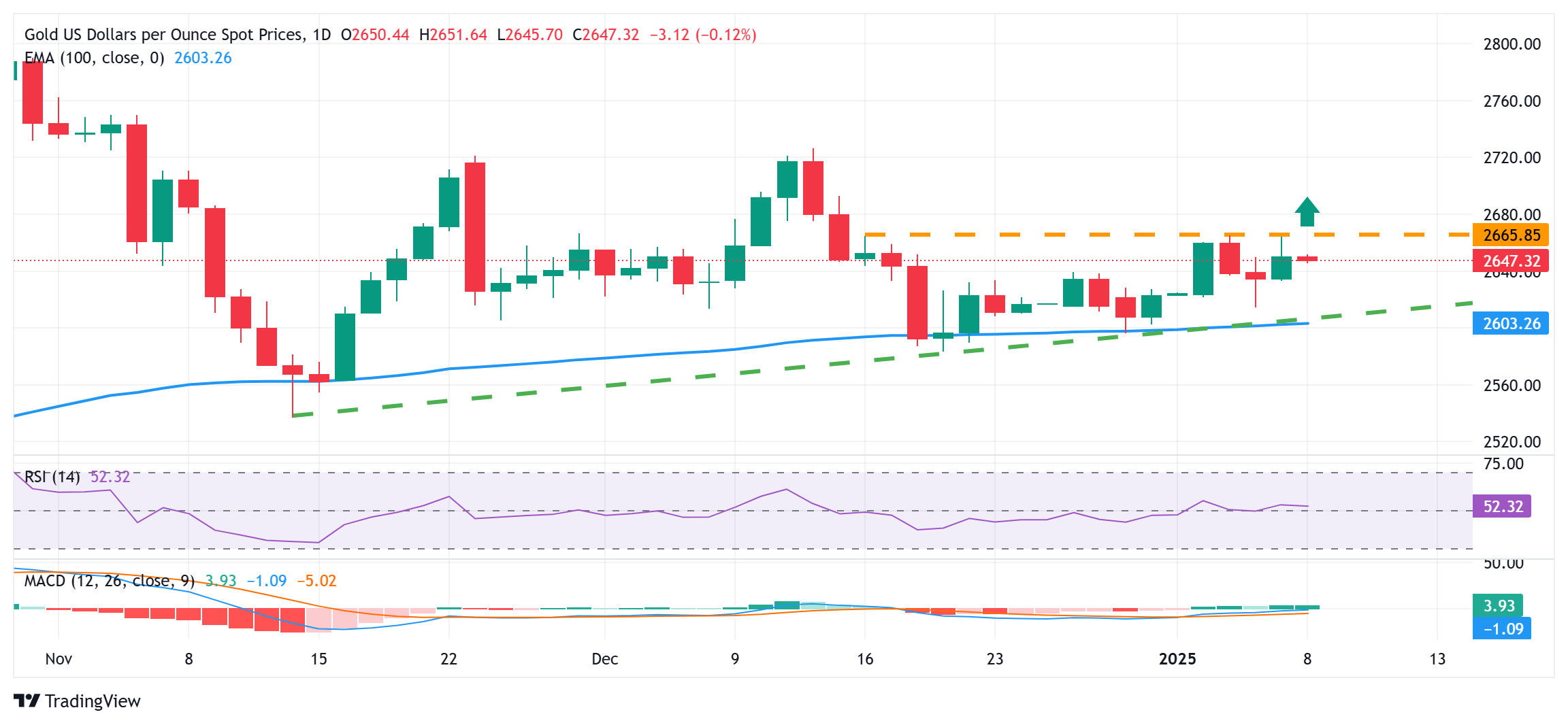
From a technical perspective, the $2,665 horizontal zone now seems to have emerged as an immediate strong barrier. Given that oscillators on the daily chart have just started moving in positive territory, a sustained strength beyond the said barrier will be seen as a fresh trigger for bulls and pave the way for additional gains. The subsequent move up might then lift the Gold price to an intermediate resistance near the $2,681-2,683 zone en route to the $2,700 mark.
On the flip side, weakness below the $2,635 area might continue to find some support near the weekly swing low, around the $2,615-2,614 region touched on Monday. This is followed by the $2,600 confluence, comprising the 100-day Exponential Moving Average (EMA) and a short-term ascending trend line extending from the November monthly trough. A convincing break below could expose the December swing low, around the $2,583 area, which if broken will shift the near-term bias in favor of bearish traders.
Gold FAQs
Gold has played a key role in human’s history as it has been widely used as a store of value and medium of exchange. Currently, apart from its shine and usage for jewelry, the precious metal is widely seen as a safe-haven asset, meaning that it is considered a good investment during turbulent times. Gold is also widely seen as a hedge against inflation and against depreciating currencies as it doesn’t rely on any specific issuer or government.
Central banks are the biggest Gold holders. In their aim to support their currencies in turbulent times, central banks tend to diversify their reserves and buy Gold to improve the perceived strength of the economy and the currency. High Gold reserves can be a source of trust for a country’s solvency. Central banks added 1,136 tonnes of Gold worth around $70 billion to their reserves in 2022, according to data from the World Gold Council. This is the highest yearly purchase since records began. Central banks from emerging economies such as China, India and Turkey are quickly increasing their Gold reserves.
Gold has an inverse correlation with the US Dollar and US Treasuries, which are both major reserve and safe-haven assets. When the Dollar depreciates, Gold tends to rise, enabling investors and central banks to diversify their assets in turbulent times. Gold is also inversely correlated with risk assets. A rally in the stock market tends to weaken Gold price, while sell-offs in riskier markets tend to favor the precious metal.
The price can move due to a wide range of factors. Geopolitical instability or fears of a deep recession can quickly make Gold price escalate due to its safe-haven status. As a yield-less asset, Gold tends to rise with lower interest rates, while higher cost of money usually weighs down on the yellow metal. Still, most moves depend on how the US Dollar (USD) behaves as the asset is priced in dollars (XAU/USD). A strong Dollar tends to keep the price of Gold controlled, whereas a weaker Dollar is likely to push Gold prices up.
- Silver price receives support due to uncertainty over the tariff policy ahead of the Trump administration.
- The industrial demand for Silver strengthens due to a positive economic outlook in China, the world's largest consumer of metals.
- The upside of the dollar-denominated metal could be restrained due to the improved US Dollar.
Silver price (XAG/USD) extends its winning streak for the fifth consecutive day, trading around $30.10 per troy ounce during the Asian hours on Wednesday. Silver, a safe-haven asset, found some support amid uncertainty over the tariff policy ahead of Trump's inauguration. However, Trump dismissed a Washington Post report suggesting that his team was considering narrowing the scope of his tariff plan to target only specific critical imports.
Additionally, a positive economic outlook in China, the world's largest consumer of Silver, is strengthening demand for the metal. The People’s Bank of China (PBoC) is working with the State Planner to stimulate the country's economy. PBoC official Peng Lifeng announced that the central bank will support banks in expanding loans under the trade-in initiative.
However, the price of the dollar-denominated precious metal may struggle as an improved US Dollar (USD) makes it more expensive for buyers using foreign currencies, thereby dampening Silver demand. The US Dollar Index (DXY), which measures the US Dollar’s (USD) performance against six major currencies, holds its position above 108.50 at the time of writing. The Greenback strengthened as the 10-year yield on US Treasury bonds rose by over 1% in the previous session, currently standing at 4.68%.
This surge highlights the changing investor sentiment toward the Federal Reserve's (Fed) interest rate outlook following robust US economic data. The latest ISM services report suggested increased activity and rising prices in the United States (US), intensifying concerns about persistent inflation. This has further pressured Silver price, as higher interest rates tend to reduce demand for the non-yielding metal. Traders are now focusing on upcoming US jobs data, including the Nonfarm Payroll (NFP) report, as well as the latest FOMC Minutes, for further policy insights.
The US ISM Services PMI increased to 54.1 in November, up from 52.1, exceeding the market expectation of 53.3. The Prices Paid Index, which reflects inflation, rose significantly to 64.4 from 58.2, while the Employment Index dipped slightly to 51.4 from 51.5.
Silver FAQs
Silver is a precious metal highly traded among investors. It has been historically used as a store of value and a medium of exchange. Although less popular than Gold, traders may turn to Silver to diversify their investment portfolio, for its intrinsic value or as a potential hedge during high-inflation periods. Investors can buy physical Silver, in coins or in bars, or trade it through vehicles such as Exchange Traded Funds, which track its price on international markets.
Silver prices can move due to a wide range of factors. Geopolitical instability or fears of a deep recession can make Silver price escalate due to its safe-haven status, although to a lesser extent than Gold's. As a yieldless asset, Silver tends to rise with lower interest rates. Its moves also depend on how the US Dollar (USD) behaves as the asset is priced in dollars (XAG/USD). A strong Dollar tends to keep the price of Silver at bay, whereas a weaker Dollar is likely to propel prices up. Other factors such as investment demand, mining supply – Silver is much more abundant than Gold – and recycling rates can also affect prices.
Silver is widely used in industry, particularly in sectors such as electronics or solar energy, as it has one of the highest electric conductivity of all metals – more than Copper and Gold. A surge in demand can increase prices, while a decline tends to lower them. Dynamics in the US, Chinese and Indian economies can also contribute to price swings: for the US and particularly China, their big industrial sectors use Silver in various processes; in India, consumers’ demand for the precious metal for jewellery also plays a key role in setting prices.
Silver prices tend to follow Gold's moves. When Gold prices rise, Silver typically follows suit, as their status as safe-haven assets is similar. The Gold/Silver ratio, which shows the number of ounces of Silver needed to equal the value of one ounce of Gold, may help to determine the relative valuation between both metals. Some investors may consider a high ratio as an indicator that Silver is undervalued, or Gold is overvalued. On the contrary, a low ratio might suggest that Gold is undervalued relative to Silver.
The Indian Rupee trades flat in Wednesday’s Asian session.
The USD sales help ease the INR’s pressure, but an unabated outflow of foreign capital could weigh on the INR.
Investors await the FOMC Minutes due later today.
The Indian Rupee (INR) holds steady on Wednesday after posting its biggest one-day gain in over a month in the previous session. The heavy US Dollar (USD) sales by foreign banks help ease the INR’s pressure. However, the local currency remains fragile amid the persistent outflows and higher crude oil prices. Additionally, geopolitical tensions and downside risks to India’s growth projections might drag the INR lower against the USD.
Investors will closely monitor the development surrounding the incoming US administration under Donald Trump’s tariff plan. Looking ahead, the Federal Open Market Committee (FOMC) Minutes are due later on Wednesday. The US December labor market data will be the highlight on Friday. Economists expect 154,000 new jobs for December, while the unemployment rate is expected to remain at 4.2% during the same report period. These reports will give further cues on the interest rate trajectory of the US Federal Reserve (Fed).
Indian Rupee steadies amid ongoing uncertainty on US tariffs
- India's economy is estimated to slow significantly in FY25, with the first advance estimate revealing a real GDP growth rate of 6.4%, down from 8.2% in FY24.
- “As the dollar index fell, the Indian rupee gained up to 85.65 during the day before dollar buying from importers and oil companies pushed the rupee to 85.72/$1 levels,” said Anil Bhansali, head of treasury, Finrex Treasury Advisors.
- The RBI’s interventions in the foreign exchange market have drawn down reserves by $65 billion since their September 2024 peak to manage depreciation.
- The US Services PMI rose to 54.1 in December from 52.1 in November, according to the Institute for Supply Management (ISM) on Tuesday. This reading came in above the market consensus of 53.3.
- US JOLTS Job Openings increased to 8.09 million in November versus 7.83 million prior. The market expected 7.7 million Job Openings in November.
- Atlanta Fed President Raphael Bostic stated that the Fed officials should be cautious with policy decisions given uneven progress on lowering inflation and err on the side of keeping interest rates elevated to achieve their price stability goal, per Reuters.
- According to the CME FedWatch tool, the markets have priced in nearly a 93.5% possibility that the Fed will hold the rate steady this month.
USD/INR maintains a positive picture, but an overbought RSI warrants caution for bulls
The Indian Rupee trades flat on the day. The constructive view of the USD/INR pair prevails, with the price holding above the key 100-day Exponential Moving Average (EMA) on the daily chart. However, further consolidation cannot be ruled out before positioning for any near-term USD/INR appreciation as the 14-day Relative Strength Index (RSI) stands near 79.60, indicating an overbought condition.
The all-time high of 85.84 acts as an immediate resistance level for USD/INR. If the pair prints bullish candlesticks and sustainably breaks above the mentioned level, it could draw in technical buyers and pave the way to the 86.00 psychological mark.
On the other hand, the first downside target to watch is 85.60, the low of January 6. Sustained trading below this level could drag the pair back down to 85.00, followed by 84.48, the 100-day EMA.
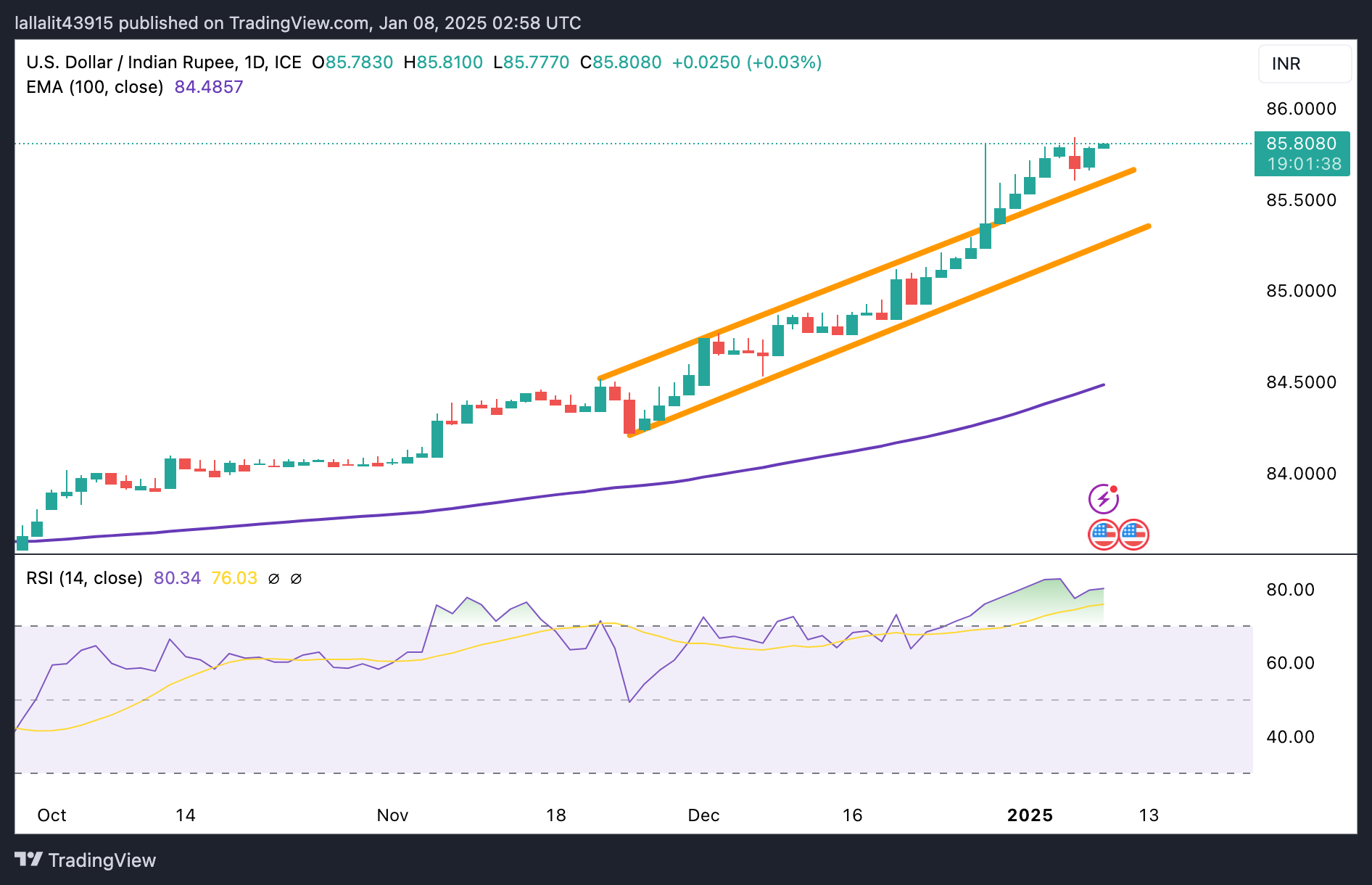
Indian Rupee FAQs
The Indian Rupee (INR) is one of the most sensitive currencies to external factors. The price of Crude Oil (the country is highly dependent on imported Oil), the value of the US Dollar – most trade is conducted in USD – and the level of foreign investment, are all influential. Direct intervention by the Reserve Bank of India (RBI) in FX markets to keep the exchange rate stable, as well as the level of interest rates set by the RBI, are further major influencing factors on the Rupee.
The Reserve Bank of India (RBI) actively intervenes in forex markets to maintain a stable exchange rate, to help facilitate trade. In addition, the RBI tries to maintain the inflation rate at its 4% target by adjusting interest rates. Higher interest rates usually strengthen the Rupee. This is due to the role of the ‘carry trade’ in which investors borrow in countries with lower interest rates so as to place their money in countries’ offering relatively higher interest rates and profit from the difference.
Macroeconomic factors that influence the value of the Rupee include inflation, interest rates, the economic growth rate (GDP), the balance of trade, and inflows from foreign investment. A higher growth rate can lead to more overseas investment, pushing up demand for the Rupee. A less negative balance of trade will eventually lead to a stronger Rupee. Higher interest rates, especially real rates (interest rates less inflation) are also positive for the Rupee. A risk-on environment can lead to greater inflows of Foreign Direct and Indirect Investment (FDI and FII), which also benefit the Rupee.
Higher inflation, particularly, if it is comparatively higher than India’s peers, is generally negative for the currency as it reflects devaluation through oversupply. Inflation also increases the cost of exports, leading to more Rupees being sold to purchase foreign imports, which is Rupee-negative. At the same time, higher inflation usually leads to the Reserve Bank of India (RBI) raising interest rates and this can be positive for the Rupee, due to increased demand from international investors. The opposite effect is true of lower inflation.
| Raw materials | Closed | Change, % |
|---|---|---|
| Silver | 30.02 | 0.27 |
| Gold | 2647.96 | 0.46 |
| Palladium | 927.43 | 0.39 |
- AUD/JPY faced challenges as Australia’s trimmed mean fell to RBA’s target band of 2% to 3%.
- Australia's monthly Consumer Price Index increased by 2.3% YoY in November, the highest level recorded since August.
- Former BoJ Governor Haruhiko Kuroda forecasted additional interest rate hikes in the years ahead.
AUD/JPY recovers its small daily losses, trading around 98.40 during the Asian session on Wednesday. However, the Australian Dollar (AUD) faces challenges against its peers following the release of the monthly inflation data. Australia’s trimmed mean, a closely watched measure of core inflation, fell to an annual 3.2% from 3.5%, edging closer to the Reserve Bank of Australia's (RBA) target band of 2% to 3%.
However, Australia’s monthly Consumer Price Index (CPI) rose 2.3% year-over-year in November, surpassing the market forecast of 2.2% and marking an increase from the 2.1% rise seen in the previous two months. This is the highest reading since August. The figure remains within the RBA’s target range of 2–3% for the fourth consecutive month, aided by the ongoing impact of the Energy Bill Relief Fund rebate.
The Japanese Yen (JPY) strengthens on concerns about potential intervention by Japanese authorities in the open market. However, uncertainty surrounding the timing of the Bank of Japan's (BoJ) next rate hike may limit the JPY's gains.
Former Bank of Japan (BoJ) Governor Haruhiko Kuroda presented a research paper on Wednesday, forecasting additional interest rate hikes in the years ahead. Kuroda highlighted that Japan's economy is expected to grow at an annual rate of over 1%, driven by increasing real wages and robust consumer spending. The BoJ's cautious pace in raising rates aligns with a positive wage-inflation cycle, which helps maintain inflation at the 2% target.
Inflation FAQs
Inflation measures the rise in the price of a representative basket of goods and services. Headline inflation is usually expressed as a percentage change on a month-on-month (MoM) and year-on-year (YoY) basis. Core inflation excludes more volatile elements such as food and fuel which can fluctuate because of geopolitical and seasonal factors. Core inflation is the figure economists focus on and is the level targeted by central banks, which are mandated to keep inflation at a manageable level, usually around 2%.
The Consumer Price Index (CPI) measures the change in prices of a basket of goods and services over a period of time. It is usually expressed as a percentage change on a month-on-month (MoM) and year-on-year (YoY) basis. Core CPI is the figure targeted by central banks as it excludes volatile food and fuel inputs. When Core CPI rises above 2% it usually results in higher interest rates and vice versa when it falls below 2%. Since higher interest rates are positive for a currency, higher inflation usually results in a stronger currency. The opposite is true when inflation falls.
Although it may seem counter-intuitive, high inflation in a country pushes up the value of its currency and vice versa for lower inflation. This is because the central bank will normally raise interest rates to combat the higher inflation, which attract more global capital inflows from investors looking for a lucrative place to park their money.
Formerly, Gold was the asset investors turned to in times of high inflation because it preserved its value, and whilst investors will often still buy Gold for its safe-haven properties in times of extreme market turmoil, this is not the case most of the time. This is because when inflation is high, central banks will put up interest rates to combat it. Higher interest rates are negative for Gold because they increase the opportunity-cost of holding Gold vis-a-vis an interest-bearing asset or placing the money in a cash deposit account. On the flipside, lower inflation tends to be positive for Gold as it brings interest rates down, making the bright metal a more viable investment alternative.
- The Japanese Yen continues to be undermined by the BoJ rate-hike uncertainty.
- The widening US-Japan yield differential further weighs on the lower-yielding JPY.
- The Fed’s hawkish stance acts as a tailwind for the USD and the USD/JPY pair.
The Japanese Yen (JPY) languishes near a six-month low against its American counterpart and seems vulnerable to prolonging a one-month-old downtrend amid uncertainty about the timing of the next rate hike by the Bank of Japan (BoJ). Adding to this, the recent widening of the US-Japan yield differential, bolstered by reduced bets for further rate cuts by the Federal Reserve (Fed), validates the near-term negative outlook for the lower-yielding JPY. That said, a combination of factors might hold back the JPY bears from placing fresh bets.
Japan’s Finance Minister Katsunobu Kato weighed in with some verbal intervention on Tuesday. This, along with concerns about US President-elect Donald Trump's tariff plans, geopolitical risks and the cautious market mood, could offer some support to the safe-haven JPY. Investors might also prefer to wait for the release of the FOMC meeting Minutes. In the meantime, the Fed's hawkish outlook remains supportive of the underlying US Dollar (USD) bullish tone, which assists the USD/JPY pair to hold steady above the 158.00 mark.
Japanese Yen bears retain control amid doubts over the timing of the next BoJ rate hike
- The Bank of Japan has kept markets guessing on how soon it could hike interest rates again, which continued to undermine the Japanese Yen and lifted the USD/JPY pair to a near six-month high on Tuesday.
- BoJ Governor Kazuo Ueda said on Monday that the central bank will raise interest rates further if the economy continues to improve, though the timing depends on economic, price and financial developments.
- Some investors are betting on the possibility of a BoJ rate hike at the January 23-24 meeting amid the broadening inflationary pressures in Japan, while others see a stronger chance of a move in March or beyond.
- The yield on the benchmark 10-year Japanese government bond (JGB) rose to its highest level since July 2011, though it failed to provide any respite to the JPY bulls amid the widening US-Japan yield differential.
- The US Treasury yields extended the recent uptrend after data released on Tuesday pointed to a resilient economy, suggesting that the Federal Reserve could cut interest rates fewer times this year than expected.
- The Institute for Supply Management reported that its Non-Manufacturing Purchasing Managers' Index (PMI) rose to 54.1 in December and the Prices Paid component rose to the highest since September 2023.
- Separately, the Job Openings and Labor Turnover Survey (JOLTS) showed that the number of job openings on the last business day of November stood at 8.09 million, up from the 7.83 million reported in October.
- The data was consistent with a strong pace of economic activity, which, along with US President-elect Donald Trump's policies, could reignite inflationary pressures and cast doubt on further rate cuts by the Fed.
- Traders now look forward to the US economic docket – featuring the release of the ADP report on private-sector employment and the usual Weekly Initial Jobless Claims data – for short-term opportunities.
- The focus, however, will remain glued to the FOMC meeting Minutes, due later during the US session, which should influence the US Dollar (USD) ahead of the closely-watched US Nonfarm Payrolls report on Friday.
USD/JPY seems poised to appreciate further; the 157.00 mark holds the key for bulls
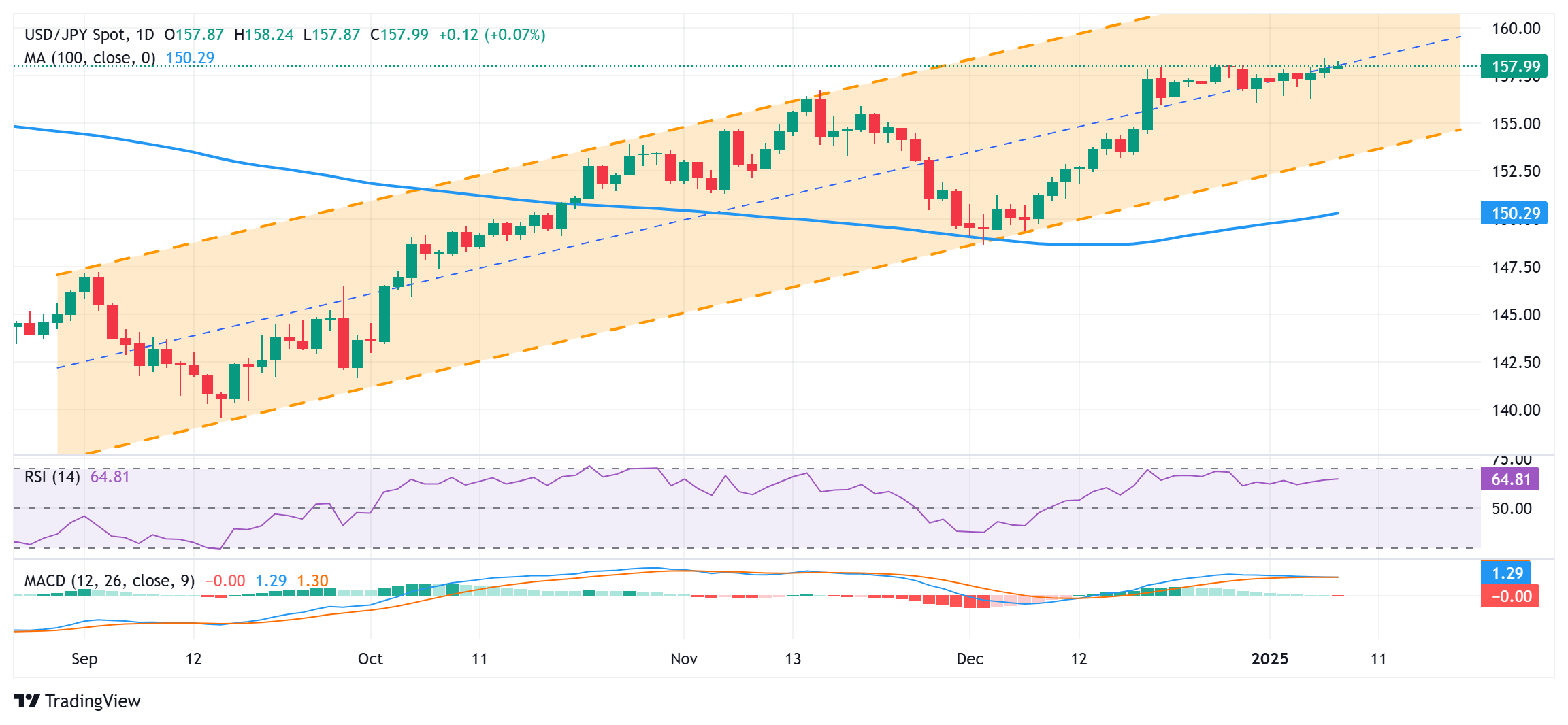
From a technical perspective, acceptance above the 158.00 round figure, along with positive oscillators on the daily chart, favor bulls for additional gains. Hence, a subsequent strength towards the 159.00 mark, en route to the 159.45 intermediate hurdle and the 160.00 psychological mark, looks like a distinct possibility.
On the flip side, the 157.60 area now seems to protect the immediate downside ahead of the 157.35-157.30 zone and the 157.00 mark. The latter should act as a pivotal point, below which the USD/JPY pair could slide to the 156.25 intermediate support en route to the 156.00 mark. Some follow-through selling might negate the positive bias and pave the way for a deeper corrective decline.
Japanese Yen FAQs
The Japanese Yen (JPY) is one of the world’s most traded currencies. Its value is broadly determined by the performance of the Japanese economy, but more specifically by the Bank of Japan’s policy, the differential between Japanese and US bond yields, or risk sentiment among traders, among other factors.
One of the Bank of Japan’s mandates is currency control, so its moves are key for the Yen. The BoJ has directly intervened in currency markets sometimes, generally to lower the value of the Yen, although it refrains from doing it often due to political concerns of its main trading partners. The BoJ ultra-loose monetary policy between 2013 and 2024 caused the Yen to depreciate against its main currency peers due to an increasing policy divergence between the Bank of Japan and other main central banks. More recently, the gradually unwinding of this ultra-loose policy has given some support to the Yen.
Over the last decade, the BoJ’s stance of sticking to ultra-loose monetary policy has led to a widening policy divergence with other central banks, particularly with the US Federal Reserve. This supported a widening of the differential between the 10-year US and Japanese bonds, which favored the US Dollar against the Japanese Yen. The BoJ decision in 2024 to gradually abandon the ultra-loose policy, coupled with interest-rate cuts in other major central banks, is narrowing this differential.
The Japanese Yen is often seen as a safe-haven investment. This means that in times of market stress, investors are more likely to put their money in the Japanese currency due to its supposed reliability and stability. Turbulent times are likely to strengthen the Yen’s value against other currencies seen as more risky to invest in.
Former Bank of Japan (BoJ) Governor Haruhiko Kuroda presented a research paper on Wednesday, predicting more interest rate hikes over the coming years.
Key takeaways
Japan's economy is projected to grow by over 1% annually, supported by rising real wages and consumer spending.
The BoJ's gradual approach to rate hikes reflects the positive wage-inflation cycle that keeps inflation stable at the 2% target.
Higher borrowing costs are unlikely to significantly impact businesses or households due to corporate cash reserves and household savings. However, the government could face challenges funding Japan's large public debt, which has grown to ¥1,100 trillion ($6.96 trillion).
A return to bond yields of 2.7% (seen in 2000) could raise annual interest payments to ¥30 trillion, stressing the need for fiscal reform.
Bank of Japan FAQs
The Bank of Japan (BoJ) is the Japanese central bank, which sets monetary policy in the country. Its mandate is to issue banknotes and carry out currency and monetary control to ensure price stability, which means an inflation target of around 2%.
The Bank of Japan embarked in an ultra-loose monetary policy in 2013 in order to stimulate the economy and fuel inflation amid a low-inflationary environment. The bank’s policy is based on Quantitative and Qualitative Easing (QQE), or printing notes to buy assets such as government or corporate bonds to provide liquidity. In 2016, the bank doubled down on its strategy and further loosened policy by first introducing negative interest rates and then directly controlling the yield of its 10-year government bonds. In March 2024, the BoJ lifted interest rates, effectively retreating from the ultra-loose monetary policy stance.
The Bank’s massive stimulus caused the Yen to depreciate against its main currency peers. This process exacerbated in 2022 and 2023 due to an increasing policy divergence between the Bank of Japan and other main central banks, which opted to increase interest rates sharply to fight decades-high levels of inflation. The BoJ’s policy led to a widening differential with other currencies, dragging down the value of the Yen. This trend partly reversed in 2024, when the BoJ decided to abandon its ultra-loose policy stance.
A weaker Yen and the spike in global energy prices led to an increase in Japanese inflation, which exceeded the BoJ’s 2% target. The prospect of rising salaries in the country – a key element fuelling inflation – also contributed to the move.
- WTI price gains traction to near $74.15 in Wednesday’s Asian session.
- US crude oil inventories fell by 4.022 million barrels last week, according to the API.
- Oil traders brace for the FOMC Minutes on Wednesday ahead of the US December NFP report.
West Texas Intermediate (WTI), the US crude oil benchmark, is trading around $74.15 on Wednesday. The WTI price edges higher amid expected higher Chinese demand and a larger drop in US crude stocks.
A large drop in US crude inventories last week provides some support to the WTI. The API weekly report showed crude oil stockpiles in the United States for the week ending January 3 fell by 4.022 million barrels, compared to a decline of 1.442 million barrels in the previous week. The market consensus estimated that stocks would decrease by 250,000 barrels. Furthermore, the escalating geopolitical tensions in the Middle East and ongoing Russia-Ukraine conflicts could boost the WTI price in the near term.
On Tuesday, the National Development and Reform Commission (NDRC), China's top economic planner, issued a guideline for building a unified national market, breaking down market barriers to boost domestic demand while enhancing openness. The positive development surrounding the Chinese stimulus measure could boost the black gold price as China is the world's second-largest economy.
”While the market is currently range-bound, it is recording gains on the back of improved demand expectations fuelled by holiday traffic and China’s economic pledges," Hilal said in a morning note. "However, the primary trend remains bearish.”
Looking ahead, Oil traders will keep an eye on the Minutes of the Federal Open Market Committee (FOMC), which is due later on Wednesday. On Friday, the US employment data for December will be in the spotlight. Economists expect 154,000 new jobs for December, while the unemployment rate is expected to remain at 4.2% during the same report period. In case of a stronger-than-expecetd outcome, this could lift the Greenback and weigh on the USD-denominated commodity price in the near term.
Gold FAQs
Gold has played a key role in human’s history as it has been widely used as a store of value and medium of exchange. Currently, apart from its shine and usage for jewelry, the precious metal is widely seen as a safe-haven asset, meaning that it is considered a good investment during turbulent times. Gold is also widely seen as a hedge against inflation and against depreciating currencies as it doesn’t rely on any specific issuer or government.
Central banks are the biggest Gold holders. In their aim to support their currencies in turbulent times, central banks tend to diversify their reserves and buy Gold to improve the perceived strength of the economy and the currency. High Gold reserves can be a source of trust for a country’s solvency. Central banks added 1,136 tonnes of Gold worth around $70 billion to their reserves in 2022, according to data from the World Gold Council. This is the highest yearly purchase since records began. Central banks from emerging economies such as China, India and Turkey are quickly increasing their Gold reserves.
Gold has an inverse correlation with the US Dollar and US Treasuries, which are both major reserve and safe-haven assets. When the Dollar depreciates, Gold tends to rise, enabling investors and central banks to diversify their assets in turbulent times. Gold is also inversely correlated with risk assets. A rally in the stock market tends to weaken Gold price, while sell-offs in riskier markets tend to favor the precious metal.
The price can move due to a wide range of factors. Geopolitical instability or fears of a deep recession can quickly make Gold price escalate due to its safe-haven status. As a yield-less asset, Gold tends to rise with lower interest rates, while higher cost of money usually weighs down on the yellow metal. Still, most moves depend on how the US Dollar (USD) behaves as the asset is priced in dollars (XAU/USD). A strong Dollar tends to keep the price of Gold controlled, whereas a weaker Dollar is likely to push Gold prices up.
- The Australian Dollar holds losses following stronger-than-expected domestic monthly inflation released on Wednesday.
- Australia's monthly Consumer Price Index increased by 2.3% YoY in November, the highest level recorded since August.
- The US Dollar appreciated as the 10-year yield on US Treasury bonds rose by over 1% on Tuesday.
The Australian Dollar (AUD) remains subdued for the second consecutive session against the US Dollar (USD), with the AUD/USD pair holding losses despite stronger-than-expected monthly inflation data released on Wednesday. However, the trimmed mean, a closely watched measure of core inflation, fell to an annual 3.2% from 3.5%, edging closer to the Reserve Bank of Australia's (RBA) target band of 2% to 3%.
Australia's monthly Consumer Price Index (CPI) rose 2.3% year-over-year in November, surpassing the market forecast of 2.2% and marking an increase from the 2.1% rise seen in the previous two months. This is the highest reading since August. However, the figure remains within the RBA’s target range of 2–3% for the fourth consecutive month, aided by the ongoing impact of the Energy Bill Relief Fund rebate.
Traders are currently pricing in a 55% probability that the RBA will lower its cash rate by 25 basis points to 4.35% in February, with a full quarter-point cut expected by April.
Australian Bureau of Statistics reported on Tuesday that permits for new construction projects in Australia dropped by 3.6% month-on-month to 14,998 units in November 2024, falling short of market expectations for a 1.0% decline. This downturn followed an upwardly revised 5.2% increase in October, marking the first decrease in three months.
Australian Dollar declines due to hawkish shift in Fed’s rate trajectory
- The US Dollar Index (DXY), which measures the US Dollar’s (USD) performance against six major currencies, holds its position above 108.50 at the time of writing.
- The US Dollar strengthened as the 10-year yield on US Treasury bonds rose by over 1% in the previous session, currently standing at 4.67%. This spike is a stark reminder of the shifting investor sentiment regarding the Federal Reserve's interest rate trajectory.
- The US ISM Services PMI increased to 54.1 in November, up from 52.1, exceeding the market expectation of 53.3. The Prices Paid Index, which reflects inflation, rose significantly to 64.4 from 58.2, while the Employment Index dipped slightly to 51.4 from 51.5.
- The US ISM Manufacturing PMI improved to 49.3 in December, from 48.4 in November. This reading came in better than the market expectation of 48.4.
- According to Bloomberg, Federal Reserve Bank of Atlanta President Raphael Bostic stated on Tuesday that Fed officials should exercise caution with policy decisions due to uneven progress in reducing inflation. Bostic emphasized the need to lean toward keeping interest rates elevated to ensure the achievement of price stability goals.
- Richmond Fed President Thomas Barkin highlighted on Friday that the benchmark policy rate should remain restrictive until there is greater confidence that inflation will return to the 2% target.
- Fed Governor Adriana Kugler and San Francisco Fed President Mary Daly underscored the challenging balancing act facing US central bankers as they aim to slow the pace of monetary easing this year.
- Traders are cautious regarding President-elect Trump’s economic policies, fearing that tariffs could increase the cost of living. These concerns were compounded by the Federal Open Market Committee’s (FOMC) recent projections, which indicated fewer rate cuts in 2025, reflecting caution amid persistent inflationary pressures.
Technical Analysis: Australian Dollar moves below nine-day EMA toward 0.6200
AUD/USD trades near 0.6210 on Wednesday, maintaining its bearish outlook as it remains confined within a descending channel on the daily chart. The 14-day Relative Strength Index (RSI) retreats toward the 30 level, signaling a potential intensification of bearish momentum.
On the downside, the AUD/USD pair may navigate the region around the lower boundary of the descending channel, at the 0.5990 level.
The AUD/USD pair may test the immediate resistance around the nine-day Exponential Moving Average (EMA) at 0.6224, followed by the 14-day EMA at 0.6239. Further barrier appears around the upper boundary of the descending channel, at 0.6270 level.
AUD/USD: Daily Chart
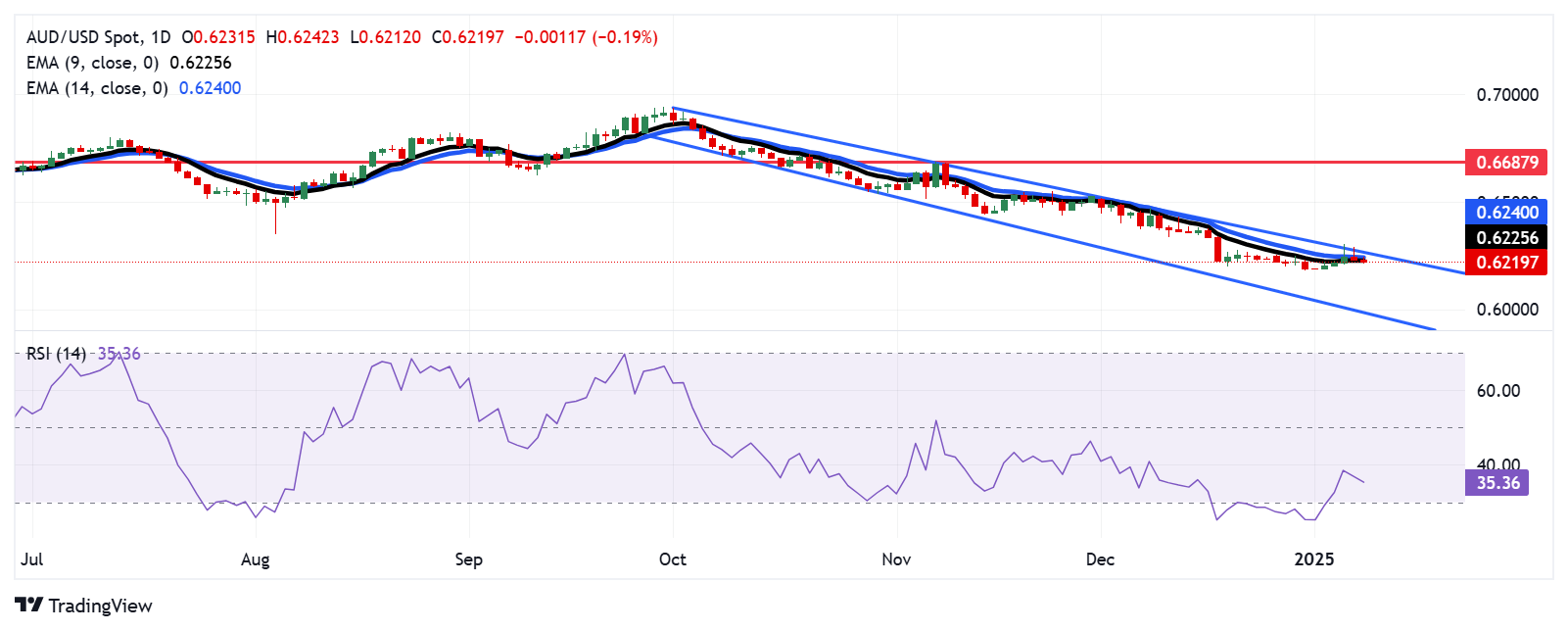
Australian Dollar PRICE Today
The table below shows the percentage change of Australian Dollar (AUD) against listed major currencies today. Australian Dollar was the weakest against the Canadian Dollar.
| USD | EUR | GBP | JPY | CAD | AUD | NZD | CHF | |
|---|---|---|---|---|---|---|---|---|
| USD | -0.05% | -0.01% | 0.09% | -0.05% | 0.21% | 0.09% | -0.01% | |
| EUR | 0.05% | 0.05% | 0.13% | 0.00% | 0.26% | 0.15% | 0.04% | |
| GBP | 0.00% | -0.05% | 0.12% | -0.05% | 0.21% | 0.10% | -0.00% | |
| JPY | -0.09% | -0.13% | -0.12% | -0.15% | 0.11% | -0.01% | -0.11% | |
| CAD | 0.05% | -0.00% | 0.05% | 0.15% | 0.26% | 0.15% | 0.04% | |
| AUD | -0.21% | -0.26% | -0.21% | -0.11% | -0.26% | -0.12% | -0.22% | |
| NZD | -0.09% | -0.15% | -0.10% | 0.01% | -0.15% | 0.12% | -0.10% | |
| CHF | 0.01% | -0.04% | 0.00% | 0.11% | -0.04% | 0.22% | 0.10% |
The heat map shows percentage changes of major currencies against each other. The base currency is picked from the left column, while the quote currency is picked from the top row. For example, if you pick the Australian Dollar from the left column and move along the horizontal line to the US Dollar, the percentage change displayed in the box will represent AUD (base)/USD (quote).
Australian Dollar FAQs
One of the most significant factors for the Australian Dollar (AUD) is the level of interest rates set by the Reserve Bank of Australia (RBA). Because Australia is a resource-rich country another key driver is the price of its biggest export, Iron Ore. The health of the Chinese economy, its largest trading partner, is a factor, as well as inflation in Australia, its growth rate and Trade Balance. Market sentiment – whether investors are taking on more risky assets (risk-on) or seeking safe-havens (risk-off) – is also a factor, with risk-on positive for AUD.
The Reserve Bank of Australia (RBA) influences the Australian Dollar (AUD) by setting the level of interest rates that Australian banks can lend to each other. This influences the level of interest rates in the economy as a whole. The main goal of the RBA is to maintain a stable inflation rate of 2-3% by adjusting interest rates up or down. Relatively high interest rates compared to other major central banks support the AUD, and the opposite for relatively low. The RBA can also use quantitative easing and tightening to influence credit conditions, with the former AUD-negative and the latter AUD-positive.
China is Australia’s largest trading partner so the health of the Chinese economy is a major influence on the value of the Australian Dollar (AUD). When the Chinese economy is doing well it purchases more raw materials, goods and services from Australia, lifting demand for the AUD, and pushing up its value. The opposite is the case when the Chinese economy is not growing as fast as expected. Positive or negative surprises in Chinese growth data, therefore, often have a direct impact on the Australian Dollar and its pairs.
Iron Ore is Australia’s largest export, accounting for $118 billion a year according to data from 2021, with China as its primary destination. The price of Iron Ore, therefore, can be a driver of the Australian Dollar. Generally, if the price of Iron Ore rises, AUD also goes up, as aggregate demand for the currency increases. The opposite is the case if the price of Iron Ore falls. Higher Iron Ore prices also tend to result in a greater likelihood of a positive Trade Balance for Australia, which is also positive of the AUD.
The Trade Balance, which is the difference between what a country earns from its exports versus what it pays for its imports, is another factor that can influence the value of the Australian Dollar. If Australia produces highly sought after exports, then its currency will gain in value purely from the surplus demand created from foreign buyers seeking to purchase its exports versus what it spends to purchase imports. Therefore, a positive net Trade Balance strengthens the AUD, with the opposite effect if the Trade Balance is negative.
On Wednesday, the People’s Bank of China (PBoC) set the USD/CNY central rate for the trading session ahead at 7.1887 as compared to the previous day's fix of 7.1879 and 7.3435 Reuters estimates.
- USD/CAD trades with a mild positive bias around 1.4360 in Wednesday’s early Asian session.
- Stronger US economic data and the Fed's cautious stance underpin the US Dollar.
- Trudeau intended to step down from the leader of Canada’s ruling Liberal Party once a new party leader is chosen.
The USD/CAD pair posts modest gains near 1.4360 during the early Asian session on Wednesday. Investors digest the announcement that Canadian Prime Minister Justin Trudeau would resign and await fresh catalysts about the severity of expected US trade tariffs. Later on Wednesday, the Minutes of the Federal Open Market Committee (FOMC) will take center stage.
The US economic data released on Tuesday showed a generally stable jobs market and a robust services sector. The reports might convince the US Federal Reserve (Fed) to slow the pace of its current rate-cutting cycle, which provides some support to the Greenback.
Furthermore, the cautious stance of the Fed officials might contribute to the USD’s upside. On Tuesday, Atlanta Fed President Raphael Bostic said that the policymakers should be cautious with policy decisions given uneven progress on lowering inflation and err on the side of keeping interest rates elevated to achieve their price stability target. The markets have priced in nearly a 93.5% possibility that the Fed will hold rate steady this month, according to the CME FedWatch tool.
Canadian Prime Minister Justin Trudeau announced his resignation on Monday, saying he intended to step down from the leader of Canada’s ruling Liberal Party once a new party leader is chosen. A Canadian election may take place in the spring and must be held on October 20, with polls indicating that the opposition Conservatives will win. "A change in leadership in Canada is not a long-term negative for the loonie," said Amo Sahota, executive director of Klarity FX in San Francisco.
Canadian Dollar FAQs
The key factors driving the Canadian Dollar (CAD) are the level of interest rates set by the Bank of Canada (BoC), the price of Oil, Canada’s largest export, the health of its economy, inflation and the Trade Balance, which is the difference between the value of Canada’s exports versus its imports. Other factors include market sentiment – whether investors are taking on more risky assets (risk-on) or seeking safe-havens (risk-off) – with risk-on being CAD-positive. As its largest trading partner, the health of the US economy is also a key factor influencing the Canadian Dollar.
The Bank of Canada (BoC) has a significant influence on the Canadian Dollar by setting the level of interest rates that banks can lend to one another. This influences the level of interest rates for everyone. The main goal of the BoC is to maintain inflation at 1-3% by adjusting interest rates up or down. Relatively higher interest rates tend to be positive for the CAD. The Bank of Canada can also use quantitative easing and tightening to influence credit conditions, with the former CAD-negative and the latter CAD-positive.
The price of Oil is a key factor impacting the value of the Canadian Dollar. Petroleum is Canada’s biggest export, so Oil price tends to have an immediate impact on the CAD value. Generally, if Oil price rises CAD also goes up, as aggregate demand for the currency increases. The opposite is the case if the price of Oil falls. Higher Oil prices also tend to result in a greater likelihood of a positive Trade Balance, which is also supportive of the CAD.
While inflation had always traditionally been thought of as a negative factor for a currency since it lowers the value of money, the opposite has actually been the case in modern times with the relaxation of cross-border capital controls. Higher inflation tends to lead central banks to put up interest rates which attracts more capital inflows from global investors seeking a lucrative place to keep their money. This increases demand for the local currency, which in Canada’s case is the Canadian Dollar.
Macroeconomic data releases gauge the health of the economy and can have an impact on the Canadian Dollar. Indicators such as GDP, Manufacturing and Services PMIs, employment, and consumer sentiment surveys can all influence the direction of the CAD. A strong economy is good for the Canadian Dollar. Not only does it attract more foreign investment but it may encourage the Bank of Canada to put up interest rates, leading to a stronger currency. If economic data is weak, however, the CAD is likely to fall.
Australia’s monthly Consumer Price Index (CPI) rose by 2.3% in the year to November, compared to a 2.1% increase seen in October, according to the data published by the Australian Bureau of Statistics (ABS) on Wednesday.
The market forecast was for 2.2% growth in the reported period.
Market reaction to Australia’s monthly CPI inflation
At the time of writing, the AUD/USD pair is trading 0.12% lower on the day to trade at 0.6224.
Australian Dollar FAQs
One of the most significant factors for the Australian Dollar (AUD) is the level of interest rates set by the Reserve Bank of Australia (RBA). Because Australia is a resource-rich country another key driver is the price of its biggest export, Iron Ore. The health of the Chinese economy, its largest trading partner, is a factor, as well as inflation in Australia, its growth rate and Trade Balance. Market sentiment – whether investors are taking on more risky assets (risk-on) or seeking safe-havens (risk-off) – is also a factor, with risk-on positive for AUD.
The Reserve Bank of Australia (RBA) influences the Australian Dollar (AUD) by setting the level of interest rates that Australian banks can lend to each other. This influences the level of interest rates in the economy as a whole. The main goal of the RBA is to maintain a stable inflation rate of 2-3% by adjusting interest rates up or down. Relatively high interest rates compared to other major central banks support the AUD, and the opposite for relatively low. The RBA can also use quantitative easing and tightening to influence credit conditions, with the former AUD-negative and the latter AUD-positive.
China is Australia’s largest trading partner so the health of the Chinese economy is a major influence on the value of the Australian Dollar (AUD). When the Chinese economy is doing well it purchases more raw materials, goods and services from Australia, lifting demand for the AUD, and pushing up its value. The opposite is the case when the Chinese economy is not growing as fast as expected. Positive or negative surprises in Chinese growth data, therefore, often have a direct impact on the Australian Dollar and its pairs.
Iron Ore is Australia’s largest export, accounting for $118 billion a year according to data from 2021, with China as its primary destination. The price of Iron Ore, therefore, can be a driver of the Australian Dollar. Generally, if the price of Iron Ore rises, AUD also goes up, as aggregate demand for the currency increases. The opposite is the case if the price of Iron Ore falls. Higher Iron Ore prices also tend to result in a greater likelihood of a positive Trade Balance for Australia, which is also positive of the AUD.
The Trade Balance, which is the difference between what a country earns from its exports versus what it pays for its imports, is another factor that can influence the value of the Australian Dollar. If Australia produces highly sought after exports, then its currency will gain in value purely from the surplus demand created from foreign buyers seeking to purchase its exports versus what it spends to purchase imports. Therefore, a positive net Trade Balance strengthens the AUD, with the opposite effect if the Trade Balance is negative.
| Index | Change, points | Closed | Change, % |
|---|---|---|---|
| NIKKEI 225 | 776.25 | 40083.3 | 1.97 |
| Hang Seng | -240.71 | 19447.58 | -1.22 |
| KOSPI | 3.46 | 2492.1 | 0.14 |
| ASX 200 | 27.7 | 8285.1 | 0.34 |
| DAX | 124.38 | 20340.57 | 0.62 |
| CAC 40 | 43.66 | 7489.35 | 0.59 |
| Dow Jones | -178.2 | 42528.36 | -0.42 |
| S&P 500 | -66.35 | 5909.03 | -1.11 |
| NASDAQ Composite | -375.3 | 19489.68 | -1.89 |
| Pare | Closed | Change, % |
|---|---|---|
| AUDUSD | 0.6231 | -0.15 |
| EURJPY | 163.454 | -0.03 |
| EURUSD | 1.03398 | -0.4 |
| GBPJPY | 197.239 | 0.03 |
| GBPUSD | 1.24778 | -0.26 |
| NZDUSD | 0.56339 | -0.11 |
| USDCAD | 1.43658 | 0.26 |
| USDCHF | 0.90966 | 0.58 |
| USDJPY | 158.071 | 0.34 |







© 2000-2026. Bản quyền Teletrade.
Trang web này được quản lý bởi Teletrade D.J. LLC 2351 LLC 2022 (Euro House, Richmond Hill Road, Kingstown, VC0100, St. Vincent and the Grenadines).
Thông tin trên trang web không phải là cơ sở để đưa ra quyết định đầu tư và chỉ được cung cấp cho mục đích làm quen.
Giao dịch trên thị trường tài chính (đặc biệt là giao dịch sử dụng các công cụ biên) mở ra những cơ hội lớn và tạo điều kiện cho các nhà đầu tư sẵn sàng mạo hiểm để thu lợi nhuận, tuy nhiên nó mang trong mình nguy cơ rủi ro khá cao. Chính vì vậy trước khi tiến hành giao dịch cần phải xem xét mọi mặt vấn đề chấp nhận tiến hành giao dịch cụ thể xét theo quan điểm của nguồn lực tài chính sẵn có và mức độ am hiểu thị trường tài chính.
Sử dụng thông tin: sử dụng toàn bộ hay riêng biệt các dữ liệu trên trang web của công ty TeleTrade như một nguồn cung cấp thông tin nhất định. Việc sử dụng tư liệu từ trang web cần kèm theo liên kết đến trang teletrade.vn. Việc tự động thu thập số liệu cũng như thông tin từ trang web TeleTrade đều không được phép.
Xin vui lòng liên hệ với pr@teletrade.global nếu có câu hỏi.


 Chuyển khoản
 ngân hàng


