- Phân tích
- Tin tức và các công cụ
- Tin tức thị trường
Tin tức thì trường
| Time | Country | Event | Period | Previous value | Forecast |
|---|---|---|---|---|---|
| 01:30 | Australia | Gross Domestic Product (QoQ) | Quarter II | -0.3% | -6% |
| 01:30 | Australia | Gross Domestic Product (YoY) | Quarter II | 1.4% | -5.3% |
| 06:00 | United Kingdom | Nationwide house price index, y/y | August | 1.5% | 2% |
| 06:00 | United Kingdom | Nationwide house price index | August | 1.7% | 0.5% |
| 06:00 | Germany | Retail sales, real unadjusted, y/y | July | 5.9% | |
| 06:00 | Germany | Retail sales, real adjusted | July | -1.6% | 0.5% |
| 09:00 | Eurozone | Producer Price Index, MoM | July | 0.7% | 0.5% |
| 09:00 | Eurozone | Producer Price Index (YoY) | July | -3.7% | -3.4% |
| 12:15 | U.S. | ADP Employment Report | August | 167 | |
| 12:30 | Canada | Labor Productivity | Quarter II | 3.4% | |
| 14:00 | U.S. | Factory Orders | July | 6.2% | 6% |
| 14:00 | U.S. | FOMC Member Williams Speaks | |||
| 14:30 | U.S. | Crude Oil Inventories | August | -4.689 | -1.95 |
| 14:30 | United Kingdom | MPC Member Dr Ben Broadbent Speaks | |||
| 15:30 | United Kingdom | MPC Member Andy Haldane Speaks | |||
| 16:00 | U.S. | FOMC Member Mester Speaks | |||
| 18:00 | U.S. | Fed's Beige Book | |||
| 18:00 | U.S. | FOMC Member Kashkari Speaks | |||
| 22:30 | Australia | AiG Performance of Construction Index | August | 42.7 |
FXStreet reports that Heng Koon How, Head of Markets Strategy, and Alvin Liew, Senior Economist, at UOB Group, reviewed the recent events in the Japanese government.
“Last Friday (28 Aug), Japan’s Prime Minister Shinzo Abe announced his resignation due to health-related issues. This marks the end of Japan’s longest serving Prime Minister and has fuelled concerns about succession plans for the third largest economy in the world.”
“The immediate focus will be on the candidate who will replace him as Liberal Democratic Party (LDP) president and Prime Minister next month. The current market expectations are for Chief Cabinet Secretary and loyal lieutenant to Abe, Suga Yoshihide (71 years old), to be the next Japanese leader.”
“Japan’s current ruling party, LDP, forms the government and its president traditionally assumes the top post of Prime Minister. The LDP has not decided when and how to choose its next president and is scheduled to hold a party general council meeting on Tuesday (1 September). Local media reports suggest that 15 September (Tuesday) is a possible date for the LDP to select its new president.”
“That said, elections are now more likely to be brought forward (maybe to the end of this year rather than in September next year). The LDP, along with its coalition partner, the Komeito party, is still expected to perform well enough to stay in power while the opposition parties remain fragmented. Thus, even with the new leadership, Japan’s political stability is expected to be maintained.”
“As for monetary policy, while the current Bank of Japan (BOJ) Governor Kuroda was appointed by Abe, it is not expected that Kuroda will leave his post because Abe is stepping down. The current government is still expected to support Kuroda in his role as the central bank head, whose term will end only in April 2023.”
“In terms of FX outlook, as long as there is no drastic change in monetary policy direction from the BOJ, we can continue to expect gradual JPY strength as a result of the broader weakness in the USD.”
FXStreet reports that Lee Sue Ann, Economist at UOB Group, believes the RBA would refrain from acting on interest rates for the time being.
“The RBA has effectively exhausted conventional monetary policy by cutting the OCR to its selfimposed floor of 0.25%. Hence, we do not see further reductions in the policy rate, with negative rates ruled out by RBA Governor Phillip Lowe (for now).”
“The focus will remain firmly on end-user rates via the yield curve target, as well as ensuring sufficient liquidity in bond markets and the free flow of credit to households and businesses.”
The Commerce
Department announced on Tuesday that construction spending edged up 0.1 percent
m-o-m in July after a revised 0.5 percent m-o-m drop in June (originally a 0.7
percent m-o-m fall). This marked the first monthly gain in construction
spending since February.
Economists had forecast
construction spending increasing 1.0 percent m-o-m in July.
According to
the report, spending on private construction rose 0.6 percent m-o-m, while
investment in public construction declined 1.3 percent m-o-m.
A report from
the Institute for Supply Management (ISM) showed on Tuesday the U.S.
manufacturing sector’s activity expanded further in August.
The ISM's index
of manufacturing activity came in at 56,0 percent last month, up 1.8 percentage
points from the July reading of 54.2 percent. The reading pointed to the
biggest expansion in factory activity since November 2018.
Economists' had
forecast the indicator to increase to 54.5 percent.
A reading above
50 percent indicates expansion, while a reading below 50 percent indicates
contraction.
According to
the report, the New Orders Index stood at 67.6 percent, an increase of 6.1
percentage points from the July reading, while the Production Index registered 63.3
percent, up 1.2 percentage points compared to the July reading, the Backlog of
Orders Index posted 54.6 percent, a gain of 2.8 percentage points compared to
the July reading, the Employment Index came in at 46.4 percent, an advance of
2.1 percentage points from the July reading, and the Supplier Deliveries Index
was at 58.2 percent, up 2.4 percentage points from the July figure.
Timothy R.
Fiore, Chair of the ISM Manufacturing Business Survey Committee, noted that after
the coronavirus (COVID-19) brought manufacturing activity to historic lows, the
sector continued its recovery in August, the first full month of operations
after supply chains restarted and adjustments were made for employees to return
to work. He also added that the past relationship between the PMI and the overall
economy indicates that the PMI for August (56 percent) corresponds to a
3.9-percent increase in real gross domestic product (GDP) on an annualized
basis.
The latest
report by IHS Markit revealed on Tuesday the seasonally adjusted IHS Markit
final U.S. Manufacturing Purchasing Managers’ Index(PMI) rose to 53.1 in
August, up from 50.9 in July, but down slightly from the “flash” figure of 53.6. The August reading pointed to the strongest growth in factory activity since January 2019.
Economists had
forecast the index to stay unrevised at 53.6.
According to
the report, the upturn reflected faster increases in output and new orders,
with firms also indicating a renewed rise in employment.
- Expects bill for consideration to be presented next week
- Says parties should pass bill on those matters it already has reached agreement and then continue to work after that on those things where they have yet to reach agreement
- Majority of negotiations are focused on small business
U.S. stock-index futures rose on Tuesday amid continued strength in the mega-cap stocks, including Apple (AAPL; +2.2%), and optimism over upbeat manufacturing sector surveys out of China and Europe.
Global Stocks:
Index/commodity | Last | Today's Change, points | Today's Change, % |
Nikkei | 23,138.07 | -1.69 | -0.01% |
Hang Seng | 25,184.85 | +7.80 | +0.03% |
Shanghai | 3,410.61 | +14.93 | +0.44% |
S&P/ASX | 5,953.40 | -107.10 | -1.77% |
FTSE | 5,886.35 | -77.22 | -1.29% |
CAC | 4,948.12 | +0.90 | +0.02% |
DAX | 12,998.31 | +52.93 | +0.41% |
Crude oil | $43.06 | +1.06% | |
Gold | $1,998.70 | +1.02% |
FXStreet notes that gold has seen a decent rebound off the six-month uptrend at 1905 and while this holds the up move is intact. The yellow metal targets the 2072 recent high, according to Commerzbank’s Karen Jones.
“Initial resistance is the 78.6% retracement at 2029 which guards the target band of 2070/2088. This is a combination of Fibonacci extensions and Elliott wave counts.”
“Above 2088 lies a Point and Figure target of 2162 and another Fibonacci extension to 2179. Our initial level is a P+F level of 2046 (on the 240 minute chart).”
(company / ticker / price / change ($/%) / volume)
3M Co | MMM | 163.15 | 0.13(0.08%) | 2248 |
ALCOA INC. | AA | 14.72 | 0.10(0.68%) | 2560 |
ALTRIA GROUP INC. | MO | 43.85 | 0.11(0.25%) | 8522 |
Amazon.com Inc., NASDAQ | AMZN | 3,488.00 | 37.04(1.07%) | 43656 |
American Express Co | AXP | 101.53 | -0.06(-0.06%) | 3249 |
AMERICAN INTERNATIONAL GROUP | AIG | 29.2 | 0.06(0.21%) | 1106 |
Apple Inc. | AAPL | 131.45 | 2.41(1.87%) | 3538921 |
AT&T Inc | T | 29.84 | 0.03(0.10%) | 83792 |
Boeing Co | BA | 171.2 | -0.62(-0.36%) | 130007 |
Chevron Corp | CVX | 84.13 | 0.20(0.24%) | 16815 |
Cisco Systems Inc | CSCO | 42.28 | 0.06(0.14%) | 54914 |
Citigroup Inc., NYSE | C | 50.85 | -0.27(-0.53%) | 43017 |
E. I. du Pont de Nemours and Co | DD | 55.6 | -0.16(-0.29%) | 796 |
Exxon Mobil Corp | XOM | 39.98 | 0.04(0.10%) | 63528 |
Facebook, Inc. | FB | 295.95 | 2.75(0.94%) | 132825 |
FedEx Corporation, NYSE | FDX | 220.39 | 0.55(0.25%) | 2441 |
Ford Motor Co. | F | 6.82 | -0.00(-0.00%) | 87928 |
Freeport-McMoRan Copper & Gold Inc., NYSE | FCX | 15.77 | 0.16(1.02%) | 40204 |
General Electric Co | GE | 6.3 | -0.04(-0.63%) | 373592 |
General Motors Company, NYSE | GM | 29.7 | 0.07(0.24%) | 28694 |
Goldman Sachs | GS | 204.05 | -0.82(-0.40%) | 4656 |
Google Inc. | GOOG | 1,644.67 | 10.49(0.64%) | 9474 |
Home Depot Inc | HD | 285.93 | 0.89(0.31%) | 4279 |
HONEYWELL INTERNATIONAL INC. | HON | 165.48 | -0.07(-0.04%) | 2892 |
Intel Corp | INTC | 51.1 | 0.15(0.29%) | 101159 |
Johnson & Johnson | JNJ | 153.58 | 0.17(0.11%) | 13752 |
JPMorgan Chase and Co | JPM | 100.09 | -0.10(-0.10%) | 40368 |
McDonald's Corp | MCD | 211.82 | -1.70(-0.80%) | 14877 |
Merck & Co Inc | MRK | 84.76 | -0.51(-0.60%) | 6968 |
Microsoft Corp | MSFT | 227.29 | 1.76(0.78%) | 226724 |
Pfizer Inc | PFE | 37.85 | 0.06(0.16%) | 23495 |
Procter & Gamble Co | PG | 137.87 | -0.46(-0.33%) | 2993 |
Starbucks Corporation, NASDAQ | SBUX | 85 | 0.53(0.63%) | 15126 |
Tesla Motors, Inc., NASDAQ | TSLA | 500.05 | 1.73(0.35%) | 5573812 |
The Coca-Cola Co | KO | 49.58 | 0.05(0.10%) | 15936 |
Twitter, Inc., NYSE | TWTR | 40.85 | 0.27(0.67%) | 17665 |
UnitedHealth Group Inc | UNH | 312.42 | -0.13(-0.04%) | 2065 |
Verizon Communications Inc | VZ | 59.24 | -0.03(-0.05%) | 5155 |
Visa | V | 213.27 | 1.28(0.60%) | 13763 |
Wal-Mart Stores Inc | WMT | 142.22 | 3.37(2.43%) | 240359 |
Walt Disney Co | DIS | 132.01 | 0.14(0.11%) | 30533 |
Yandex N.V., NASDAQ | YNDX | 69.85 | 1.62(2.37%) | 205209 |
Apple (AAPL) target raised to $150 from $115 at JP Morgan
- Britain would like to settle simpler issues in talks first to create momentum for a deal
- Barnier and Frost are holding Brexit talks in London today
- UK state aid arrangements are matter for UK not EU
FXStreet notes that August has seen the S&P 500 stage an impressive 7% gain. Economists at Credit Suisse see scope for a push into a cluster of resistances at 3525/50, but look for this to then ideally cap for a phase of consolidation.
“Support at 3484 holding can keep the immediate risk higher with resistance above 3515 seen next at Fibonacci projection resistance at 3525/29.”
“An overshoot to 3548/50 should be allowed for – 15% above the 200-day average – but we look for this 3525/50 zone to ideally cap at first for a consolidation phase. A direct break though can see resistance next at 3600/09.”
“Below 3484 can ease the immediate upside bias with support seen next at 3468/66. Beneath here remains needed to mark a minor top for a test of the uptrend from late June and the 13-day exponential average at 3433.”
“The VIX has interestingly spiked higher although still needs to clear 28.58 to mark a near-term base and more important turn higher.”
| Time | Country | Event | Period | Previous value | Forecast | Actual |
|---|---|---|---|---|---|---|
| 07:30 | Switzerland | Manufacturing PMI | August | 49.2 | 52 | 51.8 |
| 07:50 | France | Manufacturing PMI | August | 52.4 | 49 | 49.8 |
| 07:55 | Germany | Manufacturing PMI | August | 51 | 53.0 | 52.2 |
| 07:55 | Germany | Unemployment Change | August | -17 | 1 | -9 |
| 07:55 | Germany | Unemployment Rate s.a. | August | 6.4% | 6.4% | 6.4% |
| 08:00 | Eurozone | Manufacturing PMI | August | 51.8 | 51.7 | 51.7 |
| 08:30 | United Kingdom | Net Lending to Individuals, bln | July | 2 | 3.9 | |
| 08:30 | United Kingdom | Consumer credit, mln | July | -0.382 | 0.678 | 1.2 |
| 08:30 | United Kingdom | Mortgage Approvals | July | 39.9 | 54.839 | 66.3 |
| 08:30 | United Kingdom | Purchasing Manager Index Manufacturing | August | 53.3 | 55.3 | 55.2 |
| 09:00 | Eurozone | Harmonized CPI ex EFAT, Y/Y | August | 1.2% | 0.8% | 0.4% |
| 09:00 | Eurozone | Harmonized CPI, Y/Y | August | 0.4% | 0.2% | -0.2% |
| 09:00 | Eurozone | Unemployment Rate | July | 7.7% | 8% | 7.9% |
EUR traded mostly higher against its major rivals in the European session on Tuesday after the release of lower-than-expected Eurozone’s CPI data for August.
Eurostat reported its flash estimates showed that Eurozone’s inflation turned negative in August. According to the report, Eurozone’s consumer prices are expected to fall 0.2 percent y/y from a year earlier in August, reversing a 0.4 percent y/y increase in July. This will be the first decline since May 2016. Economists had forecast the prices to climb 0.2 percent y/y. Meanwhile, excluding energy, food, alcohol and tobacco, core inflation, at which the ECB looks in its policy decisions, is likely to ease to 0.4 percent from 1.2 percent in July. This represents a record low core inflation rate. Economists had expected a 0.8 percent gain.
The European Central Bank (ECB) aims to keep inflation "below, but close to 2 percent." However, the ECB’s policymakers acknowledged that inflation pressures are expected to remain more subdued this year. So, market participants do not expect the ECB to respond imminently to the latest CPI data when they meet next week, but they are curious how much lower a decline in inflation and for how long can the ECB’s officials tolerate.
FXStreet reports that UOB Group’s Economist Ho Woei Chen, CFA, assessed the latest set of Chinese data releases.
“China’s official manufacturing Purchasing Manager’s Index (PMI) expanded for the 6th straight month in August, though the reading came off slightly to 51.0 from 51.1 in July. This was mainly due to the moderation in production (53.5 from 54.0 in July) and a decline in inventory (47.1 from 47.6 in July) which may be due to flooding in parts of China.”
“The official non-manufacturing PMI surged by 1.0 point to 55.2 in August from 54.2 in July, the highest since January 2018. Services sector especially those in retail and tourismrelated industries have been hard-hit by the COVID-19 pandemic. Despite the recovery in the manufacturing activities, retail sales have yet to turn positive by July. The stronger nonmanufacturing PMI in August may assuage concerns about demand-side weakness.”
“The official manufacturing and non-manufacturing PMIs suggest that China’s economic recovery has continued into 3Q20. We maintain our forecast for the GDP growth to accelerate to around 4.9% y/y in 3Q20 from 3.2% y/y in 2Q20. At the same time, we remain vigilant of risks including floods, resurgence in COVID-19 both domestically and in its key markets as well as the US-China relations.”
FXStreet notes that the S&P 500 has surged a remarkable 55% from the 23 March low – the fastest retracement in history. At this point, Lisa Shalett from Morgan Stanley expects to see some consolidation based on three examples of current market disconnects that seem particularly ominous for market health.
“Historically, year-over-year gains in the S&P 500 and changes in the Conference Board’s US Consumer Confidence Index match up. In fact, in the past 20 yers, the dispersion between the S&P and consumer confidence has never been this wide. The just-released headline confidence number fell to a six-year low, worse than the reading in April during the nadir of the economic shutdown. And the S&P reached a new all-time high of 3508 on August 28th. It’s now about 5% higher than the pre-COVID high in February and up 23% from this time a year ago.”
“An index of US economic surprises has reached a record, with the rebound in manufacturing and strong housing sales and durable goods orders all supporting our thesis for V-shaped economic recovery. But rather than seeing the rising tide lift all boats, correlations between sectors in the S&P 500 index are at an all-time low. Cyclicals and traditional value sectors are lagging market leadership, which is dominated by a small group of large-cap growth winners, mostly in tech. Financials, which typically perform well during economic rebounds, are languishing.”
“When Treasury yields fall, stocks in sectors that tend to be less volatile and offer high dividends usually outperform as investors seek ‘bond proxies.’ But lately, bond proxies, such as real estate investment trusts, utilities and consumer staples, have been left behind. Of course, commercial real estate has been hard-hit by the COVID-19 recession, but this dynamic still seems incongruous to me, especially given the outlook for continued low rates and weakness in financial stocks.”
“We encourage investors to look for opportunities where cognitive dissonance is loudest. We suggest waiting for a correction in the S&P 500, then moving into sectors that are lagging now, such as financials, industrials, materials and health care, which are likely to outperform once investors more enthusiastically embrace the V-shaped recovery that’s starting to emerge.”
FXStreet notes that NZD/USD strength has extended to medium-term resistance at 0.6756/91, but only above here would see a major base established with next resistance seen at 0.6828/37. On the flip side, support moves to 0.6729/19, per Credit Suisse.
“NZD/USD is testing a cluster of major resistances at 0.6756/91 – the July 2019 and January 2020 highs and the 61.8% retracement of the 2018/2020 bear trend. Whilst a fresh pullback from here should be allowed for, with our broader outlook for the USD negative we continue to see the risk for a clear break above here in due course.”
“Above 0.6791 the kiwi would see the completion of a significant medium-term base to mark a more sustained turn higher with resistance then seen next at 0.6828/37, then the 0.6939/70 highs of late 2018 and early 2019.”
“Near-term support moves to 0.6748, with 0.6729/19 ideally holding to keep the immediate risk higher. A break can see a small top to warn of a retreat back to 0.6680/75 initially.”
AUD/USD to rise towards 0.75 through September as RBA considers further monetary policy measures - Westpac
FXStreet notes that the Reserve Bank of Australia (RBA) Board decided at its September meeting to extend the Term Funding Facility (TFF) and asserted that it continues to consider further monetary policy measures. The RBA also noted a depreciation in the USD along with higher commodity prices had seen the AUD lift to two-year highs. Economists at Westpac forecast the aussie rising to 0.75 but see more risks of a correction past September.
“We went into today's policy statement not expecting to see too much change in the overall tone of the statement from an FX perspective, so at face value the A$57bn increase in size and extension of tenor of the TFF plus the shift in the last paragraph to note that the Board ‘continues to consider how further monetary measures could support the recovery’ highlights this is more dovish than we expected.”
“The RBA also noted that the A$ is ‘around its highest level in nearly two years’, its first comment on the A$ since March 3, though it did note that the ‘US dollar has depreciated against most currencies over recent months’ and we have higher commodity prices as drivers.”
“We tend to see these two factors continuing in the near-term, with the Fed's recent policy tweak to 'flexible average inflation targeting' which will be formalised Sep 15/16 and China's currently almost insatiable demand for iron ore as key drivers.”
“Thus a AUD/USD push up towards 0.75 through September still looks likely to us, but beyond that, we see heightened risks of a correction as markets start pricing in US election risks.”
FXStreet notes that EUR/USD has resumed its uptrend as trades with 0.31% gains at 1.1971 after hitting fresh 2020 highs of 1.1998 earlier on in the Asian session. Analysts at Credit Suisse see next resistance at 1.2014 ahead of the 1.2145/55 core objective. On the flip side, support is seen at 1.1966, then at 1.1884.
“Immediate resistance is seen at the potential near-term trendline from late July at 1.2014 and above here is needed to see the immediate momentum stay higher with resistance seen at 1.2050/61 next, ahead of our core and long-held objective of 1.2145/55 - the ‘neckline’ to the 2018 top and 78.6% retracement of the 2018/2020 bear trend. We look for this to then cap at first for a fresh consolidation phase.”
“Big picture, we continue to see the trend higher and above 1.2155 in due course can see the ‘measured base objective’ at 1.2355 and eventually we think 1.2518/98, which we expect to remain a major barrier.”
“Support moves to 1.1966 initially, then 1.1925/22, with 1.1884 now ideally holding to keep the immediate risk higher. Below can see a deeper pullback, but with support then expected at 1.1850.”
Reuters reports that Germany expects the economic devastation caused by the COVID-19 pandemic to be less severe than originally feared this year, but it now sees a weaker rebound for Europe’s largest economy next year, two sources told on Tuesday.
The government revised upward its economic forecast for 2020 to a decline of 5.8% from a previously expected slump of 6.3%, said two people with knowledge of the figures.
Still, this would be the biggest plunge since the end of World War Two. During the world financial crisis, the German economy contracted by 5.7%.
For 2021, the government revised downward its growth forecast to an expansion of 4.4% from its previous estimate of 5.2%, said the two people who both spoke on condition of anonymity.
This means the German economy will not reach its pre-pandemic level before 2022.
The updated GDP forecast will form the basis of tax revenue estimates, which the finance ministry is expected to update next week, and with them the 2021 budget, which Finance Minister Olaf Scholz is expected to present later this month.
FXStreet reports that FX Strategists at UOB Group suggested USD/CNH could drop further and test the 6.8300 area in the next weeks.
24-hour view: “We highlighted yesterday USD ‘could dip below 6.8500 but odds for a break of the major support at 6.8460 are not high’. However, USD managed to edge below 6.8460 and touched before recovering slightly to end the day slightly lower at 6.8470 (-0.16%). Despite the breach of the major support, there is no ‘spark’ as USD traded in a relatively quiet manner. From here, USD could edge lower but any weakness is likely limited to a test of 6.8300. Resistance is at 6.8580 followed by 6.8760.”
Next 1-3 weeks: “The negative phase that started about 2 weeks ago is still clearly intact. In our latest narrative from last Thursday (27 Aug, spot at 6.8790), we highlighted that ‘the next support level of note is at 6.8460’. This is a solid support and while USD ‘cracked’ this level yesterday (31 Aug), there was hardly any follow-through (low of 6.8436). Such lackluster price actions upon a breach of major support indicates either USD is not ready for further losses or it is biding time for a more aggressive decline later on. For now, we believe it is latter scenario. In other words, we continue to hold a negative USD view and anticipate the current weakness to extend to 6.8300, possibly 6.8160. Overall, the negative USD view is deemed as intact as long as USD does not move above the ‘strong resistance’ at 6.8950 (level was previously at 6.9180).”
According to a flash estimate from Eurostat, in August 2020, a month in which COVID-19 containment measures continued to be lifted, Euro area annual inflation is expected to be -0.2%, down from 0.4% in July. Meanwhile, the core figure rises to +0.4% in the reported month when compared to +0.9% expectations and +1.2% previous.
Looking at the main components of euro area inflation, food, alcohol & tobacco is expected to have the highest annual rate in August (1.7%, compared with 2.0% in July), followed by services (0.7%, compared with 0.9% in July), non-energy industrial goods (-0.1%, compared with 1.6% in July) and energy (-7.8%, compared with -8.4% in July).
According to the report from Eurostat, in July 2020, a month marked by some relaxation of COVID-19 containment measures in many Member States, the euro area seasonally-adjusted unemployment rate was 7.9%, up from 7.7% in June 2020. Economists had expected an increase to 8.0%. The EU unemployment rate was 7.2% in July 2020, up from 7.1% in June 2020.
Eurostat estimates that 15.184 million men and women in the EU, of whom 12.793 million in the euro area, were unemployed in July 2020. Compared with June 2020, the number of persons unemployed increased by 336 000 in the EU and by 344 000 in the euro area.
In July 2020, 2.906 million young persons (under 25) were unemployed in the EU, of whom 2.338 million were in the euro area. In July 2020, the youth unemployment rate was 17.0% in the EU and 17.3% in the euro area, up from 16.9% and 17.2% respectively in the previous month. Compared with June 2020, youth unemployment increased by 37 000 in the EU and by 29 000 in the euro area.
In July 2020, the unemployment rate for women was 7.5% in the EU, up from 7.3% in June 2020. The unemployment rate for men was 7.0% in July 2020, up from 6.8% in June 2020. In the euro area, the unemployment rate for women increased from 8.0% in June 2020 to 8.3% in July 2020 while it increased from 7.5% to 7.6% for men.
According to the report from IHS Markit/CIPS, August saw UK manufacturing output expand at the fastest rate for over six years, as companies and their clients restarted operations following coronavirus disease 2019 (COVID-19) lockdowns. New order intakes also strengthened, whereas the trend in employment remained weak with job losses recorded for the seventh straight month. Survey data were collected between 12-25 August.
The seasonally adjusted PMI rose to a 30-month high of 55.2 in August, up from 53.3 in July but a tick below the earlier flash estimate of 55.3. The PMI has posted above its neutral 50.0 mark for three consecutive months.
Manufacturing production rose at the fastest pace since May 2014, reflecting solid expansions across the consumer, intermediate and investment goods sub-sectors. The steepest growth was registered in the intermediate goods category, whereas investment goods producers saw the lowest pace of growth.
Underpinning the scaling-up of output was the fastest increase in new orders since November 2017. The domestic market remained the prime source of new contract wins, although new export orders rose moderately for the first time in ten months. Manufacturers mentioned improved demand from the EMEA region, North America and Australia.
Manufacturing employment declined at one of the steepest rates during the past 11 years, with reductions seen across the consumer, intermediate and investment goods industries.
Stocks of purchases and finished goods both fell further, as companies looked to control costs and complete business delayed by the lockdown. Input inventories fell despite a modest increase in purchasing activity. Input price inflation accelerated to a 20-month high in August.
Business sentiment regarding future output prospects remained positive in August, staying close to July's 28-month high. Companies linked their expectations of output growth to hopes of a move back to more normal operating conditions over time, the launch of new products and the ongoing reopening of the domestic and global economies.
According to the report from IHS Markit, the recovery of the euro area’s manufacturing sector from the severe constraints on economic activity related to fighting the global coronavirus disease (COVID-19) continued during August. Output and new orders both rose at marked rates and ensured that the Eurozone Manufacturing PMI remained above the 50.0 no-change mark for a second successive month.
The headline index posted 51.7 in August, unchanged on the earlier flash reading and little-moved on July’s 51.8. Growth was again widespread, with all three market groups registering an improvement in operating conditions compared to the previous month. The consumer goods category was again the best performing, retaining a solid pace of expansion. Relatively modest gains were seen in the intermediate and investment goods categories.
Eurozone manufacturing output growth was recorded for a second successive month during August and accelerated to reach its highest level for over two years. New orders also increased for a second month in succession, with growth again marked despite easing slightly on July’s near two-and-a-half-year peak. The domestic market was again the primary driver of new order books, with export orders continuing to rise, but at a relatively modest pace. To help meet the growth in new orders manufacturers continued to utilise stocks of finished goods, which fell to the greatest degree since the start of 2010. Continued gains in new business led to a slight increase in backlogs of work during August, the first growth in two years. Nonetheless, manufacturers continued to make sharp reductions in employment: Latest data showed that job numbers were cut for a sixteenth successive month, albeit at the slowest rate since March.
Finally, confidence about the future continued to pick up during August, reaching its highest level for over two years as firms looked forward to the ongoing recovery from the impacts of the pandemic on economic activity.
| Time | Country | Event | Period | Previous value | Forecast | Actual |
|---|---|---|---|---|---|---|
| 00:30 | Japan | Manufacturing PMI | August | 45.2 | 46.6 | 47.2 |
| 01:30 | Australia | Building Permits, m/m | July | -4.2% | -2% | 12% |
| 01:30 | Australia | Current Account, bln | Quarter II | 9.0 | 13 | 17.7 |
| 01:45 | China | Markit/Caixin Manufacturing PMI | August | 52.8 | 52.6 | 53.1 |
| 04:30 | Australia | Announcement of the RBA decision on the discount rate | 0.25% | 0.25% | 0.25% |
In today's Asian trading, the US dollar fell against most of the world's major currencies.
The ICE index, which tracks the dynamics of the US dollar against six currencies (euro, swiss franc, yen, canadian dollar, pound sterling and swedish krona), fell by 0.3% in trading. In August, the indicator fell by 1.3%.
The US dollar rose sharply in March this year on the back of a significant increase in demand for safe haven assets, which was the first reaction of financial markets to the coronavirus pandemic. Since then, however, the value of the US currency has declined significantly and continues to fall due to continuing concerns about the prospects for the US economic recovery.
The Australian dollar rose 0.3% against the US dollar. The Reserve Bank of Australia on Tuesday confirmed the target yield of three-year government bonds at 0.25%, the base interest rate - at a record low of 0.25%. RBA Governor Philip Lowe said he expected rates to remain at an "exceptionally low level" for some time.
Meanwhile, the Purchasing managers ' index (PMI) for China's industrial sector, calculated by Caixin Media Co. and Markit, rose in August to the highest since January 2011 on the back of an increase in both domestic and external demand. The indicator increased to 53.1 points from 52.8 points a month earlier. Experts on average expected it to fall to 52.6 points.
FXStreet reports that ongoing demand for Australian bonds by Japanese investors has marked a hit over the last month, helping AUD/JPY to reach levels above 77. Patrick Bennett from CIBC Capital Markets expects the pace of AUD gains to slow and forecast AUD/JPY trading at 74 by the end of the year.
“A shift in preference for geographical denomination of foreign bonds purchased by Japanese investors has been noticeable over recent months, with strong buying of Australian holdings featuring. The yield achievable for Japanese investors in Australian bonds has topped that available elsewhere, helping to underpin the market in both bonds and the currency. This shift was associated with a strong rebound in the AUD against the JPY, but that trend now looks to be topping out.”
“AUD/JPY highs around 76.50-77.00 recorded in early-June and again in late-July are anticipated to mark the top of the near-term range. We forecast AUD/JPY shifting toward 74.00 by end-4Q and recommend shorts with stops above 77.00.”
“The flare-up in Covid-19 cases in the state of Victoria appears to be being brought under control, though the impact is still not fully felt. Tensions between China and Australia are again feeding into a cautionary undertone for the economy and the currency. A complaint over dumping of wine in the Chinese market is the latest flashpoint.”
Reuters reports that former Japanese foreign minister Fumio Kishida officially announced on Tuesday that he would run for a ruling Liberal Democratic Party (LDP) election to choose Prime Minister Shinzo Abe’s successor.
Abe said on Friday he was resigning because of poor health, his long-running battle with ulcerative colitis ending his tenure as Japan’s longest-serving prime minister.
The president of the LDP is virtually assured of being prime minister because of the party’s majority in parliament’s lower house.
FXStreet reports that in opinion of FX Strategists at UOB Group, Cable could extend the rally to the mid-1.3400s in the next weeks.
24-hour view: “We highlighted yesterday ‘further gains are not ruled out but overbought conditions suggest a slower pace of advance and the resistance at 1.3410 could be out of reach’. Our view was not wrong as GBP rose to an overnight high of 1.3396 before easing off to close at 1.3370 (+0.15%). While conditions are overbought, GBP appears to have enough momentum to test the resistance at 1.3410 first before a pull-back should ensue. For today, the next resistance at 1.3450 is unlikely to come into the picture. Support is at 1.3300 followed by 1.3300.”
Next 1-3 weeks: “We noted last Friday (28 Aug, spot at 1.3210) that GBP ‘could continue to trade in a choppy manner between the two major levels of 1.3000 and 1.3300’. We added, ‘only a clear break of either one of the two levels would indicate the start of a more sustained directional move’. That said, we did not anticipate the manner by which GBP vaulted to a high of 1.3357 before closing sharply higher at 1.3350 (+1.15%). While the advance appears to be running ahead of itself, robust momentum indicates further GBP strength is likely. From here, GBP could strengthen towards 1.3450, albeit likely at a slower pace. All in, the current positive phase in GBP is deemed as intact as long as it holds above the ‘strong support’ level of 1.3220.”
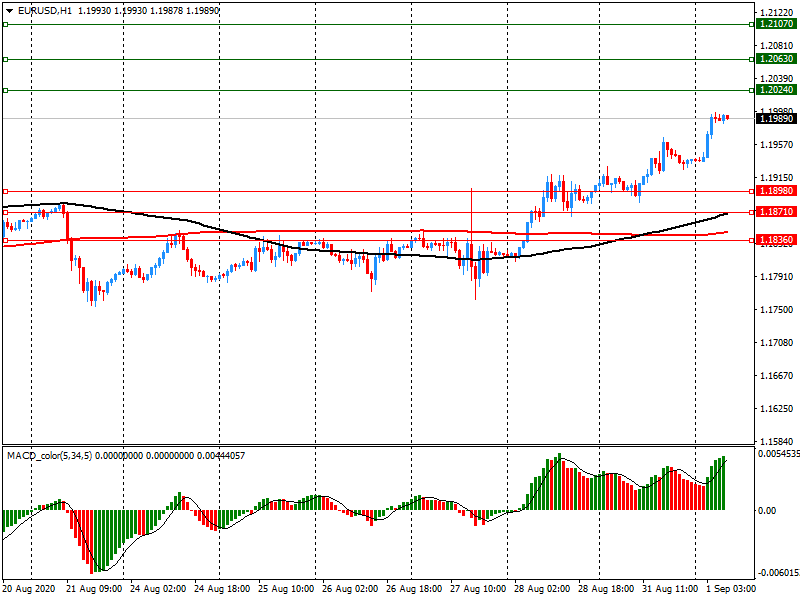
EUR/USD
Resistance levels (open interest**, contracts)
$1.2107 (1352)
$1.2063 (866)
$1.2024 (3605)
Price at time of writing this review: $1.1989
Support levels (open interest**, contracts):
$1.1898 (77)
$1.1871 (742)
$1.1836 (1282)
Comments:
- Overall open interest on the CALL options and PUT options with the expiration date September, 4 is 97796 contracts (according to data from August, 31) with the maximum number of contracts with strike price $1,0500 (5007);
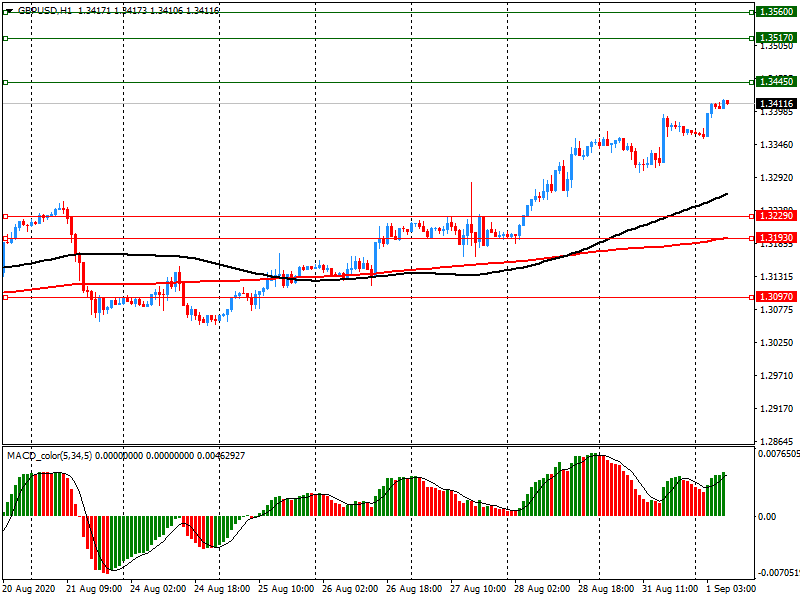
GBP/USD
Resistance levels (open interest**, contracts)
$1.3560 (264)
$1.3517 (1225)
$1.3445 (1134)
Price at time of writing this review: $1.3412
Support levels (open interest**, contracts):
$1.3229 (150)
$1.3193 (56)
$1.3097 (530)
Comments:
- Overall open interest on the CALL options with the expiration date September, 4 is 20390 contracts, with the maximum number of contracts with strike price $1,3800 (2994);
- Overall open interest on the PUT options with the expiration date September, 4 is 19263 contracts, with the maximum number of contracts with strike price $1,3000 (1567);
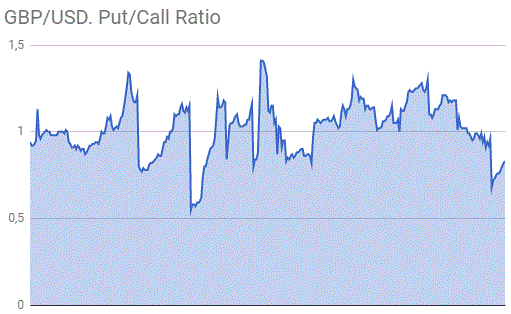
- The ratio of PUT/CALL was 0.94 versus 0.91 from the previous trading day according to data from August, 31
* - The Chicago Mercantile Exchange bulletin (CME) is used for the calculation.
** - Open interest takes into account the total number of option contracts that are open at the moment.
RTTNews reports that Australia's central bank maintained its key interest rate at a record low and quantitative easing unchanged but increased the size of the Term Funding Facility.
The board of Reserve Bank of Australia, governed by Philip Lowe, decided on Tuesday, to maintain cash rate and the targeted yield on three-year government bonds of 25 basis points.
Under the expanded Term Funding Facility, authorized deposit-taking institutions will have access to additional funding, equivalent to 2 percent of their outstanding credit, at a fixed rate of 25 basis points for three years.
Today's decision to expand term funding facility would raise the total amount available under the facility to around A$200 billion.
The Board said it will maintain highly accommodative settings as long as is required and continues to consider how further monetary measures could support the recovery.
Policymakers said that economic downturn caused by the coronavirus pandemic is not as severe as earlier expected and a recovery is now under way in most of Australia.
However, the recovery is likely to be both uneven and bumpy, with the virus outbreak in Victoria having a major effect on the Victorian economy.
| Raw materials | Closed | Change, % |
|---|---|---|
| Brent | 45.18 | -0.81 |
| Silver | 28.12 | 1.92 |
| Gold | 1968.009 | -0.05 |
| Palladium | 2243.25 | 2.01 |
| Index | Change, points | Closed | Change, % |
|---|---|---|---|
| NIKKEI 225 | 257.11 | 23139.76 | 1.12 |
| Hang Seng | -245.01 | 25177.05 | -0.96 |
| KOSPI | -27.63 | 2326.17 | -1.17 |
| ASX 200 | -13.3 | 6060.5 | -0.22 |
| DAX | -87.82 | 12945.38 | -0.67 |
| CAC 40 | -55.72 | 4947.22 | -1.11 |
| Dow Jones | -223.82 | 28430.05 | -0.78 |
| S&P 500 | -7.7 | 3500.31 | -0.22 |
| NASDAQ Composite | 79.83 | 11775.46 | 0.68 |
| Time | Country | Event | Period | Previous value | Forecast |
|---|---|---|---|---|---|
| 00:30 | Japan | Manufacturing PMI | August | 45.2 | 46.6 |
| 01:30 | Australia | Building Permits, m/m | July | -4.9% | -2% |
| 01:30 | Australia | Current Account, bln | Quarter II | 8.4 | 13 |
| 01:45 | China | Markit/Caixin Manufacturing PMI | August | 52.8 | 52.7 |
| 04:30 | Australia | Announcement of the RBA decision on the discount rate | 0.25% | 0.25% | |
| 07:30 | Switzerland | Manufacturing PMI | August | 49.2 | 52 |
| 07:50 | France | Manufacturing PMI | August | 52.4 | 49 |
| 07:55 | Germany | Manufacturing PMI | August | 51 | 53.0 |
| 07:55 | Germany | Unemployment Change | August | -18 | 1 |
| 07:55 | Germany | Unemployment Rate s.a. | August | 6.4% | 6.4% |
| 08:00 | Eurozone | Manufacturing PMI | August | 51.8 | 51.7 |
| 08:30 | United Kingdom | Net Lending to Individuals, bln | July | 1.8 | |
| 08:30 | United Kingdom | Consumer credit, mln | July | -0.086 | 0.678 |
| 08:30 | United Kingdom | Mortgage Approvals | July | 40 | 54.839 |
| 08:30 | United Kingdom | Purchasing Manager Index Manufacturing | August | 53.3 | 55.3 |
| 09:00 | Eurozone | Harmonized CPI ex EFAT, Y/Y | August | 1.2% | 0.9% |
| 09:00 | Eurozone | Harmonized CPI, Y/Y | August | 0.4% | 0.2% |
| 09:00 | Eurozone | Unemployment Rate | July | 7.8% | 8% |
| 13:45 | U.S. | Manufacturing PMI | August | 50.9 | 53.6 |
| 14:00 | U.S. | Construction Spending, m/m | July | -0.7% | 1% |
| 14:00 | U.S. | ISM Manufacturing | August | 54.2 | 54.5 |
| 17:00 | U.S. | FOMC Member Brainard Speaks |
| Pare | Closed | Change, % |
|---|---|---|
| AUDUSD | 0.73736 | 0.15 |
| EURJPY | 126.395 | 0.77 |
| EURUSD | 1.19377 | 0.27 |
| GBPJPY | 141.485 | 0.55 |
| GBPUSD | 1.33643 | 0.11 |
| NZDUSD | 0.67346 | 0.05 |
| USDCAD | 1.30394 | -0.36 |
| USDCHF | 0.90327 | -0.01 |
| USDJPY | 105.865 | 0.42 |







© 2000-2026. Bản quyền Teletrade.
Trang web này được quản lý bởi Teletrade D.J. LLC 2351 LLC 2022 (Euro House, Richmond Hill Road, Kingstown, VC0100, St. Vincent and the Grenadines).
Thông tin trên trang web không phải là cơ sở để đưa ra quyết định đầu tư và chỉ được cung cấp cho mục đích làm quen.
Giao dịch trên thị trường tài chính (đặc biệt là giao dịch sử dụng các công cụ biên) mở ra những cơ hội lớn và tạo điều kiện cho các nhà đầu tư sẵn sàng mạo hiểm để thu lợi nhuận, tuy nhiên nó mang trong mình nguy cơ rủi ro khá cao. Chính vì vậy trước khi tiến hành giao dịch cần phải xem xét mọi mặt vấn đề chấp nhận tiến hành giao dịch cụ thể xét theo quan điểm của nguồn lực tài chính sẵn có và mức độ am hiểu thị trường tài chính.
Sử dụng thông tin: sử dụng toàn bộ hay riêng biệt các dữ liệu trên trang web của công ty TeleTrade như một nguồn cung cấp thông tin nhất định. Việc sử dụng tư liệu từ trang web cần kèm theo liên kết đến trang teletrade.vn. Việc tự động thu thập số liệu cũng như thông tin từ trang web TeleTrade đều không được phép.
Xin vui lòng liên hệ với pr@teletrade.global nếu có câu hỏi.


 Chuyển khoản
 ngân hàng


