- Phân tích
- Tin tức và các công cụ
- Tin tức thị trường
Tin tức thì trường
On Monday, at 01:00 GMT, China will publish the manufacturing PMI and the non-manufacturing activity index for August. Also at 01:00 GMT, Australia will present inflation data for August, and New Zealand - ANZ's business confidence indicator for August. At 01:30 GMT, Australia will announce changes in the volume of operating profit of companies for the 2nd quarter and the volume of lending to the private sector for July. At 05:00 GMT, Japan will release a consumer confidence indicator for August and report changes in the housing starts for July. At 06:30 GMT, Switzerland will announce the change in the retail trade for July. At 12:00 GMT, Germany will present the consumer price index for August. At 12:30 GMT, Canada will release the producer price index for July and report changes in the building permits for July. At 22:30 GMT, Australia will release the AIG manufacturing activity index for August. At 22:45 GMT, New Zealand will announce a change in the building permits for July. At 23:30 GMT, Japan will report a change in the unemployment rate for July, and at 23:50 GMT - a change in the volume of capital expenditures for the 2nd quarter.
On Tuesday, at 00:30 GMT, Japan will release the manufacturing PMI for August. At 01:30 GMT, Australia will announce changes in the balance of payments for the 2nd quarter and the building permits for July. At 01:45 GMT China will release Markit/Caixin manufacturing PMI for August. At 04:30 GMT in Australia, the RBA's interest rate decision will be announced. At 07:30 GMT Switzerland will release manufacturing PMI for August. At 07:50 GMT, France will publish the index of business activity in the manufacturing sector for August. At 07:55 GMT, Germany will announce changes in the unemployment rate and the number of unemployed for August. Also at 07:55 GMT, Germany will present the index of business activity in the manufacturing sector for August. At 08:00 GMT, the Euro zone will publish the index of business activity in the manufacturing sector for August. At 08:30 GMT Britain will release PMI index for the manufacturing sector for August. Also at 08:30 GMT, Britain will announce changes in the volume of the M4 money supply aggregate, the number of approved mortgage applications and the volume of net loans to individuals for July. At 09:00 GMT, the Euro zone will publish the consumer price index for August and report changes in the unemployment rate for July. At 13:45 GMT, the US will release the manufacturing PMI for August, and at 14:00 GMT - the ISM manufacturing index for August. Also at 14:00 GMT, the US will announce a change in the volume of spending in the construction sector for July.
On Wednesday. At 01:30 GMT, Australia will report changes in GDP for the 2nd quarter. At 06:00 GMT, Germany will announce a change in retail trade volume for July. At 09:00 GMT, the Euro zone will release the producer price index for July. At 12:15 GMT, the US will announce the change in the number of employees from ADP for August. At 12:30 GMT, Canada will announce a change in labor productivity for the 2nd quarter. At 14:00 GMT, the US will report changes in the volume of production orders for July. At 14:30 GMT, the US will announce changes in oil reserves according to the Department of energy. At 18:00 GMT in the US, the Fed's Beige Book will be released.
On Thursday, at 00:30 GMT, Japan will release the index of business activity in the service sector for August. At 01:30 GMT, Australia will report a change in the foreign trade balance for July. At 01:45 GMT China will present Markit/Caixin Services PMI for August. At 06:30 GMT, Switzerland will publish the consumer price index for August. Then the focus will be on the business activity indices in the services sector for August: at 07:50 GMT, France will report, at 07:55 GMT - Germany, at 08:00 GMT - the Euro zone, and at 08:30 GMT - Britain. At 09:00 GMT, the Euro zone will report changes in retail trade volume for July. At 12:30 GMT, the US and Canada will announce changes in the foreign trade balance for July. Also at 12: 30 GMT, the US will announce changes in the level of labor productivity in the non-manufacturing sector and the level of labor costs for the 2nd quarter, as well as the number of initial applications for unemployment benefits. At 13:45 GMT USA will release services PMI for August, 14:00 GMT - ISM non-manufacturing index for August. Also at 14:00 GMT, BOE Gov Bailey Speaks will make a speech.
On Friday, at 01:30 GMT, Australia will report a change in retail trade volume for July. At 06:00 GMT, Germany will announce a change in the factory orders for July. At 06:45 GMT, France will announce a change in the state budget balance for July. At 08:30 GMT, Britain will publish the PMI construction for August and the results of the survey on expected inflation for the 3rd quarter. At 12:30 GMT, the US will report changes in the unemployment rate and the nonfarm payrolls for August. Also at 12:30 GMT, Canada will announce changes in the unemployment rate and the number of people employed for August. At 14:00 GMT in Canada, the Ivey purchasing managers index for August will be released. 17:00 GMT in the US, the Baker Hughes report on the number of active oil drilling rigs will be released.
FXStreet notes that consumer data released on Friday in the United States, came in above expectations. Analysts at Wells Fargo point out that increased spending puts the third quarter PCE on track to be quite strong. The test now is whether spending will be sustained amid a resurgent virus, explained analysts.
“With a double digit unemployment rate, a slowing in the jobs rebound and over a million people a week still filing jobless claims, financial markets were braced for a decline in personal income in July and a sharp slowing in spending—that is not what happened. Despite expectations for a 0.2% decline, personal income increased 0.4%, a feat made more impressive by the fact that last month’s decline in income was revised to a smaller drop. Unlike the spring and early summer when transfer payments were the only source of income growth, today’s report reveals that in July, the increased income came from a variety of sources, including a third straight monthly increase in wages and salaries (up 1.4%).”
“Transfer payments were down for the third straight month falling 1.7% in July; note however that August will mark the first month since the $600 federal top-up to jobless benefits went away, so look for a sharp decline here next month.”
“Today’s report is a bell-ringer for Q3 GDP. The better-than-expected print combined with upward revisions to spending at the end of Q2 mean that Q3 is on track for a big gain. With no change to goods or services spending in July or August, the annualized growth rate would come in north of 35%. But with the virus still with us, we could still see some retrenchment in spending, particularly services which would pull that figure lower.”
According to ActionForex, analysts at RBC Financial Group note that the 38.7% (annualized) drop in Canada's GDP in Q2 was more than 4 times the biggest prior drop, and built onto an 8.2% plunge in Q1.
"The pull-back was widely expected at this point, though, and was still slightly less-bad than the 43% Q2 decline the Bank of Canada assumed in the July Monetary Policy Report."
"Consumer spending plunged a record 43%, but that was still not quite as weak as the 57% drop in business investment. Virus containment measures clearly weighed on both, with a plunge in oil & gas investment tied to lower oil prices also a factor in the latter. Even government spending posted a sizeable decline with containment measures curtailing normally non-cyclical government services. Net trade was one of the few positive contributors in Q2, but only because imports fell even more than exports."
"As-expected, weakness on a monthly basis was heavily concentrated in April, when containment measures were at their peak. GDP rose 4.8% in May and another 6.5% in June. Statistics Canada’s preliminary estimate of July GDP was up another 3%. Together, those gains still only retrace about two-thirds of the 18% 2-month decline over March and April. But that would still leave risks tilted if anything to the upside of our call for a 33% (annualized) bounce-back in GDP in Q3."
"The size of that early bounce-back has clearly been helped by the exceptional level of government policy supports for households. Household disposable incomes actually rose almost 11% (non-annualized) in Q2 despite a massive downturn in labour markets. Government transfers to households surged by a whopping $56 billion in Q2 (likely the bulk from CERB payments) versus a $23 billion decline in earned wages & salaries. Retail sales were already above year-ago levels by June, and home resales have soared into the summer (helped also by pent-up demand from delayed transactions in the spring and low interest rates)."
"That income boost has also been expected for some time with payments from CERB well-publicized. The concern has long been that still exceptional softness in labour markets (the unemployment rate was still in double-digits at 10.9% in July) would outlast exceptional policy supports. Although the new programs announced last week by the federal government to replace CERB will help ease that transition."
MNI Indicators’
report revealed on Friday that business activity in Chicago picked up for the second
straight month in August, albeit at a slower pace than in July.
The MNI Chicago
Business Barometer, also known as Chicago purchasing manager's index (PMI) came
in at 51.2 in August, down from 51.9 in July. Economists had forecast the index
to increase to 52.0.
A reading above
50 indicates improving conditions, while a reading below this level shows
worsening of the situation.
According to
the report, Order Backlogs was the only category to show a monthly decline, cooling
1 point in August after a strong increase in the previous month. Meanwhile, Supplier
Deliveries recorded the largest gain, rebounding 4.2 points after three
consecutive months of decline. Elsewhere, Production improved further in
August, increasing 1.4 points to the highest level since June 2019, while New
Orders edged up to a one-year high, and employment ticked up 0.9 points but
remained in contraction territory.
The final
reading for the August Reuters/Michigan index of consumer sentiment came in at 74.1
compared to a preliminary reading of 72.8 and the July final reading of 72.5.
Economists had
forecast the index to be unrevised up to 72.8.
According to
the report, the index of the current economic conditions edged up 0.1 percent
m-o-m to 82.9 from July’s final reading of 82.8.
Meanwhile, the
index of consumer expectations jumped 3.9 percent m-o-m to 68.5 from July’s
final reading of 65.9.
Richard Curtin,
the Surveys of Consumers chief economist, noted that August gain reflected
fewer concerns about the year-ahead outlook for the economy, although those
prospects still remained half as favorable as six months ago. “Since the April
shutdown of the economy, a sizable number of consumers thought conditions could
hardly get any worse. The natural response was that economic conditions would
improve given the absence of any negative economic causes for the recession,”
he said.
- Structural drivers of low equilibrium interest rates suggest the use of central bank balance sheets for monetary policy will be more long-lived than had been anticipated
- QE clearly acted to break dangerous risk of transmission from severe market stress to the macro-economy, by avoiding a sharp tightening in financial conditions and thus increase in effective interest rates
- There indeed is some evidence that impact of QE over past decade has been largest at times of market dysfunction and illiquidity; of course, available event studies are very few in number
- If effects of QE are more powerful in crisis states of the world, we may need to ensure that we have enough headroom in the future to repeat it; the determinants of QE unwind may therefore be more subtle than previously thought, and the Covid crisis offers new lens through which to assess its role
- We should keep the options to use all our tools as open as possible, so I would conclude that the appropriate policy mix going forwards over a decade may be more nuanced than previously thought
- Covid crisis to date has demonstrated that QE and forward guidance around it have been effective in particular situation
- We also made clear that our box does include other tools, including the possibility of negative rates
- We are not out of firepower by any means, and to be honest it looks from today’s vantage point that we were too cautious about our remaining firepower pre-Covid; but, hindsight is a wonderful thing when you have it
- We need to take on board the message the Covid crisis has reiterated, namely that our tools may be state contingent in their effects
- We won't get back to pre-crisis unemployment for quite a while
- Jobs in retail, tourism and travel are not going to come back in the same way
- Fed's new monetary policy strategy is more about targeting the velocity of inflation rather than the overall level
U.S. stock-index futures rose on Friday, as prospects that interest rates would stay low for a prolonged period bolstered risk appetite.
Global Stocks:
Index/commodity | Last | Today's Change, points | Today's Change, % |
Nikkei | 22,882.65 | -326.21 | -1.41% |
Hang Seng | 25,422.06 | +140.91 | +0.56% |
Shanghai | 3,403.81 | +53.69 | +1.60% |
S&P/ASX | 6,073.80 | -52.40 | -0.86% |
FTSE | 5,993.82 | -6.17 | -0.10% |
CAC | 5,016.34 | +0.37 | +0.01% |
DAX | 13,070.74 | -25.62 | -0.20% |
Crude oil | $43.08 | +0.09% | |
Gold | $1,961.70 | +1.51% |
FXStreet notes that the S&P 500 posted a neutral ‘doji’ on Thursday as the market digested the new Fed policy announcement, however, the Credit Suisse analyst team still believes that the market has entered a more accelerated trend state, with daily RSI momentum remaining above its June peak, reinforcing the move higher. The next major resistance is seen at 3541/43.
“The break above our prior objective at the Fibonacci projection level at 3432/36 and the top of the potential trend channel resistance earlier in the week still suggests the market has entered a more accelerated phase, with daily RSI momentum also remaining above its June peak, reinforcing the break higher.”
“Next resistance is seen at the top of the weekly BollingerBand at 3500/03, then the top of our typical extreme zone (i.e. 15% above the 200- day average) at 3541/44, which is expected to prove a tougher barrier.”
“Support stays at 3468/66 initially, below which would complete a very small intraday top, however, only a break below the uptrend from late June and the 13-day exponential average at 3418/12 would remove the upside bias.”
(company / ticker / price / change ($/%) / volume)
ALCOA INC. | AA | 14.98 | 0.14(0.94%) | 6187 |
ALTRIA GROUP INC. | MO | 43.91 | 0.16(0.37%) | 5801 |
Amazon.com Inc., NASDAQ | AMZN | 3,417.80 | 17.80(0.52%) | 33612 |
American Express Co | AXP | 102.23 | 0.70(0.69%) | 1747 |
AMERICAN INTERNATIONAL GROUP | AIG | 29.9 | 0.22(0.74%) | 665 |
Apple Inc. | AAPL | 503.19 | 3.15(0.63%) | 537550 |
AT&T Inc | T | 29.93 | 0.03(0.10%) | 93651 |
Boeing Co | BA | 175.65 | 1.45(0.83%) | 199596 |
Caterpillar Inc | CAT | 142.4 | -0.97(-0.68%) | 1238 |
Chevron Corp | CVX | 85.22 | 0.31(0.37%) | 6319 |
Cisco Systems Inc | CSCO | 42.1 | -0.19(-0.45%) | 95637 |
Citigroup Inc., NYSE | C | 52.01 | 0.29(0.56%) | 73700 |
E. I. du Pont de Nemours and Co | DD | 56.8 | 0.22(0.39%) | 1133 |
Exxon Mobil Corp | XOM | 39.9 | 0.16(0.40%) | 60617 |
Facebook, Inc. | FB | 293.3 | 0.08(0.03%) | 105724 |
FedEx Corporation, NYSE | FDX | 219.39 | 1.18(0.54%) | 1521 |
Ford Motor Co. | F | 6.92 | 0.01(0.15%) | 171898 |
Freeport-McMoRan Copper & Gold Inc., NYSE | FCX | 15.2 | 0.30(2.01%) | 50467 |
General Electric Co | GE | 6.53 | 0.05(0.77%) | 360520 |
General Motors Company, NYSE | GM | 29.9 | 0.21(0.71%) | 8816 |
Goldman Sachs | GS | 211.67 | 1.52(0.72%) | 3776 |
Google Inc. | GOOG | 1,636.26 | 1.93(0.12%) | 4031 |
Hewlett-Packard Co. | HPQ | 19.27 | 0.57(3.05%) | 61634 |
Home Depot Inc | HD | 289.8 | 1.17(0.41%) | 5449 |
HONEYWELL INTERNATIONAL INC. | HON | 166.49 | 0.50(0.30%) | 1051 |
Intel Corp | INTC | 49.45 | 0.05(0.10%) | 186532 |
International Business Machines Co... | IBM | 124.83 | 0.18(0.14%) | 10521 |
Johnson & Johnson | JNJ | 153.68 | 0.70(0.46%) | 7011 |
JPMorgan Chase and Co | JPM | 102.92 | 0.57(0.56%) | 28306 |
McDonald's Corp | MCD | 212.21 | 0.02(0.01%) | 3411 |
Merck & Co Inc | MRK | 86.1 | 0.28(0.33%) | 1222 |
Microsoft Corp | MSFT | 227.94 | 1.36(0.60%) | 375706 |
Nike | NKE | 111.18 | 0.59(0.53%) | 1429 |
Pfizer Inc | PFE | 37.88 | 0.02(0.05%) | 27167 |
Procter & Gamble Co | PG | 138.84 | 0.63(0.46%) | 3008 |
Starbucks Corporation, NASDAQ | SBUX | 83.55 | 0.14(0.17%) | 9295 |
Tesla Motors, Inc., NASDAQ | TSLA | 2,299.00 | 60.25(2.69%) | 482849 |
The Coca-Cola Co | KO | 48.6 | 0.37(0.77%) | 89303 |
Twitter, Inc., NYSE | TWTR | 40.5 | 0.11(0.27%) | 9268 |
Verizon Communications Inc | VZ | 59.47 | 0.04(0.07%) | 4653 |
Visa | V | 212.1 | 1.07(0.51%) | 6407 |
Wal-Mart Stores Inc | WMT | 141.35 | 4.72(3.45%) | 430439 |
Walt Disney Co | DIS | 134.8 | 1.07(0.80%) | 22475 |
Yandex N.V., NASDAQ | YNDX | 65.47 | 0.88(1.36%) | 129442 |
Statistics
Canada announced on Friday that the country’s gross domestic product (GDP) rose
6.5 percent m-o-m in June after a revised 4.8 m-o-m advance in May (originally
a growth of 4.5 percent m-o-m).
That was above economists’
forecast for an increase of 5.6 percent m-o-m.
In the second
quarter of 2020, the Canadian GDP plunged 11.5 percent q-o-q, following a 2.1percent
q-o-q growth in the first quarter. That was the sharpest drop since quarterly
data were first recorded in 1961.
According to
the report, the q-o-q decline in GDP reflected sharp decreases in household
spending, business investment, and international trade owing to widespread
shutdowns of non-essential businesses, border closures, and restrictions on
travel and tourism in response to the COVID-19 pandemic. Household spending dropped
13.1 percent q-o-q due to substantial job losses and limited opportunities to
spend because of closures of stores and restaurants and restrictions on travel
and tourism. Meanwhile, business investment fell 16.2 percent q-o-q, reflecting
limited construction activities, plant closures, low oil prices and heightened
uncertainty. Export volumes declined 18.4 percent q-o-q and import volumes plunged
22.6 percent q-o-q, as major trading partners' economies shrank owing to their
adoption of measures to contain the pandemic.
Expressed at an
annualized rate, Canada’s GDP tumbled 38.7 percent in the second quarter, the
most on record, after an unrevised 8.2 percent decrease in the previous
quarter, better than economists’ forecast of 39.6 percent contraction.
The Commerce
Department reported on Friday that consumer spending in the U.S. rose 1.9
percent m-o-m in July after a revised 6.2 percent m-o-m climb in June
(originally a 5.6 percent m-o-m gain). Economists
had forecast the reading to show a 1.5 percent m-o-m advance.
Meanwhile,
consumer income increased 0.4 percent m-o-m in July, following a revised 1.0
percent m-o-m drop in the previous month (originally a 1.1 percent m-o-m fall).
Economists had forecast a 0.2 percent m-o-m decline.
The July advance
in personal income was more than accounted for by compensation of employees as
portions of the economy continued to reopen, the report said. Proprietors’
income and rental income of persons also contributed to the gain. Partially offsetting
these increases were declines in government social benefits and income on
assets.
The personal
consumption expenditures (PCE) price index, excluding the volatile categories
of food and energy, which is the Fed's preferred inflation measure, went up 0.3
percent m-o-m in July, following a revised 0.3 percent m-o-m increase in the
prior month (originally a 0.2 percent m-o-m advance). Economists had projected
the index would rise 0.5 percent m-o-m.
In the 12 months
through July, the core PCE increased 1.3 percent, following a revised 1.1
percent gain in the 12 months through June (originally a 0.9 percent jump).
Economists had forecast an advance of 1.2 percent y-o-y.
- It will take a while for inflation to get back to 2%
- Technology-enabled disruption is putting downward pressure on prices
- For me, inflation a little bit above 2% means maybe 2.25% but Fed seeks flexibility
- Fed needs to be conscious of financial stability and excesses that could exist as a result of their policies
- I don't view average inflation targeting as a radical change, it's an affirmation of how we've been operating for some time
- Says he would prefer to wait for more clarity on the path of the virus before Fed gives more forward guidance
- I think it's very important that we indicate that the pandemic programs will lapse
- I'm particularly concerned about debt buildup
- Thinks unemployment will end the year near 8% unless there is a greater resurgence of the virus
- Willing to have a little more inflation in order for the labour market to strengthen and bring in underrepresented groups
| Time | Country | Event | Period | Previous value | Forecast | Actual |
|---|---|---|---|---|---|---|
| 06:00 | Germany | Gfk Consumer Confidence Survey | September | -0.2 | 1.2 | -1.8 |
| 06:45 | France | Consumer spending | July | 10.3% | 2% | 0.5% |
| 06:45 | France | CPI, m/m | August | 0.4% | -0.1% | |
| 06:45 | France | CPI, y/y | August | 0.8% | 0.2% | |
| 06:45 | France | GDP, q/q | Quarter II | -5.9% | -13.8% | -13.8% |
| 07:00 | Switzerland | KOF Leading Indicator | August | 86 | 90 | 110.2 |
| 09:00 | Eurozone | Industrial confidence | August | -16.2 | -14.3 | -12.7 |
| 09:00 | Eurozone | Consumer Confidence | August | -15 | -14.7 | -14.7 |
| 09:00 | Eurozone | Economic sentiment index | August | 82.4 | 85 | 87.7 |
JPY strengthened against most other major currencies in the European session on Friday after Japan's Prime Minister (PM) Shinzo Abe announced that he was stepping down after eight years amid failing health.
Mr. Abe suffers from chronic inflammatory bowel disease. During a televised press conference on Friday, the Japanese PM said that his health started worsening around the middle of last month. So, he decided to step down as he did not want his illness to result in any policy mistakes. “I needed to fight against the disease and be treated and I was not really in a perfect state in terms of the health condition,” Abe said. “I would like to send my apologies to the people of Japan,” he added. Shinzo Abe will continue to carry out his duties as prime minister until the next leader is appointed.
The shock announcement raised worries whether Abe's successor would pursue a similar expansionary economic policy.
Meanwhile, the Bank of Japan (BoJ) reaffirmed that it would maintain its current monetary policy even as PM Abe resigns.
- Economic activity is slowing in some regions
- The virus is really driving things
- Businesses have tempered hiring as virus cases have been increasing
- High-frequency data shows economic activity has slowed down a bit
- There is no mathematical formula, the strategy is about stabilizing inflation expectations
- The Fed will take into account financial stability when setting monetary policy
- Stock markets are rising based on where investors think the economy is headed
- Understands concern that Fed liquidity is fueling stock gains but does not feel that Fed is contributing to an asset bubble
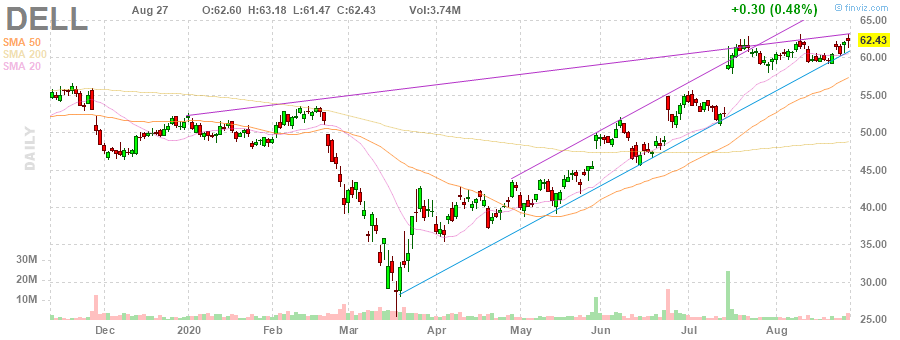
Dell Technologies Inc. (DELL) reported Q2 FY 2020 earnings of $1.92 per share (versus $2.15 per share in Q2 FY 2019), beating analysts’ consensus estimate of $1.40 per share.
The company’s quarterly revenues amounted to $22.775 bln (-2.9% y/y), beating analysts’ consensus estimate of $22.498 bln.
DELL rose to $64.25 (+2.92%) in pre-market trading.
Peter Vanden Houte, ING's Chief Economist, Belgium, Luxembourg, notes that the European’s Commission economic sentiment indicator rose more than expected in August, suggesting double-digit GDP growth in the third quarter. However, this growth pace is unlikely to extend into the fourth quarter.
"The European’s Commission economic sentiment indicator rose to 87.7 in August from 82.4 in June and that was better than expected."
"Amongst the bigger member states, all countries saw higher sentiment figures, with Spain being the notable exception. All sectors, except for construction and the consumer where sentiment was broadly unchanged, saw confidence improving."
"Especially the services sector stood out, with a nine-point jump in confidence."
"As we mentioned before, the consumer remains the weak spot in the current recovery, with confidence largely unchanged since June. The recent rise in new Covid-19 infections might have hampered the improvement in confidence. But more importantly, fears of unemployment over the next twelve months remain quite elevated."
"Fortunately, several member states have decided to lengthen the temporary unemployment schemes, which limits the drop in disposable income. At the same time, more precautionary savings cannot be excluded."
"We’re looking at quarter-on-quarter GDP growth of close to 10% for the third quarter. But this is likely to slow down quite rapidly to more moderate growth figures, meaning that the year will likely end with a GDP level that is still about 6% lower than in the fourth quarter of 2019."
"A sign that generous monetary and budgetary support will have to be maintained in 2021, especially so if the introduction and the rolling out of a vaccine would take some time."
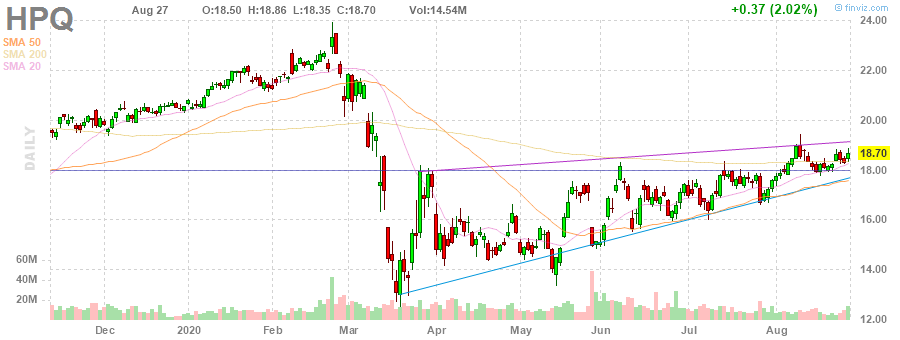
HP Inc. (HPQ) reported Q3 FY 2020 earnings of $0.49 per share (versus $0.58 per share in Q3 FY 2019), beating analysts’ consensus estimate of $0.43 per share.
The company’s quarterly revenues amounted to $14.294 bln (-2.1% y/y), beating analysts’ consensus estimate of $13.286 bln.
The company also issued upside guidance for Q4 FY 2020, projecting EPS of $0.50-0.54, versus analysts’ consensus estimate of $0.50.
HPQ rose to $19.30 (+3.21%) in pre-market trading.
FXStreet reports that AUDUSD has moved sharply higher this week and has broken above the 0.7276/95 range highs. This breakout does suggest the medium-term uptrend should be resuming, with next resistance seen at 0.7394, analysts at Credit Suisse reports.
“AUD/USD has moved sharply higher this week and is now breaking above its range highs and the important 2019 high at 0.7276/7295, after holding as expected above the much tested 21-day exponential average at 0.7188/84 and in line with our medium-term bullish outlook.”
“Whilst short-term momentum remains incredibly lackluster, which suggests some caution is warranted, this breakout does suggest the medium-term uptrend should be resuming, with next resistances at 0.7394, which is the December 2018 high, then our long held medium-term objective at 0.7574/7638, which is a cluster of major Fibonacci retracement levels.”
“We now ideally look for the market to hold above the 0.7290/76 breakout point, particularly into the daily close today. Below would reinforce the story of an exhausted momentum state, with next supports then seen at 0.7217/16.”
As the Fed adopts average inflation targeting, we think interest rate hikes are very unlikely to happen in the near future and USD real rate will remain low and could even go (initially) lower if the Fed succeeds in generating higher domestic price pressures, Petr Krpata, an FX strategist at ING, reports.
"Fed Chair Jerome Powell formally announced yesterday the adoption of average inflation targeting."
"The adoption of average inflation targeting and tolerance for inflation to overshoot and make up for prior undershoots suggests (a) interest rate increases are a very distant proposition, and (b) USD real rate will remain low and should even go (initially) lower if the Fed succeeds in generating higher domestic price pressures."
"This points to a bearish USD outlook for many quarters to come (indeed, USD weakened across the board overnight). The scope for prolonged USD weakness and the non-tightening Fed should be also beneficial for emerging market currencies, particularly if it will take time for US inflation to start persistently overshooting the 2% target and the curve steepening will remain moderate as this would make local EM bonds attractive -unhedged -and keep inflows into EM markets in place."
- The situation continues to be serious
- Economy should be kept alive, further efforts are needed to bring it back to life
- Negotiations with European Parliament on recovery fund have not been easy
- Germany is to get around €22 billion from recovery fund
- Things won't return to normal until we have a coronavirus vaccine
- BoJ wants to keep the peace as Japan deals with the virus crisis still
- BoJ's Governor Kuroda plans to complete his full term, which ends in 2023
Bloomberg reports that Japanese equities and the yen shook Friday on news that Prime Minister Shinzo Abe is resigning, but economists said his departure is unlikely to trigger changes in Bank of Japan policy.
One reason is that BOJ Governor Haruhiko Kuroda, the architect of the bank’s massive easing policy, isn’t likely to follow Abe in stepping down before his term is up, in April 2023. The pandemic has also made it even more difficult for the bank to contemplate unwinding its bond purchases or lifting rates that have been in negative territory for years.
“There’ll be no impact on monetary policy,”’ said economist Masamichi Adachi at UBS Securities in Tokyo. “If it did change, it would make you reassess the relationship between the BOJ and the government,” he said, stressing that the bank is likely to protect its independence.
Abe’s signature program of “Abenomics” delivered mixed results, but the biggest achievements were made as a result of changes in BOJ policy spearheaded by Governor Kuroda. The BOJ head has no reason to resign now, according to UBS’s Adachi.
The pandemic has also tied the hands of policy makers in government and at the BOJ, according to economist Masaki Kuwahara at Nomura Securities Co., who said authorities now have little choice but to maintain the current stimulus.
“For now, anyone would want to prioritize a recovery from the Covid-19 downturn,” said Kuwahara. “For the BOJ, if policy suddenly swings toward normalization there’ll be market impact.”
In tandem with massive spending from the government, the BOJ has also stepped in with more asset purchases and loans support. Any Abe successor is unlikely to change that accommodative path, said Shunsuke Kobayashi, chief economist at Mizuho Securities Co.
“With the economy doing this badly, fiscal and monetary policy will remain at full throttle whoever follows Abe,” he said.
FXStreet reports that in opinion of FX Strategists at UOB Group, USD/CNH’s stance remains negative and targets a potential visit to the 6.8460 level in the next weeks.
24-hour view: “We highlighted yesterday that ‘further weakness is not ruled out but oversold conditions suggest a more moderate pace of decline and the next support at 6.8650 may not come into the picture’. Our view was not wrong as USD rebounded after touching a low of 6.8690. Momentum indicators are beginning to turn ‘neutral’ and further USD weakness is unlikely for today. USD is more likely to trade sideways, expected to be between 6.8700 and 6.8900.”
Next 1-3 weeks: “After about a week, the 6.8850 level that we first indicated last Wednesday (19 Aug, spot at 6.9120) finally came into the picture as USD plummeted to a low of 6.8801 yesterday (26 Aug). The lackluster momentum over the past several days has perked up and as indicated in recent updates, the next support level of note below 6.8850 is at 6.8460. Overall, the current negative phase in USD is deemed as intact as long as USD stays below the 6.9180 (‘strong resistance’ level was previously at 6.9400).”
According to the report from European Commission, following the historical slump in March and April, the recovery of the Economic Sentiment Indicator (ESI) continued in August 2020. Registering marked increases in the euro area (+5.3 points up to 87.7) and the EU (+5.0 points up to 86.9), the ESI in both regions has so far recovered around 60% the combined losses of March and April. Also the Employment Expectations Indicator (EEI) improved for the fourth month in a row (by 2.9 points to 89.6 in the euro area and by 2.7 points to 89.5 in the EU).
In the euro area, the ESI’s recovery resulted from a sustained improvement of industry, retail trade, and, in particular, services confidence. By contrast, confidence edged down in construction and remained broadly stable among consumers
Industry confidence continued to recover (+3.5), fuelled by more sanguine appraisals of the stocks of finished products and the current level of overall order books. The third sharp increase in a row in services confidence (+9.0) was driven by managers' improved assessment of both the business situation and demand over the last 3 months, while their demand expectations slipped for the first time in four months. Virtually unchanged consumer confidence (+0.3) reflects households’ broadly stable intentions to make major purchases and expectations concerning their financial conditions. By contrast, households’ assessment of the future general economic situation and of their financial conditions over the last 12 months improved slightly.
The increase of the Employment Expectations Indicator (+2.9) reflects significantly improved employment plans in retail trade, industry, and services, which were only partly diminished by worsened employment plans in construction. Although not included in the EEI, consumers’ unemployment expectations remained broadly unchanged.
CNBC reports that the U.S. economy looks set to rebound in the current quarter from the previous three months’ deep contraction — but it could sink again if the coronavirus outbreak is not managed well, warned a former Federal Reserve official.
Dennis Lockhart, president of the Atlanta Fed from 2007 to 2017, was among economists and experts who have raised the possibility of a “double-dip” recession in the U.S. economy. A double dip means an economy returning to a period of decline after a brief recovery.
“I continue to believe that looking forward you have to consider a range of scenarios and among those scenarios would be, obviously, a pessimistic one and that could be a double dip,” Lockhart told CNBC’s “Squawk Box Asia” on Friday.
“If things go badly with the management of the virus and there’s more cascading — which (Thursday’s) numbers of initial claims might suggest — then yes, it’s possible we have a double dip. I don’t think that’s probably the base case, but I think it’s still possible.”
He was referring to the initial jobless claims in the U.S., which came in just over 1 million for the week ending August 22, according to the Labor Department. That was the 22nd time that initial jobless claims had come in above the 1 million-mark in 23 weeks.
Before Lockhart, other prominent policymakers and economists who have warned about the possibility of a double dip include Kansas City Fed President Esther George and former Morgan Stanley Asia Chairman Stephen Roach.
CNBC reports that Japanese Prime Minister Shinzo Abe intends to resign for health reasons.
Abe plans to step down to deal with a health problem, national broadcaster NHK reported citing sources close to the prime minister. Kyodo News also reported that Abe plans to resign, citing a source from the ruling Liberal Democratic Party.
Reuters reported that a source close to a senior party official said Abe’s resignation was “a done deal.”
Abe had been scheduled to hold a press conference at 5 p.m. local time.
Stocks in Japan briefly fell after the reports and the yen strengthened against the dollar.
Those reports come after Abe’s recent hospital visits, which spurred concerns about his health. The Japanese leader visited a hospital twice in the last two weeks, according to NHK.
Abe suffers from a chronic inflammatory bowel disease and had to previously step down as prime minister in 2007 following a flare up, Reuters reported. He returned to the top job after his party registered a landslide election victory in 2012. Abe’s current term does not end until 2021.
Since resuming the office of prime minister, Abe has sought to revive Japan’s lackluster economy through a policy package dubbed Abenomics.
While the coronavirus pandemic has hammered economies globally, Japan was already reeling from a drop in consumer spending after it hiked the consumption tax rate in October. The country entered a technical recession after its economy shrank at an annualized rate of 3.4% in the January to March quarter.
Japan’s economy contracted at an annualized rate of 27.8% in the April to June quarter, marking its third quarter of declines. Reuters reported that plunge wiped out gains from Abenomics stimulus policies.
FXStreet reports that Brexit negotiations have continued over the summer and last week the negotiations ended without any major breakthrough. Economists at Danske Bank have lowered the odds of a deal to 60% from 65% while have lifted the probability of a no-deal to 40% from 35%. EUR/GBP will skyrocket to 0.97 on a no-deal scenario.
“We have lowered our probability of a deal from 65% to 60%. The reason is that the small probability of a deal over the summer did not happen. The probability of a comprehensive deal is slim (5%) and we expect a simple free-trade agreement covering goods (55%).”
“We now believe the probability of a no-deal Brexit is 40% (up from 35%). As the UK has rejected extending the transition period, the EU and the UK will trade on WTO terms on 1 January 2021 in the event of no deal. This also means that, in our view, businesses should continue preparing for the worst.”
“The next round of negotiations begins on 7 September and negotiating rounds are scheduled until 2 October, ahead of the EU summit on 15-16 October, where the ambition (hope?) is that EU leaders can say yes to an agreement. However, we believe that the two parts may need some 'overtime' and that an agreement is more likely in early November.”
“We believe EUR/GBP will continue to trade around 0.90, as it has done for some time now. If negotiations are on the brink of breaking down, we could see EUR/GBP moving higher to around 0.92. We believe GBP strength is on the cards when a deal is in sight and forecast EUR/GBP is 0.88 in three months and 0.86 in six-to twelve months.”
“If we are wrong and there is no deal, we believe EUR/GBP will move significantly higher but stay below parity. We pencil in EUR/GBP at 0.97 in this scenario.”
According to the report from KOF Economic Research Agency, the economic barometer rose sharply in August, now for the third month in a row. The plus was almost the same as in the previous month, when the barometer showed the strongest monthly increase since the beginning of the calculated values in the early 1990s. The crash in the spring of this year was, however, also the worst in the history of the barometer. According to this, the Swiss economy is in the upswing phase of what appears for the time being a V-shaped recession.
The KOF Economic Barometer rose by 24.2 points in August. After 86.0 (revised from 85.7) in July, the barometer now points to 110.2. This is well above the long-term average. Economists had expected an increase to 90. The indicator groups for manufacturing, the hospitality sector and foreign demand are primarily responsible for the current increase. To a lesser extent, the indicators relating to financial and insurance services as well as other services contributed to the improvement. The construction sector, on the other hand, recorded a slight deterioration.
In the manufacturing sector, the outlook has brightened in all sectors. This was particularly pronounced in the metal and chemical, electrical and textile industries.
In the goods producing sector (manufacturing and construction), the indicators related to incoming orders, employment and the business situation were more favorable. The other aspects taken into account in the surveys, such as the assessment of preliminary products, inventories and the competitive position, did at least not generate negative impulses.
| Time | Country | Event | Period | Previous value | Forecast | Actual |
|---|---|---|---|---|---|---|
| 06:00 | Germany | Gfk Consumer Confidence Survey | September | -0.2 | 1.2 | -1.8 |
| 06:45 | France | Consumer spending | July | 10.3% | 2% | 0.5% |
| 06:45 | France | CPI, m/m | August | 0.4% | -0.1% | |
| 06:45 | France | CPI, y/y | August | 0.8% | 0.2% | |
| 06:45 | France | GDP, q/q | Quarter II | -5.9% | -13.8% | -13.8% |
| 07:00 | Switzerland | KOF Leading Indicator | August | 86 | 90 | 110.2 |
During today's Asian trading, the US dollar fell against major world currencies after a speech by Federal Reserve Chairman Jerome Powell.
The ICE index, which tracks the dynamics of the US dollar against six currencies (euro, swiss franc, yen, canadian dollar, pound sterling and swedish krona), fell by 0.35% compared to the previous day.
During a speech at an online event hosted by the Federal reserve Bank of Kansas City, on Thursday, Powell said that the regulator has approved a new monetary policy strategy that allows for US inflation to exceed the 2 percent target at certain times. "As the economic situation is constantly in flux, the strategy of the Federal open market committee (FOMC) to achieve monetary policy goals must adapt to emerging new challenges," Powell said
Powell stressed that the longer-run goal continues to be an inflation rate of 2 percent but noted inflation will average less than that if it runs below 2 percent following economic downturns and never moves above that level even when the economy is strong. "Households and businesses will come to expect this result, meaning that inflation expectations would tend to move below our inflation goal and pull realized inflation down," Powell said.
"To prevent this outcome and the adverse dynamics that could ensue, our new statement indicates that we will seek to achieve inflation that averages 2 percent over time," he added.
According to the report from INSEE, in Q2 2020, GDP in volume terms declined: –13.8%, after –5.9% in Q1 2020. It is 19% lower than in Q2 2019. GDP’s negative developments in first half of 2020 is linked to the shut-down of “non-essential” activities in the context of the implementation of the lockdown between mid-March and the beginning of May. The gradual ending of restrictions led to a gradual recovery of economic activity in May and June, after the low point reached in April.
Household consumption expenditures dropped (–11.0% after –5.8%), as did total gross fixed capital formation in a more pronounced manner (GFCF: –17.8% after –10.3%). General government expenditure also stepped back (–8.0% after –3.5%). Overall, final domestic demand excluding inventory changes fell sharply: it contributed to –12.0 points to GDP growth.
Exports fell this quarter (–25.5% after –6.1%) more strongly than imports (–17.3% after –5.5%). All in all, the foreign trade balance contributed negatively to GDP growth: –2.3 points, after –0.1 points the previous quarter. Conversely, changes in inventories contributed positively to GDP growth (+0.6 points).
Overall production of goods and services declined sharply (–14.2% after –5.5%). It fell the hardest in construction (–24.1% after –12.8%). Output in goods also declined (–16.8% after –5.6%) as output in market services (–13.4% after –5.0%).
Household consumption dropped in Q2 2020 (–11.0% after –5.8%), more in services (–15.3% after –5.8%) than in goods (–7.1% after –6.8%). With regards to goods, consumption of engineered goods fell strongly (–12.0% after –16.0%) and expenditure on energy declined markedly (–11.1% after –3.7%) notably due to the heavy decline in fuel purchases, related to the lockdown. Food expenditure slightly decreased (–0.5% after +2.8%). With regards to services, expenditure on transport services (−45.8% après −13.1%) and accommodation and food services (–56.9% après –16.5%) plummeted, linked to the administrative restrictions enforced to fight the pandemic.
FXStreet reports that NZD/USD could advance further and re-test the 0.6690 zone in the next weeks, according to FX Strategists at UOB Group.
24-hour view: “Yesterday, we highlighted that ‘momentum remains strong and NZD could advance further towards 0.6665’. We added, ‘the rapid rise is already overbought and the next resistance at 0.6690 could be just out of reach for now’. Our view was not wrong as NZD popped briefly to a high of 0.6675. Momentum has eased and the current movement is viewed as part of a consolidation phase. In other words, NZD is expected to trade sideways, likely not straying much out of yesterday’s 0.6600/0.6675 range.”
Next 1-3 weeks: “After trading in a relatively quiet manner for several days, NZD popped to a high of 0.6625 before extending its gains this morning. The sudden surge in momentum could lead to further NZD strength towards 0.6690. For now, the probability for a sustained advance above this level is not high. Note that last month’s top near 0.6715 is another solid resistance. Overall, NZD is expected to trade on a firm note as long as it does not move below the ‘strong support’ level at 0.6545 within these few days.”
According to the report from GfK Group, expectations for a rapid recovery in the consumer climate in Germany were dealt a significant blow in August. After gaining for three consecutive periods, the indicator suffered a considerable decline. While economic expectations and propensity to buy showed marginal gains, income expectations fell sharply. As propensity to save is also currently gaining, GfK is forecasting a figure of -1.8 for September 2020, 1.6 points down from August this year (revised to -0.2). Economists had expected an increase to 1.2.
"An increase in the number of infections and the fear that coronavirus-related restrictions will be further tightened are creating uncertainty and consequently dampening the mood. The reduction in value added tax (VAT) which came into effect in Germany on July 1st may be boosting propensity to consume but has not yet been able to provide a stronger stimulus," explains Rolf Bürkl, consumer expert at GfK. "Whether or not this is just a temporary slowdown will depend primarily on what infection rates look like in future and the necessary measures to be put in place by policy makers."
This uncertainty is particularly evident when it comes to income expectations, which, after having gained for three consecutive periods, showed a marked decline in August. The indicator fell by 5.8 points to 12.8 – a loss of around 37 points when compared to the previous year. Another signal of the growing uncertainty was provided by propensity to save, which gained 5.5 points this month, further impacting the consumer climate.
Unlike income expectations, propensity to buy was able to further improve on an already strong level – though its gains were marginal at just 1.2 points. The indicator is currently at 43.7, just over five points below the previous year's level.
The economic outlook of German consumers also improved in August for the fourth time in a row. But here too, the improvement was limited with the indicator gaining just 1.1 points to reach 11.7. This is already the fourth consecutive increase. The last time a higher value was recorded was in November 2018, when the indicator stood at 14.8.
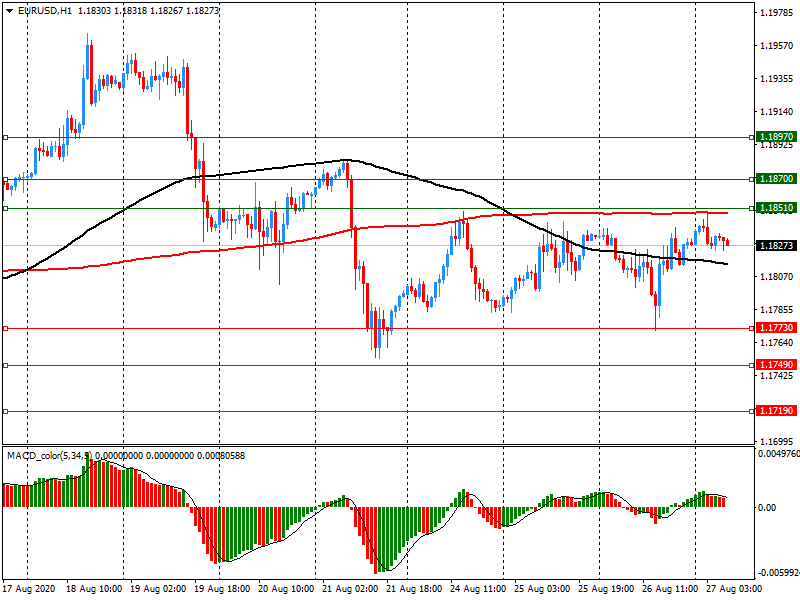
EUR/USD
Resistance levels (open interest**, contracts)
$1.1965 (1612)
$1.1926 (2269)
$1.1893 (2105)
Price at time of writing this review: $1.1873
Support levels (open interest**, contracts):
$1.1802 (342)
$1.1785 (1245)
$1.1761 (831)
Comments:
- Overall open interest on the CALL options and PUT options with the expiration date September, 4 is 94072 contracts (according to data from August, 27) with the maximum number of contracts with strike price $1,0500 (5007);
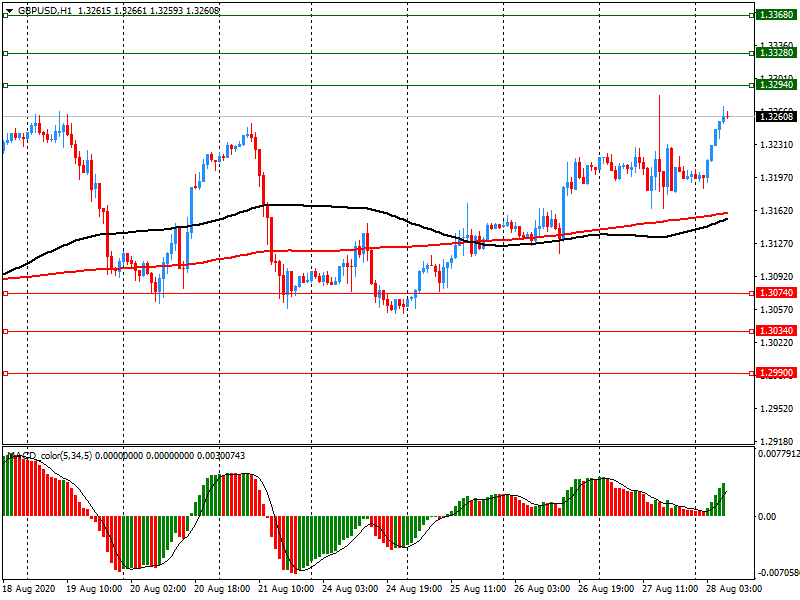
GBP/USD
Resistance levels (open interest**, contracts)
$1.3368 (572)
$1.3328 (1371)
$1.3294 (1499)
Price at time of writing this review: $1.3261
Support levels (open interest**, contracts):
$1.3074 (560)
$1.3034 (562)
$1.2990 (1566)
Comments:
- Overall open interest on the CALL options with the expiration date September, 4 is 22199 contracts, with the maximum number of contracts with strike price $1,3800 (3394);
- Overall open interest on the PUT options with the expiration date September, 4 is 19234 contracts, with the maximum number of contracts with strike price $1,3000 (1566);
- The ratio of PUT/CALL was 0.87 versus 0.88 from the previous trading day according to data from August, 27
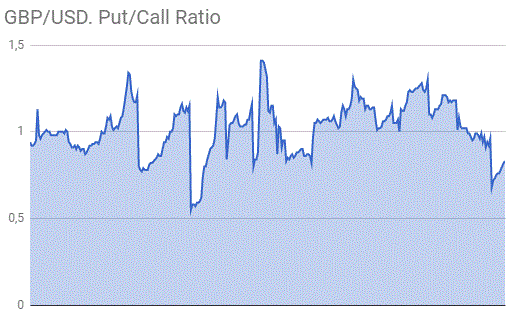
* - The Chicago Mercantile Exchange bulletin (CME) is used for the calculation.
** - Open interest takes into account the total number of option contracts that are open at the moment.
| Raw materials | Closed | Change, % |
|---|---|---|
| Brent | 45.11 | -1.25 |
| Silver | 26.95 | -1.61 |
| Gold | 1928.072 | -1.26 |
| Palladium | 2171.79 | -0.45 |
| Index | Change, points | Closed | Change, % |
|---|---|---|---|
| NIKKEI 225 | -82 | 23208.86 | -0.35 |
| Hang Seng | -210.64 | 25281.15 | -0.83 |
| KOSPI | -24.87 | 2344.45 | -1.05 |
| ASX 200 | 9.8 | 6126.2 | 0.16 |
| FTSE 100 | -45.61 | 5999.99 | -0.75 |
| DAX | -93.79 | 13096.36 | -0.71 |
| CAC 40 | -32.46 | 5015.97 | -0.64 |
| Dow Jones | 160.35 | 28492.27 | 0.57 |
| S&P 500 | 5.82 | 3484.55 | 0.17 |
| NASDAQ Composite | -39.72 | 11625.34 | -0.34 |
| Time | Country | Event | Period | Previous value | Forecast |
|---|---|---|---|---|---|
| 06:00 | Germany | Gfk Consumer Confidence Survey | September | -0.3 | 1.2 |
| 06:45 | France | Consumer spending | July | 9% | 2% |
| 06:45 | France | CPI, m/m | August | 0.4% | |
| 06:45 | France | CPI, y/y | August | 0.8% | |
| 06:45 | France | GDP, q/q | Quarter II | -5.9% | -13.8% |
| 07:00 | Switzerland | KOF Leading Indicator | August | 85.7 | 90 |
| 09:00 | Eurozone | Industrial confidence | August | -16.2 | -14.3 |
| 09:00 | Eurozone | Consumer Confidence | August | -15 | -14.7 |
| 09:00 | Eurozone | Economic sentiment index | August | 82.3 | 85 |
| 12:30 | U.S. | Goods Trade Balance, $ bln. | July | -70.99 | |
| 12:30 | U.S. | Personal spending | July | 5.6% | 1.5% |
| 12:30 | Canada | GDP (m/m) | June | 4.5% | 5.6% |
| 12:30 | U.S. | PCE price index ex food, energy, Y/Y | July | 0.9% | 1.2% |
| 12:30 | U.S. | PCE price index ex food, energy, m/m | July | 0.2% | 0.5% |
| 12:30 | U.S. | Personal Income, m/m | July | -1.1% | -0.2% |
| 12:30 | Canada | GDP QoQ | Quarter II | -2.1% | |
| 12:30 | Canada | GDP (YoY) | Quarter II | -8.2% | -39.6% |
| 13:05 | United Kingdom | BOE Gov Bailey Speaks | |||
| 13:45 | U.S. | Chicago Purchasing Managers' Index | August | 51.9 | 52 |
| 14:00 | U.S. | Reuters/Michigan Consumer Sentiment Index | August | 72.5 | 72.8 |
| 15:00 | U.S. | Jackson Hole Symposium | |||
| 17:00 | U.S. | Baker Hughes Oil Rig Count | August | 183 |
| Pare | Closed | Change, % |
|---|---|---|
| AUDUSD | 0.72585 | 0.38 |
| EURJPY | 125.922 | 0.44 |
| EURUSD | 1.18183 | -0.08 |
| GBPJPY | 140.625 | 0.48 |
| GBPUSD | 1.32002 | -0.04 |
| NZDUSD | 0.66401 | 0.4 |
| USDCAD | 1.31207 | -0.18 |
| USDCHF | 0.90832 | 0.09 |
| USDJPY | 106.525 | 0.52 |







© 2000-2026. Bản quyền Teletrade.
Trang web này được quản lý bởi Teletrade D.J. LLC 2351 LLC 2022 (Euro House, Richmond Hill Road, Kingstown, VC0100, St. Vincent and the Grenadines).
Thông tin trên trang web không phải là cơ sở để đưa ra quyết định đầu tư và chỉ được cung cấp cho mục đích làm quen.
Giao dịch trên thị trường tài chính (đặc biệt là giao dịch sử dụng các công cụ biên) mở ra những cơ hội lớn và tạo điều kiện cho các nhà đầu tư sẵn sàng mạo hiểm để thu lợi nhuận, tuy nhiên nó mang trong mình nguy cơ rủi ro khá cao. Chính vì vậy trước khi tiến hành giao dịch cần phải xem xét mọi mặt vấn đề chấp nhận tiến hành giao dịch cụ thể xét theo quan điểm của nguồn lực tài chính sẵn có và mức độ am hiểu thị trường tài chính.
Sử dụng thông tin: sử dụng toàn bộ hay riêng biệt các dữ liệu trên trang web của công ty TeleTrade như một nguồn cung cấp thông tin nhất định. Việc sử dụng tư liệu từ trang web cần kèm theo liên kết đến trang teletrade.vn. Việc tự động thu thập số liệu cũng như thông tin từ trang web TeleTrade đều không được phép.
Xin vui lòng liên hệ với pr@teletrade.global nếu có câu hỏi.


 Chuyển khoản
 ngân hàng


