- Phân tích
- Tin tức và các công cụ
- Tin tức thị trường
Tin tức thì trường
| Time | Country | Event | Period | Previous value | Forecast |
|---|---|---|---|---|---|
| 00:30 | Japan | Manufacturing PMI | August | 45.2 | 46.6 |
| 01:30 | Australia | Building Permits, m/m | July | -4.9% | -2% |
| 01:30 | Australia | Current Account, bln | Quarter II | 8.4 | 13 |
| 01:45 | China | Markit/Caixin Manufacturing PMI | August | 52.8 | 52.7 |
| 04:30 | Australia | Announcement of the RBA decision on the discount rate | 0.25% | 0.25% | |
| 07:30 | Switzerland | Manufacturing PMI | August | 49.2 | 52 |
| 07:50 | France | Manufacturing PMI | August | 52.4 | 49 |
| 07:55 | Germany | Manufacturing PMI | August | 51 | 53.0 |
| 07:55 | Germany | Unemployment Change | August | -18 | 1 |
| 07:55 | Germany | Unemployment Rate s.a. | August | 6.4% | 6.4% |
| 08:00 | Eurozone | Manufacturing PMI | August | 51.8 | 51.7 |
| 08:30 | United Kingdom | Net Lending to Individuals, bln | July | 1.8 | |
| 08:30 | United Kingdom | Consumer credit, mln | July | -0.086 | 0.678 |
| 08:30 | United Kingdom | Mortgage Approvals | July | 40 | 54.839 |
| 08:30 | United Kingdom | Purchasing Manager Index Manufacturing | August | 53.3 | 55.3 |
| 09:00 | Eurozone | Harmonized CPI ex EFAT, Y/Y | August | 1.2% | 0.9% |
| 09:00 | Eurozone | Harmonized CPI, Y/Y | August | 0.4% | 0.2% |
| 09:00 | Eurozone | Unemployment Rate | July | 7.8% | 8% |
| 13:45 | U.S. | Manufacturing PMI | August | 50.9 | 53.6 |
| 14:00 | U.S. | Construction Spending, m/m | July | -0.7% | 1% |
| 14:00 | U.S. | ISM Manufacturing | August | 54.2 | 54.5 |
| 17:00 | U.S. | FOMC Member Brainard Speaks |
The Federal
Reserve Bank of Dallas reported its general business activity index for
manufacturing in Texas rose to 8.0 in August from an unrevised -3.0 in July,
pointing to expansion in Texas factory activity after five months of
contraction. This was the highest reading since February 2019 as well.
According to
the report, the production index, a key measure of state manufacturing conditions,
came in at 13.1 in August, down slightly from July but still indicative of
moderate growth. Meanwhile, the new orders index went up three points to 9.8,
and the growth rate of orders index surged more than 10 points to 11.8. The
shipments index increased from 17.3 to 23.3, while the capacity utilization
index inched down but remained positive at 10.9. The employment index climbed from
3.1 to 10.6, suggesting more robust hiring. The company outlook index
registered a third consecutive positive reading, jumping 11 points to 16.6, its
highest reading in nearly two years. On the price front, the raw materials
prices index climbed 10 points to 19.4, and the wages and benefits index rose
six points to 15.2. The finished goods prices index remained near zero, suggesting
no change in selling prices from July.
CNBC reports that according to JPMorgan’s global head of macro quantitative and derivatives strategy Marko Kolanovic, President Donald Trump’s re-election chances are rising, which could leave investors positioned for a Biden victory in the dust.
“We currently believe that momentum in favor of Trump will continue, while the most investors are still positioned for a Biden win,” Kolanovic said in a note to clients on Monday. “The impact on sectors and factors (momentum vs value, cyclicals vs tech, ESG) could be dramatic and investment portfolios should adjust for a potential Trump re-election,” he added.
Carsten Brzeski, Chief Economist, Eurozone and Global Head of Macro for ING Research, notes that Germany's inflation came in at 0.0% YoY in August, reflecting the VAT cut and low energy prices.
"Based on the inflation outcomes in several regional states, German inflation came in at 0.0% year-on-year in August, from -0.1% YoY in July. The harmonised index, relevant for ECB policy making, dropped to -0.1% YoY, from 0.0% in July."
"The regional data paint a picture of diverging inflationary trends in the German economy. The negative base effect from low energy prices is keeping headline inflation low but there is more: the VAT cut of July is most visible in prices for food and clothing, while at the same time inflation for services has remained almost stable. The fact that the increase in hotel prices is still very much in line with the trend seen prior to the VAT cut suggests that lower taxes are also used to support businesses and are not necessarily entirely passed on to consumers."
"There had been speculation as to whether the current crisis would be deflationary or inflationary. While rising unemployment and very little pricing power for companies argue in favour of deflationary trends, monetary and fiscal stimulus eventually argue in favour of more inflationary pressure. Today’s German inflation data suggest that for the time being the deflationary threat is clearly more pressing than any inflationary one."
FXStreet notes that RBA commentary over the past month makes it clear the Board is content with current monetary policy settings. As such, economists at TD Securities expect no changes at this week's meeting. The August statement made no mention of the currency, but the Bank has been vocal that it sees the aussie as being fair even though it would welcome a lower AUD. AUD/USD trades around 0.7350, extending the corrective decline in European trading.
“Dovish (<10% prob): The Bank would need to express concern at the pick up in infections globally, that the border closures for foreigners are likely to extend to end 2021, NSW goes into lockdown and/or that unemployment is likely to remain at 10% in 2021. Developments have not deteriorated that significantly in the last month to justify those concerns. For now the Bank believes there is little benefit of cutting the cash rate to 0.1%. If the Bank was to act, we expect the RBA would be inclined to extend the TFF maturity to 5yrs, but this is perhaps a possibility end 2020 or in early 2021 if the outlook deteriorates as per developments mentioned above. The Board is nowhere near considering this as an option tomorrow. AUD/USD at 0.7250.”
“Neutral (>85% prob): The Bank is likely to indicate that the downturn has not been as bad as initially feared but for the recovery to be 'uneven and bumpy'. We anticipate the Bank is likely to indicate it's content with current policy settings. Indeed the expected drawdown of the initial allowance should be enough to keep the RBA observing developments from the the sidelines. Further with the Victorian Premier indicating a roadmap to exit lockdown to be detailed on 6 Sep, this should be news the RBA would welcome, reinforcing no need for the RBA to shift its current stance. AUD/USD flat to 0.74.”
“Hawkish (<5% prob): The RBA has indicated the risks are tilted to the downside even though the downturn has not been as severe. RBA commentary suggesting the risk is for lower, not higher inflation and that the unemployment rate is likely to be higher if those on zero hours are counted means a hawkish stance is hard to justify at the moment. Indeed, the Governor stated just last month that the employment and inflation conditions are not likely to be met for at least three years meaning it's a stretch for the RBA to deliver a hawkish stance. AUD/USD at 0.75.”
U.S. stock-index futures rose slightly on Monday, undermined by supportive Fed’s policy and positive China's PMIs.
Global Stocks:
Index/commodity | Last | Today's Change, points | Today's Change, % |
Nikkei | 23,139.76 | +257.11 | +1.12% |
Hang Seng | 25,177.05 | -245.01 | -0.96% |
Shanghai | 3,395.68 | -8.13 | -0.24% |
S&P/ASX | 6,060.50 | -13.30 | -0.22% |
FTSE | - | - | - |
CAC | 5,019.64 | +16.70 | +0.33% |
DAX | 13,073.74 | +40.54 | +0.31% |
Crude oil | $43.27 | +0.70% | |
Gold | $1,975.10 | +0.01% |
- Yield caps are complicated to implement and communicate
- Yield caps an option if circumstances change markedly
- Change in employment language shows that macro models "have been wrong" and that rate hikes in the absence of inflation are "difficult to justify"
- Negative rates not seen as attractive policy for U.S.
- New language on employment means a low unemployment rate “by itself” and in the absence of inflation will not be a sufficient trigger for a rate hike
- Fed debate on new policy included healthy range of views
- Fed policymakers broadly agreed that the economy had changed so much in recent years that Fed’s approach needed to change as well
- New goal of average 2% inflation over time represents aspiration and does not tether policy to any formula or rule
- Forward guidance and large scale asset purchases “have been and continue to be effective ways to support the economy"
- Eurozone economy performing according to ECB's baseline forecast
- As the risk of fragmentation recedes, need to deviate from the capital key is also reduced
- Post-review ECB inflation aim should maintain a medium-term perspective, must be simple to communicate
- Joint EU debt issuance on its own does not justify increase in PEPP
- Time has not yet come to adjust tiering multiplier
- May have to revise plans to meet in person on September 10
(company / ticker / price / change ($/%) / volume)
3M Co | MMM | 165.9 | 0.24(0.14%) | 783 |
ALCOA INC. | AA | 15.35 | 0.23(1.52%) | 5454 |
ALTRIA GROUP INC. | MO | 44.07 | 0.14(0.32%) | 33025 |
Amazon.com Inc., NASDAQ | AMZN | 3,413.00 | 11.20(0.33%) | 24072 |
American Express Co | AXP | 102.73 | 0.19(0.19%) | 1447 |
AMERICAN INTERNATIONAL GROUP | AIG | 29.38 | 0.01(0.03%) | 802 |
Apple Inc. | AAPL | 125.48 | 0.67(0.54%) | 4877344 |
AT&T Inc | T | 30.33 | 0.29(0.97%) | 214218 |
Boeing Co | BA | 175.68 | -0.12(-0.07%) | 71357 |
Caterpillar Inc | CAT | 143.65 | 0.02(0.01%) | 1885 |
Chevron Corp | CVX | 85.67 | 0.04(0.05%) | 5522 |
Cisco Systems Inc | CSCO | 42.19 | -0.01(-0.02%) | 93332 |
Citigroup Inc., NYSE | C | 52.1 | -0.18(-0.34%) | 54830 |
Deere & Company, NYSE | DE | 212.24 | 2.34(1.12%) | 1395 |
E. I. du Pont de Nemours and Co | DD | 57 | -0.18(-0.31%) | 460 |
Exxon Mobil Corp | XOM | 40.85 | 0.16(0.39%) | 69996 |
Facebook, Inc. | FB | 294.62 | 0.96(0.33%) | 135224 |
FedEx Corporation, NYSE | FDX | 223 | 1.10(0.50%) | 4492 |
Ford Motor Co. | F | 6.93 | -0.01(-0.14%) | 139163 |
Freeport-McMoRan Copper & Gold Inc., NYSE | FCX | 15.98 | 0.33(2.11%) | 93632 |
General Electric Co | GE | 6.49 | -0.12(-1.82%) | 1689981 |
General Motors Company, NYSE | GM | 30.2 | 0.18(0.60%) | 29838 |
Goldman Sachs | GS | 207 | 0.54(0.26%) | 4774 |
Google Inc. | GOOG | 1,655.00 | 10.59(0.64%) | 6052 |
Home Depot Inc | HD | 286.7 | 0.41(0.14%) | 5175 |
HONEYWELL INTERNATIONAL INC. | HON | 169 | 0.62(0.37%) | 3627 |
Intel Corp | INTC | 51.2 | 0.77(1.53%) | 443147 |
International Business Machines Co... | IBM | 125.25 | 0.18(0.14%) | 8310 |
Johnson & Johnson | JNJ | 154 | 0.36(0.23%) | 5206 |
JPMorgan Chase and Co | JPM | 102.6 | -0.17(-0.17%) | 22238 |
McDonald's Corp | MCD | 214.29 | 0.63(0.29%) | 1434 |
Merck & Co Inc | MRK | 85.7 | 0.05(0.06%) | 4166 |
Microsoft Corp | MSFT | 226.99 | -1.92(-0.84%) | 527338 |
Pfizer Inc | PFE | 37.91 | 0.00(0.00%) | 40847 |
Procter & Gamble Co | PG | 138.4 | -0.37(-0.27%) | 1393 |
Starbucks Corporation, NASDAQ | SBUX | 84.8 | -0.20(-0.24%) | 20251 |
Tesla Motors, Inc., NASDAQ | TSLA | 446.28 | 3.60(0.81%) | 2291837 |
The Coca-Cola Co | KO | 49.9 | 0.07(0.14%) | 90549 |
Twitter, Inc., NYSE | TWTR | 40.9 | -0.17(-0.41%) | 35656 |
UnitedHealth Group Inc | UNH | 314.9 | 0.53(0.17%) | 497 |
Verizon Communications Inc | VZ | 59.15 | -0.11(-0.19%) | 13814 |
Visa | V | 216.26 | 0.55(0.26%) | 13333 |
Wal-Mart Stores Inc | WMT | 138.3 | -2.00(-1.43%) | 406279 |
Walt Disney Co | DIS | 135.73 | 0.19(0.14%) | 14683 |
Yandex N.V., NASDAQ | YNDX | 68.65 | 3.40(5.21%) | 309739 |
Apple (AAPL) target raised to $144 from $117.50 at Monness Crespi & Hardt
AT&T (T) downgraded to Sector Underperform from Sector Perform at Scotiabank; target $30
Walmart (WMT) downgraded to Hold from Buy at R5 Capital
Statistics
Canada announced on Monday that the value of building permits issued by the
Canadian municipalities fell 3.0 percent m-o-m in July, following a revised 5.7
percent m-o-m climb in June (originally a gain of 6.2 percent m-o-m).
Economists had
forecast a 5.5 percent increase in July from the previous month.
According to
the report, the value of residential permits plummeted 6.2 percent m-o-m in
July, as permits for multi-family dwellings plunged by 12.8 percent m-o-m,
while single-family permits rose by 3.9 percent m-o-m.
At the same
time, the value of non-residential building permits increased 3.3 percent m-o-m
in July, due to a surge in commercial permits (+29.9 percent m-o-m), which more
than offsets declines in industrial (-15.7 percent m-o-m) and institutional (-24.2
percent m-o-m) permits,
In y-o-y terms,
building permits tumbled 9.6 percent in July.
Germany's
Federal Statistical Office (Destatis) reported on Monday the country’s consumer
price index (CPI) is expected to decrease 0.1 percent m-o-m in August after decreasing
0.5 percent m-o-m in the previous month.
On the y-o-y
basis, Germany’s inflation rate is seen to be unchanged this month, following a
0.1 percent drop in July.
Economists had
predicted inflation would be flat m-o-m and increase 0.1 percent y-o-y in
August.
According to
the report, food price growth decelerated to 0.7 percent y-o-y in August from 1.2
percent y-o-y in July, while energy prices fell 6.3 percent y-o-y after a 6.7
percent y-o-y drop in the previous month. Services costs rose 1.0 percent y-o-y
in August, following a 1.2 percent y-o-y gain as in July.
Meanwhile, the
harmonized index of consumer prices for Germany (HICP), which is calculated for
European purposes, is expected to fall 0.2 percent m-o-m and 0.1 percent y-o-y.
| Time | Country | Event | Period | Previous value | Forecast | Actual |
|---|---|---|---|---|---|---|
| 06:30 | Switzerland | Retail Sales (MoM) | July | -2.3% | 0.7% | |
| 06:30 | Switzerland | Retail Sales Y/Y | July | 3.3% | 4.1% | |
| 12:00 | Germany | CPI, m/m | August | -0.5% | 0% | -0.1% |
| 12:00 | Germany | CPI, y/y | August | -0.1% | 0.1% | 0.0% |
USD weakened against most other major currencies in the European session on Monday as expectations of lower interest rates for longer in the U.S. continued to support market sentiment. The U.S. Dollar Index (DXY), measuring the U.S. currency's value relative to a basket of foreign currencies, dropped 0.19% to 92.20.
The U.S. Federal Reserve Chairman Jerome Powell laid out an accommodative policy change last week, which is believed to result in inflation moving slightly higher and interest rates remaining lower for longer.
Positive PMI data out of China added to the positive sentiment as well. The National Bureau of Statistics (NBS) reported that China's non-manufacturing purchasing managers' index (PMI) rose to 55.2 in August, up from 54.2 in July. That pointed to the fastest growth in the service sector since January 2018. Economists had forecast the reading to remain unchanged at 54.2.
Meanwhile, China's manufacturing sector continued to expand in August, albeit at a slower pace. The NBS' Manufacturing PMI stood at 51.0 in August 2020, marginally down from 51.1 in the previous month. Economists had forecast the index to edge up to 51.2.
Market focus is gradually shifting to the U.S. payrolls for August, set to be released on Friday. Economists are looking for a non-farm payrolls print of 1.425 million and an unemployment rate decreasing to 9.8%.
FXStreet notes that the UK has lagged most G10 counterparts during the pandemic despite the UK data outperforming, but as the result of low market expectations rather than real outperformance. Bipan Rai from CIBC Capital Markets believes that expectations will remain low moving forward, as the UK economy will face headwinds beyond those expected from Brexit uncertainty.
“The most recent jobs report shows that employment has dropped to levels not seen since the financial crisis. Survey data suggests that expectations of job cuts are discouraging discretionary spending, which in turn is impacting business decisions. With the government furlough scheme ending in October, we expect a slowdown in growth as we head into Q4, unless an extension is announced.”
“Weakness in domestic fundamentals will be made worse by Brexit risks, especially as we approach the end of the transition period. The next round of talks will begin on September 7, though unless concessions can be made, progress will be limited. We do not expect to see GBP strength until a deal is agreed upon, as our base case is still for some form of skinny trade agreement in Q4.”
“Q4 2020: 1.30 | Q1 2021: 1.30.”
Petr Krpata, an FX strategist at ING, expects Fed Chair Powell's induced USD softness to continue this week, with the narrative of negative US real rates for longer making the dollar fairly unattractive over upcoming months and quarters.
"On the data front, the focus of the week will be on the US labour market report due on Friday. Our economists are looking for a below-consensus non-farm payrolls number and unchanged unemployment rate. While backwards-looking indicators, less positive numbers vs market expectations might be modestly USD negative as it would cement the lower-for-longer Fed interest rate outlook and the unappealing USD attractiveness."
"Expect DXY to continue to grind lower, though in a more orderly fashion than last week. As for today, price action will be influenced by the month-end rebalancing lows."
FXStreet notes that the loonie has been carried stronger than expected in the past month by general USD weakness. Katherine Judge and Avery Shenfeld from CIBC Capital Markets expect USD/CAD to trade at 1.30 by year-end and to recover to 1.32 in the first quarter of 2021. However, they forecast the pair at 1.36 by end-2021 due to weak Cadanian trade fundamentals.
“It appears that the negatives for CAD, including a wide current account deficit and soft oil prices relative to prior to 2015, will largely be overlooked until the trend to a weaker USD has run its course. The current account deficit will get a temporary benefit from a narrowing in the travel deficit due to frozen cross-border tourism.”
“With central bank target rates globally largely expected to stay at current levels through next year, currencies could become more sensitive to small moves in short rates.”
“The weakness in Canada’s trade fundamentals should only come to the forefront in the latter part of 2021 when the run against the USD might have run its course. The Bank of Canada could end up slightly lagging the Fed on rate hikes with an eye of undoing some loonie strength and allowing exports to take a larger share of growth, thereby reducing the dependence on debt-driven housing or consumption. We see USD/CAD ending 2021 at 1.36 as a result.”
Iris Pang, ING's Chief Economist, Greater China, notes that China's manufacturing PMI stabilized in August while the non-manufacturing PMI showed faster growth. These outcomes stem from the low number of Covid-19 cases in China, providing an opportunity for economic growth, Pang adds.
"China's manufacturing PMI showed growth slowed just slightly in August (PMI edged lower to 51.0 in August from 51.1 in July). New orders (for domestic use) continued to experience faster growth, while new export orders kept shrinking, albeit at a slower rate."
"China's non-manufacturing PMI rose significantly from 54.2 to 55.2 in August. Most of the growth came from new orders. This could be due to the strong demand for cross-provincial leisure trips as families spend summer holidays within Mainland China because overseas travel restrictions remain mostly unchanged."
"The growth engine is now clear. Overseas demand will only pick up slowly and travel restrictions will only be relaxed if Covid-19 cases subside overseas. Until then China will rely more on its own for economic growth."
FXStreet notes that USD weakness was sufficient to pull the EUR/USD higher, with the pair consolidating around the 1.1900. Terence Wu, FX straetgist at OCBC Bank, expects the market to chase the 1.1966 top this week.
“The recent top at 1.1966 is within sight, and maybe the target that the market will be pushing for this week. Beyond that, watch resistance at 1.2000.”
“Down below, expect support to enter at 1.1850.”
- Says that improving China's benchmark interest rate system is key for deepening market-based interest rate reform
Reuters reports that Japan’s Chief Cabinet Secretary Yoshihide Suga, one of major contenders for next premier, has indicated he would stand in the ruling LDP leadership election, a source with direct knowledge of the matter said on Monday.
Suga said he would consider running in the election after 14 LDP lawmakers visited his parliamentary office and asked him to join the race, the source said.
Suga declined to comment earlier the day when asked about the LDP leadership race at his regular news conference as the government’s top spokesman.
FXStreet reports that since the S&P 500 first broke out to a new high on 18 August, the index has barely paused and continues to set new records almost daily. As a result, each new high becomes the upside resistance for the next day, though it has rarely held. Ryan Frederick from Charles Schwab believes the S&P 500 index can rise to 3,700 by the end of 2020.
“Since the close on Friday was 3,508, that is the upside resistance for now. As for downside support, it looks like there may be some moderate support at 3,400, but mostly I would focus on the YTD unchanged line of 3,230 since the S&P 500 struggled both in June and July to break above that level.”
“I continue to believe that the S&P 500 can reach 3,700 (+14.5%) by year-end, but probably not without 3 or 4 small pullbacks along the way.”
Reuters reports that European Union finance ministers meet for monthly talks in Brussels
The Spanish economy has been growing at a rate of more than 10% so far in the third quarter following a record drop in the preceding quarter due to the impact of the coronavirus pandemic, Economy Minister Nadia Calvino said on Monday.
She also said that the labour market had already begun to recover.
"With all the precaution and prudence, we can expect growth of more than 10% in the third quarter of the year," Calvino told a financial event.
Bloomberg reports that there isn’t any urgency for the Federal Reserve to offer more clarity on how long it will hold interest rates near zero at the moment because investors already understand the central bank won’t be tightening for a while, Minneapolis Fed President Neel Kashkari said.
“Market expectations are that rates will be low for a long period of time, and so I don’t feel like there’s a burning pressure that we need to change our forward guidance today to change market expectations,” Kashkari said during an interview on the Bloomberg Odd Lots podcast with Joe Weisenthal and Tracy Alloway, recorded on Aug. 26 and published Monday.
“I think the committee’s already done a good job setting expectations,” he said. “So, I think the work will come and my guess is that we will adopt some more formal form of state-contingent forward guidance, but the committee just hasn’t gotten to that conclusion yet. But I think, I suspect that we’ll get there.”
Fed Chair Jerome Powell used the U.S. central bank’s annual Jackson Hole symposium to announce on Aug. 27 a shift in strategy. Going forward, Fed officials will attempt to guide inflation modestly above their 2% target temporarily following periods of undershooting, in order to average 2% over time.
The change raises the question of whether the Fed will enhance its guidance on the preconditions for any future rate hikes after cutting its benchmark rate to nearly zero at the onset of the coronavirus pandemic in March.
According to the minutes of the last meeting of the central bank’s rate-setting committee in July, a number of officials thought such a change would be useful “at some point.” That’s raised expectations among Fed-watchers for an update as soon as the committee’s Sept. 15-16 meeting.
The minutes showed that officials discussed the possibility of new guidance “using thresholds calibrated to inflation outcomes, unemployment rate outcomes, or combinations of the two.” Kashkari said they should focus on inflation in crafting new language.
“More than a year ago, I proposed that the committee adopt a forward guidance that says we will not raise rates until core inflation gets back to 2% on a sustained basis,” he said. “I think forward guidance that is anchored to an outcome of actually achieving our inflation target would be a big step forward relative to where we are today.”
FXStreet reports that in opinion of FX Strategists at UOB Group, USD/CNH stays within a negative phase and could drop to the 6.8460 region in the next weeks.
24-hour view: “Our expectation for USD to ‘trade sideways’ was incorrect as it plunged to a low of 6.8579 before ending the day on a weak note at 6.8582 (-0.44%). While it is too early to expect a recovery, severely oversold conditions suggest further sustained USD weakness is unlikely. From here, USD could dip below 6.8500 but the odds for a break of the major support at 6.8460 are not high. Resistance is at 6.8670 followed by 6.8900.”
Next 1-3 weeks: “After about a week, the 6.8850 level that we first indicated last Wednesday (19 Aug, spot at 6.9120) finally came into the picture as USD plummeted to a low of 6.8801 yesterday (26 Aug). The lackluster momentum over the past several days has perked up and as indicated in recent updates, the next support level of note below 6.8850 is at 6.8460. Overall, the current negative phase in USD is deemed as intact as long as USD stays below the 6.9180 (‘strong resistance’ level was previously at 6.9400).”
According to the report Istat, in the second quarter of 2020 the seasonally and calendar adjusted, chained volume measure of Gross Domestic Product (GDP) decreased by 12.8 per cent to the previous quarter and by 17.7 per cent in comparison with the second quarter of 2019.
Compared to previous quarter, final consumption expenditure decreased by 8.7 per cent, gross fixed capital formation by 14.9 per cent, imports and exports by 20.5 per cent and 26.4 per cent respectively.
With respect to the second quarter of 2019, final consumption expenditure decreased by 13.7 per cent, gross fixed capital formation by 21.6 per cent, imports by 26.8 per cent, and exports by 33.1 per cent.
The carry-over annual GDP growth for 2020 is equal to -14.7 per cent.
FXStreet reports that a drop to the 104.70 region in USD/JPY should not be ruled out in the next weeks, noted FX Strategists at UOB Group.
24-hour view: “Last Friday, we held the view that USD ‘could edge higher but chance for a break of the solid resistance at 107.00 is not high’. While our view was not wrong as the advance in USD stopped at 106.94, the sudden and sharp sell-off that resulted in huge drop of -1.14% (NY close of 105.34) was clearly unexpected. The rapid decline appears to be running ahead of itself and while USD could weaken from here, any weakness is viewed as a lower trading range of 105.00/105.85. In other words, a sustained decline below 105.00 is not expected.”
Next 1-3 weeks: “We noted last Friday (28 Aug, spot at 106.60) that ‘momentum outlook still appears positive but USD has to close above 107.00 before further sustained advance can be expected’. USD subsequently rose to 106.94 before suddenly plunging to a low of 105.18 (closed at 105.34, -1.14%). The risk has shifted quickly to the downside and from here; USD could and test the solid support at 104.70. At this stage, the chance for a sustained decline below this level is not high (105.00 is already quite a strong level). On the upside, the ‘strong resistance’ at 106.30 is likely strong enough to hold, at least for these few days.”
Reuters reports that Japan is considering tax reform to attract foreign financial firms and skilled workers in an effort to improve the country's standing as a global financial centre, the Financial Services Agency said in annual policy guidelines released Monday.
While Japan has sought for years to lure foreign professionals, experts said Tokyo needed to tackle issues including a relatively high tax rate and a lack of English language fluency in the workplace.
"To improve business environment for foreign financial firms, we will comprehensively consider concrete ways such as human resources development, tax reform and budgetary measures," the policy guideline said, without elaborating on when changes would be made.
Japan's ruling party had proposed visa support and streamlining approvals for investment management licences but there was no mention in those plans of tax reform.
Prime Minister Shinzo Abe, who last week said he would resign, had suggested in parliament that Japan could take in Hong Kong residents who worked in the financial sector or other specialised areas.
Hong Kong's corporate tax rate of 16.5% is a little over half that of Japan's and Australia's, and among the lowest in the region.
China's parliament in June passed national security legislation for Hong Kong, raising fears among democracy activists and some foreign governments that Beijing is further eroding autonomy there.
The Financial Services Agency also said it would use more English in administrative procedures to make it easier for foreign firms to start businesses in Japan.
Tokyo ranked third in Z/Yen Group's rankings of global financial centres published in March, up from sixth place in September 2019, while Hong Kong, which had faced domestic political turbulence, fell from third to sixth place.
| Time | Country | Event | Period | Previous value | Forecast | Actual |
|---|---|---|---|---|---|---|
| 01:00 | Australia | MI Inflation Gauge, m/m | August | 0.9% | 0.1% | |
| 01:00 | China | Non-Manufacturing PMI | August | 54.2 | 55.2 | |
| 01:00 | New Zealand | ANZ Business Confidence | August | -31.8 | -41.8 | |
| 01:00 | China | Manufacturing PMI | August | 51.1 | 51.2 | 51 |
| 01:30 | Australia | Private Sector Credit, y/y | July | 2.9% | 2.4% | |
| 01:30 | Australia | Private Sector Credit, m/m | July | -0.2% | -0.1% | |
| 01:30 | Australia | Company Gross Profits QoQ | Quarter II | 1.4% | -7.5% | 15% |
| 05:00 | Japan | Construction Orders, y/y | July | -13.4% | -22.9% | |
| 05:00 | Japan | Housing Starts, y/y | July | -12.8% | -12.5% | -11.4% |
| 05:00 | Japan | Consumer Confidence | August | 29.5 | 29.3 | |
| 06:30 | Switzerland | Retail Sales (MoM) | July | -2.3% | 0.7% | |
| 06:30 | Switzerland | Retail Sales Y/Y | July | 3.3% | 4.1% |
During today's Asian trading, the US dollar traded steadily against the euro and rose against the yen, slightly recovering from the decline noted at the end of the previous session.
The new strategy of the Federal reserve system (Fed), which allows inflation to rise above 2%, means that interest rates in the US will remain low for a long time, and this is a positive factor for risky assets, including the currencies of Asian countries, with the exception of Japan, experts say. At the same time, the dollar is likely to remain weak in such conditions.
Last week, the Fed approved a new strategy centered on changing the approach to inflation targeting. The long-term goal of the Fed remains inflation at 2%, but the Fed considers it " appropriate to use monetary policy to achieve inflation slightly above 2%" if it has remained below 2% for a long time.
The Japanese currency is also getting cheaper against the euro amid mixed statistics on the country's economy. Retail sales in Japan fell 3.3 percent in July from the previous month after jumping 13.1 percent in June, official data showed. The drop, which was marked for the first time since April, experts attribute to a renewed increase in the incidence of COVID-19 in some parts of the country.
Meanwhile, industrial production in Japan increased at a record pace in July - by 8% compared to the previous month, according to preliminary data. The consensus forecast was for a 5.8% increase.
The ICE index, which tracks the dynamics of the US dollar against six currencies (euro, swiss franc, yen, canadian dollar, pound sterling and swedish krona), fell 0.06% in trading.
FXStreet reports that сable remains firm and is now expected to test the mid-1.3400s in the next weeks, suggested FX Strategists at UOB Group.
24-hour view: “The strong surge in GBP last Friday that led to a whopping gain of +1.15% (1.3350) came as a surprise. Further gains are not ruled out but overbought conditions suggest a slower pace of advance and the resistance at 1.3410 could be out of reach (next resistance is at 1.3450). Support is at 1.3300 followed by 1.3260.”
Next 1-3 weeks: “We noted last Friday (28 Aug, spot at 1.3210) that GBP ‘could continue to trade in a choppy manner between the two major levels of 1.3000 and 1.3300’. We added, ‘only a clear break of either one of the two levels would indicate the start of a more sustained directional move’. That said, we did not anticipate the manner by which GBP vaulted to a high of 1.3357 before closing sharply higher at 1.3350 (+1.15%). While the advance appears to be running ahead of itself, robust momentum indicates further GBP strength is likely. From here, GBP could strengthen towards 1.3450, albeit likely at a slower pace. All in, the current positive phase in GBP is deemed as intact as long as it holds above the ‘strong support’ level of 1.3220.”
According to the report from Federal Statistical Office (FSO), turnover adjusted for sales days and holidays rose in the retail sector by 3.4% in nominal terms in July 2020 compared with the previous year. Seasonally adjusted, nominal turnover rose by 0.7% compared with the previous month.
Real turnover adjusted for sales days and holidays rose in the retail sector by 4.1% in July 2020 compared with the previous year. Real growth takes inflation into consideration. Compared with the previous month, real, seasonally adjusted retail trade turnover registered an increase of 0.7%.
Adjusted for sales days and holidays, the retail sector excluding service stations showed a 5.0% increase in nominal turnover in July 2020 compared with July 2019 (in real terms +5.6%). Turnover at service stations continued its decline at –15.9% in nominal terms (–1.9% in real terms).
Retail sales of food, drinks and tobacco registered an increase in nominal turnover of 8.8% (in real terms +7.9%), whereas the non-food sector registered a nominal plus of 1.4% (in real terms +3.0%). The sectors “other household equipment, textiles, DIY and furniture” (+16.2%: +17.1% in real terms) and “market stalls, retail sale via mail order houses or via internet” (+13.7%; in real terms +14.5%) saw the largest gains. In contrast, the sectors “Cultural and recreation goods in specialised stores” (–8.8%; in real terms –9.9%) and “others goods (clothing, chemists, watches and jewellery)” (–15%; in real terms –0.7%) continued to show negative figures.
Excluding service stations, the retail sector showed a seasonally adjusted increase in nominal turnover of 0.8% compared with the previous month (in real terms +0.8%). Retail sales of food, drinks and tobacco registered a plus of 0.7% (in real terms +1.2%). The non-food sector showed a plus of 0.3% (in real terms +0.2%).
Reuters reports that сredit rating agency Fitch Ratings said on Monday that Japan's policy setting is likely to remain stable in the wake of the resignation of Japanese Prime Minister Shinzo Abe.
Abe announced on Friday he was resigning because of poor health, as his protracted battle with ulcerative colitis brought to an end his tenure as Japan's longest-serving prime minister.
Fitch said its baseline remained that a new leader in Japan will not usher in significant policy changes and it anticipated that putting public debt on a "sustainable trajectory" will remain a core policy goal for the nation.
CNBC reports that China on Monday announced that manufacturing activity expanded in the month of August as the country continued to recover from the coronavirus pandemic.
The official manufacturing Purchasing Manager’s Index (PMI) for the month of August came in at 51.0 as compared to 51.1 in July, according to the National Bureau of Statistics.
However, the pace of expansion missed expectations. Analysts polled by Reuters had expected August PMI to come in at 51.2.
PMI readings above 50 indicate expansion, while those below that signal contraction. PMI readings are sequential and indicate on-month expansion or contraction.
Heavy floods in south China have also impacted manufacturing activity, Zhao Qinghe, a senior statistician with the bureau, said in a statement.
Growth in services moved at a faster clip in August with the official non-manufacturing PMI coming in at 55.2 as compared to 54.2 in July.
Zhao from the National Bureau of Statistics said in his report that demand was gradually recovering, with new orders for products such as pharmaceuticals and electrical machinery and equipment moving at a faster pace in August than in July. Exports were also improving in general, added the bureau.
China’s manufacturing sector was battered earlier this year as factories shut due to large-scale lockdowns to contain the coronavirus pandemic.
But recent data out of China paint a picture of recovery, with expansion in manufacturing activity and industrial output rising for the fourth straight month in July.
“Manufacturing rebounded most quickly. It didn’t require as much social distancing, it wasn’t as sensitive to social distancing so activity was rebounding more quickly there, and as such is now decelerating after the initial strong rebound,” said Andrew Tilton, chief Asia Pacific economist at Goldman Sachs.
EUR/USD
Resistance levels (open interest**, contracts)
$1.1980 (1741)
$1.1949 (2523)
$1.1926 (2087)
Price at time of writing this review: $1.1903
Support levels (open interest**, contracts):
$1.1845 (659)
$1.1818 (1244)
$1.1783 (794)
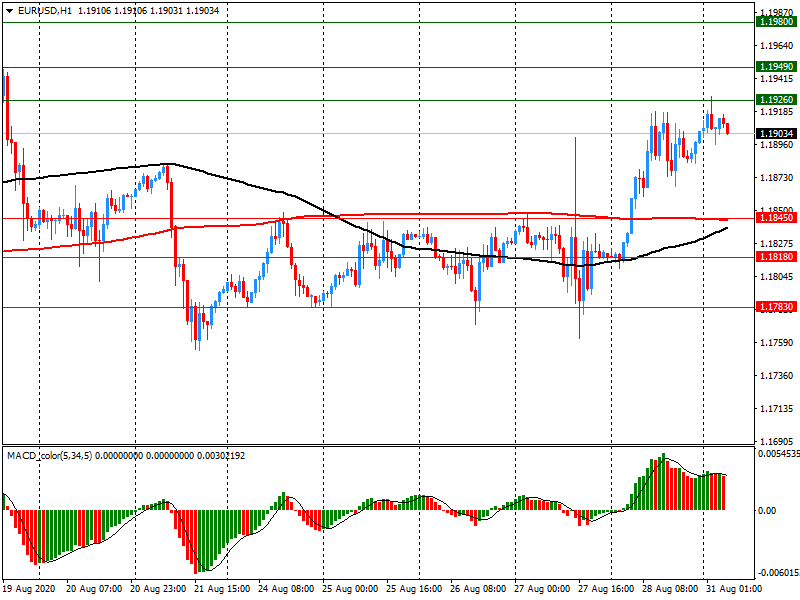
Comments:
- Overall open interest on the CALL options and PUT options with the expiration date September, 4 is 95996 contracts (according to data from August, 28) with the maximum number of contracts with strike price $1,0500 (5007);
GBP/USD
Resistance levels (open interest**, contracts)
$1.3438 (1332)
$1.3408 (771)
$1.3385 (1349)
Price at time of writing this review: $1.3342
Support levels (open interest**, contracts):
$1.3213 (150)
$1.3140 (103)
$1.3094 (529)
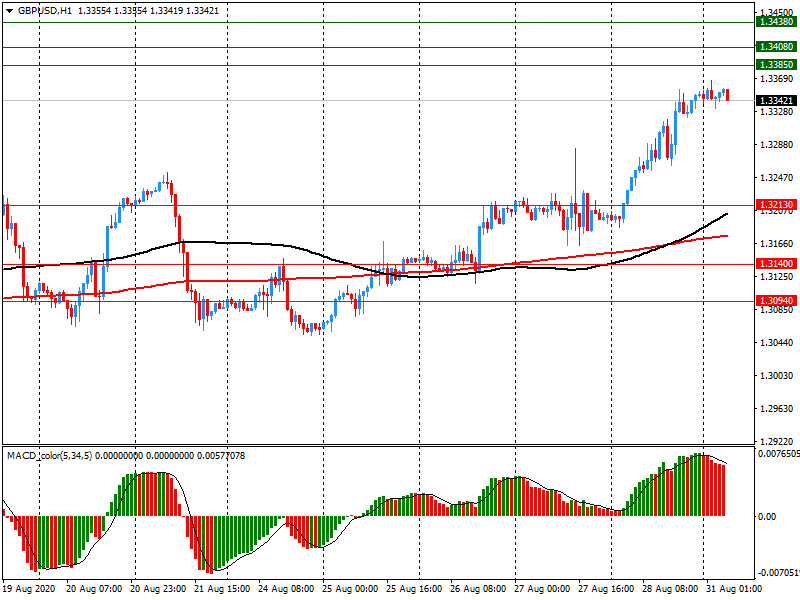
Comments:
- Overall open interest on the CALL options with the expiration date September, 4 is 21244 contracts, with the maximum number of contracts with strike price $1,3800 (2994);
- Overall open interest on the PUT options with the expiration date September, 4 is 19237 contracts, with the maximum number of contracts with strike price $1,3000 (1566);
- The ratio of PUT/CALL was 0.91 versus 0.88 from the previous trading day according to data from August, 28
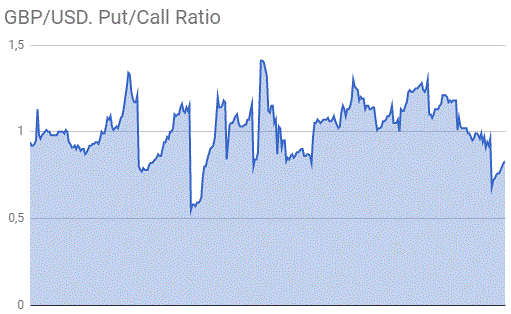
* - The Chicago Mercantile Exchange bulletin (CME) is used for the calculation.
** - Open interest takes into account the total number of option contracts that are open at the moment.
| Raw materials | Closed | Change, % |
|---|---|---|
| Brent | 45.4 | 0.67 |
| Silver | 27.46 | 1.85 |
| Gold | 1964.061 | 1.85 |
| Palladium | 2197.03 | 1.19 |
| Index | Change, points | Closed | Change, % |
|---|---|---|---|
| NIKKEI 225 | -326.21 | 22882.65 | -1.41 |
| Hang Seng | 140.91 | 25422.06 | 0.56 |
| KOSPI | 9.35 | 2353.8 | 0.4 |
| ASX 200 | -52.4 | 6073.8 | -0.86 |
| FTSE 100 | -36.42 | 5963.57 | -0.61 |
| DAX | -63.16 | 13033.2 | -0.48 |
| CAC 40 | -13.03 | 5002.94 | -0.26 |
| Dow Jones | 161.6 | 28653.87 | 0.57 |
| S&P 500 | 23.46 | 3508.01 | 0.67 |
| NASDAQ Composite | 70.29 | 11695.63 | 0.6 |
| Time | Country | Event | Period | Previous value | Forecast |
|---|---|---|---|---|---|
| 01:00 | Australia | MI Inflation Gauge, m/m | August | 0.9% | |
| 01:00 | China | Non-Manufacturing PMI | August | 54.2 | |
| 01:00 | New Zealand | ANZ Business Confidence | August | -31.8 | |
| 01:00 | China | Manufacturing PMI | August | 51.1 | 51.2 |
| 01:30 | Australia | Private Sector Credit, y/y | July | 2.9% | |
| 01:30 | Australia | Private Sector Credit, m/m | July | -0.2% | |
| 01:30 | Australia | Company Gross Profits QoQ | Quarter II | 1.1% | -7.5% |
| 05:00 | Japan | Construction Orders, y/y | July | -13.4% | |
| 05:00 | Japan | Housing Starts, y/y | July | -12.8% | -12.5% |
| 05:00 | Japan | Consumer Confidence | August | 29.5 | |
| 06:30 | Switzerland | Retail Sales (MoM) | July | -3.8% | |
| 06:30 | Switzerland | Retail Sales Y/Y | July | 1.1% | |
| 12:00 | Germany | CPI, m/m | August | -0.5% | 0% |
| 12:00 | Germany | CPI, y/y | August | -0.1% | 0.1% |
| 12:30 | Canada | Industrial Product Price Index, y/y | July | -3.1% | |
| 12:30 | Canada | Industrial Product Price Index, m/m | July | 0.4% | |
| 12:30 | Canada | Building Permits (MoM) | July | 6.2% | |
| 22:30 | Australia | AIG Manufacturing Index | August | 53.5 | |
| 22:45 | New Zealand | Building Permits, m/m | July | 0.5% | |
| 23:30 | Japan | Unemployment Rate | July | 2.8% | 3% |
| 23:50 | Japan | Capital Spending | Quarter II | 0.1% |
| Pare | Closed | Change, % |
|---|---|---|
| AUDUSD | 0.73643 | 1.46 |
| EURJPY | 125.403 | -0.41 |
| EURUSD | 1.19049 | 0.73 |
| GBPJPY | 140.614 | -0.01 |
| GBPUSD | 1.33492 | 1.13 |
| NZDUSD | 0.6737 | 1.46 |
| USDCAD | 1.30942 | -0.2 |
| USDCHF | 0.90397 | -0.48 |
| USDJPY | 105.332 | -1.12 |







© 2000-2026. Bản quyền Teletrade.
Trang web này được quản lý bởi Teletrade D.J. LLC 2351 LLC 2022 (Euro House, Richmond Hill Road, Kingstown, VC0100, St. Vincent and the Grenadines).
Thông tin trên trang web không phải là cơ sở để đưa ra quyết định đầu tư và chỉ được cung cấp cho mục đích làm quen.
Giao dịch trên thị trường tài chính (đặc biệt là giao dịch sử dụng các công cụ biên) mở ra những cơ hội lớn và tạo điều kiện cho các nhà đầu tư sẵn sàng mạo hiểm để thu lợi nhuận, tuy nhiên nó mang trong mình nguy cơ rủi ro khá cao. Chính vì vậy trước khi tiến hành giao dịch cần phải xem xét mọi mặt vấn đề chấp nhận tiến hành giao dịch cụ thể xét theo quan điểm của nguồn lực tài chính sẵn có và mức độ am hiểu thị trường tài chính.
Sử dụng thông tin: sử dụng toàn bộ hay riêng biệt các dữ liệu trên trang web của công ty TeleTrade như một nguồn cung cấp thông tin nhất định. Việc sử dụng tư liệu từ trang web cần kèm theo liên kết đến trang teletrade.vn. Việc tự động thu thập số liệu cũng như thông tin từ trang web TeleTrade đều không được phép.
Xin vui lòng liên hệ với pr@teletrade.global nếu có câu hỏi.


 Chuyển khoản
 ngân hàng


